
FMCSA Road Test for CDL Jobs: What Drivers Must Demonstrate
Passing the state CDL skills test earns a credential. A motor carrier's road test answers a different question: can this driver safely operate the type of commercial vehicle and associated equipment the carrier intends to assign?
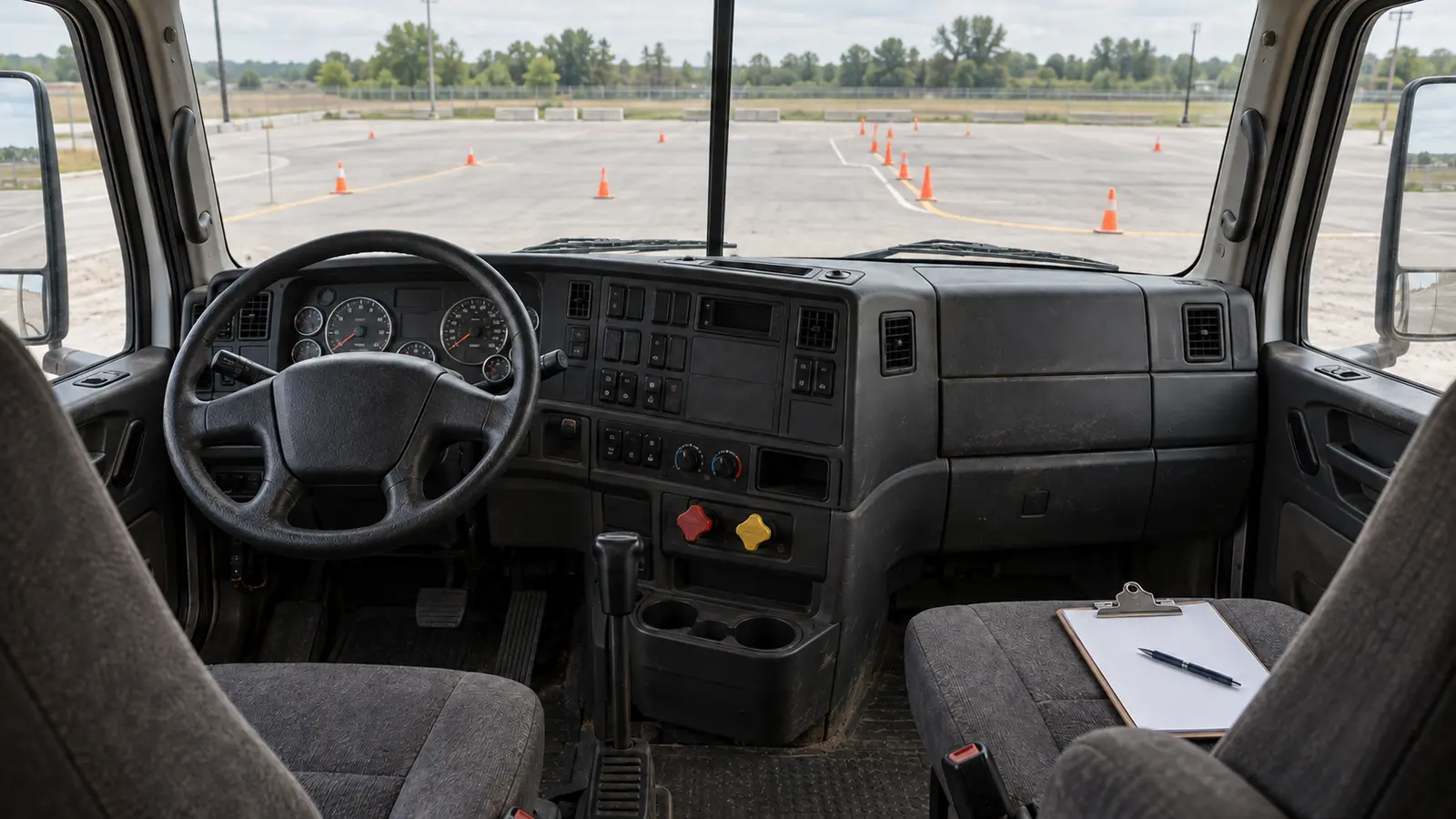
New drivers are often surprised when a job application includes another inspection, backing exercise and road evaluation after they already passed the CDL test. The two evaluations serve different purposes. The state skills test supports licensing under Part 383. The motor-carrier road test in 49 CFR 391.31 is part of qualifying a driver for the carrier's actual equipment and work.
Federal rules establish a minimum set of operations, but they do not prescribe one universal route, mileage, score sheet or retest schedule. A carrier may make the evaluation longer, add company-policy items or require a test even when a valid CDL or recent certificate could be accepted as an equivalent. The best preparation is therefore not memorizing a route. It is building a controlled, explainable driving routine that transfers to an unfamiliar but representative vehicle.
First, separate three different evaluations
The phrase “road test” is used loosely in trucking. Before test day, confirm which evaluation is being discussed:
- State CDL skills test: the vehicle inspection, basic-control skills and on-road sections used to issue the license. ProntoCDL's three-part CDL skills-test guide explains that sequence.
- Motor-carrier road test: the Part 391 qualification test covering the type of CMV and associated equipment the carrier plans to assign.
- Company orientation or finishing evaluation: additional training and checks for fleet procedures, customer locations, technology, routes or job-specific tasks. These items may be company requirements even when they are not listed as federal road-test minimums.
Passing one does not promise success on every other evaluation. A driver can hold the correct CDL yet need time to learn a different wheelbase, transmission, mirror layout, brake response or trailer configuration. Treat the carrier test as a professional demonstration rather than a repeat of the licensing exam.
Who gives the test and what vehicle must be used?
The motor carrier may give the test or designate another person to do it. The examiner must be competent to decide whether the applicant can operate the intended vehicle and associated equipment. An owner-driver who is also the motor carrier cannot evaluate himself or herself; another person must give the test.
The evaluation must last long enough for the examiner to judge the required skills and must use the type of CMV the carrier intends to assign. That representative-vehicle requirement is practical. A tractor-trailer evaluation should expose the examiner to combination-vehicle control. A bus assignment should be evaluated in the applicable bus type. A straight truck should not be treated as proof of combination-vehicle skill.
Ask what equipment will be used before arriving. Knowing whether the vehicle has air or hydraulic brakes, automatic or manual transmission, a long or short wheelbase, a trailer, or specialized controls lets you review the correct routine without pretending that all CMVs handle alike.
The eight federal minimum evaluation areas
Section 391.31 requires the test to cover at least the following operations. The examiner rates the driver on a road-test form and signs the completed report.
| Required area | What a prepared driver demonstrates |
|---|---|
| Pre-trip inspection | A systematic check required by 49 CFR 392.7, with clear defect decisions before movement. |
| Coupling and uncoupling | Safe connection and separation when the possible assignment includes combination units. |
| Placing the CMV in operation | Secure entry, seat and mirror setup, startup checks, brake release and controlled initial movement. |
| Controls and emergency equipment | Correct use of vehicle controls plus familiarity with the emergency equipment carried on the unit. |
| Traffic and passing | Legal, predictable operation with scanning, space, signals, lane control and safe passing decisions. |
| Turning | Speed, position, mirror use, clearance and off-tracking management without striking or crowding. |
| Braking and other slowing methods | Progressive braking plus safe use of gearing or installed retarding systems when appropriate. |
| Backing and parking | Controlled setup, observation, pull-ups, GOAL checks and a safe final parked condition. |
Pre-trip inspection: prove judgment, not just vocabulary
The road-test minimum incorporates the pre-driving inspection required by 49 CFR 392.7. Before driving, the driver must be satisfied that specified safety components are in good working order, including service and parking brakes, steering, lighting and reflectors, tires, horn, wipers, mirrors, coupling devices, and wheels and rims. Emergency equipment also belongs in the readiness check.
Use a repeatable pattern: identify the component, describe its condition and operation, then state the safety decision. Do not rush past a defect because the examiner is waiting. An applicant who recognizes a serious leak, insecure coupling component or failed brake check and stops the process is demonstrating judgment. Driving a vehicle you have just declared unsafe undermines the entire inspection.
After entering the cab, adjust the seat and mirrors before movement. Locate the parking-brake controls, transmission selector, gauges, warning indicators, lights, wipers, horn, defroster and any unfamiliar auxiliary control. Confirm the neutral or park condition required for startup, fasten the seat belt and complete the brake checks appropriate to the system. Review ProntoCDL's dashboard and warning-light guide if control familiarization needs work.
Coupling: required when combination units are part of the assignment
If the equipment the driver may operate includes combination units, coupling and uncoupling are part of the federal minimum. That can include trailer-height judgment, fifth-wheel alignment, air and electrical connections, landing-gear handling, a tug check and a direct visual lock check. The safe sequence matters more than speed.
Never use the tug test as the only proof that the kingpin and locking jaws are correctly connected. Keep clear of pinch and crush zones, secure the units against movement and inspect the connection from a safe position. ProntoCDL's coupling and uncoupling guide provides the full practice sequence.
Putting the vehicle in motion
Before releasing the parking brake, build a complete picture around the vehicle. Check mirrors, blind areas and the intended path. Signal when required, select the correct gear or drive range, release the brakes only after pressure and warnings are normal, and move smoothly enough to test response without surprising traffic.
The first few feet reveal whether the brakes release, steering tracks normally and the load or trailer responds as expected. If the vehicle pulls, a warning appears, pressure behaves abnormally or a connection feels wrong, stop safely. A road test is not a reason to continue through a developing defect.
Traffic operation and passing
Examiners need enough road time to see how the driver gathers information and manages risk. Scan well ahead, check mirrors regularly and before changing speed or direction, communicate early, maintain a usable following interval and protect space around the vehicle. ProntoCDL's lane-change and blind-spot guide explains a disciplined mirror-signal-mirror sequence.
Do not manufacture a passing maneuver because passing appears on the form. The test evaluates operation “in traffic and while passing,” but the safe decision may be to hold position when sight distance, speed, traffic, weather or road markings do not support a pass. If the route creates a legitimate passing opportunity, complete it with adequate clearance and a deliberate return to lane.
Company policy may set conservative speed, following-distance or lane-use expectations. Ask before departure and follow the posted limit and any lower speed required by conditions. Smooth, predictable operation usually demonstrates more professionalism than trying to impress an examiner with pace.
Turns: plan for off-tracking and front swing
Approach each turn at a speed that permits continuous observation and control. Position legally, signal early, scan for pedestrians and cyclists, and use the mirrors to track the rear of the vehicle or trailer. Protect the inside from off-tracking while monitoring outside front swing. Do not swing left before a right turn in a way that invites another vehicle into the opening.
If the setup is wrong, do not force the turn across a curb, object or occupied lane. Stop where legal and safe, reassess and follow the examiner's direction. The practical geometry is covered in ProntoCDL's right-turn and off-tracking guide.
Braking and slowing without the service brake
The test must include braking and slowing by means other than braking. In a suitable vehicle, that can mean selecting an appropriate gear and using engine resistance or an installed retarder according to the equipment instructions and conditions. It does not mean coasting in neutral or experimenting with an unfamiliar control.
Brake early and progressively, leave a stopping margin and avoid abrupt inputs that shift the load or surprise following traffic. On a descent, choose a safe speed and gear before the grade rather than trying to recover after speed builds. If traction is poor, follow the vehicle and carrier restrictions for engine brakes or retarders. See the engine-brake and retarder guide for dry-road and low-traction decisions.
Backing and parking: control beats speed
Backing begins with the setup. Survey the space, identify fixed and moving hazards, plan the driver-side view when practical and use a trained spotter under an agreed communication plan when one is available. Back at walking speed, scan both mirrors, monitor front swing and stop whenever the picture becomes uncertain.
Get out and look when necessary and safe. Pull-ups and GOAL checks are tools for preventing contact, not signs of failure. If a spotter disappears from view, stop. ProntoCDL's GOAL, spotter and pull-up guide turns those decisions into a repeatable routine.
At the end, park in the assigned location, straighten the vehicle when possible, select the correct transmission position, set the parking brake and complete the securement steps required by the vehicle and site. Do not leave the cab until the unit is stable.
The report, certificate and driver qualification file
The examiner records a rating for every activity included in the test and signs the road-test form. After a successful test, the examiner completes a certificate identifying the driver and vehicle type and stating that the driver has sufficient skill to operate that type safely. The certificate form also records the approximate test mileage.
The driver receives a copy of the certificate. The carrier keeps the signed road-test form and the original or a copy of the certificate in the driver qualification file. Section 391.51 lists the road-test certificate or accepted equivalent among the required qualification-file records. The broader file is explained in ProntoCDL's driver qualification file checklist.
Keep your copy. It documents the vehicle type and successful evaluation and may be useful when discussing experience with a future carrier. It does not automatically replace every future road test; the next carrier decides whether an available equivalent is acceptable within the rule.
When a CDL or earlier certificate may be accepted instead
49 CFR 391.33 lets a driver present—and a carrier accept—one of two equivalents:
- a valid CDL for the relevant CMV category when state law issued it after a successful road test in the type of CMV the carrier intends to assign; or
- a copy of a valid Part 391 road-test certificate issued within the preceding three years.
The CDL alternative does not include doubles/triples or tank-vehicle endorsements. FMCSA guidance says that when the assignment requires one of those endorsements, the employer must administer the Section 391.31 test in a representative vehicle. Even outside those assignments, Section 391.33 expressly allows the carrier to require a road test or another driving-skill test as a condition of employment.
So a recruiter's “CDL required” and an operations manager's “road test required” can both be correct. The license establishes legal qualification for the class and endorsements; the carrier still owns the hiring and equipment-assignment decision.
Clearinghouse timing at the road-test stage
For a prospective driver subject to Part 382, FMCSA's Drug and Alcohol Clearinghouse FAQ says an employer is not required to complete the pre-employment query before administering the road test. The road test occurs before hiring. The query is required when the employer hires the driver to perform safety-sensitive functions, although the employer may choose to query when the road test occurs.
This narrow timing answer does not waive the hiring query, testing program or return-to-duty rules. Applicants should provide truthful information and resolve any prohibited Clearinghouse status before expecting to perform safety-sensitive work.
A practical preparation plan
- Confirm the vehicle: class, body type, trailer, transmission and brake system.
- Bring valid documents: the license and any medical or hiring documents the carrier requested.
- Review a complete pre-trip: practice component, condition and defect decision rather than reciting a script.
- Ask for control orientation: identify unfamiliar switches, interlocks and emergency equipment before movement.
- Use deliberate observation: make mirror checks, hazard scans and clearance decisions visible without exaggerating them.
- Drive smoothly: protect space, brake early, choose gears before grades and avoid rushed steering.
- Back conservatively: set up, stop, GOAL and pull up before a small uncertainty becomes contact.
- Report problems: do not hide a warning, damage or handling concern to finish the test.
Federal regulations do not establish a universal waiting period or number of attempts after an unsuccessful carrier road test. The carrier controls its hiring, retraining and retest process. Ask what skill needs improvement, practice it in authorized training and return only when the carrier permits.
Practical takeaways
- The motor-carrier road test is a driver-qualification step, not the state CDL licensing test.
- The examiner must be competent, and the test must be long enough to judge the assigned vehicle type.
- Federal minimums cover pre-trip, startup, controls, traffic, turns, braking, backing and parking.
- Coupling and uncoupling are included when the possible assignment uses combination units.
- Safe decisions matter more than a memorized route or a fast backing maneuver.
- A valid CDL may be accepted as an equivalent in qualifying circumstances, but the carrier is not required to accept it.
- The CDL equivalent excludes doubles/triples and tank-vehicle endorsements.
- A qualifying road-test certificate from the preceding three years may also be accepted.
- The driver receives a certificate copy; the carrier retains the required records in the qualification file.
- The Clearinghouse query is not required before the prospective-driver road test, but it is required at hiring for safety-sensitive work.
Motor-carrier road-test FAQ
Does a valid CDL always replace the motor-carrier road test?
No. A carrier may accept a valid CDL as an equivalent only when it licenses the driver for the relevant vehicle category after a successful state road test. The regulation excludes doubles/triples and tank endorsements from that CDL alternative, and a carrier may still require a road test or another driving-skill test as a condition of employment.
Must the road test use the exact truck I will drive every day?
The rule requires testing in the type of commercial motor vehicle the carrier intends to assign, including the associated equipment needed for the evaluation. It does not say the test must use one specific fleet unit, but the vehicle must be representative enough to evaluate the work the driver will perform.
Is coupling and uncoupling always part of the road test?
It is required when the equipment the driver may operate includes combination units. A straight-truck or bus assignment does not create that combination-unit testing item, although the rest of the applicable minimum operations still must be evaluated.
Who may administer the federal motor-carrier road test?
The motor carrier or a person it designates may give the test. The examiner must be competent to evaluate whether the driver can operate the assigned type of commercial motor vehicle and associated equipment. A driver who is also the motor carrier cannot test himself or herself.
Do I receive a copy of the road-test certificate?
Yes. After a successful test, the examiner completes a certificate and a copy must be given to the person examined. The carrier retains the signed road-test form and the original or a copy of the certificate in the driver qualification file.
Is a Clearinghouse query required before a prospective driver takes the road test?
FMCSA says no. A pre-employment Clearinghouse query is not required before administering the road test because the test occurs before hiring. The query is required when the employer hires the driver to perform safety-sensitive functions, and an employer may choose to query at the road-test stage.
Prepare beyond the hiring test
Build a stronger inspection and driving foundation with ProntoCDL's CDL study guides, then practice knowledge topics in the free practice center.