
CDL Lane Change Guide: Blind Spots, Mirrors and Safe Gaps
A lane change should feel almost uneventful. The driver sees the need early, builds a complete traffic picture, communicates, waits for a gap that fits the entire vehicle and moves gradually while continuing to monitor both lanes. If any part of that picture becomes uncertain, the safest lane change is the one you postpone.
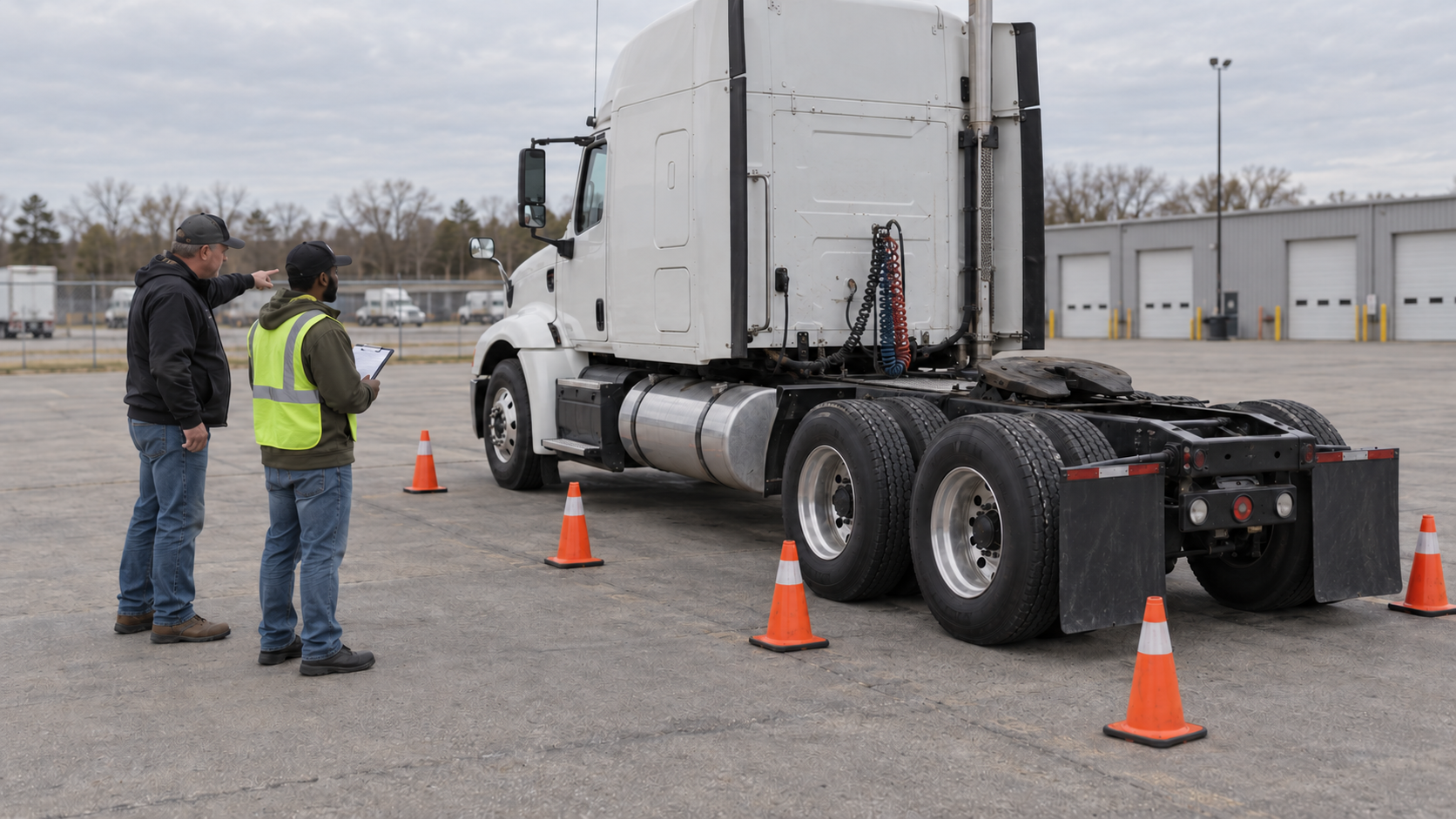
Commercial vehicles make this ordinary maneuver demanding. The driver sits high and forward, the right side can hide a passenger vehicle, a trailer may occupy the original lane after the tractor begins moving, and traffic can close a planned gap before a long combination finishes crossing. Safe technique turns those limitations into a deliberate sequence instead of a last-second steering decision.
The federal skills standard is a complete system
49 CFR 383.113 requires CDL applicants to demonstrate proper visual search, appropriate signaling, safe speed adjustment, selection of a safe gap for changing lanes and observation of other vehicles before changing speed or direction. Passing one mirror check is not enough; the required skills work together.
The federal Class A ELDT curriculum requires instruction in visual search, communication, speed management, space management and hazard perception. During public-road training, the trainee must demonstrate proficiency in lane changes as well as signaling, visual search and maintaining proper spacing.
Map the blind areas of the actual vehicle
“No-Zone” is useful as a warning, not as a precise diagram that fits every truck. Blind areas can exist close to the front, along both sides and behind the vehicle. Their size changes with the cab, hood, mirror design, trailer width and length, load, seating position and whether traffic is climbing a grade or following through a curve.
| Area | What can disappear | Lane-change implication |
|---|---|---|
| Left side | A car or motorcycle beside the cab or drive axles | Check the main and convex mirrors repeatedly; do not assume a vehicle seen earlier has fallen back |
| Right side | One or more smaller vehicles, bicycles or a merging road user | Allow extra observation time and never move merely because the signal is on |
| Directly behind | A close-following vehicle hidden by the trailer or body | Expect a follower to appear suddenly when lanes curve or separate |
| Front corners | A small vehicle or vulnerable road user below the direct sightline | Confirm the new lane remains clear near the tractor as steering begins |
Mirror adjustment belongs in the pre-trip routine. Clean, secure glass and a useful field of view are the foundation; ProntoCDL’s windshield, wiper and mirror inspection guide explains how to inspect the complete visibility system.
Use the mirror–signal–recheck–move routine
- Look far enough ahead. Identify the reason for moving and the point where the lane change must be complete. An exit, lane closure or slow vehicle should not become a surprise.
- Build a traffic picture. Check forward, the target-side flat mirror, the target-side convex mirror and the opposite mirror. Track which vehicles are gaining, falling back or staying beside you.
- Create space before you need it. Adjust speed smoothly when appropriate. Do not accelerate into a disappearing gap or force a faster vehicle to brake.
- Signal early. Give surrounding drivers time to understand your intent, but remember that the signal is a request for space—not permission to occupy it.
- Recheck the target lane. A motorcycle or fast-closing car can move from the distant mirror view into a blind area during the signal interval.
- Move gradually. Use a small, steady steering input and keep scanning the target lane, the original lane and the road ahead.
- Finish with the whole vehicle. Center the tractor and trailer in the new lane, rebuild following space and cancel the signal.
FMCSA’s current truck-and-bus driver guidance, updated May 12, 2026, recommends mirror checks every 8 to 10 seconds and a forward scan of about 15 seconds. That general cadence maintains awareness, but the focused lane-change sequence still needs multiple checks before and during movement.
Choose a gap for the entire combination
A usable gap has space ahead and behind after the complete vehicle enters it. Judge relative speed, not just distance. A car that looks small in a convex mirror may be approaching quickly, and convex glass makes objects appear farther away than they are.
- Do not make another driver solve the maneuver with hard braking.
- Leave room for the tractor’s lateral movement and the trailer’s delayed response.
- Account for wet pavement, darkness, grades, curves and heavy traffic before deciding the space will remain available.
- When returning after a pass, confirm the passed vehicle is fully clear and the separation is increasing before moving back.
- Change one lane at a time unless traffic control specifically directs otherwise.
Use ProntoCDL’s defensive-driving guide to connect the gap decision with following distance and escape-space management.
Keep the trailer in the decision
The tractor can enter the new lane while much of the trailer remains in the old one. Continue monitoring until the rear of the trailer clears the lane line. A quick steering reversal can make the trailer swing and can be especially unstable with multiple trailers, a high center of gravity, crosswinds or slippery pavement.
Steer smoothly, avoid changing lanes in a sharp curve when a safer straight section is available and reduce speed before strong wind or low traction makes lateral control uncertain. The high-wind guide explains why a light or tall trailer may need an earlier stop decision.
Merging requires cooperation without assumption
On an entrance ramp, use the available acceleration lane to observe traffic and reach an appropriate speed without exceeding a safe speed for the ramp or conditions. Signal, identify a real opening and keep an alternate plan. Do not assume mainline traffic will move over, and do not continue accelerating toward the end of a closed gap.
When another vehicle is merging, protect space when it can be done safely. A lane change to help is still a lane change: it needs the same mirror checks, signal and safe gap. Sudden courtesy steering can create a collision in the adjacent lane.
Know when to cancel the move
Before crossing the lane line, remain in the original lane if a vehicle disappears from the mirror, the gap closes, the road curves out of view, the trailer begins to move unexpectedly or the path ahead changes. Cancel the signal when appropriate, stabilize speed and rebuild the traffic picture.
After the vehicle begins crossing, avoid a sharp snap back that could cause trailer swing, loss of traction or a secondary conflict. Maintain control, reduce steering input smoothly and use the safest available space. The correct response depends on vehicle position and surrounding traffic; prevention gives the driver far better options than an emergency reversal.
Driver-assistance systems are a second layer
NHTSA explains that blind-spot warning alerts a driver to a vehicle in an adjacent blind area, while blind-spot intervention may apply light braking or steering when a move begins. These features can help, but NHTSA also emphasizes that the driver remains responsible for driving and monitoring.
Learn the indicators and limitations in the vehicle’s manual. Dirt, spray, snow, damaged sensors, road curvature, temporary lane markings or a small and fast-moving road user can affect detection. A silent system is not proof that the lane is clear, and an alert is a reason to hold the lane—not to look at the display longer while drifting.
A safe blind-area training exercise
- Park and secure the training vehicle on a closed, level range.
- Seat the trainee in the normal driving position with mirrors adjusted.
- Place cones—not people—in locations that disappear from direct and mirror view.
- Have the trainee identify where each cone becomes visible in the flat mirror, convex mirror and direct view.
- Repeat with a different trailer or vehicle only after recording how the visible zones changed.
- Walk through the mirror–signal–recheck–move sequence verbally before practicing it on a controlled road segment.
Never station a person in a blind area around a vehicle that may move. Connect the exercise to the Class A ELDT guide and reinforce visual-search terms in the free CDL practice center.
Practical takeaways
- Plan lane changes early enough that waiting remains an option.
- Use flat and convex mirrors together; understand what each view can distort or omit.
- Signal intent, then verify the gap again before steering.
- Choose space for the entire combination and the closing speed of surrounding traffic.
- Move one lane at a time with a small, steady steering input.
- Monitor the trailer until it clears and the vehicle is centered.
- Cancel an uncertain maneuver before crossing the line whenever possible.
- Treat blind-spot technology as assistance, never as clearance to move.
CDL lane-change and blind-spot FAQ
What is a truck No-Zone?
No-Zone is a safety term for areas around a large truck or bus where another road user can be difficult or impossible for the driver to see. The exact shape changes with the vehicle, trailer, mirror adjustment, seating position and surrounding traffic, so it should not be treated as one fixed measurement.
How often should a commercial driver check mirrors?
FMCSA’s current truck-and-bus driver guidance recommends checking mirrors every 8 to 10 seconds to stay aware of vehicles entering blind areas. A lane change also requires focused checks before signaling, before steering and throughout the movement.
Does using a turn signal give a truck the right of way?
No. A signal communicates intent; it does not create a safe gap or transfer responsibility to another driver. Wait until the complete truck or combination can enter without forcing another road user to brake, swerve or surrender occupied space.
Should a truck driver turn their head for a shoulder check?
Use the observation method taught for the specific cab and operation. A quick direct-view check may help in some vehicles, but a large head turn can take attention away from the road ahead and still may not reveal areas blocked by the cab or trailer. Properly adjusted mirrors, repeated scans and a stable traffic picture remain essential.
Can blind-spot warning replace mirror checks?
No. Warning and intervention systems are driver-assistance features. Sensors can have limits involving weather, dirt, road geometry, motorcycles and fast-closing traffic. The driver remains responsible for monitoring, signaling, gap selection and vehicle control.
Are lane changes included in federal CDL and ELDT standards?
Yes. Federal CDL skills standards require proper visual search, signaling, observation and safe gap selection. The Class A ELDT public-road curriculum requires trainees to demonstrate proficiency in lane changes, communication, visual search, speed and space management.
See the gap. Recheck it. Move smoothly.
The best lane change preserves time to wait, space to steer and a clear picture of every part of the vehicle.
Start free CDL practice