
CDL Right-Turn Guide: Off-Tracking and Safe Setup
A safe right turn is decided before the steering wheel moves. The driver needs the correct lane, a slow and controlled approach, a protected curb side, enough forward room for the tractor and a continuing picture of where the rear wheels are tracking. If that setup is wrong, the professional response is to stop—not force the trailer through a shrinking gap.
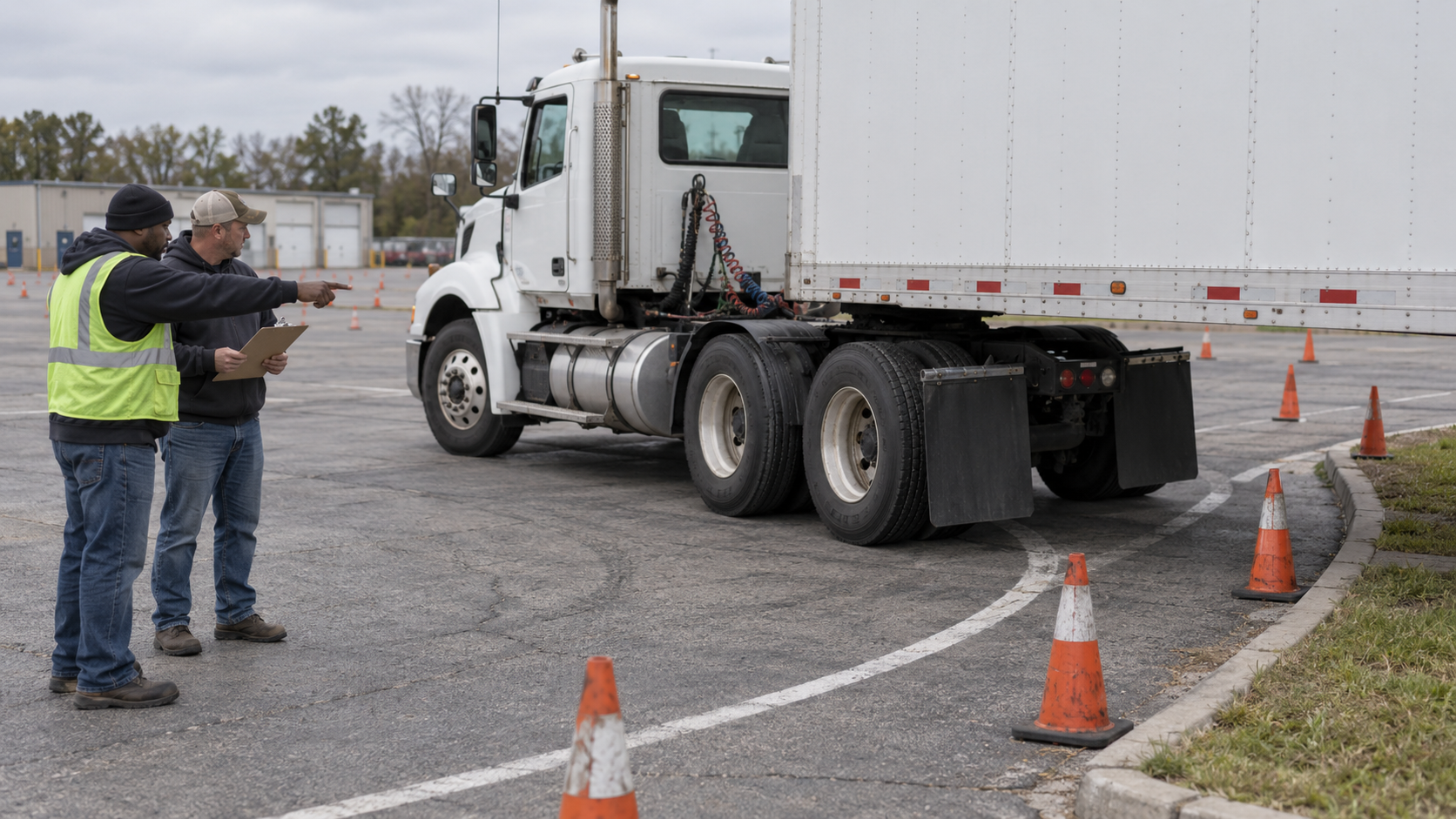
Right turns combine several risks in one small space. The tractor’s front wheels move outward while the trailer’s rear wheels cut toward the curb. A pedestrian or bicycle can enter from the right, a passenger vehicle can try to pass into the turning space, and the tractor can crowd traffic on the road being entered. The solution is not one memorized steering point. It is a repeatable process of setup, search, speed control and correction.
The federal CDL standard behind the turn
49 CFR 383.113 requires a CDL applicant to position the vehicle correctly before and during a turn, then make left and right turns safely. The on-road skills standard specifically connects correct position with preventing another vehicle from passing on the wrong side and avoiding off-tracking problems. It also calls for proper visual search, signaling, speed adjustment and selection of safe gaps.
The federal Class A ELDT curriculum includes sharp left and right turns in basic vehicle control and requires public-road proficiency in right and left turns. The Class B curriculum includes the same core turn and visual-search principles for straight trucks and buses.
Federal rules do not replace local traffic law. Under 49 CFR 392.2, a commercial motor vehicle must follow the laws, ordinances and regulations of the jurisdiction where it is operated unless an FMCSA rule imposes a higher standard. Lane arrows, turn restrictions, bicycle-lane controls and instructions from authorized traffic control therefore matter at the actual intersection.
Understand off-tracking before trying to control it
During a turn, the rear wheels do not trace the same arc as the steer wheels. They follow a shorter path toward the inside of the curve. On a tractor-trailer, the combination bends at the fifth wheel, so the driver must consider both the tractor’s path and the trailer’s inside rear-wheel path. Longer combinations, sharper steering angles and tighter corners generally demand more space.
| Area to protect | How the conflict develops | Driver response |
|---|---|---|
| Inside curb and fixed objects | Trailer wheels track inside the tractor path | Gain forward room before turning and keep checking the inside rear-wheel path |
| Pedestrians and bicycles | They can be hidden beside the cab or enter the crosswalk during the turn | Search the curb, bike lane and crosswalk before moving and again before the trailer closes the space |
| Vehicle passing on the right | A large gap can look like an open lane | Set up close enough to protect the side without striking the curb or trapping a road user |
| Traffic on the road being entered | The tractor may need room to complete the turn | Wait for a gap that fits the entire combination and keep the front swing in view |
| Trailer tail swing | The rear body can move outward opposite the turn | Check the opposite side and keep people and objects out of the swing area |
Off-tracking is not limited to trailers. A long straight truck or bus also has rear wheels that track inside the steer-axle path. Practice with the exact vehicle group used for training, then adjust when wheelbase, trailer length or articulation changes.
Build the setup before entering the intersection
- Read the whole corner. Identify the legal turn lane, curb shape, crosswalk, bicycle lane, stop line, traffic islands, poles, signs and the lane you will enter.
- Reduce speed early. Complete the major deceleration and choose an appropriate gear before the turn. Slow entry preserves time to search and stop.
- Signal with enough notice. Communicate before braking and positioning become ambiguous, then confirm the signal remains operating.
- Search both sides. Use the right mirrors for the curbside path, the left mirror for traffic and tail swing, and the windshield for the path ahead. Review mirror condition with the windshield, wiper and mirror inspection guide.
- Protect the right side. Stay in the correct lane and avoid leaving a tempting pass-through gap. Do not crowd a person or bicycle already beside the vehicle.
- Wait for a complete gap. The opening must accommodate the entire combination, not just the tractor’s nose.
If the route repeatedly requires doubtful turns, the planning problem comes first. Use the CDL trip-planning guide to verify truck routes, last-mile access and restricted intersections before departure.
Do not begin with a button hook
The current New York CDL manual gives a clear warning: do not swing left before turning right. That early movement can make a following driver think you are changing lanes or turning left, then encourage the driver to move into the space on your right just as the truck turns across it.
Instead, approach in the correct legal lane, keep the rear of the vehicle positioned to protect the right side and move far enough into the intersection to create turning room. Then turn wide as the maneuver is completed. The exact path depends on the vehicle, lane markings, corner geometry and applicable law; “wide” never means taking an unauthorized lane without regard for other traffic.
Use a moving mirror sequence through the turn
At low speed, move the view rather than locking onto one point:
- Forward: confirm the tractor has room to continue and the receiving lane remains open.
- Right mirror: watch the curb, crosswalk edge and trailer’s inside rear-wheel path.
- Forward again: check for traffic, a stopped vehicle or a pedestrian entering from the far side.
- Left mirror: monitor front swing, opposing traffic and the trailer’s outside tail swing.
- Right mirror again: verify the trailer is clearing before it reaches the corner.
The sequence is continuous, not a one-time checklist. Keep the steering rate slow enough that the eyes can stay ahead of the vehicle. If the rear wheel is moving toward a curb faster than you can evaluate it, stop while clearance remains.
Give vulnerable road users two separate checks
A person walking or riding beside a commercial vehicle can disappear from direct view and reappear in a mirror. Before moving, scan the sidewalk, corner, crosswalk and bicycle lane. Before increasing steering input, check those areas again. Do not assume eye contact means the person will wait, and do not use the horn as a substitute for yielding or stopping.
If someone is already in the inside space, hold the vehicle and let the conflict clear. A green signal permits movement only when the path is safe. Darkness, rain, work-zone channelization and dirty mirrors demand more time; the work-zone driving guide explains how temporary lane shifts can change the normal turn picture.
Recover from a poor setup without creating a second hazard
If the trailer is about to climb the curb, strike an object or squeeze another road user, stop. Do not accelerate to “pull it around,” add a sudden steering correction or continue because traffic is waiting. Secure the vehicle as conditions require, reassess every side and follow carrier procedure.
Backing in an intersection can expose people and vehicles that the driver cannot see. Do not back blindly. When recovery requires reversing or controlling public traffic, obtain qualified assistance and authorized traffic control as appropriate. If the turn cannot be completed safely and legally, the right decision may be to remain stopped until the path is protected or an official directs the recovery.
A missed turn is safer than an improvised one. Continue to a verified alternate only when it can be done lawfully without handling a device while driving; review ProntoCDL’s mobile-phone and distracted-driving guide.
A closed-range off-tracking drill
An instructor can make off-tracking visible without placing a trainee in live traffic:
- Inspect the training area and build a wide corner with cones, leaving a generous escape zone.
- Mark one reference line for the steer-wheel path and another for the inside rear-wheel path.
- Walk the course before driving and ask the trainee to predict where the rear wheels will travel.
- Drive at idle speed while the trainee uses a forward-right-left-right search pattern.
- Stop at the turn’s midpoint, secure the vehicle and compare the actual wheel positions with the prediction.
- Repeat with a slightly different entry position or steering start so the trainee can see how setup changes the rear-wheel path.
- Debrief the stop decision, curbside protection, mirror timing and clearance on both sides.
Keep spotters on the ground in an agreed visible position and stop immediately if the driver loses sight of them. Connect the drill to ProntoCDL’s Class A ELDT guide or Class B ELDT guide, then reinforce turning terminology in the free CDL practice center.
Practical takeaways
- Plan the lane, speed, gear, signal and receiving path before beginning the turn.
- Expect rear wheels to track inside the steer-axle path; protect the curbside space throughout the maneuver.
- Do not swing left first to create a button-hook turn.
- Use a continuing mirror-and-windshield search instead of staring at one reference point.
- Check crosswalks, sidewalks and bicycle lanes before moving and again before closing the inside space.
- Wait for a gap that accommodates the whole vehicle, including front swing and trailer movement.
- Stop when the path becomes uncertain. Never use speed or a sharp correction to rescue poor setup.
- Obey the lane markings and traffic rules that apply at the actual intersection.
CDL right-turn and off-tracking FAQ
What is off-tracking in a tractor-trailer turn?
Off-tracking is the tendency of the rear wheels to follow a path inside the path of the steering axle during a turn. A sharper turn, longer vehicle and multiple articulation points can increase the difference, so the driver must protect the inside of the turn.
Why is a button-hook right turn unsafe?
Swinging left before beginning a right turn can invite a following driver to enter the open space on the right and can move the tractor unexpectedly toward traffic in the adjacent lane. Set up in the correct legal lane and gain needed room as the turn is completed, not with an early left swing.
How close should a tractor-trailer stay to the curb before a right turn?
There is no universal measurement for every vehicle and intersection. The goal is to keep the rear of the vehicle close enough to protect the right side from unsafe passing while preserving clearance from the curb, pedestrians, bicycles and fixed objects. Use the geometry taught for the actual vehicle and follow local lane rules.
Should a driver turn right from a second lane to gain room?
Not unless signs, pavement markings, applicable law or authorized traffic control establish that lane for the turn. A wide vehicle does not automatically have permission to start from another lane. Plan the route and use the legally designated lane.
Where should a CDL driver look during a right turn?
Keep moving the view among the forward path, the right-side mirrors, the left-side mirror and the area the tractor is entering. The inside rear-wheel path needs repeated checks, but staring in one mirror can hide a pedestrian, vehicle or new conflict ahead.
Are right turns and off-tracking part of CDL training and testing?
Yes. Federal CDL skills standards require safe left and right turns and correct positioning to prevent wrong-side passing and off-tracking problems. Class A and Class B ELDT curricula also include sharp turns, visual search, communication, speed management and public-road turn proficiency.
Set up early. Track the rear wheels.
A slow approach and active mirror sequence give you time to protect the curb, the trailer and every road user beside the truck.
Start free CDL practice