
CDL Driver Qualification File Checklist: Get Job-Ready
A CDL opens the door to commercial driving, but it does not complete a carrier’s hiring process. Before putting a driver behind the wheel, a motor carrier must establish that the person is qualified and document the required checks. Applicants who understand that process can submit cleaner paperwork, prevent avoidable delays and recognize the difference between an MVR, PSP report, Clearinghouse query and medical-status record.
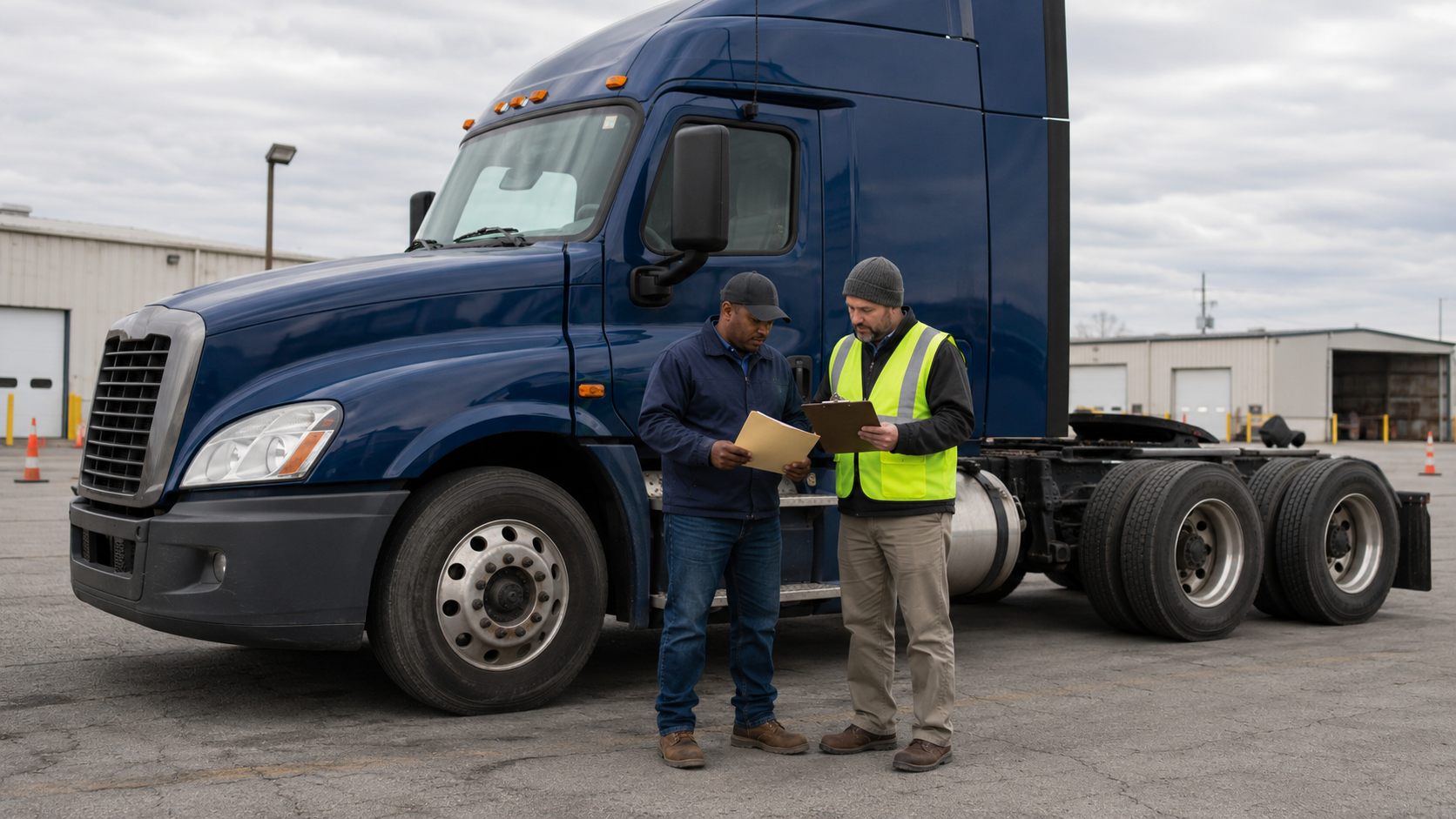
Under 49 CFR 391.51, each covered motor carrier must maintain a driver qualification file, commonly called a DQ file or DQF, for each driver it employs. The carrier owns that compliance responsibility. The applicant provides accurate information and authorizations; the carrier performs, documents and retains the required reviews.
Part 391 can apply to some commercial drivers who do not need a CDL, and limited exceptions exist. This guide focuses on a typical interstate CDL applicant joining a motor carrier. State rules, intrastate operations, vehicle type and the driver’s role can add or modify requirements.
What belongs in the qualification-file system?
The official file is more than a photocopy of a CDL. It connects the driver’s application with independent licensing records, safety-history checks, medical qualification and proof of driving skill. Certain sensitive investigation records are maintained in a secure driver-investigation history file under 49 CFR 391.53, rather than casually mixed into an open personnel folder.
| Record or check | Who supplies or obtains it? | What it establishes |
|---|---|---|
| Signed driver application | Driver completes the carrier’s form | Identity, licenses, experience, crashes, violations and employment history |
| Initial State MVR inquiries | Carrier obtains records from relevant licensing authorities | The prior three-year State driving history |
| Safety-performance history | Carrier investigates prior regulated employers | Required employment, crash and applicable safety information |
| Road-test certificate or accepted equivalent | Carrier tests the driver or accepts qualifying proof | Driving-skill qualification for the intended equipment |
| Medical status and variances | Carrier verifies the applicable certificate or CDLIS MVR | Current physical qualification for the operation |
| Annual MVR and review note | Carrier obtains and reviews at least every 12 months | Continuing qualification and absence of disqualifying events |
Build a complete employment timeline before applying
49 CFR 391.21 requires a signed application with specific information. It includes three years of residence history; current commercial licenses or permits; driving experience by equipment type; specified crashes, violations and licensing actions; and employment history.
Every applicant lists employers from the preceding three years. A CDL applicant seeking to operate a Part 383 CMV must also list employers for whom the applicant operated a CMV during the additional seven-year period. That is why many carrier applications ask for 10 years of CMV employment history, even though the carrier’s safety-performance investigation generally focuses on the preceding three years.
Prepare a private timeline before opening an online application. For each employer, collect:
- Legal company name and address.
- Accurate start and end dates.
- Job title and the equipment operated.
- Whether the job was DOT-regulated or safety-sensitive.
- A truthful, concise reason for leaving.
- A current records or safety-department contact when available.
Do not invent dates to eliminate a gap. A gap is usually easier to explain than a timeline that conflicts with payroll, licensing or prior-employer records.
Know the three-year MVR and employer checks
Under 49 CFR 391.23, the carrier must inquire with each licensing authority where the driver held a license or permit during the preceding three years. The resulting MVR must be placed in the qualification file within 30 days after employment begins. If a licensing authority does not respond, the carrier documents its good-faith effort.
The carrier must also investigate required safety-performance history with applicable DOT-regulated employers from the preceding three years. That investigation covers identification and employment verification, defined crash information and, when applicable, drug-and-alcohol program information. Since January 6, 2023, employers subject to the FMCSA Clearinghouse query rule use the Clearinghouse to satisfy the specified Section 391.23 drug-and-alcohol inquiry requirement for FMCSA-regulated employers.
The driver must be notified of rights to review certain prior-employer information, request a correction and submit a rebuttal. If something is genuinely wrong, use the regulatory process and document the disagreement. Do not alter records or conceal a reportable event.
MVR, PSP and Clearinghouse are different records
These systems are often mixed together in job-search conversations, but each answers a different question:
| System | Main information | What it does not replace |
|---|---|---|
| State MVR | State license status and driver-record information | PSP inspection history or Clearinghouse status |
| FMCSA PSP | Five years of FMCSA-reportable crashes and three years of roadside inspections | The required State MVR inquiry, a criminal background check or Clearinghouse query |
| Drug and Alcohol Clearinghouse | Covered violations, prohibited status and return-to-duty milestones | The State MVR, PSP or full qualification review |
| CDLIS medical-status record | Medical certification associated with the CDL or CLP | License validity, endorsements or employment qualification as a whole |
The FMCSA Pre-Employment Screening Program lets a driver request a personal PSP record. Reviewing it before applying can expose identity errors or inspection records that deserve context. It is a useful preparation step, not the official DQ file and not a guaranteed hiring decision.
For prohibited-status and consent details, use the ProntoCDL Clearinghouse guide. For the current medical-record workflow, see the 2026 CDL medical-card guide.
Road-test proof depends on the assigned equipment
49 CFR 391.31 requires a driver to complete a road test and receive a certificate before driving a CMV unless a permitted equivalent or exception applies. The test evaluates the type of vehicle and associated equipment the carrier intends to assign. It includes pre-trip inspection, controls, traffic operation, turning, braking, backing and parking; coupling is included when combination units will be operated.
Under 49 CFR 391.33, a carrier may accept a qualifying CDL or a road-test certificate issued within the preceding three years as an equivalent. A carrier may still require its own road test or skills evaluation. A valid CDL establishes licensing; it does not force a carrier to accept a driver for unfamiliar equipment.
Applicants should be ready to identify actual experience: manual or automatic transmission, tractor-trailer or straight truck, tanker, passenger vehicle, length and configuration. Honest equipment history helps the carrier select appropriate orientation and protects the driver from being assigned beyond demonstrated competence.
Medical qualification must match the electronic record
For CDL and CLP holders, the carrier generally verifies medical status through the CDLIS motor vehicle record obtained from the current licensing State. Any required medical variance must also be documented. The electronic record matters even when the driver carries paper proof.
Before onboarding, verify the expiration date, self-certification category and State medical status. The non-excepted interstate CDL guide explains the operating categories. Do not wait until orientation to discover that the State record shows “not certified.”
Annual reviews continue after hiring
A DQ file is not a one-day onboarding packet. Under 49 CFR 391.25, the carrier must obtain and review an updated MVR at least once every 12 months. The review considers safe-driving requirements, disqualifying events, crashes and serious violations. The carrier retains the MVR and a note identifying the reviewer and review date.
Drivers should report convictions, suspensions and other required changes through the proper company and licensing channels instead of assuming the annual review is the first time the carrier will learn about them. Keep medical qualification, license class, endorsements and restrictions current throughout employment.
A driver’s job-readiness folder
The carrier maintains the legal file, but a driver can keep a secure personal preparation folder. Include:
- Current CDL or CLP details and expiration date.
- A complete three-year residence and employment timeline.
- The additional seven years of CMV employers when applicable.
- Equipment types, endorsements and restriction information.
- Current medical certificate copy and any applicable variance documents.
- ELDT completion details for a recently obtained credential or endorsement.
- Accurate crash, violation and licensing-action notes needed for applications.
- A personal PSP report if the driver chooses to review one.
Store sensitive documents securely. Send them only through the carrier’s verified hiring system or another confirmed channel. A recruiter does not need your login credentials for FMCSA, a State portal or an identity provider.
Practical takeaways
- The carrier—not the driver—owns the official DQ-file obligation.
- A CDL application generally needs three years of all employers and 10 years of CMV-driving employers.
- Initial MVR and prior-employer inquiries generally use a three-year lookback and must be documented within 30 days after employment begins.
- MVR, PSP, Clearinghouse and medical-status records serve different purposes.
- A carrier may accept a qualifying CDL as a road-test equivalent but may still require its own skills evaluation.
- The DQ process continues with annual MVR inquiries and reviews.
- Accurate dates and honest disclosures are safer than unexplained inconsistencies.
New applicants can strengthen the knowledge side of job readiness with ProntoCDL practice tests, the CDL study-guide library and the ELDT readiness checklist.
CDL driver qualification file FAQ
Does a CDL driver build and keep the official driver qualification file?
No. The motor carrier is responsible for creating, maintaining and protecting the official file. The driver’s job is to provide complete, truthful information, supply requested authorizations and keep personal credentials current.
How many years of employment history must a CDL applicant list?
The federal application requires all employers from the preceding three years. A driver applying to operate a CMV that requires a CDL must also list employers for whom the applicant operated a CMV during the additional seven years, creating a 10-year CMV-employment lookback.
Is a PSP report the same as a motor vehicle record?
No. A PSP report contains five years of FMCSA-reportable crash history and three years of roadside inspection history. An MVR comes from a State licensing authority and shows State driver-record information. Neither should be treated as a substitute for the other.
Does holding a valid CDL replace a carrier road test?
A carrier may accept a qualifying CDL as the regulatory equivalent of a road test when it licenses the driver for the type of CMV the carrier intends to assign. The carrier may still require its own road or skills test as a condition of employment.
Can a carrier let a new driver operate while background inquiries are still pending?
Some 49 CFR 391.23 inquiries and documentation have a 30-day completion window after employment begins, but other prerequisites apply before the driver operates, including qualification, medical-status verification and an accepted road-test certificate or equivalent. Drug-and-alcohol and Clearinghouse requirements also apply when the position is covered.
Can a driver challenge incorrect information supplied by a former employer?
Yes. Section 391.23 gives drivers procedures to review certain safety-performance history, request correction and submit a rebuttal. The carrier must provide the required written notice of those rights.
Prepare for the credential and the career
Build a clean employment timeline, verify your records and reinforce the CDL knowledge carriers expect.
Start free CDL practice