
CDL Backing Safety Guide: GOAL, Spotters and Pull-Ups
Safe backing is not one continuous maneuver. It is a series of short, controlled decisions: choose the best setup, inspect the path, move slowly, scan both sides, stop when the picture changes and reset before a small error becomes a strike.
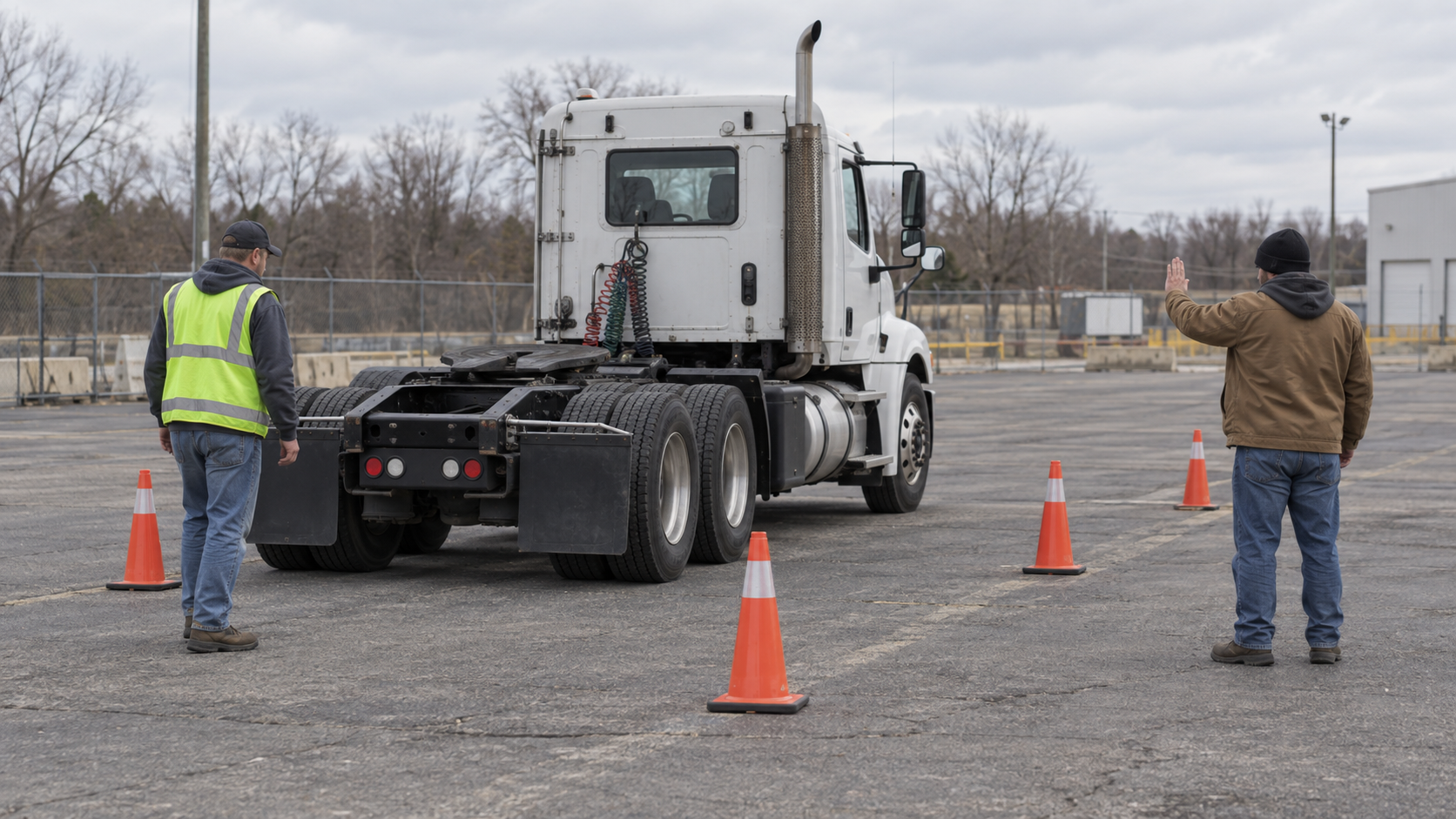
Commercial vehicles create blind areas, front swing and a long path that cannot be judged from one mirror. A good backing routine therefore begins before reverse gear is selected. The professional question is not “Can I save this maneuver?” It is “Do I still know that every part of the vehicle has room?”
What the federal CDL and ELDT standards cover
49 CFR 383.113 requires CDL applicants to demonstrate straight-line backing with path-and-clearance checks and backing along a curved path. It also requires smooth forward and backward acceleration.
The federal Class A ELDT curriculum goes beyond the maneuver name. Its backing-and-docking unit specifically covers Get Out And Look (GOAL), evaluating backing and loading facilities, backing setups and using spotters. The Class B ELDT curriculum contains the same core subjects for heavy straight vehicles.
Those requirements explain the real skill being tested: the driver must manage visibility and clearance, not merely make the rear of the vehicle arrive at a line.
Avoid the reverse move when a safer choice exists
The current New York State Commercial Driver’s Manual, Section 2, begins its backing guidance with a simple principle: avoid backing when possible and park so the vehicle can leave forward. That decision is easiest on arrival, before another truck, customer or pile of freight removes the option.
- Use a pull-through space when it is legal and designed for the vehicle.
- Face the truck toward the next safe exit when parking overnight.
- Walk an unfamiliar dock or yard before committing to a narrow lane.
- Ask the facility which approach, staging area and door are intended for the vehicle.
- Do not create an improvised reverse move into public traffic because a forward exit was missed.
Set up before selecting reverse
A strong setup makes the target visible and reduces the steering needed later. Approach slowly, use the available space, square the vehicle as much as the maneuver allows and favor the driver’s side when possible. The current CDL manual recommends driver-side backing because the driver has the better view.
Before movement, stop in a secure position and GOAL. Walk the path from the vehicle to the target and inspect:
- pedestrians, workers, children, animals and moving equipment;
- both side clearances, the rear boundary and the space needed for front swing;
- overhead doors, canopies, branches, wires, pipes and dock equipment;
- curbs, holes, soft shoulders, slopes, debris, wheel stops and low objects;
- the target line, dock face and any gap between the dock and building; and
- a place to stop or pull forward if the setup does not develop as planned.
Do not rely on the area being unchanged since the previous visit. A pallet, parked forklift, open door or person can appear after the initial walk-around.
Use GOAL as a control, not a rescue
GOAL is most useful before the first movement, while every option remains open. Use it again whenever the mirror picture no longer answers the clearance question. Secure the vehicle using the approved procedure before leaving the seat; a rushed walk-around that allows the truck to move creates a new hazard.
| Trigger | What to verify on the ground |
|---|---|
| Before the first reverse movement | Full route, overhead clearance, side space, rear target and front-swing area |
| After a pull-up or major steering correction | New rear-wheel path, pivot position and whether the target remains reachable |
| Object disappears from a mirror | Actual distance and whether it entered a blind area |
| Person or equipment enters the scene | That the area is clear and everyone understands the next movement |
| Spotter signal or position is lost | Spotter location, communication plan and safe restart condition |
| Final approach to a dock or boundary | Rear, side and overhead clearance plus dock condition |
There is no useful prize for making fewer safe stops. The shortest backing maneuver is the one that avoids damage, injury and a complete restart.
Create a spotter contract before the truck moves
The CDL manual recommends using a helper when possible, placing that helper near the rear where the driver can see them, agreeing on hand signals and defining a stop signal. Turn that advice into a short pre-move contract:
- Name one primary spotter. Other people may call an emergency stop, but only one person should direct routine movement.
- Choose the visible position. The spotter stays on the ground, outside the projected path and pinch points, where the driver can maintain mirror contact.
- Review signals. Agree on stop, straight back, turn direction, distance remaining and pull forward. Use the facility or carrier standard.
- Set the lost-contact rule. If the driver cannot see the spotter or does not understand the signal, the vehicle stops.
- Protect the spotter. The spotter never stands between the moving vehicle and a dock, wall, trailer, parked vehicle or other fixed object.
A spotter improves information; a spotter does not remove the driver’s duty to control the vehicle. If the spotter waves the truck toward an uncertain clearance, stop and look.
Use a moving mirror cycle
Do not stare at the target-side mirror until the other side becomes a surprise. Use a deliberate cycle: target side, opposite side, rear path, front swing, then back to the target side. For a combination vehicle, add the trailer wheel path and changing tractor-trailer angle to that scan.
Move as slowly as practical under the vehicle, facility and training procedure. The CDL manual advises the lowest reverse gear because slow movement gives the driver more time to recognize and correct an error. Keep steering inputs small and wait long enough to see their effect. Rapid opposite corrections can make the rear path harder to predict.
If a mirror is dirty, damaged, iced over, vibrating out of position or blocked by the load, stop. The answer is to restore the view or change the plan—not to continue on memory. Review the inspection routine in ProntoCDL’s windshield, wiper and mirror guide.
Watch both the rear path and the front swing
When the rear of a long vehicle moves one way, the front can swing the other. A driver who focuses only on the dock may bring the tractor nose, bus front or body corner into a parked vehicle, post, gate or person. Stop before a steering change removes the remaining front clearance.
Combination vehicles add off-tracking and changing trailer angle. Learn the relationship in ProntoCDL’s alley-dock backing guide, then connect it to the off-tracking guide. The same geometry matters in reverse even though the steering response feels different.
Pull forward before the maneuver runs out of options
A pull-up is not an act of surrender. It is a way to reduce angle, restore mirror coverage and create room for a simpler correction. Use it early, while the vehicle can move forward without crossing a boundary or entering another hazard area.
- Stop completely and scan the forward path.
- Choose the correction you want before releasing the brake.
- Pull forward only far enough to improve the setup.
- Stop, reassess both sides and GOAL again if the path changed materially.
- Resume with a new mirror cycle instead of continuing the old assumptions.
On a CDL skills test, follow the examiner’s directions and the State scoring rules. In the yard or on the job, never trade safety for a cleaner-looking maneuver.
Know when to abort and rebuild the plan
Stop the maneuver when a pedestrian enters the area, the spotter disappears, lighting is inadequate, the surface will not support the vehicle, a door or dock position is uncertain, traffic cannot be controlled or the setup requires repeated large corrections. A full reset may mean driving around the yard, asking for a different door, waiting for equipment to move or obtaining qualified traffic control.
Do not allow pressure from a schedule, another driver or a waiting dock crew to replace a known safe path. When the area cannot be made safe, keep the vehicle stopped and contact the carrier or site supervisor.
A closed-yard backing practice drill
- Use a closed training pad and inspect it for people, holes, overhead hazards and unrelated traffic.
- Build a wide straight corridor with cones and mark a separate, protected spotter zone.
- Have the trainee perform GOAL and describe the rear path, front swing and stopping boundary aloud.
- Agree on the hand signals and lost-contact rule before the driver enters the cab.
- Back at controlled speed using a full mirror cycle; stop immediately when the instructor steps out of mirror view.
- Add one planned pull-up, then repeat the GOAL inspection before resuming.
- Progress to offset or alley-dock work only after straight-line control is consistent.
Never place a trainee behind a moving truck to imitate a hazard. Connect the range work to ProntoCDL’s Class A ELDT guide or Class B ELDT guide, and reinforce the terminology in the free CDL practice center.
Practical takeaways
- Avoid backing when a legal, designed pull-through option exists.
- Inspect the complete path before moving, including the front-swing and overhead areas.
- Favor a driver-side setup and restore the view whenever possible.
- Move slowly, scan both mirrors and use small steering corrections.
- Agree on one spotter, one signal set and an immediate stop when visual contact is lost.
- GOAL again whenever the path, clearance or setup changes.
- Use pull-ups early to restore control; do not wait for a heroic correction.
- Abort the move when the area, communication or equipment cannot support a known safe path.
CDL backing safety FAQ
What does GOAL mean in truck backing?
GOAL means Get Out And Look. Secure the vehicle according to the school, examiner, carrier and vehicle procedure, then inspect the complete path and clearances from the ground. GOAL should happen before movement and again whenever the view, setup or clearance becomes uncertain.
Does federal law require a spotter for every backing maneuver?
The cited federal CDL skills standard and ELDT curricula require backing skill and training in the use of spotters, but they do not create a universal rule that every backing movement must use one. A carrier, terminal, customer, school, examiner or State may impose stricter procedures.
Where should a backing spotter stand?
The current CDL manual says the helper should stand near the rear where the driver can see the helper. In practice, the spotter also needs a protected position outside the truck’s path and pinch points, a reliable view of the hazard area and an agreed escape route. Site rules may define a specific position.
Who controls the move when a spotter is present?
The driver controls the vehicle and should move only while the signal, path and clearance are understood. The spotter provides information and stop signals; the spotter does not make an unsafe path safe. Stop immediately if the spotter disappears from view or any signal is unclear.
Is taking a pull-up a failure on a CDL backing exercise?
A pull-up is a controlled correction that can prevent a poor setup from becoming a collision. An examiner may score pull-ups under the applicable State test rules, but safety comes first. Know the test instructions, stop before crossing a boundary or striking an object, and reset deliberately.
When should a driver stop and GOAL again?
Stop when a mirror view is lost, a person or object enters the area, the rear or front-swing clearance is uncertain, the spotter is no longer visible, the vehicle is not responding as expected or a pull-up changes the path. If doubt remains after looking, do not continue.
Stop before uncertainty becomes motion.
Inspect the path, agree on the signals and reset the maneuver whenever the picture changes.
Start free CDL practice