
CDL Tire Inspection Guide: Tread, Pressure and Defects
A commercial tire can look acceptable from a few steps away and still have low pressure, a deep cut, exposed belt material or tread below the legal minimum. A professional inspection combines a deliberate visual scan with hands-on measurements and a clear decision about whether the vehicle is safe to move.
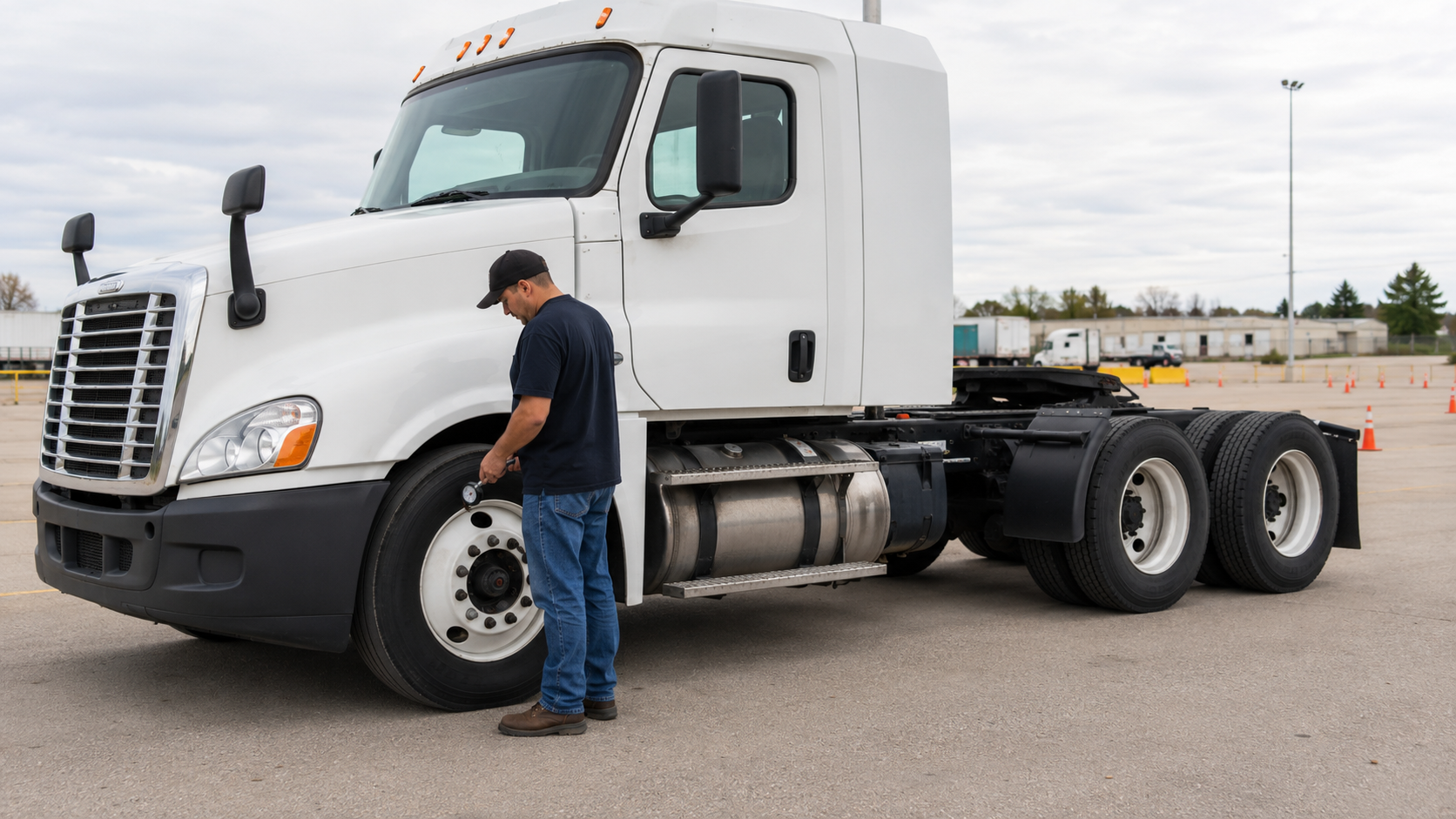
The current federal tire requirements are in 49 CFR 393.75. Section 392.7 also says a CMV must not be driven until the driver is satisfied that its tires, wheels and rims are in good working order.
Use the same inspection order every time
Start at the driver-side steer tire, continue around the tractor, inspect every drive-tire position and then examine each trailer tire. Keep the order consistent so a hidden inside dual or a tire on the far side of the vehicle is not forgotten.
At each position, use this sequence:
- Tread: Check depth, uneven wear and embedded objects.
- Sidewall: Look for cuts, exposed material, bulges, weather cracking and separation.
- Pressure: Measure with an accurate gauge when required by the inspection procedure.
- Valve: Check the stem and cap for damage, looseness or leakage.
- Wheel area: Look for rim damage, loose or missing fasteners, hub leakage and anything rubbing the tire.
- Dual spacing: Inspect both tires and confirm they are not touching each other or another vehicle component.
Remember the 4/32 and 2/32 tread rules
Front-wheel tires on a bus, truck or truck tractor must have at least 4/32 inch of tread depth when measured at any point in a major tread groove. Other tire positions generally require at least 2/32 inch in a major tread groove.
Do not measure on a tie bar, hump or fillet. Check more than one location because irregular wear can leave a shallow area even when another part of the tread looks deep. A tread-depth gauge is faster and more dependable than guessing with your eyes.
Know the defects that prohibit operation
Section 393.75 prohibits operating a motor vehicle on a tire that:
- Has body-ply or belt material exposed through the tread or sidewall
- Has tread or sidewall separation
- Is flat or has an audible leak
- Has a cut deep enough to expose ply or belt material
A bulge can indicate internal separation even when the outside rubber has not split. An object embedded in the tread may also be sealing a puncture temporarily. Do not pull out an object during the pre-trip; mark the location and follow the carrier’s maintenance process.
Measure inflation—do not thump and guess
The current federal rule says a vehicle may not operate on a tire whose cold inflation pressure is below the pressure specified for the load being carried. A tire’s sidewall marking, the tire manufacturer’s load-and-inflation information and the carrier’s approved specification work together; the sidewall maximum is not automatically the correct operating target for every load.
Check pressure before the vehicle has been driven and before sunlight or braking heat changes the reading whenever a cold measurement is required. A tire that has recently operated will read higher because of heat. Do not bleed a hot tire down to a cold target unless an authorized procedure specifically directs it.
Give dual tires extra attention
Inside dual tires are easy to miss. View them from multiple angles and use a light when necessary. Check that both tires are inflated appropriately, have adequate clearance and are not trapping rocks or debris between them. Unequal pressure makes the tires carry different shares of the load and can create heat and irregular wear.
Confirm that valve stems are accessible and protected. Look between the tires for sidewall contact, rubbed surfaces, damaged spacers or anything mounted nearby that can touch the tire during suspension movement.
Read wear patterns as early warnings
- Center wear: may point to an inflation or application problem.
- Both shoulders worn: may indicate chronic underinflation or overloading.
- One shoulder worn: can suggest alignment or suspension concerns.
- Cupping or scalloping: may be connected to balance, shocks, bearings or suspension movement.
- Flat spotting: can follow wheel lockup, dragging brakes or prolonged parking.
A driver does not need to diagnose the repair. The driver’s job is to describe the location and observable condition accurately so qualified maintenance personnel can evaluate it.
Do not ignore rating and application limits
A tire must not carry more weight than its marked or otherwise applicable load rating, except under the narrow special-permit conditions described in the federal rule. Speed-restricted tires also may not be operated above their rated limit.
Front-wheel restrictions deserve special attention. Buses may not use regrooved, recapped or retreaded tires on the front wheels. A regrooved tire with a load-carrying capacity of at least 4,920 pounds may not be used on the front wheels of a truck or truck tractor.
Make a clear go, repair or stop decision
If the tire has an exposed ply or belt, separation, a flat condition, an audible leak, a qualifying deep cut or tread below the applicable minimum, do not dispatch the vehicle. Report the exact tire position and condition. Use terms such as “right front steer,” “left rear outer drive” or “trailer axle two, right inner” so maintenance finds the correct tire immediately.
For a condition that is not obviously prohibited but still appears unsafe—such as a new bulge, rapid pressure loss or severe irregular wear—follow the carrier’s escalation procedure and obtain a qualified evaluation before moving.
Practical takeaways for CDL study
- Steer tires need at least 4/32 inch; most other positions need at least 2/32 inch.
- Measure in a major tread groove, away from tie bars, humps and fillets.
- Never operate with exposed ply or belt material, tread or sidewall separation, a flat tire, an audible leak or a cut exposing structural material.
- Use an accurate gauge and the correct cold-inflation requirement for the load.
- Inspect both tires in every dual assembly and verify safe spacing.
- Describe the tire position and observable defect precisely.
- A passing measurement does not override a visible safety defect.
Review inspection vocabulary in the ProntoCDL CDL glossary, strengthen your full walkaround sequence with the CDL study guides, and test these concepts in the General Knowledge and Pre-Trip Practice Center.
Frequently asked questions
What is the minimum tread depth for a commercial truck steer tire?
Federal rules require at least 4/32 inch in every major tread groove on the front wheels of a bus, truck or truck tractor. Measurements are not taken at tie bars, humps or fillets.
What is the minimum tread depth for drive and trailer tires?
Tires other than the front-wheel tires covered by the 4/32-inch rule generally require at least 2/32 inch in a major tread groove, measured away from tie bars, humps and fillets.
Can a driver judge tire pressure by looking at the tire?
No. A tire can be seriously underinflated without appearing flat, especially in a dual assembly. Use an accurate gauge and the correct cold-inflation requirement for the tire and load.
Is a cut in a commercial tire automatically illegal?
The federal rule prohibits operating on a tire with a cut deep enough to expose ply or belt material. Any cut, bulge, separation, leak or unusual damage should still be evaluated under the carrier’s safety and maintenance procedures before operation.