
CDL Skills Test Guide: Pre-Trip, Basic Control & Road Test
The CDL skills test is not one long drive. It is a three-stage demonstration in a representative commercial vehicle, and every stage depends on habits built before test day.
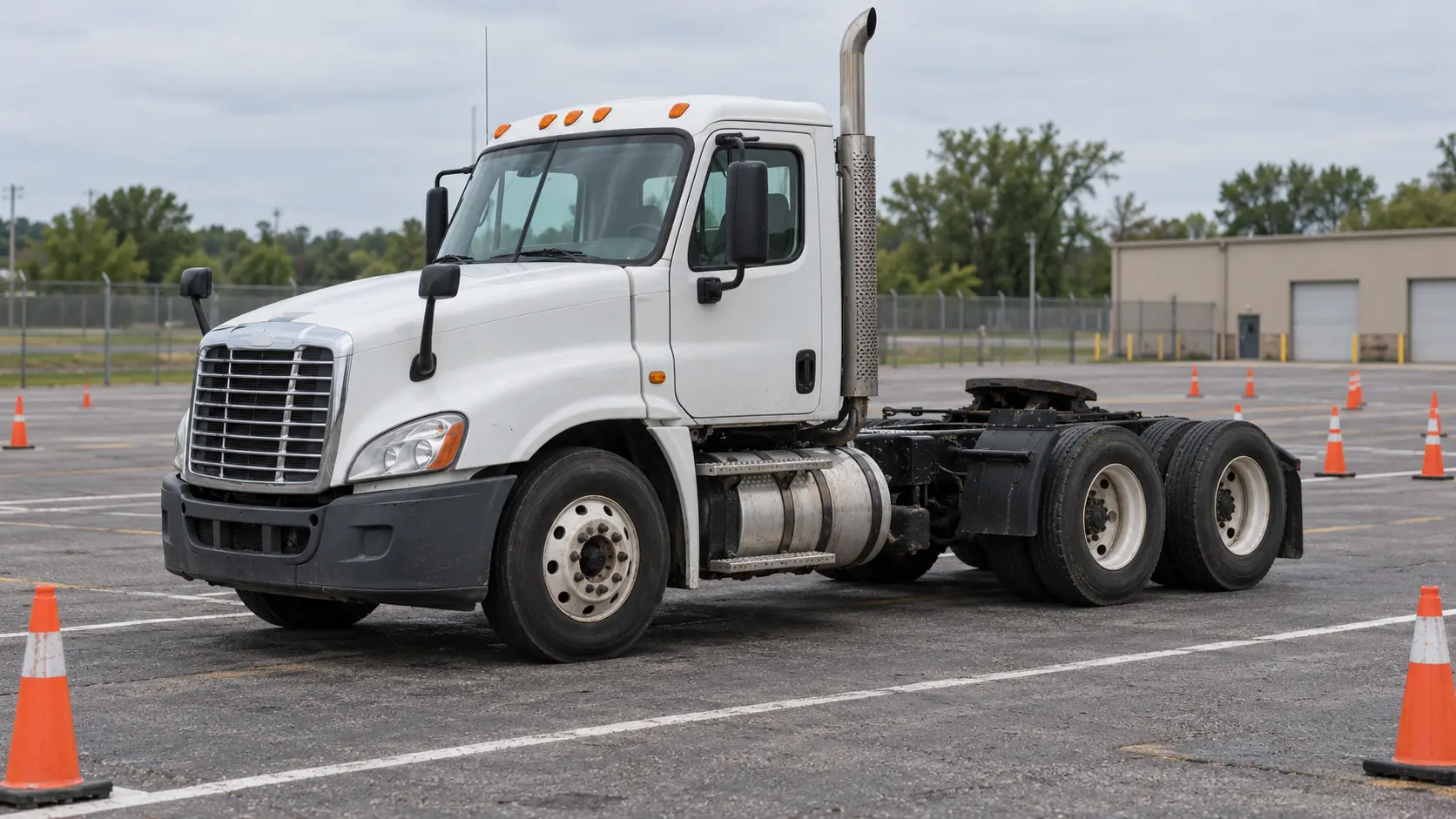
Federal 49 CFR 383.133 requires CDL skills tests to be administered and successfully completed in a fixed order: pre-trip vehicle inspection, basic vehicle control skills and on-road skills. If an applicant fails a segment, the test stops before the next segment.
The abilities behind those three parts are described in 49 CFR 383.113. The rule covers inspection of safety-related components, straight and curved backing, smooth starts and stops, turns, shifting when applicable, visual search, signaling, speed and space management, traffic gaps and control in changing conditions.
This guide explains the federal structure and a practical way to prepare. Exact maneuvers, scoring details, appointments, fees and retest procedures come from the licensing State. Use the current State CDL manual and examiner instructions alongside federal requirements.
First confirm that you are eligible to test
A well-practiced candidate can still lose a test date because one administrative requirement is incomplete. Check eligibility before reserving equipment or traveling to the test site.
- Valid CLP: The commercial learner's permit must match the jurisdiction, vehicle group and endorsements needed for the test.
- Fourteen-day wait: Under 49 CFR 383.25, a CLP holder is not eligible to test during the first 14 days after initial permit issuance.
- ELDT completion: A first Class A or B CDL, a covered upgrade, or a first P or S endorsement requires the applicable training from a provider listed on FMCSA's Training Provider Registry before the skills test.
- Medical and license status: Confirm that the underlying driver license, medical certification when required, CLP and driving privilege remain valid.
- State appointment rules: Verify required documents, identification, fees, arrival time, sponsor or vehicle-owner paperwork and any State-specific form.
Federal 49 CFR 380.717 gives a training provider until midnight of the second business day after completion to transmit certification information to the TPR. Do not assume the licensing agency can see a same-day completion immediately. Confirm the record before relying on a test appointment.
For the full readiness sequence, use ProntoCDL's ELDT before the skills-test checklist and CLP supervision guide.
Know why the test order matters
The three segments build on each other. The inspection asks whether you can recognize a safe vehicle. Basic control asks whether you can place that vehicle accurately at low speed. The road test asks whether you can combine inspection knowledge and physical control with traffic judgment.
A candidate cannot use a strong road drive to compensate for an unsuccessful inspection or control segment, because the federal sequence stops progression after a failed segment. Prepare for the first part with the same seriousness as the road portion.
Passed-segment scores are protected only within the initial issuance of the current CLP under the federal rule. If that permit is renewed, all three segments must be retaken. Within an unexpired initial CLP, the State controls retest scheduling and how eligible passed segments are recognized.
Part 1: Pre-trip vehicle inspection
The inspection segment tests whether you can identify safety-related parts on the actual vehicle and explain what must be checked to confirm safe operating condition. Federal categories include the engine compartment, cab and engine start, steering, suspension, brakes, wheels, vehicle sides, rear and special features of a tractor-trailer, school bus or coach/transit bus when applicable.
That means naming a component is not enough. Point to the real part, describe the condition you are checking and connect the observation to safe operation. “This is the steering gearbox; it is securely mounted, not cracked or leaking” is useful. A memorized list delivered while pointing generally beneath the hood is not.
Air-brake-equipped test vehicles add operational checks. The federal skill set includes identifying controls and monitoring devices, evaluating brake-system condition and connections, testing low-pressure warnings, confirming compressed-air supply and buildup, and checking system performance. Practice the approved sequence from the current State manual on the same brake configuration you will test in. ProntoCDL's air-brake test guide can help organize the concepts, but the State procedure controls test-day order and wording.
The current New York CDL manual explains that an examiner may direct the applicant to inspect the entire vehicle or selected areas. That is a good reason to learn a complete, flexible system instead of memorizing only one assigned route. Class B and passenger vehicles also require attention to their installed special features.
Build an inspection method that survives test-day stress
Divide the vehicle into physical zones and use the same movement pattern each time. Within every zone, follow a component order: mounting, condition, connections, leaks or contamination, clearance and operation when a functional test is required. Point before speaking so your words stay tied to the correct part.
Practice aloud with the hood, cab and coupling areas arranged as they will be on test day. Record one complete run, then review where you skipped a zone, used vague language or named something you did not actually indicate. Short, accurate statements are safer than long scripts that mix components.
Do not crawl under the vehicle or place yourself in an unsafe position. State manuals define how the inspection is demonstrated. If a component is not visible because of the vehicle design, explain its location and applicable check in the manner your instructor and current manual require.
Part 2: Basic vehicle control skills
The federal standard requires fundamental control of the vehicle class: smooth forward and backward movement, smooth stopping, straight-line backing, path-and-clearance checks, proper positioning for turns, appropriate gear selection when applicable and curved-path backing. States convert those abilities into specific range exercises using lines, cones or boundaries.
The exact exercise set can differ by State and testing system. Straight-line backing, offset-style movement and parallel or alley-type parking are common examples, but do not build your plan from a video made for another jurisdiction. Use the current manual for the State administering your test.
Strong range work begins before the truck moves:
- Secure the starting position and understand the boundaries.
- Set mirrors and seat for the actual vehicle.
- Choose reference points that are repeatable, not dependent on one cone being slightly misplaced.
- Move at a controlled idle or low speed appropriate to the equipment.
- Scan both mirrors and the tractor's front swing instead of staring at one rear corner.
- Stop before uncertainty becomes a boundary contact.
- Use permitted pull-ups and get-out-and-look opportunities according to the current test rules.
GOAL is a safety tool, not a sign that preparation failed. The Class A and Class B ELDT curricula require instructors to teach get-out-and-look as it applies to range exercises. Practice securing and exiting the vehicle correctly so the observation itself does not create a new error. Review ProntoCDL's backing, GOAL and pull-up guide for the safety logic behind those habits.
Part 3: On-road driving skills
The road test evaluates safe operation in traffic, not a rehearsed neighborhood drive. Federal skills include visual search, appropriate signaling, speed adjustment, safe gap selection, turn position, following distance, weather response and awareness of other road users before changing speed or direction.
The examiner may observe starts and stops, intersections, turns, lane changes, grades, railroad crossings, urban or rural roads and highway operation where available. The route is chosen by the testing authority. Your job is to respond to the road and the examiner's instructions without being asked to drive unsafely.
Keep one repeatable observation rhythm: look far enough ahead, check mirrors frequently, identify the next control point, communicate early and recheck the path before committing. Allow the commercial vehicle's full length, width, height and off-tracking to guide every decision. The habits in ProntoCDL's hazard-perception guide and following-distance guide apply directly here.
Do not let a small error create a larger one. If a turn setup is imperfect, continue safely or follow the examiner's direction; do not make a sudden lane move to “save” the maneuver. Safety, observation and control matter more than reproducing a memorized path.
Choose the test vehicle deliberately
Federal rules require a representative vehicle. For the CDL group determination, the licensing agency uses the vehicle's GVWR or GCWR—not its actual loaded weight that day. The class, vehicle type, brake system, transmission and coupling arrangement can affect the credential or restrictions issued.
A candidate seeking an unrestricted Class A credential should understand what the planned combination demonstrates. Testing in an automatic transmission, without a full air-brake system or in a non-fifth-wheel combination may create a restriction when the applicable federal conditions are met. Passenger applicants must also match the vehicle group they intend to operate.
Review the registration, ratings, inspection status and equipment before test day. Confirm that the vehicle can be presented legally and safely, that required proof is available and that installed equipment works. Do not use the test appointment as the first complete pre-trip. ProntoCDL's CDL restrictions guide explains how E, L, Z, O, M and N restrictions relate to the vehicle used.
Practice in layers instead of repeating full mock tests
Full simulations are valuable near the end, but repeating them from the first lesson can hide specific weaknesses. Use a layered plan:
| Training layer | Primary goal | Readiness proof |
|---|---|---|
| Component blocks | Identify and explain one vehicle zone accurately | No skipped components or vague safety language |
| Control drills | Separate mirror scanning, speed control and steering timing | Repeatable path without rushed corrections |
| Road patterns | Practice observation, communication, gaps and positioning | Safe decisions on unfamiliar streets and traffic levels |
| Segment simulations | Complete each test part under realistic limits | Consistent performance without instructor rescue |
| Full mock test | Connect all three segments with test-day discipline | Accurate inspection, controlled range work and safe road drive |
Keep an error log organized by cause, not just maneuver. “Crossed boundary” describes the result; “turned too early after losing the landing-gear reference in the convex mirror” identifies something trainable. Review the cause before the next repetition.
Test-day routine
Arrive with enough time to handle check-in without rushing, but follow the site's arrival rules. Bring the exact documents the State requires. Confirm the vehicle condition, permit, medical status where applicable and ELDT record before departure for the site.
During the test, listen to the complete instruction before acting. Ask for a direction to be repeated when you did not hear it; do not ask the examiner to coach the maneuver. Skills-test communication must be in English without an interpreter under 49 CFR 383.133.
Use deliberate pauses. Secure the vehicle before leaving the seat, complete the required observation before moving and do not race a clock unless the State procedure imposes a specific time. If a warning light, air-pressure problem or other unsafe condition appears, address safety first and tell the examiner what you observe.
If a segment does not go as planned
A failed attempt is data. Before practicing again, obtain the allowed score information or examiner feedback and compare it with the State manual. Separate a knowledge gap from a control-timing problem, observation lapse, communication problem or vehicle-familiarity issue.
Verify which passed segments remain valid, the next eligible test date, fee, appointment process and CLP expiration. Do not assume rules from another State or a previous candidate apply. If the CLP is renewed, the federal rule requires all three segments again.
Then practice the weakest cause under controlled conditions before another full simulation. A rushed retest with the same uncorrected pattern is not readiness.
Practical takeaways
- Confirm the CLP, 14-day wait, ELDT record, medical status and State documents before scheduling.
- Prepare for the required order: inspection, basic control, then on-road driving.
- Expect the attempt to stop if a segment is not passed.
- Inspect by physical zones and connect every component to a specific safe-condition check.
- Practice the air-brake procedure exactly as the current State manual requires.
- Build low-speed accuracy with controlled speed, mirror scanning, pull-ups and permitted GOAL checks.
- On the road, prioritize visual search, communication, gaps, space and safe vehicle position.
- Use a representative vehicle whose ratings, brake system, transmission and configuration match the credential you want.
- Train on unfamiliar routes and varied conditions instead of memorizing one test path.
- After an unsuccessful attempt, correct the cause and verify State retest rules before rescheduling.
CDL skills test FAQ
What are the three parts of the CDL skills test?
Federal rules require the skills test to be administered in this order: pre-trip vehicle inspection, basic vehicle control skills and on-road skills. A candidate must complete each segment successfully before advancing to the next.
Can I take the CDL skills test immediately after receiving my CLP?
No. A CLP holder is not eligible for the CDL skills test during the first 14 days after the permit was initially issued. The test date must also follow any applicable ELDT completion requirement and State scheduling rules.
Must ELDT be completed before the skills test?
For a first Class A or Class B CDL, a Class B-to-A upgrade, or a first passenger or school-bus endorsement, the applicable entry-level driver training must be completed through a provider listed on the Training Provider Registry before the relevant skills test. Exemptions may apply in limited situations.
What happens if I fail one segment of the CDL skills test?
You cannot continue to the next segment on that attempt. Federal rules allow passed-segment scores to remain valid only during the initial issuance of that CLP; if the CLP is renewed, all three segments must be retaken. State retest waiting periods, fees and appointment procedures can add requirements.
Does the actual weight of the test truck determine the CDL class?
No. For deciding whether a test vehicle represents the requested CDL group, federal rules use the vehicle manufacturer ratings—GVWR or GCWR—not the vehicle’s actual scale weight on test day.
May an interpreter assist during a CDL skills test?
No. Interpreters are prohibited during the skills test. The applicant must understand and respond to the examiner’s verbal commands and instructions in English, and neither participant may communicate in another language during the test.
Prepare for all three segments—not only the road drive.
A test-ready driver can explain the vehicle, place it accurately and make safe decisions when the route changes.
Start free CDL practice