
CDL Following Distance Guide: Time Gaps and Stopping Space
A following gap is working space. It gives a commercial driver time to see a change, decide what it means and slow or stop without turning a routine traffic event into an emergency. Measure that space in seconds, adjust it to the truck and conditions, and rebuild it every time traffic takes it away.
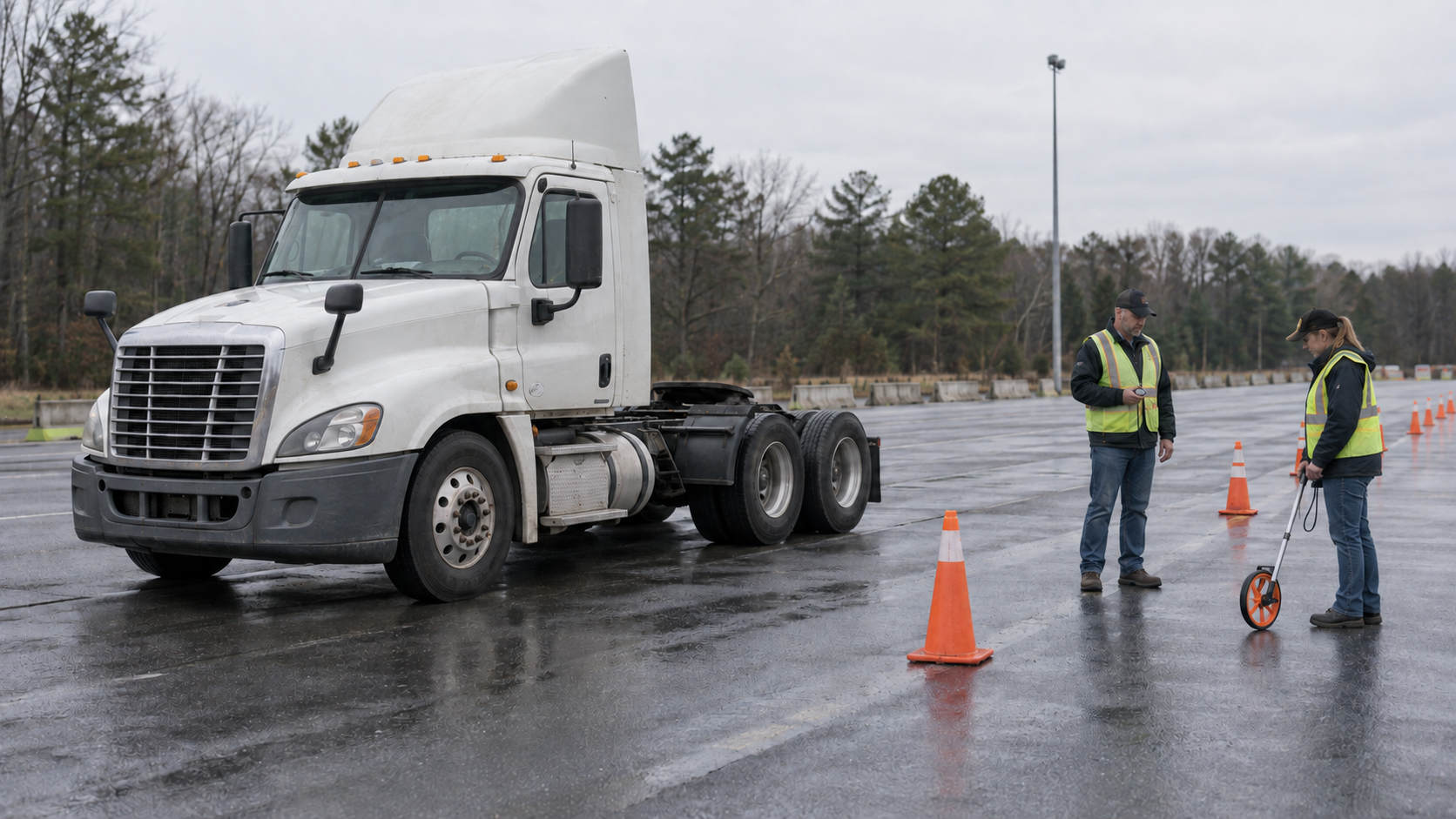
Good space management is active. The interval that was adequate on dry, level pavement can become too short after rain begins, traffic compresses, the road tips downhill or a lighter vehicle moves into the lane. A professional driver keeps asking one question: Can I still stop within the distance I can see and control?
What the federal CDL standards require
49 CFR 383.111 makes speed and space management required CDL knowledge. Applicants must understand stopping distance, space cushions and traffic gaps. The on-road standard in 49 CFR 383.113 requires a driver to maintain a safe following distance according to the road, visibility and vehicle weight.
The federal Class A ELDT curriculum adds traffic, weather, vehicle weight and vehicle length to the factors used to calibrate a safe gap. Federal 49 CFR 392.14 requires extreme caution and reduced speed when rain, snow, ice, fog, dust or smoke make conditions hazardous—and operation must stop when the danger becomes too great.
Those rules intentionally do not create one all-purpose seconds value. They make the driver responsible for matching the gap to the actual vehicle and scene.
Start with the CDL time-gap baseline
The current New York State Commercial Driver’s Manual, Section 2, gives a simple study and driving rule:
- Below 40 mph, allow at least one second for each 10 feet of vehicle length.
- Above 40 mph, use the same calculation and add one second.
| Vehicle length | Below 40 mph | Above 40 mph |
|---|---|---|
| 30 feet | At least 3 seconds | At least 4 seconds |
| 40 feet | At least 4 seconds | At least 5 seconds |
| 60 feet | At least 6 seconds | At least 7 seconds |
Treat these values as a starting point, not a guarantee. The manual also says slippery roads require much more stopping space. A carrier, State rule, examiner or vehicle procedure may demand a larger margin.
Measure the interval without guessing truck lengths
- Choose a fixed object. Use a bridge shadow, signpost, pavement patch or another point that will not move.
- Watch the lead vehicle pass it. Begin counting when the rear of that vehicle clears the object.
- Count evenly. Use a steady one-second cadence until the front of your truck reaches the same point.
- Compare and correct. If the interval is short, ease off the accelerator, let the gap grow and measure again.
Seconds work better than a visual guess because the physical distance automatically grows as speed rises. Repeat the check after a merge, lane change, speed increase, crest, curve or change in weather. Avoid staring at the landmark; keep scanning mirrors, traffic and the road ahead while counting.
Know what the gap has to absorb
Stopping space is more than the distance traveled after the brakes apply. The driver first has to detect the hazard, understand it and react. An air-brake system then needs time to transmit the brake application before the vehicle begins sustained deceleration. Actual braking performance changes with speed, load, grade, traction, tire condition, brake condition and heat.
This is why a gap that merely prevents contact during gentle traffic flow is not enough. It must leave room for an unexpected hard stop by a smaller vehicle, debris appearing from beneath that vehicle or a queue hidden beyond a curve. For the related visual routine, review ProntoCDL’s defensive-driving guide.
Conditions that call for more space
| Condition | Why the baseline can fail | Driver response |
|---|---|---|
| Rain, snow, ice or standing water | Traction and visibility fall; spray can hide brake lights and road hazards | Reduce speed early, open a much larger gap and stop if safe control is doubtful |
| Fog, darkness, glare or smoke | Hazards are detected later and the visible stopping area shrinks | Create more time, use the correct lights and never outrun useful visibility |
| Downgrade or heavy load | Gravity adds speed and the braking system must manage more energy | Select a safe speed and gear before the descent and preserve extra room |
| Work zone or queue | Traffic may stop abruptly while lanes narrow or shift | Scan far ahead, avoid packs and keep a gap that protects workers and traffic |
| Lead vehicle blocks the view | You cannot see brake lights or hazards farther ahead | Drop back until the sight line and escape options improve |
| Uncertain tires or brakes | A safety defect makes stopping performance unreliable | Do not compensate by guessing at a larger gap; stop and resolve the defect |
Use the dedicated ProntoCDL guides for night driving, work zones, mountain downgrades and tire inspection to practice those adjustments in context.
When another vehicle takes the gap
A safe space cushion attracts merging traffic. That does not mean it failed. It means the driver must rebuild it without adding a second hazard.
- Keep the truck stable in its lane and check mirrors.
- Release the accelerator smoothly unless the developing hazard requires stronger action.
- Let the new lead vehicle move away; do not follow closely to “hold” the space.
- Recount the interval once the traffic pattern settles.
- If a lane change becomes appropriate, use the full mirror-signal-recheck sequence in the CDL lane-change guide.
Abrupt braking can surprise a vehicle following behind, while an angry lane change can trade a short front gap for a blind-area conflict. The calm response is usually a small speed reduction that recreates time.
Manage a tailgater by protecting the space ahead
You cannot control the rear driver, but you can reduce the chance that you will need a sudden stop. The current CDL manual advises gradual speed changes, early signaling and a larger space cushion ahead. Stay in the appropriate lane when practical and do not speed up, flash the brakes or use other tricks.
Continue normal mirror checks without fixating on the tailgater. If a safe opportunity allows the vehicle to pass, cooperate. Your front margin is the part of the problem you can directly manage.
Use technology as a cross-check, not a substitute
Some tractors display a following-time estimate or use adaptive cruise control and forward-collision warnings. These can support awareness, but sensors can be obscured and systems have operating limits. They do not know every road, load, weather or work-zone detail as well as an attentive driver should.
Know what the display measures, keep sensors maintained and intervene early when the truck’s target gap is not appropriate. A warning that activates after the space has disappeared is not a space-management plan.
A safe closed-course practice drill
- Park the training vehicle in a closed yard and verify its overall length from reliable vehicle information.
- Use cones to mark a reference line and a separate observation position—never place a trainee in a live travel lane.
- Have an instructor demonstrate the fixed-object count at low training speed with ample room.
- Repeat at approved speeds while the trainee states the target interval and actual count aloud.
- Practice rebuilding the gap through accelerator release, not an emergency stop.
- Debrief how rain, darkness, grades, load and traffic would change the target.
Do not simulate cut-ins, panic stops or close following on a public road. Connect the drill to the Class A ELDT guide and reinforce the underlying knowledge in ProntoCDL’s free CDL practice center.
Practical takeaways
- Use seconds and a fixed landmark; do not guess the gap in truck lengths.
- Learn the CDL-manual baseline, then add space for the actual vehicle and conditions.
- Recheck the interval after every meaningful speed, traffic, grade or weather change.
- When a vehicle cuts in, stay stable, ease off and rebuild—never retaliate.
- When tailgated, protect more space ahead and make every speed change gradual.
- Reduce speed before a downgrade, low-visibility area, work zone or traffic queue.
- Never use extra following distance to excuse unsafe tires, brakes or visibility equipment.
- Treat driver-assistance systems as tools; the space decision remains the driver’s.
CDL following-distance FAQ
Is there one federal following-distance number for every CDL driver?
No single number fits every commercial vehicle and condition. Federal CDL standards require drivers to maintain a safe following distance based on factors such as road condition, visibility and vehicle weight. The familiar seconds-by-vehicle-length method is a practical CDL-manual baseline, not permission to ignore weather, traffic, grades, equipment condition or a stricter carrier rule.
How do I measure following distance in seconds?
Choose a fixed landmark ahead. When the rear of the vehicle in front passes it, begin counting seconds. Stop when the front of your truck reaches the same landmark. If the count is shorter than your target interval, ease off the accelerator and measure again after the gap opens.
What should I do when a car cuts into my following gap?
Stay composed, check the traffic around you and smoothly release the accelerator to rebuild space. Avoid retaliatory following, abrupt braking that is not required by the hazard or an unplanned lane change. Recount the interval once traffic stabilizes.
How much following distance should I add in rain or snow?
There is no safe universal add-on for every storm. The current CDL manual says slippery roads require much more stopping space, while federal rules require extreme caution and lower speed in adverse conditions. Increase the interval enough for the surface, visibility, traffic, grade and vehicle, and stop operating when conditions become too dangerous.
Does adaptive cruise control replace the driver’s following-distance decision?
No. Driver-assistance features have limits and can react differently to stopped traffic, sharp curves, weather, blocked sensors or vehicles cutting in. The driver remains responsible for speed, space, observation and intervention. Follow the vehicle and carrier instructions without treating the system as an autopilot.
Why can a loaded truck need a larger space cushion?
Vehicle weight is one of the conditions federal CDL standards tell drivers to consider. A heavy combination also changes acceleration, downgrade speed control and the energy the brakes must manage. Load, brake adjustment, tires, road surface, grade and speed work together, so the driver must preserve a margin appropriate to the actual vehicle.
Make space before you need it.
Measure the interval, adjust it to the scene and rebuild it calmly whenever traffic changes.
Start free CDL practice