
CDL Restrictions Guide: E, L, Z, O, M, N, K and V
A CDL class describes the broad vehicle group a driver may operate. Restriction codes narrow that authority. The transmission, brake system, coupling type and passenger-vehicle group used for the skills test can follow a driver onto the license, while K and V reflect operating territory or medical status.
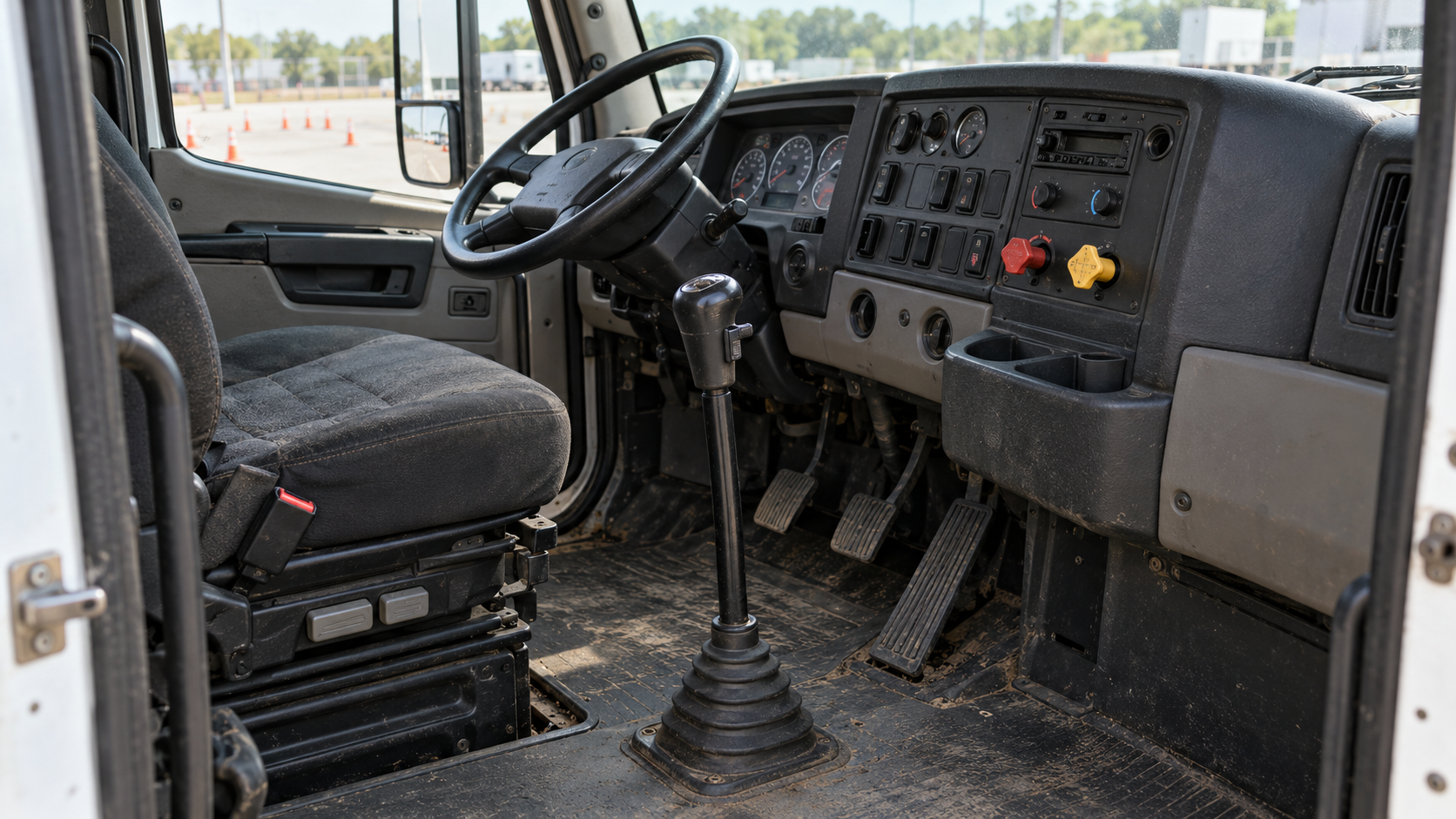
A Class A license does not automatically authorize every Class A vehicle. A driver who tests in an automatic straight truck and pintle-hook combination may earn the class while still being barred from manual-transmission CMVs or fifth-wheel tractor-trailers. Passenger applicants can face a similar mismatch when the test bus is smaller than the vehicle group required for the intended job.
The most effective restriction strategy starts before training: identify the job, inspect the planned test vehicle and decide whether its equipment matches the authority you want printed on the CDL.
The federal standardized CDL restriction codes
49 CFR 383.153 establishes the standardized codes that States place on CDL documents. A State may add other jurisdiction-specific restrictions, but it must explain those additional codes on the front or back of the license.
| Code | Federal meaning | Common reason it appears |
|---|---|---|
| E | No manual-transmission-equipped CMV. | The applicant took the skills test in an automatic-transmission vehicle. |
| L | No air-brake-equipped CMV. | The applicant did not qualify on the air-brake knowledge component or tested in a vehicle without air brakes. |
| Z | No full-air-brake-equipped CMV. | The applicant tested in a vehicle with air-over-hydraulic brakes. |
| O | No tractor-trailer CMV. | A Class A combination test used a pintle hook or another non-fifth-wheel connection. |
| M | No Class A passenger vehicle. | The passenger skills test used a Group B passenger vehicle. |
| N | No Class A or B passenger vehicle. | The passenger skills test used a Group C passenger vehicle. |
| K | Intrastate only. | The driver is limited to operating within the issuing State. |
| V | Medical variance. | The driver has a federally recognized medical exemption, Skill Performance Evaluation certificate or other medical variance recorded in CDLIS. |
E restriction: no manual-transmission CMV
Under 49 CFR 383.95, a driver who performs the skills test in a vehicle equipped with an automatic transmission must receive a restriction against operating a manual-transmission CMV. For this rule, “automatic” includes any transmission other than the federal definition of a manual transmission.
The practical question is not whether automatic trucks are common. It is whether a future employer operates a vehicle the restriction excludes. Local delivery, refuse, construction, towing and specialized fleets may still use manual equipment. If that work matters, train and test in a qualifying manual vehicle from the beginning or plan a later State removal test.
Manual preparation involves more than moving the shifter. The federal skills standard requires applicants to shift as required and select an appropriate gear for speed and highway conditions. Training should cover coordinated clutch use, starting, upshifting, downshifting, stopping, turns, grades and avoiding improper gear changes.
L and Z restrictions: two different air-brake limits
The L restriction is the broader limit. It means the driver may not operate any air-brake-equipped CMV. Federal rules require it when the applicant fails the air-brake knowledge component or performs the skills test in a vehicle without air brakes. For restriction purposes, an air brake includes a system operating fully or partially on the air-brake principle.
The Z restriction is narrower. It results when the skills test vehicle uses air-over-hydraulic brakes. The driver is restricted from full-air-brake CMVs, even though the tested vehicle uses air pressure for part of its braking system.
Before the test, identify the actual brake architecture—not simply whether the dashboard has an air-pressure gauge. Use ProntoCDL’s air-brake test guide and air-brake component inspection to review the controls, pressure checks and hardware the applicant must understand.
O restriction: Class A without fifth-wheel tractor-trailer authority
A Class A combination can be connected by equipment other than a fifth wheel. If the skills-test power unit and towed unit use a pintle hook or another non-fifth-wheel connection, federal rules require the O restriction. The driver may not operate a tractor-trailer combination connected by a fifth wheel that requires a Class A CDL.
This matters because many over-the-road, regional and local freight jobs use conventional fifth-wheel tractor-trailers. A Class A license with O may satisfy the weight classification while still excluding the equipment used by the employer.
Ask the school for the exact test combination. A vague phrase such as “Class A truck” does not answer the coupling question. If fifth-wheel work is the goal, practice the complete inspection and coupling sequence covered in the fifth-wheel coupling guide.
M and N restrictions: passenger vehicle group matters
The P endorsement is not the whole passenger qualification. The group of bus used for the skills test controls the size of passenger vehicle the driver may operate:
- M restriction: the P applicant tested in a Group B passenger vehicle and may not operate a passenger vehicle requiring a Class A CDL.
- N restriction: the P applicant tested in a Group C passenger vehicle and may not operate a passenger vehicle requiring a Class A or B CDL.
Do not confuse the N passenger restriction with the N tank-vehicle endorsement. Federal license formatting uses N in both systems, so the endorsement and restriction fields—and their printed explanations—must be read separately.
A candidate preparing for transit, motorcoach or school-bus work should match the vehicle group to the employer’s fleet before taking the test. Review the passenger and school-bus endorsement guide for the P-versus-S distinction, ELDT requirements and CLP passenger limits.
K restriction: intrastate-only operation
K means the CDL holder is restricted to intrastate commerce. “Intrastate” is not determined only by whether the truck crosses a State line on a particular trip; the nature and routing of the commerce can matter. Drivers should rely on the issuing State and carrier compliance team for classification rather than guessing from the day’s route.
The code may reflect the driver’s self-certification or qualification status. A person planning interstate work should resolve the correct operating category, medical qualification and State record before accepting dispatch. ProntoCDL’s interstate self-certification guide explains the four certification categories and how medical requirements fit.
V restriction: medical variance on the driver record
V indicates that the driver has a medical variance recorded in the Commercial Driver’s License Information System. The CDL restriction points to additional medical information; it does not describe the condition on the license.
Federal rules also note that, under the United States–Canada agreement referenced in the medical qualification regulations, a driver with the V restriction is restricted from operating a CMV in the other country. The driver should carry any documents required by the variance and monitor renewal dates independently from the CDL expiration date.
Use the medical-card and electronic-reporting guide to plan renewals and confirm that the State CDL record reflects the current medical status.
The test vehicle can shape an entire job search
Restriction planning belongs in the enrollment conversation, not the final test-day checklist. Before training begins, compare the school’s vehicle with the intended job:
| Career target | Test-vehicle feature to confirm | Restriction risk |
|---|---|---|
| General tractor-trailer freight | Class A fifth-wheel tractor-trailer; manual transmission if manual authority is needed; full air brakes. | E, L, Z or O. |
| Transit or large school bus | Passenger vehicle group that matches the fleet, correct P/S path and required brake system. | M, N, L or Z. |
| Construction or vocational fleet | Transmission and brake system used by target employers. | E, L or Z. |
| Interstate carrier | Interstate self-certification and medical qualification. | K or V-related operating limits. |
How restriction removal usually works
Federal rules define when restrictions must be imposed, while the issuing State administers the removal transaction. Contact the State Driver Licensing Agency before renting a vehicle or scheduling a test. Ask which permit, knowledge test, inspection, basic-control or road-test segments apply.
- Read the license exactly: list every endorsement and restriction separately.
- Define the authority needed: identify the employer’s transmission, brake system, coupling and passenger group.
- Confirm the State procedure: obtain the current testing, permit, document and fee requirements.
- Use a qualifying vehicle: it must correct the equipment limitation that created the restriction.
- Practice the complete test: do not prepare only the single feature associated with the code.
- Verify the new CDL: check the class, endorsements and restrictions before leaving the licensing transaction.
Removing a restriction is not itself listed as a separate federal ELDT trigger. However, if the transaction also involves a first Class A or B CDL, a Class B-to-A upgrade, or a first P, S or H endorsement, ELDT may apply. Read the ELDT hours and proficiency guide and confirm the exact transaction with the State.
Common restriction-planning mistakes
- Choosing the easiest available test vehicle without comparing it with the intended job.
- Assuming every Class A license permits fifth-wheel tractor-trailer operation.
- Treating air-over-hydraulic brakes as equivalent to a full-air system.
- Reading N as a tanker endorsement without checking whether it appears in the restriction field.
- Believing a K restriction permits interstate work as long as the truck stays inside the State that day.
- Waiting until employer orientation to discover an equipment restriction.
- Assuming one State’s removal procedure applies nationwide.
Practical takeaways
- CDL class, endorsements and restrictions are three separate parts of operating authority.
- E, L, Z, O, M and N are strongly influenced by the equipment used for the skills test.
- K limits operation to intrastate commerce; V identifies a medical variance on the driver record.
- Inspect the planned test vehicle before enrolling or scheduling: transmission, brake system, coupling and passenger group all matter.
- Match the license to the job you want, not merely the vehicle that is easiest to test in.
- Use the issuing State’s current procedure for removal; federal rules do not create one national retest appointment process.
- After any transaction, inspect the newly issued CDL for the correct class, endorsements and restrictions.
CDL restrictions FAQ
What does an E restriction mean on a CDL?
E means the driver may not operate a commercial motor vehicle equipped with a manual transmission. It is placed on the CDL when the applicant performs the skills test in a vehicle with an automatic transmission, as that term is defined in the federal CDL rule.
What is the difference between L and Z restrictions?
L prohibits operating any air-brake-equipped CMV. Z prohibits operating a CMV with a full-air-brake system but allows operation within the air-over-hydraulic limitation. The test vehicle and the air-brake knowledge component determine which restriction applies.
Can a Class A driver have an O restriction?
Yes. O means no tractor-trailer CMV. It applies when a Class A applicant takes the skills test in a combination vehicle connected by a pintle hook or another non-fifth-wheel connection rather than a qualifying fifth-wheel tractor-trailer.
Why can N appear as both an endorsement and a restriction?
The location and description on the license matter. N is the standardized tank-vehicle endorsement, but N is also the standardized restriction meaning no Class A or B passenger vehicle. Read the endorsement and restriction fields separately.
Does removing a CDL restriction require ELDT?
Restriction removal by itself is not listed as a separate federal ELDT trigger. ELDT applies to specified first-time Class A or B licenses, a Class B-to-A upgrade, and first-time P, S or H endorsements. A removal transaction may still overlap one of those triggers, and the State may impose additional training or testing requirements.
How do I remove a CDL restriction?
Start with the issuing State licensing agency. The usual path is to meet any knowledge, medical or self-certification requirement and, for an equipment restriction, pass the required test in a properly equipped vehicle. Procedures, permit needs, fees and test segments vary by State.
Choose the test vehicle for the job you want.
Confirm the transmission, brakes, coupling and vehicle group before test day—then build the knowledge and control skills to operate it safely.
Start free CDL practice