
CDL Learner's Permit Rules: Supervision & Restrictions
A commercial learner's permit creates a supervised path to CDL driving experience—it is not permission to operate alone. The vehicle, supervising driver, seating position, occupants, cargo and test calendar must all fit the permit rules.
49 CFR 383.25 defines the federal minimum conditions under which a CLP is treated as a valid CDL for behind-the-wheel training on public roads or highways. The rule ties together direct supervision, the learner's underlying license, knowledge testing, age, endorsements, cargo restrictions, permit duration and the skills-test waiting period. Use this guide with ProntoCDL's ELDT readiness checklist, ELDT hours and proficiency guide and CDL restrictions guide.
What a CLP actually authorizes
A CLP is a training credential. On a public road or highway, it is considered valid for behind-the-wheel training only when every minimum condition in section 383.25 is satisfied. That means a learner cannot separate the permit from the supervisor, vehicle group, required endorsements or trip authorization.
The CLP holder must also carry a valid noncommercial driver's license issued by the same jurisdiction that issued the CLP. The learner must be at least 18 and must have passed the knowledge testing required for the commercial vehicle being operated or expected to be operated. States may add application, document, scheduling or intrastate requirements, so the federal rule is the starting point rather than the only checklist.
The supervising CDL holder: five checks
- Valid CDL. Confirm the supervisor's credential is valid, current and not disqualified.
- Correct vehicle group. The supervisor must hold the CDL group needed for the CMV being driven. A credential that covers only a lower vehicle group is not enough.
- Required endorsements. The supervisor must have the endorsements necessary for that CMV and operation. Compare the vehicle and trip with the actual credential.
- Authorized for the trip. The supervisor must otherwise be legally authorized to operate the CMV for that trip. A matching class alone does not cure a restriction, disqualification or other operating limit.
- Direct supervision from the required seat. The supervisor must remain physically present, able to observe the learner and positioned as the rule requires.
Where the supervisor must sit
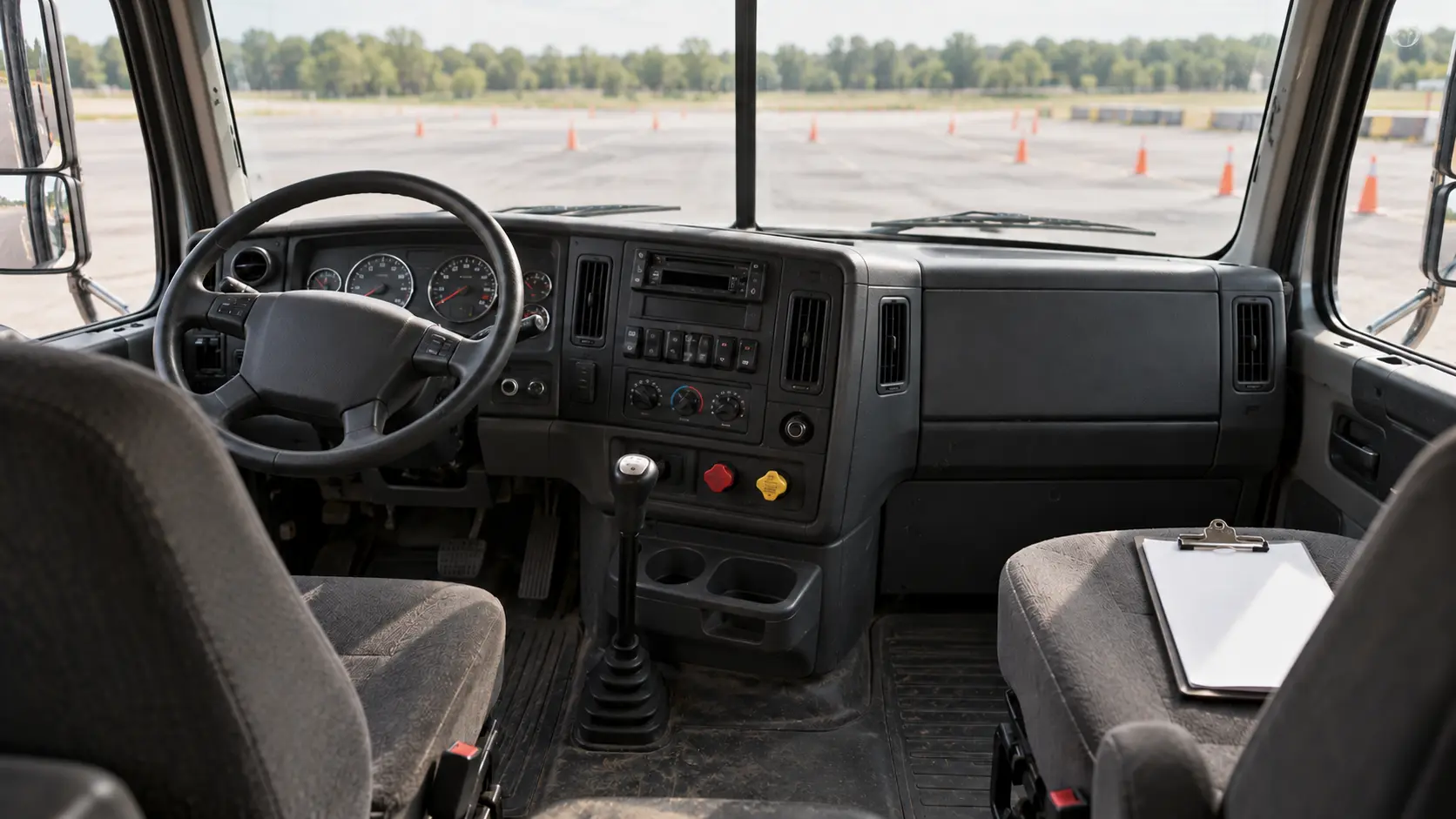
In a truck or truck-tractor, the CDL holder must remain in the front seat next to the CLP holder. Riding in a sleeper berth, following in another vehicle, monitoring by phone or waiting at the next stop does not satisfy the direct-supervision rule.
Passenger vehicles have a specific alternative because their seating layout differs. The CDL holder may be directly behind the driver or in the first row behind the driver, but must keep the learner under observation and direct supervision. The rule does not permit a supervisor to sit anywhere in the vehicle simply because the driver is visible on a camera.
Endorsement and load limits
| CLP training type | Federal condition | Not permitted |
|---|---|---|
| Passenger (P) | Pass the P knowledge test; endorsement is class specific | Ordinary passengers outside the limited training, testing and audit group |
| School bus (S) | Pass the S knowledge test and comply with supervised training | School-bus passengers outside the limited training, testing and audit group |
| Tank vehicle (N) | Pass the N knowledge test and operate only an empty tank vehicle | A loaded tank or an unpurged tank that previously contained hazardous material |
| Hazardous materials | No CLP operation transporting hazardous materials | Any CMV movement carrying hazardous materials as defined in section 383.5 |
| Other federal endorsements | Not placed on a CLP under section 383.25 | Using the CLP as authorization for another federal endorsement |
Passenger and school-bus training is not regular service
A P-endorsed CLP holder may carry only the accompanying CDL holder, other trainees, test examiners and Federal or State auditors and inspectors. The S-endorsed CLP holder has the same limited categories while operating a school bus. Students, customers, tour groups and ordinary riders are not permitted practice passengers.
The P endorsement is class specific, so the vehicle group matters. Plan training in the same class of passenger vehicle that matches the intended test and license. Review ProntoCDL's passenger and school-bus endorsement guide before selecting the vehicle.
Tank vehicles and hazardous materials
An N-endorsed CLP holder may operate only an empty tank vehicle. If the tank previously carried hazardous material, it must be purged of residue before the learner operates it. “Empty” and “safe for CLP practice” are therefore not always the same condition.
A CLP holder may not operate a CMV transporting hazardous materials. Do not treat a shipping-paper description, placard decision or small quantity as permission for practice. Confirm the tank condition and load status before dispatch, and review the ProntoCDL tanker endorsement guide for the separate knowledge and vehicle-control topics.
The 14-day wait and ELDT are separate gates
The CLP holder is not eligible to take the CDL skills test during the first 14 days after initial permit issuance. The rule establishes a waiting period; it does not guarantee an appointment on the next day. State counting methods, appointment availability and document checks still control the actual test date.
ELDT is a separate requirement. Under 49 CFR 383.71 and 49 CFR 380.609, covered first-time Class A or B applicants, Class B-to-A upgrades and first-time P or S applicants must complete applicable training from a provider listed on the Training Provider Registry before the relevant skills test. First-time H applicants complete applicable ELDT before the H knowledge test.
A learner may use the waiting period for lawful supervised practice and ELDT completion, but must satisfy both gates. Holding a CLP for 14 days does not create an ELDT completion record, and completing ELDT does not shorten the federal waiting period.
CLP validity: understand the one-year federal ceiling
A CLP may be valid for no more than one year from its initial issuance date without retaking the general and endorsement knowledge tests. A State may issue a permit for less than one year and renew it, but the permit cannot remain valid beyond one year from that original date under this provision without the required retesting.
Do not assume a renewal resets every federal clock or preserves every state appointment. Track the initial issue date, printed expiration date, ELDT status, medical qualification when applicable and state scheduling rules in one place.
A practical pre-drive CLP check
- Match the learner's documents. Confirm the CLP and underlying driver's license are valid and issued by the same jurisdiction.
- Match the vehicle. Compare the CMV group, brake system, transmission, coupling and endorsements with the training objective.
- Match the supervisor. Verify CDL class, endorsements, restrictions, validity and authorization for this trip.
- Check occupants and cargo. Apply P, S, N and hazardous-material limits before the vehicle moves.
- Confirm the seat. The supervisor must occupy the required adjacent or passenger-vehicle observation position.
- Plan the route and lesson. Choose a route appropriate for the learner's current skill and the vehicle, and establish clear communication before entering traffic.
- Document the session. Follow the training provider's and carrier's recordkeeping process without treating a practice log as a substitute for the CLP rules.
Common planning mistakes
- Assuming any experienced CDL driver may supervise any class or endorsement.
- Letting the supervisor sit in the sleeper berth of a tractor.
- Carrying ordinary passengers during P or S permit practice.
- Calling a residue-containing tank “empty” without confirming it was purged.
- Scheduling the skills test from a guessed day count instead of the licensing agency's eligible date.
- Confusing 14 days of permit age with completed ELDT.
- Assuming a short-term CLP renewal automatically extends federal validity beyond one year from initial issuance.
Practical takeaways
- A CLP authorizes supervised training—not solo commercial driving on public roads.
- Match the supervisor's CDL group, endorsements and trip authority to the actual vehicle and operation.
- Keep the supervisor in the front seat next to the learner, except for the specific passenger-vehicle seating alternative.
- Apply passenger, school-bus, tank and hazardous-material restrictions before dispatch.
- Track the initial issue date, printed expiration date, 14-day wait and ELDT completion separately.
- Use only a registered training provider when ELDT applies.
- Confirm state procedures and the exact eligible test date with the licensing agency.
Commercial learner's permit FAQ
Can a CLP holder drive a commercial vehicle alone?
No on public roads or highways. The CLP holder must be under direct supervision of a valid CDL holder who has the proper vehicle group and endorsements, is authorized for that trip and occupies the position required by 49 CFR 383.25.
Where must the supervising CDL holder sit?
In a truck or truck-tractor, the supervisor must be physically present in the front seat next to the CLP holder. In a passenger vehicle, the supervisor may sit directly behind the driver or in the first row behind the driver, while keeping the learner under observation and direct supervision.
Can a CLP holder carry regular passengers?
A CLP holder with a P endorsement may not carry ordinary passengers. Federal rules limit occupants to auditors or inspectors, test examiners, other trainees and the accompanying CDL holder. The school-bus restriction is equivalent for a CLP holder with an S endorsement.
Can a CLP holder practice in a loaded tanker?
A CLP holder with an N endorsement may operate only an empty tank vehicle. A tank that previously contained hazardous material is prohibited unless it has been purged of residue. The CLP holder may not transport hazardous materials.
How long must a driver hold a CLP before the CDL skills test?
Federal law makes the CLP holder ineligible for the CDL skills test during the first 14 days after initial issuance. State scheduling and document rules still apply, so confirm the actual eligible test date with the licensing agency rather than guessing how it counts days.
Does the 14-day wait replace ELDT?
No. They are separate requirements. Covered first-time Class A or B applicants, Class B-to-A upgrades and first-time P or S applicants must complete applicable ELDT from a registered provider before the relevant skills test. First-time H applicants complete applicable ELDT before the H knowledge test.
Match the permit, supervisor and trip before moving.
A lawful practice session begins with the correct credentials, seating position, vehicle group, occupants and cargo—not just an available truck.
Start free CDL practice