
CDL Hazard Perception Guide: Visual Search and Escape Space
Hazard perception is not simply noticing danger. It is a repeatable cycle: scan far enough ahead, gather the side and rear picture, recognize clues, predict what may change and create a safe response before the situation demands an emergency maneuver.
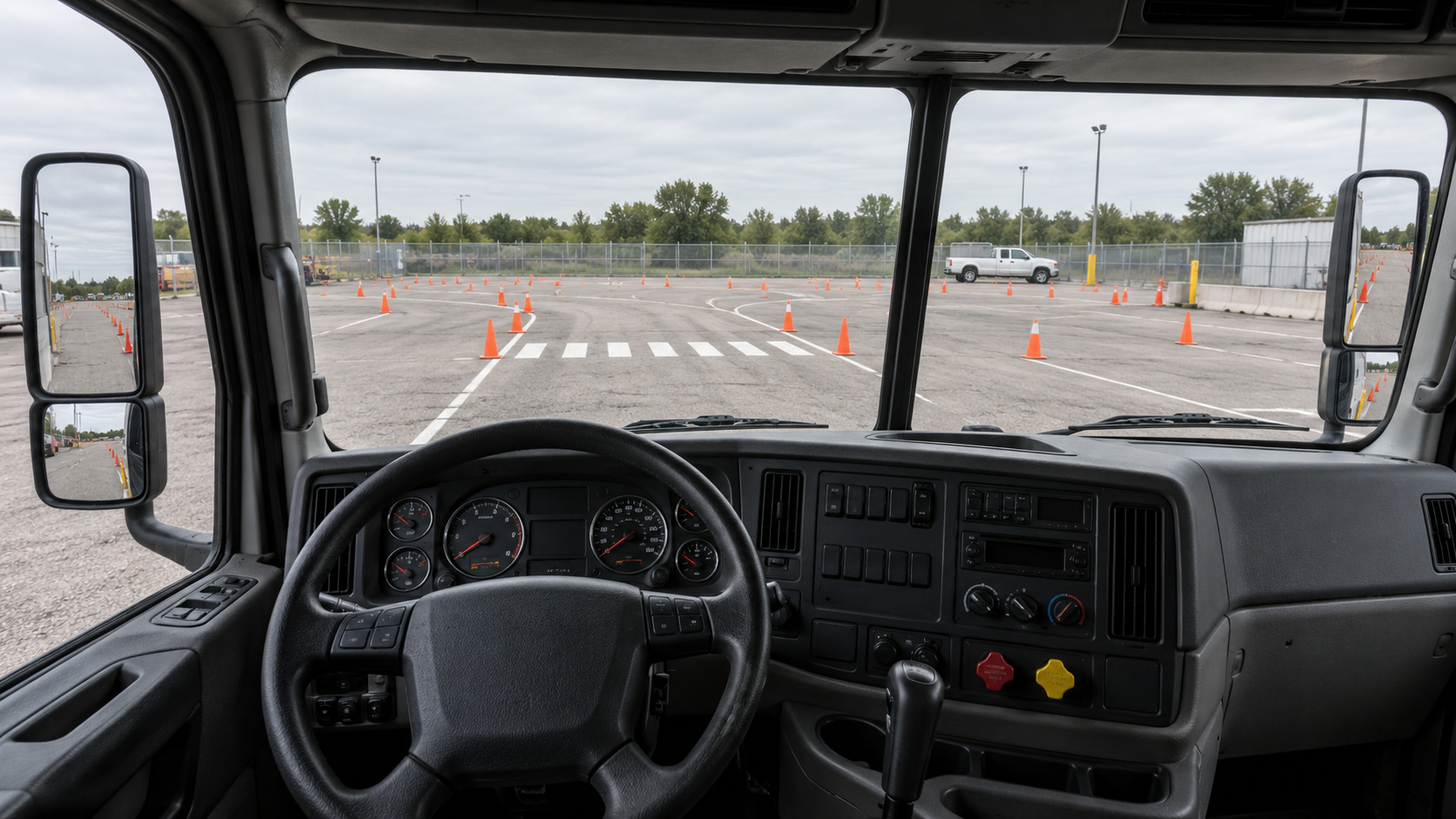
A commercial vehicle needs more time and space to slow, stop, turn or change lanes than a passenger car. That makes early information a control input. A brake light a quarter mile ahead, a pedestrian whose attention is elsewhere or a shoulder that disappears near a work zone can change the safest lane and speed long before the truck reaches the conflict.
The goal is not to predict every mistake. It is to notice clues early enough that the driver still has several calm options. Once only one option remains, a manageable hazard is close to becoming an emergency.
Hazard perception is required CDL knowledge
49 CFR 383.111 requires every CMV operator to understand visual search, including seeing ahead and to the sides, using mirrors and seeing to the rear. The same federal standard separately requires knowledge of hazard perception and the clues created by road characteristics and other road users.
The federal Class A ELDT curriculum turns that knowledge into training. Its visual-search unit includes potential hazards, critical objects and distracted road users. Its hazard-perception unit requires training in recognizing road conditions and people who may threaten the combination vehicle, then choosing adjustments that can reduce or neutralize the danger.
Use a moving scan, not a fixed stare
The current New York State Commercial Driver’s Manual, Section 2, teaches looking at least 12 to 15 seconds ahead. At lower speeds that is about one block; at highway speeds it is about a quarter mile. The manual also makes an important distinction: looking far ahead does not mean ignoring what is close. Good drivers move their attention between near and far areas.
FMCSA’s truck-and-bus driver guidance similarly advises scanning about 15 seconds ahead and checking mirrors every 8 to 10 seconds. Those figures are practical guidance, not a mechanical countdown. The driver must shorten or expand the scan cycle as intersections, curves, lane changes, work zones and traffic movement demand.
| Scan zone | What to collect | Decision it supports |
|---|---|---|
| Far scene | Traffic waves, signals, lane closures, grade, curves, overhead limits and weather. | Early speed or lane choice. |
| Middle distance | Brake lights, merging traffic, pedestrians, driveways and narrowing space. | Following-space and escape-route adjustment. |
| Immediate path | Lane position, pavement defects, debris, clearance and vulnerable road users. | Precise vehicle placement. |
| Mirrors and sides | Vehicles entering blind areas, trailer tracking, rear traffic and shrinking gaps. | Whether a speed or direction change remains available. |
| Instruments | Speed, warning lamps, air pressure and other relevant vehicle cues. | Whether the vehicle can execute the plan safely. |
Turn an object into a prediction
Seeing a vehicle is not the same as perceiving a hazard. Hazard perception asks what the vehicle, person or road feature may do next. A car waiting at a driveway is ordinary. Its front wheel beginning to roll, the driver looking away and a small gap opening in traffic are clues that it may enter the lane.
Use a four-part mental callout:
- Clue: What changed? Example: brake lights appear several vehicles ahead.
- Conflict: What could reach the truck’s path? Example: traffic may stop beyond the visible curve.
- Space: Where can the full vehicle safely go? Example: the right shoulder is clear, but the left side is occupied.
- Response: What smooth action buys time? Example: release the accelerator, increase the gap and cover the brake.
This separates recognition from panic. The first response is often a small speed or position change rather than a horn blast, hard brake or sudden lane change.
Road features that create hazard clues
- Intersections and driveways: wheels moving, a driver looking the wrong direction or a vehicle edging over a stop line.
- Curves and hills: sight distance that becomes shorter than the space needed to stop.
- Work zones: lane shifts, reduced shoulders, workers, construction equipment and traffic queues hidden by geometry.
- Road surface: standing water, tire spray, polished ice, loose gravel, potholes or a sharp pavement edge.
- Restricted space: barriers, bridge rails, parked vehicles, narrow lanes and missing escape shoulders.
- Weather transition: the first rain after a dry period, fog banks, crosswind exposure and shaded areas that may freeze first.
Do not wait for a work-zone arrow board or a curve sign to reach the windshield before acting. The work-zone guide, high-wind guide and night-driving guide show how early clues change speed and space decisions in specific environments.
Road users often reveal risk before they enter the lane
People communicate with movement, position and attention. Watch a pedestrian’s head and feet, a bicyclist’s lane position, a car’s front wheel angle and the closing speed of traffic behind. A turn signal is one clue, not a guarantee. The vehicle’s actual path matters more.
- A pedestrian facing away from traffic may step without seeing the truck.
- A delivery vehicle with doors open may hide a worker entering the roadway.
- A driver moving much slower than traffic may be lost, impaired or preparing for an abrupt turn.
- A vehicle trapped beside the trailer may accelerate, brake or merge suddenly when its lane ends.
- Children, workers and people talking near the roadway may have divided attention.
The professional response is to create margin without trying to punish or teach another road user. Reduce speed early, increase following distance, avoid riding beside vehicles and communicate only when it helps others understand the truck’s presence or intended movement.
Preserve an escape route around the entire combination
An escape route is usable space, not an empty patch beside the tractor. It must fit the complete vehicle and remain reachable at the current speed. A shoulder may be blocked by a guardrail, soft ground, a disabled vehicle or a bridge. A left-lane opening may disappear before the trailer clears.
Pair every hazard with a space check: ahead, behind, left, right and overhead. If one side is occupied, create more room ahead so gentle braking remains available. Review ProntoCDL’s following-distance guide and lane-change guide for the timing and mirror sequence that support those choices.
Match speed to what can actually be seen
A driver cannot respond to a hazard hidden beyond the visible road. Before a curve, crest, fog bank, glare zone or traffic queue, reduce speed while there is still a clear stopping path. Do not use the posted maximum as proof that the available sight distance is safe for the loaded vehicle.
Watch for a closing visual gap: objects ahead grow larger faster, brake lights spread across more lanes or the road surface disappears under stopped traffic. Those changes deserve an early accelerator release and a wider following interval. A smooth early reduction also gives following drivers more time to react.
Common visual-search mistakes
- Hood fixation: watching only the lane immediately in front of the bumper.
- Far-scene fixation: seeing the horizon but missing a nearby pedestrian or debris.
- Mirror staring: remaining in one mirror long enough to lose the forward picture.
- Empty-space assumption: treating a blind area as clear because no vehicle was visible a moment ago.
- Signal trust: believing a turn signal instead of monitoring the actual wheel path and speed.
- Object naming: saying “car” or “pedestrian” without predicting how it may affect the truck.
- No response threshold: identifying a hazard but waiting until it becomes an emergency before changing speed or position.
A safe practice progression
- Parked-cab scan: adjust the seat and mirrors, then name the far, middle, near, left, right and rear views without moving.
- Static hazard board: study a road photo for five seconds, cover it and list the developing hazards and open spaces.
- Commentary video: pause before each conflict and state the clue, prediction and first smooth response.
- Closed-course walk: trace a cone route on foot and identify where sight distance or escape space changes.
- Low-speed cab drill: with a qualified instructor, call out critical objects while maintaining precise lane position.
- Public-road coaching: progress only when the instructor can add commentary without disrupting basic vehicle control.
Commentary must remain short. A trainee who is trying to narrate every object can lose attention and control. Call only the critical clue, likely conflict, available space and planned response. Use the Class A ELDT guide and free CDL practice center to reinforce the vocabulary between supervised driving sessions.
Practical takeaways
- Look 12 to 15 seconds ahead while continuing to scan near, far, sides, mirrors and instruments.
- Use the 8-to-10-second mirror check as a rhythm, then add targeted checks whenever the traffic picture changes.
- Convert every important clue into a prediction: what may enter the truck’s path next?
- Identify escape space for the entire commercial vehicle, not only the tractor.
- Respond early with a small speed, gap or position adjustment whenever possible.
- Never assume a signal, eye contact or previously empty blind area guarantees another road user’s action.
- Practice hazard commentary first while parked, then in a controlled environment with a qualified instructor.
CDL hazard perception FAQ
How far ahead should a CDL driver look?
The current CDL manual teaches looking at least 12 to 15 seconds ahead—roughly one block at lower speeds and about a quarter mile at highway speed—while continuing to shift attention between near and far areas. FMCSA driver guidance similarly recommends scanning about 15 seconds ahead.
How often should a commercial driver check mirrors?
FMCSA safety guidance recommends checking mirrors every 8 to 10 seconds to monitor vehicles entering blind areas. Treat that as a scanning rhythm rather than permission to stare at a mirror; traffic, turns, lane changes, braking and changing road conditions may require more frequent targeted checks.
What is the difference between a hazard and an emergency?
A hazard is a road condition or road user that could become dangerous. An emergency exists when immediate action is required. Recognizing the hazard early creates time to reduce speed, change position, communicate or build space before an emergency develops.
Should I watch the road far ahead or the area close to the truck?
Both. A fixed far-ahead stare misses close threats, while watching only the hood area produces late reactions. Move attention through the far scene, the developing middle distance, the immediate path, both mirrors and instrument cues without lingering on one view.
What hazard clues deserve an early response?
Brake lights far ahead, a narrowing lane, workers near traffic, a pedestrian looking away, a vehicle creeping from a driveway, a turn signal that may not match the vehicle path, a blocked shoulder, tire spray, smoke, swaying cargo or an erratic driver all justify more space and a planned response.
How can a CDL trainee practice hazard perception safely?
Use a parked-cab commentary drill, instructor-led video, route diagrams and low-speed closed-course scenarios. Name the clue, predict the possible conflict, identify the escape space and state the first smooth response. Public-road practice belongs with a qualified instructor in a properly controlled training vehicle.
See the change while options remain.
Build a visual-search routine that turns early clues into time, space and controlled decisions.
Start free CDL practice