
CDL Vision Standard & MCSA-5871 Guide
A vision deficiency in one eye does not automatically end an interstate commercial-driving career. Federal rules provide an alternative qualification pathway, but it requires the right eye evaluation, a current MCSA-5871, an annual medical examination and—when applicable—a motor-carrier road test. Knowing which professional makes each decision helps a driver avoid the most common paperwork and scheduling mistakes.
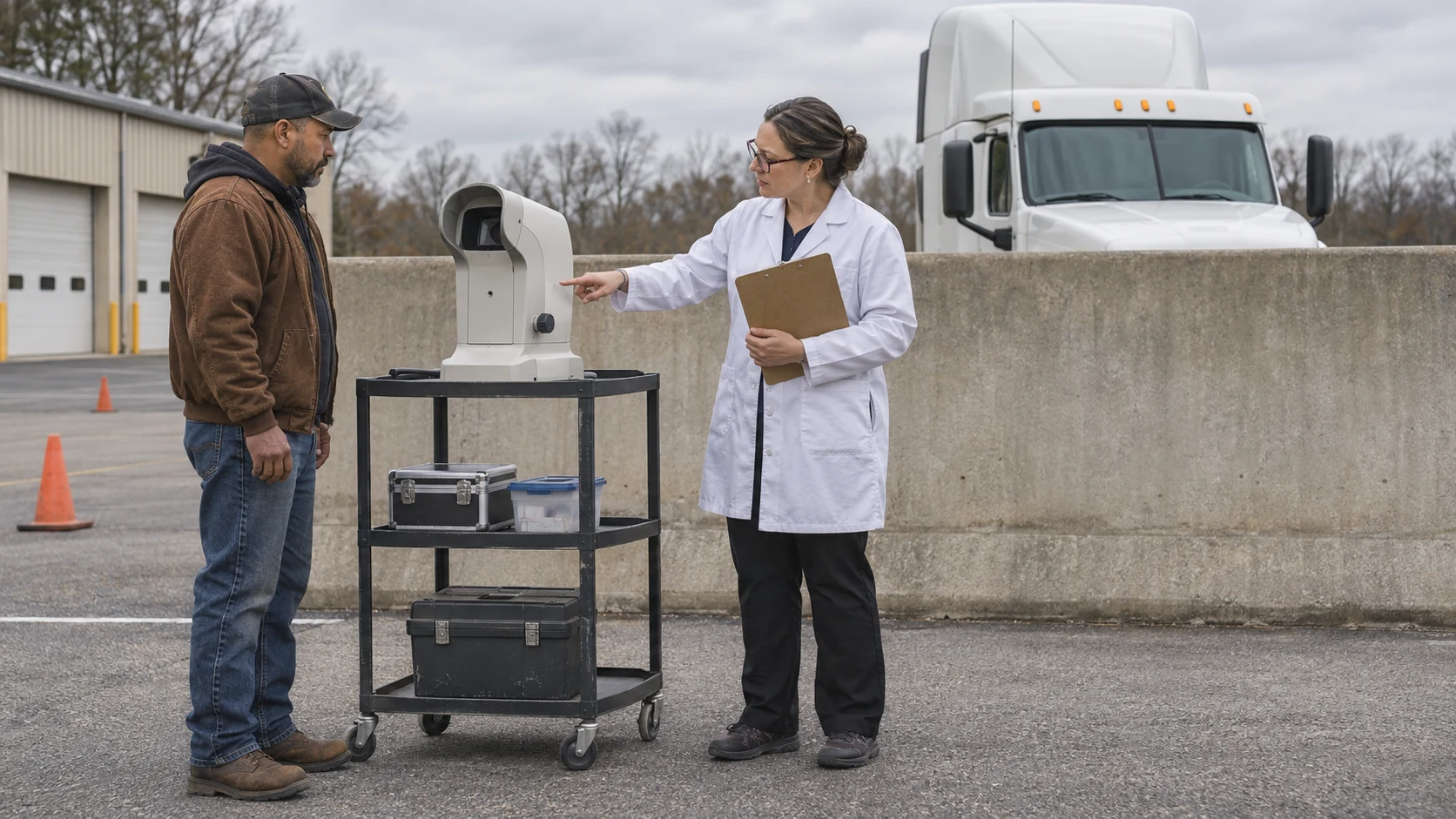
The ordinary federal vision standard appears in 49 CFR 391.41(b)(10). The alternative process is in 49 CFR 391.44. These are federal interstate-CMV rules; a State may use different standards for intrastate-only driving.
Vision is one part of a complete physical-qualification decision. A driver still must meet every other applicable medical standard, maintain the proper CDL or commercial learner's permit, complete any required entry-level driver training and satisfy the motor carrier's qualification process.
Know the ordinary federal vision thresholds
Under the ordinary standard, the driver must have at least 20/40 distant visual acuity in each eye, separately, with or without correction; at least 20/40 binocular distant acuity; a field of vision of at least 70 degrees in the horizontal meridian in each eye; and the ability to recognize the standard red, green and amber colors used by traffic signals and devices.
| Vision item | Ordinary standard | Alternative standard |
|---|---|---|
| Distant acuity | At least 20/40 in each eye and binocularly, with or without correction | At least 20/40 in the better eye, with or without correction |
| Horizontal field | At least 70° in each eye | At least 70° in the better eye |
| Traffic-signal colors | Recognize standard red, green and amber | The same recognition requirement still applies |
| Evaluation form | No MCSA-5871 solely for meeting the ordinary standard | Current MCSA-5871 from an ophthalmologist or optometrist |
| Medical-exam interval | Up to the interval the applicable rules and examiner allow | At least annually; no more than 12 months |
Corrective lenses are permitted. When the driver needs them to qualify, the restriction is recorded on the medical certification and must be followed while driving. The standard is not a test of whether the driver can function without the prescribed correction.
When the alternative standard applies
Section 391.44 is for an individual who does not satisfy, in the worse eye, the corrected distant-acuity standard, the field-of-vision standard or both. It is not a blanket exception from every part of the vision rule. The better eye still must have at least 20/40 distant acuity and at least a 70-degree horizontal field, and the driver still must recognize standard red, green and amber.
The vision deficiency also must be stable, and enough time must have passed since it became stable for the driver to adapt to and compensate for the change. A progressive condition is not automatically treated as stable merely because the driver feels comfortable today. The eye specialist documents the condition and course; the medical examiner uses that information and independent medical judgment to make the qualification decision.
The alternative vision standard replaced FMCSA's former federal vision-exemption program in 2022. A new applicant uses the regulatory process rather than submitting a separate federal vision-exemption application. That change does not convert MCSA-5871 into an exemption letter or guarantee certification.
MCSA-5871 has a specific purpose
The current Vision Evaluation Report, Form MCSA-5871 is completed by a licensed ophthalmologist or licensed optometrist. The form asks for more than a simple eye-chart result. It records:
- uncorrected and corrected distant acuity for each eye;
- the type of correction used;
- formal perimetry results for each eye, using a modality that tests at least 120 degrees horizontally;
- whether the driver recognizes standard red, green and amber traffic-control colors;
- the cause and onset of the monocular vision or other qualifying deficiency;
- progressive eye conditions, severity, treatment and stability; and
- the specialist's opinion about stability, adaptation and how often vision should be reevaluated.
The current form instructs the specialist to attach the formal perimetry test for each eye and to report the field in degrees; “normal” or “full” is not accepted as a substitute. Before leaving the appointment, the driver should confirm that every required page, signature, date and attachment is present.
The eye specialist and medical examiner have different roles
A common mistake is assuming the eye specialist “passes” the driver. The ophthalmologist or optometrist evaluates vision and completes MCSA-5871. A certified medical examiner listed on FMCSA's National Registry receives that report, performs the full federal examination and decides whether the driver is physically qualified. If qualified, the medical examiner issues MCSA-5876.
The medical examiner must consider the specialist's findings, but the decision is independent and includes every applicable physical standard. Medication effects, neurological conditions, cardiovascular health, hearing and limb function do not disappear because the vision pathway is satisfied. ProntoCDL's prescription-medication guide, hearing guide and SPE guide explain related but separate issues.
Use the 45-day examination window correctly
The medical examiner must receive the completed MCSA-5871 and begin the physical-qualification examination no more than 45 calendar days after the ophthalmologist or optometrist signs the report. That window applies to each required examination under the alternative standard.
- Download the current form instead of reusing an old saved copy.
- Schedule the eye evaluation first and the medical examination soon after it.
- Tell the eye office in advance that formal perimetry and attached results are required.
- Check the specialist's signature date and ensure the examiner receives the complete packet.
- Leave enough margin to handle a missing attachment or rescheduled appointment.
- If the examination cannot begin inside 45 days, obtain a newly completed report.
The 45 days do not extend an expiring medical certificate, create a grace period or describe the length of a new certificate. A driver using the alternative standard should track the existing MCSA-5876 expiration separately and begin planning early. The medical-card and NRII guide covers the separate electronic-reporting process.
Annual certification is the federal maximum cycle
A driver qualifying under §391.44 must be medically examined and certified at least annually. A fresh, signed MCSA-5871 is required for each examination, so a certificate issued through this pathway cannot exceed 12 months. The medical examiner may issue a shorter certificate when the findings or monitoring interval warrant closer review.
Do not assume that last year's certification guarantees renewal. Changes in acuity, field, disease progression, treatment, adaptation or another medical condition can affect the new decision. A practical renewal plan includes a reminder for the eye evaluation, a second reminder for the medical examination and a small buffer before the current certificate expires.
Understand the motor-carrier road-test requirement
A driver who is being physically qualified for the first time under the alternative vision standard generally must complete the motor-carrier road test required by 49 CFR 391.31. The sequence matters: first obtain medical qualification, then complete the applicable road test, then operate in interstate commerce.
This is not the same as the State-administered CDL skills test or the ELDT behind-the-wheel curriculum. It is an employer qualification step that evaluates the driver in the type of vehicle the carrier intends the person to operate. ProntoCDL's employer road-test guide explains the test and certificate.
Section 391.44 provides a limited prior-experience exception. The motor carrier must determine and document that the driver held the required license and operated a CMV with the vision deficiency for the preceding three years in the qualifying circumstances described by the rule. A driver should not self-declare the exception. The carrier must obtain and retain the required statement or certification in the driver qualification file.
Prepare for the vision and medical appointments
- Bring current glasses and contact lenses, including a backup pair if used for driving.
- Bring the current MCSA-5871 and identify the medical examiner who will receive it.
- Ask whether the office performs formal perimetry that reaches at least 120 degrees horizontally.
- Bring relevant operative reports, disease history and treatment information.
- Tell the specialist when the deficiency began and when vision became stable.
- Review every page for the specialist's signature, date and complete contact information.
- Confirm that the perimetry printout for each eye is attached.
- Schedule the medical examination to begin within the 45-day window.
- Bring an accurate medication list and requested records to the medical examiner.
- After certification, verify the expiration date and any corrective-lens restriction.
The form contains sensitive medical information. Keep it under the control of authorized people and transfer it through the method the clinics specify. It is not ordinary roadside paperwork and should not be left loose in the cab.
Driving habits still matter after certification
Medical qualification is a threshold, not a substitute for active visual search. A driver adapting to a stable deficiency should use disciplined mirror scans, deliberate head movement, appropriate following distance and extra care in low light, work zones and complex intersections. Review the night-driving guide and visual-search guide for practical routines.
A new or worsening visual symptom should be taken seriously even if the medical certificate has not expired. Stop safely when vision may make continued operation unsafe, follow the carrier's reporting process and obtain appropriate clinical evaluation. A valid card does not authorize driving through an acute impairment.
Practical takeaways
- Use §391.41 for the ordinary standard and §391.44 only when the worse eye fails the specified acuity or field threshold.
- The better eye and traffic-signal color recognition still must meet the federal requirements.
- Have a licensed ophthalmologist or optometrist complete the current MCSA-5871.
- Obtain formal perimetry for both eyes and attach the results.
- Make sure the medical examination begins within 45 days after the specialist signs.
- Expect annual medical certification and prepare a new MCSA-5871 each time.
- Do not confuse the eye specialist's report with MCSA-5876 or with a qualification guarantee.
- Complete the carrier road test when the rule requires it; do not substitute a CDL skills-test result without confirming the federal exception.
- Track corrective-lens restrictions and carry the lenses used to qualify.
- Report material vision changes promptly and never drive while vision is acutely unsafe.
CDL vision standard FAQ
Can a driver with vision in only one eye qualify for interstate CMV operation?
Potentially. A driver who does not meet the ordinary distant-acuity or field-of-vision standard in the worse eye may qualify under 49 CFR 391.44. The better eye must meet the required acuity and field thresholds, the driver must recognize standard traffic-signal colors, the deficiency must be stable, enough time must have passed for adaptation, and the certified medical examiner must find the driver otherwise qualified.
Is MCSA-5871 the driver’s DOT medical certificate?
No. MCSA-5871 is a Vision Evaluation Report completed by a licensed ophthalmologist or optometrist. The certified medical examiner reviews it and makes the federal qualification decision. If qualified, the driver receives a Medical Examiner’s Certificate, Form MCSA-5876.
How long is a signed MCSA-5871 usable?
The medical examiner must receive the completed report and begin the physical-qualification examination no more than 45 calendar days after the ophthalmologist or optometrist signs it. The 45-day window is not the duration of the medical certificate.
How often must a driver using the alternative vision standard renew medical certification?
At least annually. A driver qualifying under 49 CFR 391.44 must bring a newly completed MCSA-5871 to each required examination, so the maximum medical-certificate period is 12 months. A medical examiner may choose a shorter period based on individual findings.
Does every driver using MCSA-5871 need a carrier road test?
A first-time driver qualifying under the alternative vision standard generally must complete the motor-carrier road test in 49 CFR 391.31 after medical certification and before operating in interstate commerce. Section 391.44 contains a limited exception for a driver whose carrier documents at least three years of qualifying prior CMV operation with the same vision deficiency.
Can glasses or contact lenses be used to meet the federal vision standard?
Yes. The acuity thresholds may be met with corrective lenses, and the medical certificate will show the applicable corrective-lens restriction. FMCSA guidance says contact lenses may be acceptable when the driver is adapted to and can tolerate them; bioptic telescopic lenses do not satisfy the standard.
Continue with the medical-card guide, employer road-test guide and driver qualification checklist.