
CDL Night Driving Guide: Vision, Glare and Safe Speed
Night driving changes the amount, quality and timing of the information available to a commercial driver. The professional response is not simply to switch on the headlights. It is to prepare the visibility system, keep stopping distance inside the visible path, manage glare and space, and stop when darkness, weather or fatigue removes the safety margin.
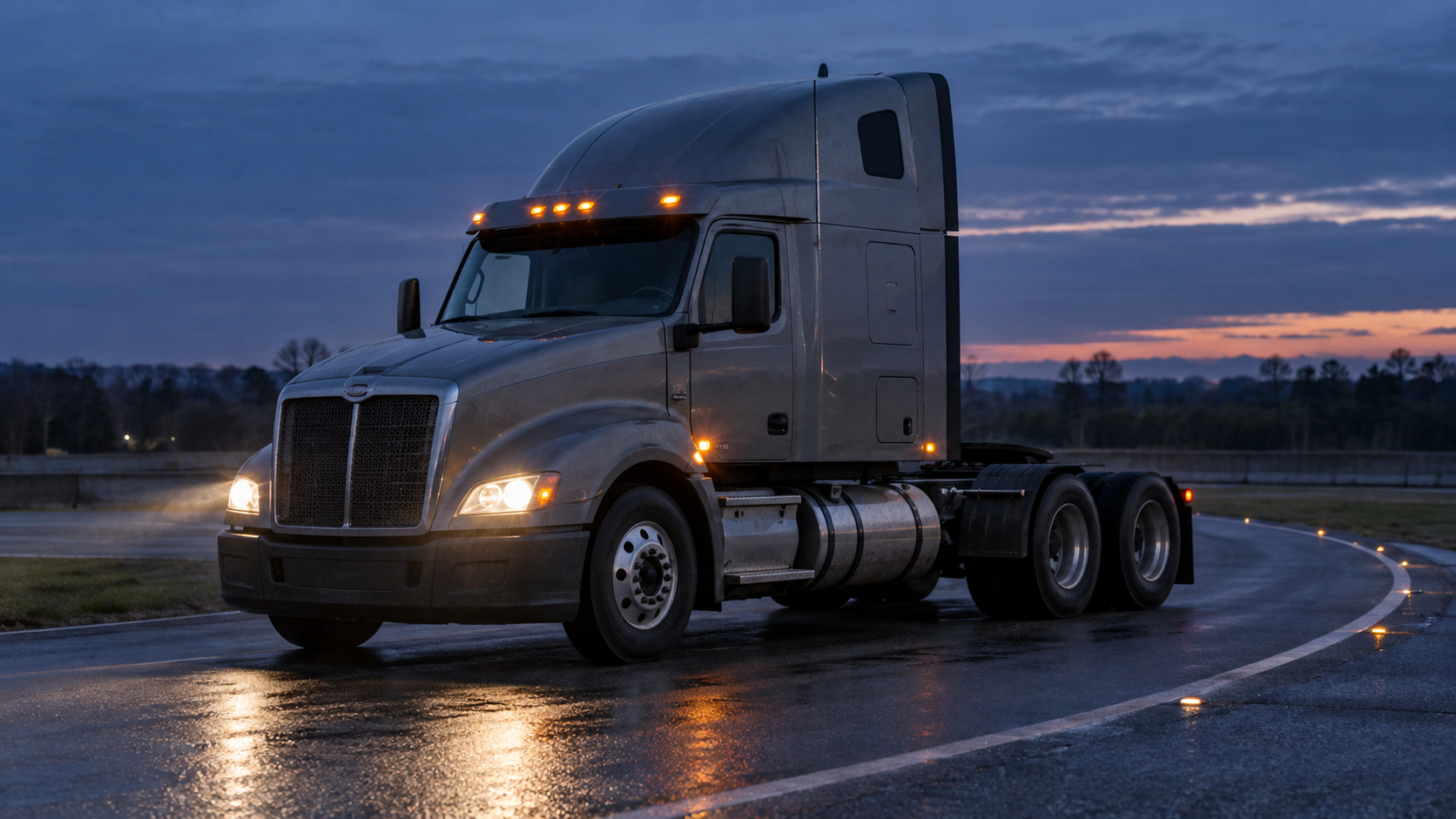
A driver who uses the same speed and scanning rhythm at noon and midnight is accepting less time to recognize hazards. Headlights illuminate only part of the roadway, objects outside the beam can disappear, and glare can reduce useful vision for several seconds. Every night-driving choice should protect time and distance.
Night operation is a federal ELDT topic
The federal Class A ELDT curriculum and Class B ELDT curriculum both require Night Operation instruction. The curricula identify changes in vision, communications, speed, space management and proper use of lights, and describe night driving as a circumstance requiring heightened attention.
Federal equipment rules support that operating skill. Under 49 CFR 392.7, a CMV may not be driven until the driver is satisfied that listed equipment—including lighting devices, reflectors, wipers and mirrors—is in good working order. 49 CFR 393.9 requires lamps covered by the subpart to be capable of operation and prohibits required lamps and reflective material from being obscured by dirt, a load or other equipment.
What changes after dark
| Night factor | What it removes | Driver adjustment |
|---|---|---|
| Limited headlight reach | Early detection time | Reduce speed until stopping distance fits inside the visible path |
| Oncoming or mirror glare | Contrast and detail | Use an edge reference, avoid staring at lights and add following distance |
| Dark roadside areas | Pedestrian, animal and obstacle visibility | Scan beam edges and likely conflict points |
| Bright dashboard or device | Ability to see dim objects outside | Lower nonessential interior brightness and keep attention outside |
| Rain, mist or dirty glass | Clear contrast | Slow down, clean the visibility system and stop if the path is not usable |
The current New York State Commercial Driver’s Manual, Section 2 explains the central night-driving principle: drive slowly enough to stop within the distance visible ahead. Exact lighting laws vary by State, but the stopping-distance problem does not.
Prepare the complete visibility system
Night readiness includes everything that creates, transmits or reflects useful light. A lamp can operate while the system still performs poorly because the lens, windshield or mirror is dirty, the aim is wrong, or the trailer blocks a required device.
- Test every required light. Check headlamps on both beam settings, turn signals, four-way flashers, stop and tail lamps, clearance and identification lamps, side markers and license-plate illumination where required.
- Clean lenses and reflective material. Road film and spray reduce light output and conspicuity. Do not accept a glowing lamp as a complete check.
- Inspect headlamp aim clues. A dark side, unusually high beam or uneven pattern needs qualified correction. Improvised roadside aiming can create glare for others.
- Clean glass inside and out. Interior film often becomes visible only when another vehicle’s lights hit it. Clean mirrors, eyeglasses and camera lenses used by approved vehicle systems.
- Verify wipers, washers and defroster. Moisture or fogging can turn adequate night lighting into scattered glare within seconds.
Use the CDL lighting inspection guide for the full lamp-and-reflector walkaround and the windshield, wiper and mirror guide for a clear-view check.
Keep stopping distance inside sight distance
At night, the relevant question is not “What is the speed limit?” but “Can this truck stop before the farthest hazard I can clearly identify?” Total stopping distance includes perception distance, reaction distance and braking distance. Darkness shortens the first part of the available path while speed increases the distance the truck travels through every phase.
- Reduce speed before a dark curve, hill crest, construction transition or poorly lit interchange.
- Do not assume the road beyond the beam is clear because no reflector is visible.
- Increase following distance so another vehicle does not hide debris, a stopped car or a lane closure.
- On wet pavement, account for both reduced traction and light reflected back toward the driver.
- If low beams are required because of traffic, reassess speed for the shorter useful view.
A speed that was reasonable under high beams may be too fast after dimming. Make the adjustment smoothly before the visible path shrinks.
Manage glare without losing the vehicle path
When bright oncoming lights appear, do not look directly into them and do not retaliate with high beams. Keep the truck’s path anchored to the right lane line or road edge, continue scanning, and reduce speed when detail disappears. A long stare away from the roadway creates a different hazard, so the technique is a controlled shift of visual reference rather than looking off the road.
Glare can also come from behind. Adjust mirrors through the vehicle’s intended controls, avoid keeping highly reflective objects on the dash and create space from a vehicle whose lamps dominate the mirrors. Do not angle a mirror to send glare toward someone else.
Inside the cab, set instrument brightness only high enough to read the gauges. Bright screens and dome lights reduce the contrast between the cab and the roadway. Complete route, message and device changes while safely parked, following the CDL distracted-driving guide.
Use high beams as a tool, not a habit
High beams can extend the useful view on an unlit road, but only when their use is legal and will not blind another road user. Dim early for approaching traffic, followed traffic, workers and reflective environments where high beams make the scene harder to read. State law sets the applicable distances and circumstances, so a national driver must know the rule for the road being used.
Never “outdrive” low beams while waiting for high beams to become available. If traffic prevents safe use of high beams, slow enough for the view that remains.
Scan for hazards that do not produce light
Pedestrians, bicyclists, animals, disabled vehicles, lost cargo and road workers may appear first as movement, silhouette or a small reflective point. Scan beyond the center of the beam and pay special attention to:
- the right edge near ramps, shoulders, bus stops and parked vehicles;
- median openings and intersections where a dark vehicle may enter;
- bridge approaches, work zones and lane shifts with competing reflectors;
- the outside of curves, where the headlight beam may not follow the roadway far enough; and
- areas near animals, debris or one stopped vehicle, where a second hazard may be hidden.
Communicate early. Signal before reducing speed or changing lanes, use warning flashers when legally and operationally appropriate, and avoid sudden control inputs that surprise traffic behind the truck.
Night weather needs a larger margin
Rain, fog, snow and spray scatter light, reduce contrast and cover reflective material. High beams may reflect back from moisture and make the view worse. Select the beam setting that produces the best usable view, lower speed, increase following distance and keep the windshield clear. If the driver cannot identify the path far enough ahead to stop safely, leave traffic and wait at a legal location.
Combine this routine with the high-wind guide, skid-control guide and work-zone guide when darkness is only one part of the risk.
Separate the darkness problem from the fatigue problem
Night vision can be limited even when the driver feels rested. Fatigue can also make scanning, judgment and reaction worse on a well-lit road. Treat them as separate checks. If visibility is inadequate, slow or stop. If drowsiness appears, stop and rest even when the lamps, weather and HOS clock would otherwise allow the trip.
Use ProntoCDL’s driver fatigue guide to recognize warning signs and communicate a safe stop. A brighter screen, open window or louder radio does not solve either poor visibility or impaired alertness.
A night-driving practice routine
A trainee can build the right habits in a controlled setting before applying them on public roads:
- Complete the full light, reflector, glass, mirror, wiper and defroster inspection before dusk.
- Compare the visible path under low and high beams on a closed course without staring into the lamps.
- Practice selecting a speed from usable sight distance, vehicle weight, surface and stopping needs.
- Rehearse the right-edge glare reference while maintaining lane position and mirror awareness.
- Identify dark hazards placed safely near—but never in—the training path.
- Explain aloud when to dim, slow, add space, leave the route or stop.
Connect this drill to ProntoCDL’s Class A ELDT guide or Class B ELDT guide, then reinforce the knowledge in the free CDL practice center.
Practical takeaways
- Night driving reduces useful sight distance, so speed and following distance must change.
- Inspect and clean the entire visibility system, not only the headlamp bulbs.
- Keep total stopping distance inside the path that can be clearly seen.
- Do not stare at oncoming lights; use the right lane line or road edge as a temporary reference.
- Use high beams only when safe and legal, and slow down when low beams shorten the view.
- Lower unnecessary cab brightness and keep device work off the moving truck.
- Scan beam edges for pedestrians, animals, debris and disabled vehicles.
- Stop when vision or alertness no longer supports safe operation.
CDL night driving FAQ
Why is night driving harder in a commercial motor vehicle?
Drivers see hazards later in darkness, need time to adapt after bright light, and must interpret roadway information inside a shorter visible area. A CMV also needs substantial stopping distance, so the driver must adjust speed and space to the distance that is actually visible.
What does it mean to drive within the range of the headlights?
It means selecting a speed that allows the vehicle to stop within the clearly visible path ahead. If total stopping distance is longer than the illuminated, usable sight distance, the truck is traveling too fast for what the driver can see.
Where should a CDL driver look when oncoming headlights cause glare?
Do not stare into the lights. Keep tracking the vehicle path and use the right lane line or road edge as a visual reference until the oncoming vehicle passes. Slow smoothly when usable sight distance is reduced.
Should a driver always use high beams on a dark road?
No. High beams can improve forward visibility when their use is safe and legal, but they must be dimmed as required for approaching or followed traffic and whenever they would create glare. State laws specify exact distances and circumstances.
Can clean glass really make a major difference at night?
Yes. Film, dust, streaks and moisture on the inside or outside of the windshield and mirrors scatter light and can create glare that was not obvious in daylight. Clean both sides of the windshield and all mirrors before a night trip.
Does federal ELDT include night driving?
Yes. The Class A and Class B ELDT curricula include Night Operation in theory and public-road instruction. They require attention to night vision, communications, speed, space management and proper use of lights.
Drive for the road you can see
Prepare the visibility system, slow before the view shrinks and preserve enough distance to stop inside the illuminated path.
Start free CDL practice