
CDL Hearing Standard & FMCSA Exemption Guide
Hearing loss does not automatically prevent a person from driving a commercial motor vehicle. Some drivers meet the federal standard with a hearing aid, cochlear implant or audiometric test; others may qualify for an FMCSA exemption. The correct path starts with the actual test result—not an assumption based on a diagnosis.
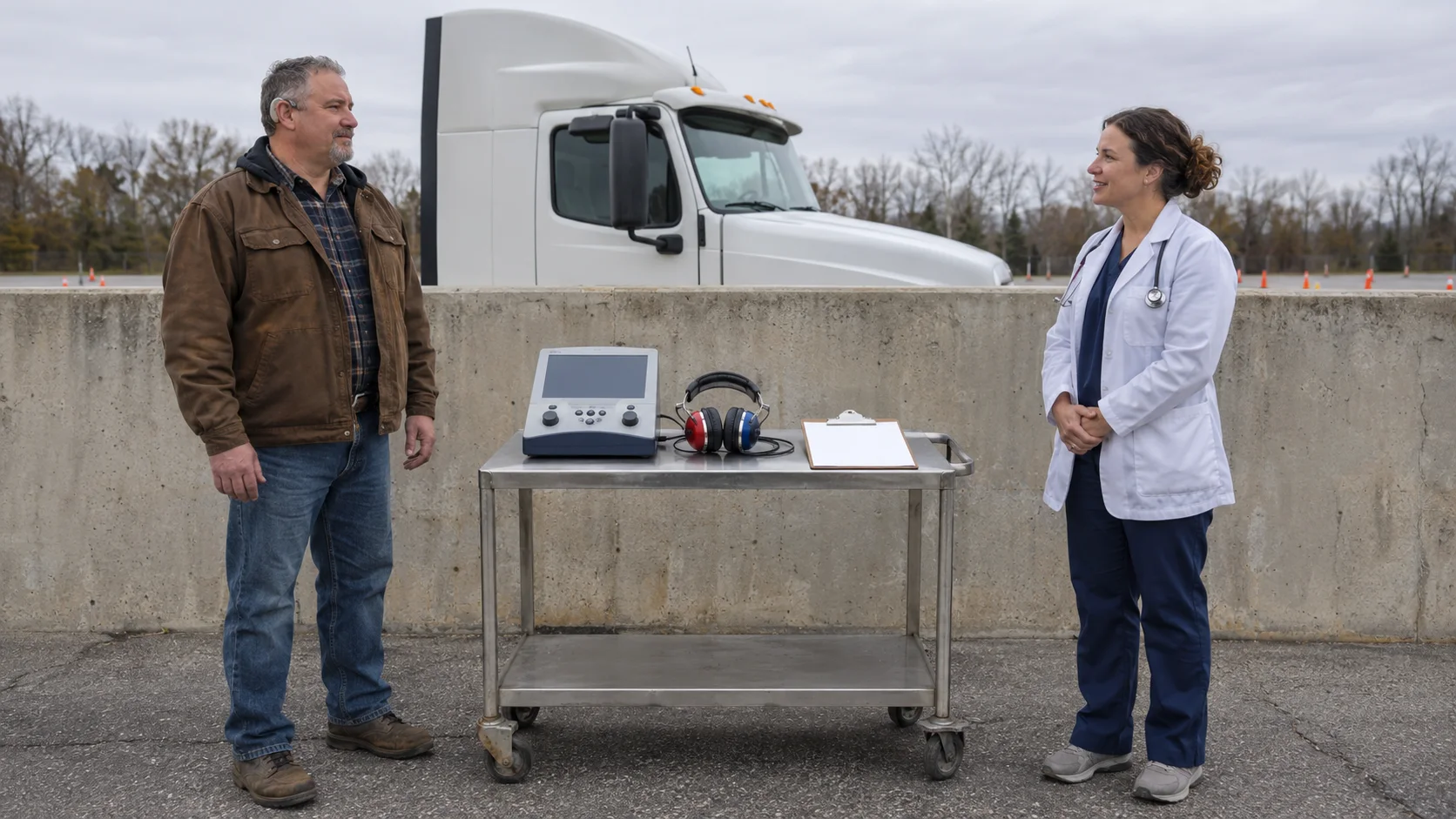
The federal hearing rule appears in 49 CFR 391.41(b)(11). It applies to drivers subject to the federal physical-qualification standards for interstate CMV operation. The standard offers two testing routes, and it evaluates the better ear. A driver needs one ear—not both—to meet the threshold.
A federal hearing exemption is a separate medical variance for a driver who cannot meet either route, even with an appropriate hearing device, but can demonstrate an equivalent or greater level of safety. It does not replace a CDL, commercial learner's permit, endorsement, ELDT completion, Medical Examiner's Certificate or employer qualification requirement.
The two ways to meet the federal hearing standard
| Test route | Passing threshold | Important detail |
|---|---|---|
| Forced-whisper test | First perceive a forced whispered voice in the better ear from at least 5 feet | The test may be completed with or without a hearing aid |
| Audiometric test | Average hearing loss in the better ear is no greater than 40 dB at 500, 1,000 and 2,000 Hz | The three readings are added and divided by three; FMCSA guidance says not to round the result |
The current FMCSA Medical Examiner's Handbook instructs examiners to test both ears, but only the better ear has to pass. The conversational frequencies used for the audiometric average are 500, 1,000 and 2,000 Hz. A test result at another frequency may be medically useful, but it does not substitute for the specific federal calculation.
Hearing aids and cochlear implants
A hearing aid is not an automatic disqualification. FMCSA guidance states that a driver using a hearing aid or cochlear implant may be physically qualified when the driver meets the standard. The medical examiner can administer the forced-whisper test while the driver wears the device or use an audiometric report completed with the device.
If qualification depends on a hearing aid, the MCSA-5876 Medical Examiner's Certificate identifies that restriction. The driver must use the required hearing aid while operating. A dead battery, missing device or device that no longer provides the tested benefit can turn a medically qualified trip into an unsafe and noncompliant one.
- Bring the hearing aid or implant processor used in daily driving to the medical examination.
- Carry spare batteries or a charged backup power source appropriate for the device.
- Explain whether the device is worn in one ear or both ears and whether settings change in traffic.
- Report meaningful changes in hearing, device performance, balance or communication ability before driving.
ProntoCDL's medical-card guide explains how the medical result reaches the CDL record. The medication guide covers the separate review of medicines and treated conditions.
If the forced-whisper screening is not passed
Failing the whisper test in both ears does not automatically settle the qualification decision. The Handbook says the driver may be referred to an audiologist or hearing-aid center for testing with appropriate audiometric equipment. A signed audiology report should identify the professional and record each ear at the required frequencies. The medical examiner records the results on MCSA-5875 and attaches the specialist report.
The Handbook also says the examiner should not place a driver who fails the hearing screening into determination pending while the driver obtains the specialist consultation. The applicant may complete the audiometric work and undergo a new physical-qualification examination. That distinction matters because a pending examination and a completed not-qualified examination have different record consequences.
If the better ear then meets the 40-dB average, with or without a hearing device, the driver may satisfy the ordinary standard. If it does not, the medical examiner determines whether the driver otherwise meets the applicable physical standards and whether the MCSA-5876 should indicate that a hearing exemption is required.
Who can use the federal hearing-exemption program
FMCSA's Driver Exemption Programs page limits the federal hearing program to drivers who operate or intend to operate CMVs in interstate commerce. The shipment's essential interstate character can matter even when a particular route stays inside one State. An applicant should describe the intended work accurately rather than deciding from the day's map alone.
FMCSA cannot grant relief from a State's intrastate medical standard. A driver planning intrastate-only operation must contact the State Driver Licensing Agency and follow that State's variance process. A State waiver should not be assumed to authorize interstate operation.
The driver must also satisfy the other medical standards and applicable licensing requirements. Review the SPE certificate guide if a limb issue is involved; the hearing exemption and SPE program are different pathways.
Build the initial FMCSA application
Use the current Federal Hearing Exemption Application. FMCSA's checklist requests:
- An applicant statement. Give the full name, mailing address, date of birth, phone number, email, intended vehicle type and gross vehicle weight, and confirm interstate operation.
- Driver's license. Supply legible copies of the front and back.
- Medical release. Complete and sign FMCSA's Authorization for Release of Medical Information.
- Three-year driving record. The record must be dated within three months of the application. Include official documentation for reported crashes or moving violations.
- Medical Examiner's Certificate. Include a legible MCSA-5876 showing that a hearing exemption is required.
Send the packet by one method listed in the current instructions—email, mail or fax. Sending duplicate copies through several channels does not create a faster second review and can complicate document matching. Keep a complete, dated copy and proof of transmission.
The medical-release form deserves careful attention. The exemption process involves a public Federal Register notice and docket. Read the release, understand what medical information may be published, and do not add unrelated medical records or personal identifiers the application does not request.
What happens after FMCSA receives the packet
FMCSA says it will make a final decision within 180 days after receiving a complete application. Under 49 CFR 381.315, the Agency publishes a notice requesting public comment, reviews the comments and then publishes the grant or denial decision. The grant notice identifies the effective period and all conditions.
A submitted application is not temporary permission to drive. The driver needs the written grant, a current medical certificate reflecting the variance, a valid CDL or CLP as applicable and every other required qualification before operating under the exemption.
Current FMCSA practice issues medical exemptions for two years to align with the maximum medical-certificate period, although the general exemption regulation permits longer periods. Read the actual exemption letter and Federal Register notice; the dates and conditions on those documents control.
Typical operating conditions after approval
Conditions can change, so never rely on another driver's letter. Recent FMCSA hearing-exemption notices have required drivers to carry a copy of the exemption while driving and have included duties involving crash reports, citations or convictions, annual certified driving records and limits on operating a motorcoach or bus with passengers in interstate commerce.
- Carry the medical variance. Section 391.41 requires a driver who qualifies through an FMCSA variance to possess the variance documentation while on duty.
- Give the carrier a copy. The employing motor carrier keeps required medical-variance documentation in the driver qualification file.
- Follow event-report deadlines. The individual grant may require reports sooner than an ordinary carrier workflow.
- Keep every credential current. The exemption does not extend an expired CDL, endorsement or medical certificate.
- Prepare for roadside presentation. Store a legible copy with organized driver documents; use the roadside inspection guide to build a repeatable document check.
Renewal timing and documents
FMCSA's current hearing-exemption renewal package says to submit renewal information no sooner than three months and no later than one month before expiration. Filing outside that window can create a lapse in interstate operating authority.
The renewal packet calls for a written renewal request, front-and-back license copy, signed medical release, a three-year driving record dated within three months, documentation for crashes or moving violations, and a current MCSA-5876 showing that the hearing exemption is required. Update changed contact, license, employer and driving information instead of copying an old packet without review.
Track three clocks separately: the exemption, medical certificate and CDL. A timely exemption renewal does not extend the other documents. Start the DOT examination early enough to correct an audiology report or missing record before the renewal deadline.
Practical hearing-readiness checklist
- Use a certified medical examiner listed on FMCSA's National Registry.
- Bring the hearing device used while driving and a reliable power backup.
- If the whisper test is not passed, obtain the required-frequency audiometric results rather than assuming an exemption is inevitable.
- Verify that MCSA-5875 and MCSA-5876 accurately show the test, device and exemption status.
- Confirm whether the intended work is interstate or intrastate.
- Use the current FMCSA application package and submit every listed item once.
- Keep copies of the packet, transmission record, FMCSA correspondence and final grant.
- Read the exact grant conditions and calendar every reporting deadline.
- Carry the exemption documentation while on duty and give the carrier a copy.
- Start renewal within FMCSA's three-month-to-one-month filing window.
Medical qualification is only one part of entry into the industry. New applicants should also use ProntoCDL's ELDT readiness checklist, CLP supervision guide and CDL skills-test guide.
CDL hearing standard FAQ
What is the federal hearing standard for an interstate CMV driver?
The driver must perceive a forced whispered voice in the better ear from at least 5 feet, with or without a hearing aid, or have an average hearing loss in the better ear of no more than 40 decibels at 500, 1,000 and 2,000 Hz on the specified audiometric test, with or without a hearing aid.
Can a CDL driver qualify while using a hearing aid or cochlear implant?
Yes. FMCSA guidance says a driver using a hearing aid or cochlear implant can qualify if the driver meets the hearing standard. When the qualification depends on a hearing aid, the medical certificate records that requirement and the driver must use the device while operating.
Does failing the forced-whisper test automatically mean a hearing exemption is required?
No. A driver who does not pass the forced-whisper screening in both ears may obtain an audiometric test from an audiologist or hearing-aid center. If the better ear meets the audiometric standard, with or without an aid, the driver may meet the ordinary standard without an exemption.
Can FMCSA issue a hearing exemption for intrastate-only driving?
No. The federal hearing-exemption program is for drivers who operate or intend to operate CMVs in interstate commerce. An intrastate-only driver must follow the medical-variance rules of the licensing State.
How long does FMCSA take to decide a hearing-exemption application?
FMCSA says it will make a final decision within 180 days after receiving a complete application. An incomplete packet can delay that timeline, and the process includes publication for public comment before the final decision.
When should a driver apply to renew a federal hearing exemption?
The current FMCSA renewal package says to submit the renewal no sooner than three months and no later than one month before the current exemption expires. Drivers should also track the separate medical-certificate and CDL expiration dates.
Continue with the medical-card guide, SPE certificate guide and driver qualification checklist.