
CDL Passenger & School Bus Endorsements: P vs. S
The passenger (P) and school bus (S) endorsements are related, but they are not interchangeable. P authorizes the appropriate class of passenger-carrying commercial vehicle. S adds the specialized qualification for a school bus—and a driver seeking S must also qualify for P. The right plan starts with the exact vehicle and job, then aligns the permit, ELDT and skills test with that vehicle group.
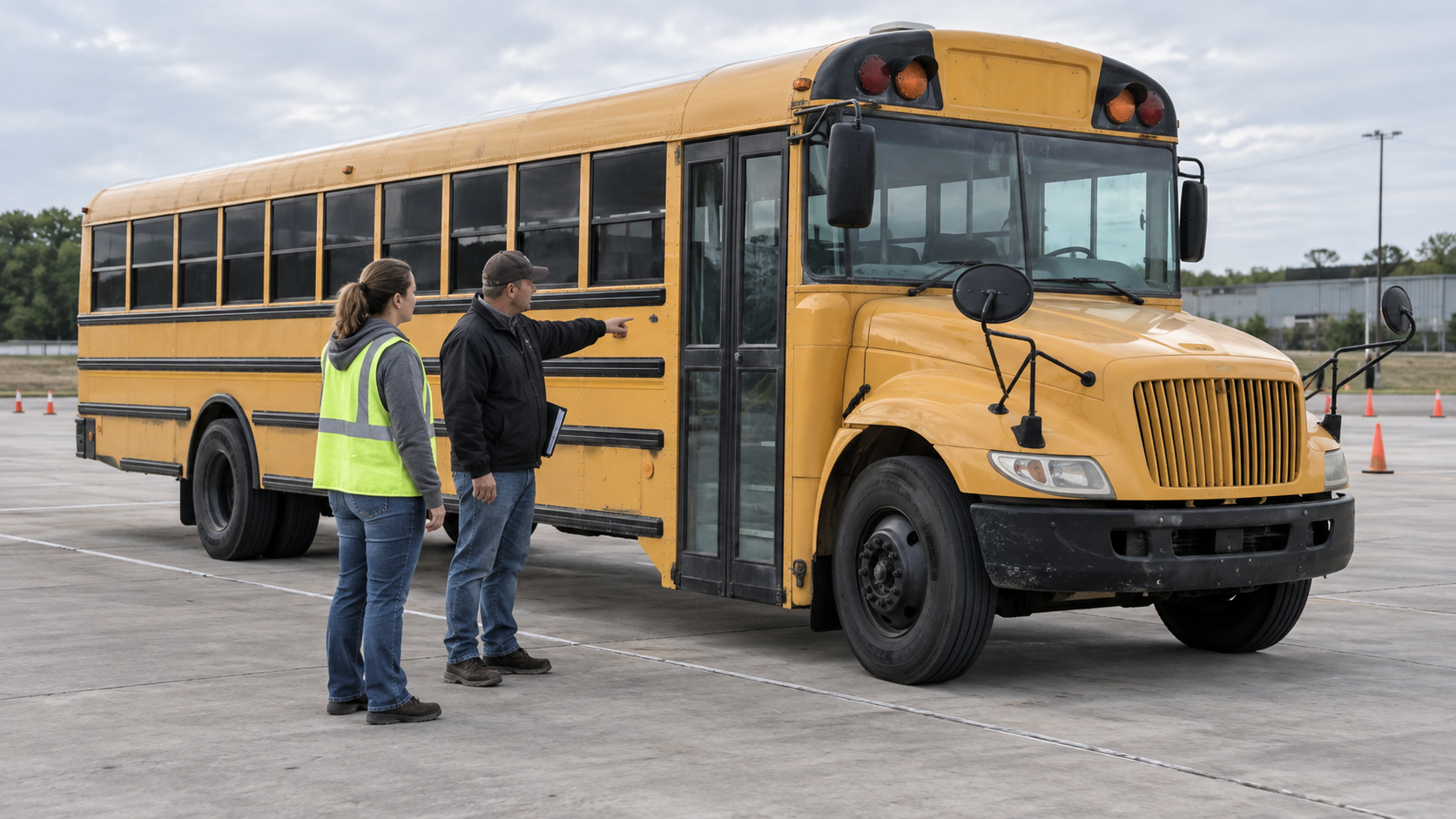
A motorcoach, transit bus, shuttle and school bus can all place different demands on the driver. Before paying for training, identify the vehicle’s passenger capacity, gross vehicle weight rating, brake system and intended work. The endorsement letters are only part of the credential; the CDL class and any restrictions must also match.
P and S at a glance
| Credential | What it covers | Federal tests | ELDT for first-time applicants |
|---|---|---|---|
| P endorsement | Passenger-carrying CMVs in the vehicle group shown by the CDL and restrictions | Passenger knowledge and skills tests | Theory plus behind-the-wheel |
| S endorsement | School buses as federally defined; P qualification is also required | P requirements plus school-bus knowledge and skills tests | School-bus theory plus behind-the-wheel, in addition to applicable P training |
| P or S on a CLP | Supervised training only | Applicable knowledge test before the learner endorsement | Must be complete before the applicable State skills test when ELDT applies |
Under 49 CFR 383.93, both P and S require knowledge and skills testing. P, S and tank (N) are the only federal endorsements allowed on a commercial learner’s permit.
When a passenger endorsement is required
The federal CDL definition in 49 CFR 383.5 includes a Group C vehicle designed to transport 16 or more passengers, including the driver. Heavier passenger vehicles can fall into Group A or Group B based on their weight and configuration. State licensing rules can reach additional vehicles or operations, so the vehicle’s rating plate and seating design—not an informal name such as “shuttle”—should guide the question.
The federal passenger endorsement rule requires knowledge of passenger loading and unloading, emergency exits, fires and unruly-passenger response, railroad crossings, drawbridges and braking. The skills test must be taken in a passenger vehicle that satisfies the vehicle group for which the endorsement will apply.
Why the test vehicle matters
A P endorsement does not erase the class limits created by the skills-test vehicle. Federal restrictions in 49 CFR 383.95 protect the connection between demonstrated skill and authorized equipment:
- Testing for P in a Group B passenger vehicle restricts the driver from Group A passenger vehicles.
- Testing for P in a Group C passenger vehicle restricts the driver from Group A and Group B passenger vehicles.
- Testing without full air brakes can create an air-brake restriction.
- Testing in an automatic can create a manual-transmission restriction.
Ask a prospective employer for the CDL class, seating capacity, brake system and transmission used in the actual fleet. Then confirm that the training and test vehicle preserve the operating privileges the job needs. A convenient smaller bus can produce a valid credential that is still too limited for the intended position.
What the school bus endorsement adds
Federal rules define a school bus as a CMV used to carry pre-primary, primary or secondary students between home and school or to and from school-sponsored events; the definition excludes for-hire motor-carrier operations. Under 49 CFR 383.123, an S applicant must first qualify for P, then meet school-bus-specific requirements.
The S knowledge material emphasizes:
- loading and unloading children safely;
- stop-signal devices, flashing lamps, external mirrors and other warning systems;
- emergency exits and evacuation;
- railroad-highway grade crossings; and
- school-bus operating practices required by Federal and State rules.
The S skills test must use a school bus in the same vehicle group the applicant intends to drive. State education, background-check, medical, age and training requirements may add steps beyond the federal CDL minimums. Check the licensing agency and the school-bus employer before assuming the CDL alone completes qualification.
Understand the CLP passenger limits
A learner endorsement is authorization to train under supervision, not to carry a normal route. 49 CFR 383.25 permits only specified people aboard during P or S CLP operation: the properly qualified supervising CDL holder, other trainees, test examiners and Federal or State auditors or inspectors.
The supervising driver must have the correct CDL group and endorsements and must be positioned next to the CLP holder—or directly behind or in the first row behind the driver in a passenger vehicle—while maintaining observation and direct supervision. Do not treat a familiarization trip, empty move or employer request as permission to transport ordinary passengers.
ELDT for passenger and school bus applicants
FMCSA’s current ELDT applicability guidance says first-time P and S applicants subject to the rule must complete training with a provider listed on the Training Provider Registry before taking the applicable skills test. The rule generally applies to first-time endorsements sought on or after February 7, 2022, with specified exceptions.
The curricula are separate because the operating responsibilities differ:
- The P endorsement curriculum covers passenger-vehicle orientation, inspections, emergencies, baggage, accessibility equipment, passenger management, safety briefings, railroad crossings and other bus operations.
- The S endorsement curriculum adds danger zones, student loading and unloading, emergency evacuation, student management, route and stop review, special mirrors, stop arms, crossing arms and school-bus inspections.
Neither federal curriculum specifies a minimum number of theory or behind-the-wheel hours. The provider must cover every required topic, document the training time and determine that the trainee has demonstrated proficiency. This makes “fastest course” a poor comparison by itself; vehicle-group match, instructor access and meaningful practice matter more.
A practical P and S preparation sequence
- Define the target job. Record the vehicle class, seating design, brake system, transmission and whether the work is school-bus service.
- Read the State manual and application rules. State procedures, fees and school-bus qualifications can exceed the federal baseline.
- Pass the applicable knowledge tests. Obtain the correct class-specific P and, when needed, S learner endorsements.
- Select a registered provider. Verify the provider offers the correct P and S curricula and trains in the same vehicle group needed for the job.
- Practice passenger-specific inspections. Include emergency exits, seats, aisles, accessibility equipment, luggage areas, warning devices and service-door operation.
- Practice the complete driving task. Work on smooth stops, mirror coverage, rear overhang, railroad crossings, passenger stops, backing limits and emergency procedures.
- Verify the TPR record. Confirm completion is recorded before scheduling the State skills test.
- Inspect the issued credential. Confirm the class, P and S endorsements, and every restriction before accepting a driving assignment.
Use ProntoCDL’s ELDT readiness checklist to organize the provider and testing steps. Review Class B ELDT preparation if the intended bus is a heavy straight vehicle, then reinforce the knowledge with the free CDL practice center.
Build passenger-safe operating habits
Passenger work changes the consequences of ordinary control inputs. Smooth acceleration and braking protect standing or moving passengers; deliberate mirror use protects people near doors and wheels; a complete stop inspection protects anyone left behind. Add these routines to endorsement study:
- Know every emergency exit and how to explain it clearly.
- Keep aisles and exits unobstructed and secure baggage or mobility devices correctly.
- Count the vehicle’s rear overhang into every turn and backing plan.
- Approach railroad crossings with the exact procedure for the vehicle and jurisdiction.
- Use a final interior sweep and documented defect handoff after the route.
Connect the vehicle routine to ProntoCDL’s post-trip and DVIR guide, emergency-equipment checklist, railroad-crossing guide and trip-planning guide.
Practical takeaways
- P and S both require knowledge and skills testing; S also requires qualification for P.
- The federal CDL passenger threshold includes vehicles designed for 16 or more people, including the driver.
- P and S learner endorsements do not allow ordinary passenger service.
- First-time P and S applicants generally need registered-provider ELDT before the skills test.
- Federal ELDT is proficiency-based, without a prescribed minimum hour count.
- Training and testing in a smaller vehicle group can limit the passenger vehicles the CDL authorizes.
- Match the test vehicle’s class, brakes and transmission to the intended fleet.
- School-bus qualification can include additional State and employer requirements.
CDL passenger and school bus endorsement FAQ
Do I need a passenger endorsement before a school bus endorsement?
A school bus endorsement applicant must qualify for the passenger endorsement by passing its required knowledge and skills tests. The school bus endorsement then adds school-bus-specific knowledge and skills requirements. State application and testing procedures determine how those steps are scheduled.
Can I carry passengers while practicing with a P or S learner endorsement?
Not ordinary passengers. Federal CLP rules limit occupants to the supervising CDL holder and specified auditors, inspectors, examiners or other trainees. The supervising CDL holder must have the proper class and endorsements and be positioned as required by the rule.
Is a passenger endorsement valid for every size of bus?
Not automatically. The passenger skills test is vehicle-group specific. Testing in a Group B passenger vehicle can restrict Group A passenger operation, while testing in a Group C passenger vehicle can restrict both Group A and Group B passenger operation.
Does ELDT apply when adding P or S to an existing CDL?
Generally yes for a first-time P or S endorsement sought on or after February 7, 2022, unless an exception applies. Training must come from a provider listed on FMCSA’s Training Provider Registry before the State-administered endorsement skills test.
How many federal ELDT hours are required for P or S?
The federal curricula do not prescribe a minimum number of theory or behind-the-wheel hours. The provider must cover every required topic, document training time and determine that the trainee has demonstrated proficiency. A State or employer may require more.
Can school bus ELDT be completed in a different class of bus?
The federal school bus curriculum says the training must be conducted in a school bus of the same vehicle group as the bus the applicant intends to drive. Match the training and test vehicle to the job before enrolling.
Train for the bus you plan to drive
Match the permit, ELDT provider, vehicle group and skills test before the first training day.
Start free CDL practice