
Post-Trip Inspection and DVIR Guide for CDL Drivers
A useful end-of-day vehicle check is more than a quick walk past the tires. It is a deliberate handoff: identify conditions that changed during the shift, document reportable defects accurately, and give the next driver and maintenance team information they can act on.
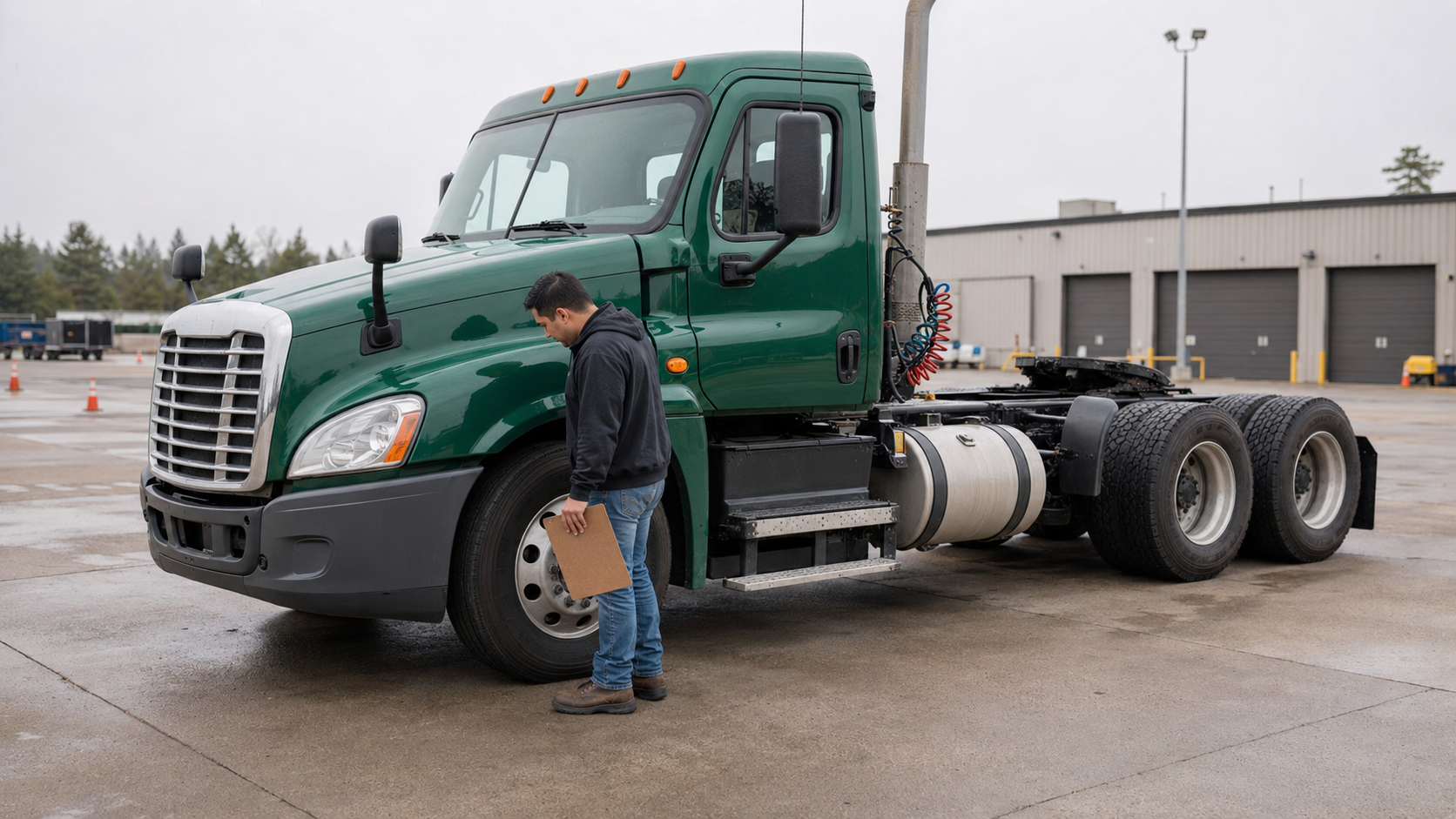
The federal driver vehicle inspection report rule appears in 49 CFR 396.11. The next-driver review appears in 49 CFR 396.13. This guide translates those requirements into a practical CDL study routine; it does not replace a carrier procedure or a state-specific rule.
Start with the important distinction: inspection versus report
Drivers often use “post-trip” and “DVIR” as if they mean the same thing. They are related but not identical. FMCSA guidance explains that section 396.11 does not require a separate post-trip inspection of the kind described in section 396.15. It does require the written report to include defects in the listed parts and accessories that were discovered by or reported to the driver during the day.
A careful end-of-day walkaround is still a strong operating practice. It helps a driver find developing problems while the day’s route, noises, warning lights, handling changes, and equipment events are fresh. Carrier policy may also require a specific inspection or electronic workflow.
Know when a federal DVIR is required
For most property-carrying CMVs, the federal rule requires a DVIR at the completion of the day’s work when a defect or deficiency was discovered by or reported to the driver. A clean report is not federally required when no defect was found or reported, although a carrier can require one.
Passenger-carrying CMVs are different: the driver must prepare and submit the report even if no defect or deficiency was discovered or reported. If a driver operated more than one vehicle, the rule applies to each vehicle operated.
Use a repeatable end-of-day walkaround
- Park securely. Choose level ground when available, set the parking brakes, secure the vehicle, and use required wheel chocks or site procedures.
- Review the day. Recall warning lights, unusual sounds, pulling, vibration, weak braking, air loss, hard steering, coupling concerns, or equipment damage.
- Check the tractor systematically. Move in the same direction every time. Look at lights and reflectors, mirrors, glass, wipers, steering components, tires, wheels, rims, leaks, brakes, and emergency equipment.
- Inspect the connection area. Check the fifth wheel or other coupling device, air and electrical lines, trailer connections, and visible security of the coupling.
- Continue around the trailer. Inspect tires, wheels, lights, reflectors, doors, visible suspension and brake components, and any condition related to the load or trailer body.
- Write specific observations. Identify the vehicle, location, component, and symptom. “Right tractor drive tire has exposed cord” is more useful than “tire bad.”
- Submit through the carrier’s process. Do not rely on a verbal mention when a written DVIR is required.
What the federal report must cover
The report must identify the vehicle and list any defect or deficiency discovered by or reported to the driver that could affect safe operation or cause mechanical breakdown. The minimum federal component list includes:
- Service brakes, including trailer brake connections
- Parking brake
- Steering mechanism
- Lighting devices and reflectors
- Tires, wheels and rims
- Horn, windshield wipers and rear-vision mirrors
- Coupling devices
- Emergency equipment
Do not wait for a component to fail completely. A loose connection, damaged tire, fresh fluid trail, cracked wheel, inoperative lamp, or air-system symptom can be the early evidence that prevents a roadside breakdown.
Write defects so another person can act
A strong defect entry answers four questions: Which vehicle? Which component? Where is it? What exactly did you observe? Add operating symptoms when relevant, but do not diagnose beyond your knowledge. “Air pressure drops during a full brake application” is a useful observation; guessing which valve caused it may send maintenance in the wrong direction.
Never mark a vehicle satisfactory to avoid delay. The report is a safety communication tool, not a paperwork score. Follow the carrier’s escalation process for a condition that could make the vehicle unsafe to move.
What happens before the vehicle returns to service
When a reported defect could affect safe operation, the motor carrier must repair it before the vehicle is operated again or certify that repair is unnecessary. Before driving, section 396.13 requires the next driver to be satisfied that the vehicle is safe, review the last report when one was required, and sign it when repairs were certified.
The practical lesson for a CDL applicant is simple: the incoming inspection and the prior driver’s report work together. A signature never replaces an actual check of the vehicle.
Practical takeaways for CDL study
- Separate the physical inspection routine from the legal trigger for a federal DVIR.
- Remember the property-versus-passenger reporting difference.
- Use the same walkaround sequence at the end of every shift.
- Describe the component, location, and observable condition precisely.
- Report every safety-related defect through the required carrier process.
- Review the previous report and confirm the vehicle is safe before the next trip.
Build inspection vocabulary with the ProntoCDL glossary, strengthen your sequence with the CDL study guides, and apply the concepts in the General Knowledge and Pre-Trip practice tests.
Frequently asked questions
Must a property-carrying CMV driver submit a clean DVIR every day?
Under the federal rule, generally no. A property-carrying CMV driver prepares the report when a defect or deficiency was discovered by or reported to the driver during that day. A motor carrier or another jurisdiction may require additional documentation.
Do passenger-carrying CMV drivers have the same DVIR rule?
No. Under 49 CFR 396.11, a driver of a passenger-carrying CMV must prepare and submit the report even when no defect or deficiency is discovered or reported.
What parts and accessories belong in a DVIR?
The federal list includes service brakes and trailer connections, parking brake, steering, lights and reflectors, tires, horn, windshield wipers, mirrors, coupling devices, wheels and rims, and emergency equipment.
What happens after a safety-related defect is reported?
The motor carrier must repair the defect before the vehicle is operated again, or certify that repair is unnecessary, when the defect could affect safe operation.