
CMV Emergency Equipment Checklist for CDL Drivers
Emergency equipment is useful only when it is present, charged, secured, accessible and ready before the truck leaves. A fire extinguisher rolling under a bunk or a triangle kit buried behind cargo may technically be on the vehicle, but it is not ready for a roadside emergency.
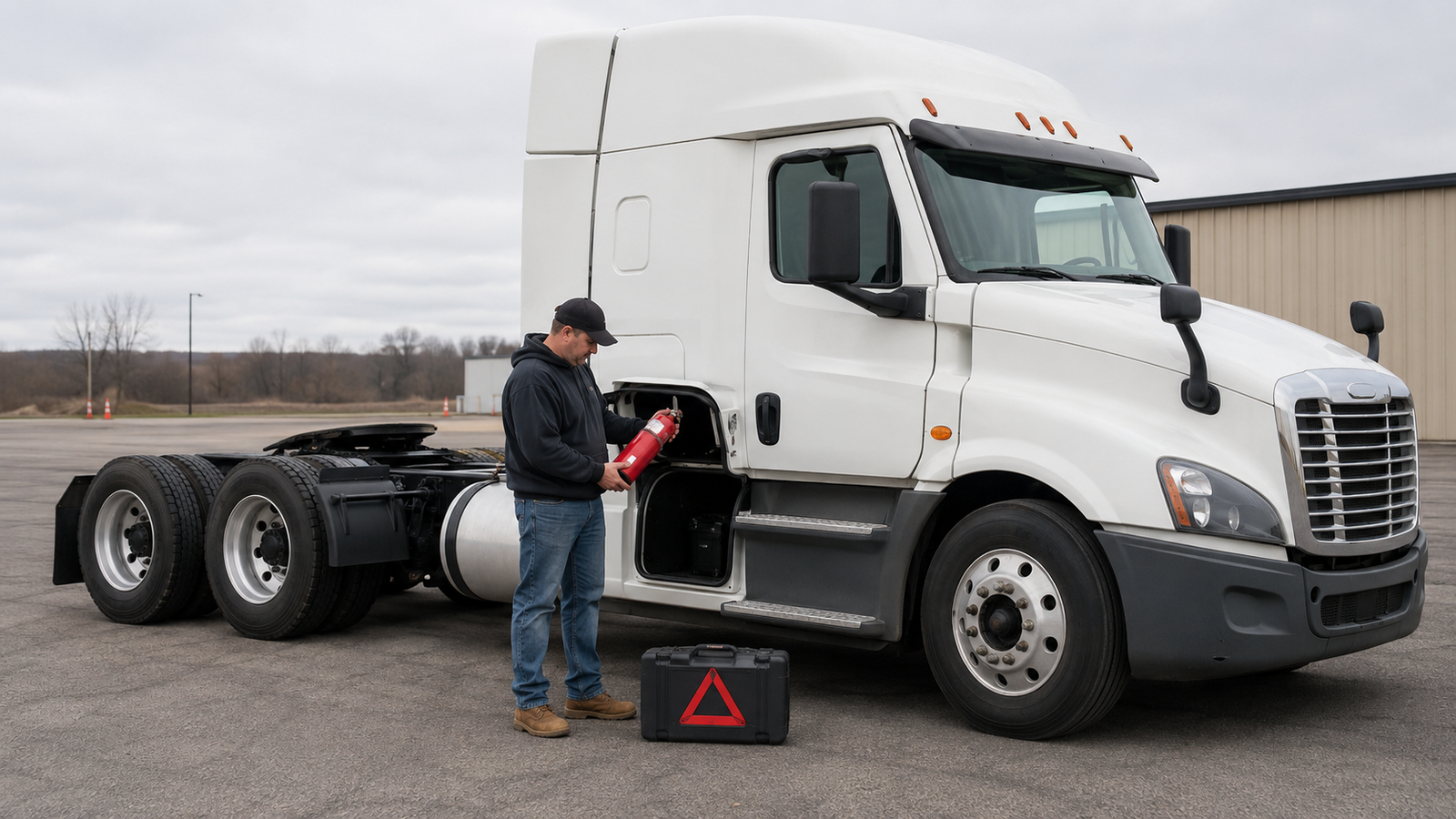
The current equipment requirements appear in 49 CFR 393.95. Section 392.8 says a CMV must not be driven until the driver is satisfied that the required emergency equipment is in place and ready for use. Roadside deployment rules appear in 392.22.
What equipment does the current federal rule require?
For trucks, truck tractors and buses covered by section 393.95, the two core equipment categories are a compliant fire extinguisher and compliant warning devices for a stopped vehicle. One accepted warning-device option is three bidirectional reflective triangles meeting the referenced federal standard. The rule also permits at least six compliant fusees, with important restrictions on flame-producing devices.
A useful current-rule detail: paragraphs 393.95(b) through (e) are reserved. That means the current federal text does not contain the older spare-fuse requirement still found in some legacy study materials. A carrier may still require spare electrical protection or other supplies, so separate the current federal minimum from carrier policy.
Check the correct fire-extinguisher rating
A power unit transporting hazardous materials in a quantity requiring placarding must carry an extinguisher rated at least 10 B:C. A power unit not used for placardable hazardous materials must have either one extinguisher rated at least 5 B:C or two extinguishers rated at least 4 B:C each.
The rating must be marked by the manufacturer. Do not rely on the cylinder’s color or physical size. Read the rating and confirm it matches the operation.
Inspect condition, charge, access and mounting
The rule requires the extinguisher to be filled, readily accessible and securely mounted so it cannot slide, roll or move vertically relative to the vehicle. It must also allow a visual determination that it is fully charged. FMCSA guidance confirms that a pressure gauge is not the only acceptable indicator, but the extinguisher must provide some means of visual confirmation.
Use this five-point inspection:
- Correct rating: Verify the marked rating for the load and operation.
- Charge indication: Confirm the visual indicator shows the extinguisher is ready.
- Physical condition: Look for corrosion, damage, leakage, a missing safety pin or a blocked nozzle.
- Secure mount: Check that the bracket and retaining strap hold the cylinder firmly.
- Immediate access: Make sure bags, tools, freight and personal items do not block removal.
Inspect the warning-device kit
For a triangle-equipped vehicle, confirm that all three devices are present. Open the case periodically under safe conditions and check that the triangles, bases and hinges are complete, clean and usable. Reflective surfaces should not be covered by mud, grease or damage, and the case should be stored where the driver can retrieve it without unloading the truck.
Other lights or warning products may supplement the required devices, but section 393.95 says they cannot replace the compliant equipment or reduce its effectiveness.
Know the standard roadside placement pattern
When a CMV stops on the traveled portion or shoulder for a reason other than a necessary traffic stop, the driver must immediately activate the hazard flashers. Warning devices must then be placed as soon as possible and within 10 minutes.
Under the general two-way-road rule, place:
- One device on the traffic side about 10 feet from the stopped CMV toward approaching traffic
- One device about 100 feet toward approaching traffic, centered in the occupied lane or shoulder
- One device about 100 feet in the opposite direction, centered in the occupied lane or shoulder
Divided or one-way roads use a different pattern: one device near the rear traffic side and the others 100 and 200 feet toward approaching traffic. Hills, curves and other view obstructions can require a device 100 to 500 feet away so approaching road users receive adequate warning. Drivers should study the complete special rules rather than applying the standard pattern everywhere.
Deploy equipment without creating a second emergency
- Stop as far from moving traffic as conditions safely allow.
- Activate hazard flashers immediately.
- Exit on the side away from traffic when that route is available.
- Carry the devices facing traffic so reflective surfaces remain visible.
- Watch approaching traffic continuously and never turn your back longer than necessary.
- Use the placement pattern for the road shape and visibility conditions.
- Keep flashers operating while collecting the devices before moving.
Flame-producing warning devices create special hazards. Federal rules prohibit carrying them on certain explosives, cargo-tank flammable-gas or flammable-liquid operations and CMVs using compressed gas as motor fuel. Never light a flame-producing device near leaking fuel, gas or another flammable material.
Practical takeaways for CDL study
- Inspect emergency equipment during the pre-trip; do not merely say that it is present.
- Memorize the rating difference: 10 B:C for placardable hazmat; 5 B:C or two 4 B:C units for other covered power units.
- Confirm the extinguisher is charged, undamaged, secured and accessible.
- Verify three compliant reflective triangles are complete and usable when that is the vehicle’s warning-device option.
- Turn on hazard flashers immediately and place warning devices within 10 minutes.
- Learn the different patterns for two-way, divided, one-way, hill and curve situations.
- Use current official rules when older study materials conflict.
Review equipment terms in the ProntoCDL CDL glossary, strengthen your inspection routine with the CDL study guides, and test these concepts in the General Knowledge and Pre-Trip Practice Center.
Frequently asked questions
How many reflective triangles must a commercial motor vehicle carry?
The current federal rule allows three compliant bidirectional emergency reflective triangles as one warning-device option. The rule also describes an alternative using at least six fusees, but flame-producing devices are prohibited for certain hazardous-material and compressed-gas-fuel operations.
What fire-extinguisher rating does a non-hazmat CMV need?
A non-placarded power unit generally needs one extinguisher rated at least 5 B:C or two extinguishers rated at least 4 B:C each. A power unit transporting placardable hazardous materials requires an extinguisher rated at least 10 B:C.
Does the current federal rule require spare fuses on every power unit?
No. In the current version of 49 CFR 393.95, paragraphs (b) through (e) are reserved. Some older CDL or compliance materials still mention spare fuses, so use current official sources and follow any additional carrier requirements.
How quickly must warning devices be placed after a roadside stop?
For a covered stop on the traveled portion or shoulder, the driver must place the required warning devices as soon as possible and within 10 minutes, subject to the special placement rules in 49 CFR 392.22.