
Railroad Crossing Safety for CDL Drivers: Stop, Look and Clear the Tracks
A highway-rail grade crossing is an intersection where the train always has the right of way. A truck driver cannot depend on a train stopping, traffic clearing, or a low trailer finding enough undercarriage clearance after entering the crossing. The safe decision must be made before the first rail.
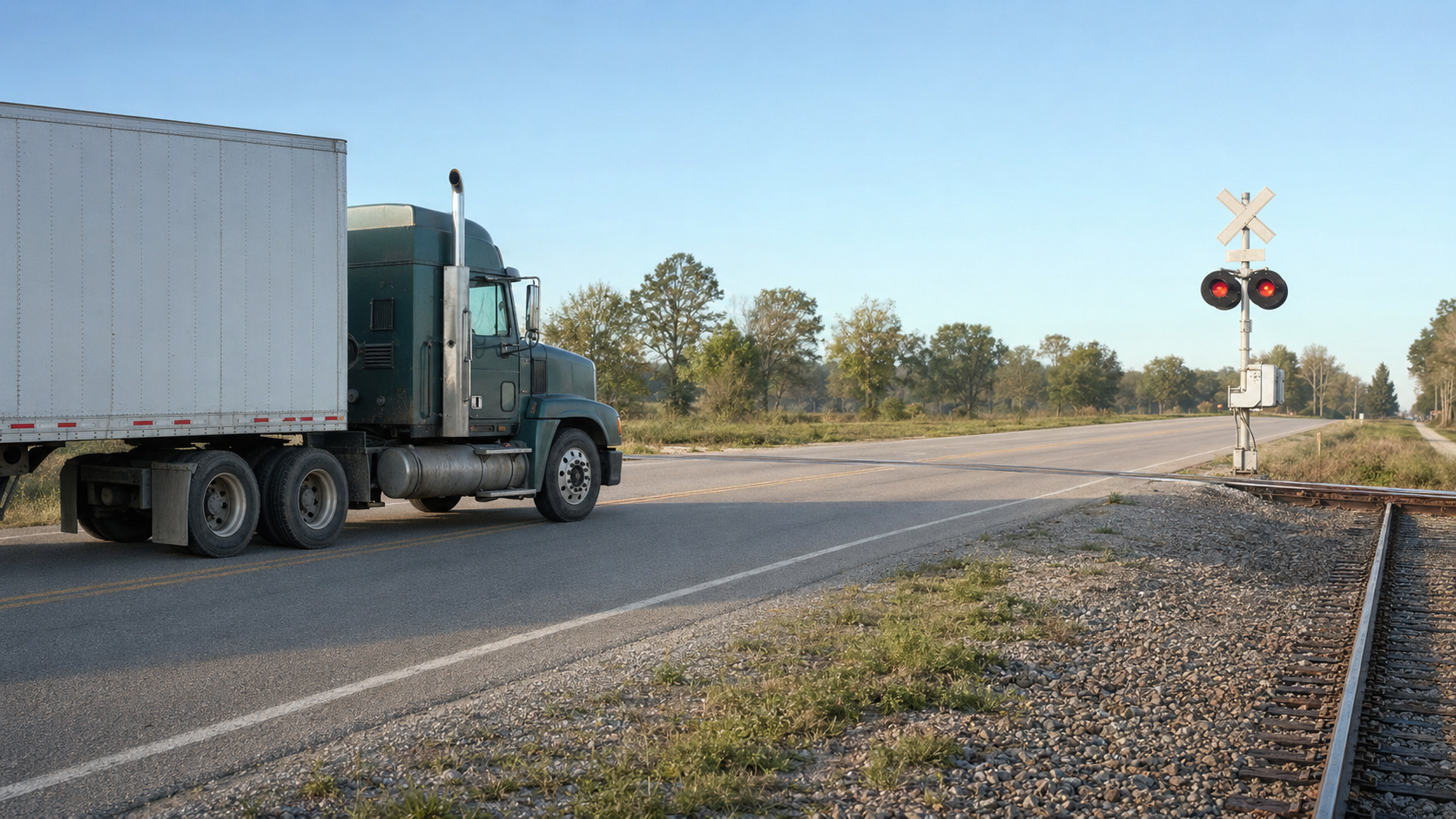
Federal commercial-driving rules address three separate ideas: when certain CMVs must stop, how other CMVs must slow and use due caution, and why no driver may enter without enough room to clear the tracks. The current rules appear in 49 CFR 392.10, 392.11, and 392.12.
First, know whether your vehicle must stop
Under the federal stopping rule, covered vehicles include buses transporting passengers and specified vehicles transporting certain hazardous materials, including listed placarded loads and certain cargo tank operations. Unless an exception in the rule applies, the driver must stop within 50 feet of—but not closer than 15 feet to—the tracks, then look and listen in both directions and confirm that no train is approaching.
Do not reduce this to “all trucks stop” or “only buses stop.” The cargo, placarding, tank use, vehicle operation, and applicable state or local law can change the answer. Confirm the rule for the vehicle and load before departure.
Every CMV driver must approach prepared to stop
For CMVs not listed in the mandatory-stop section, federal rules still require an approach speed that allows the vehicle to stop before the nearest rail. The driver must use due caution and confirm that the course is clear before driving onto or over the crossing.
Begin the scan early. Identify advance-warning signs, pavement markings, the number of tracks, active lights or gates, nearby intersections, traffic beyond the rails, and the shape of the crossing. A quiet crossing is not proof that no train is coming.
Use a seven-step crossing routine
- Approach deliberately. Reduce speed early, communicate the slowdown, and use a safe pull-out area when one is provided.
- Prepare to hear. Reduce cab noise and open the window when appropriate so warnings and an approaching train are easier to detect.
- Look both ways. Move your eyes along the tracks in both directions; check again before committing.
- Verify the exit. Make sure traffic leaves enough space for the tractor and the entire trailer beyond the far rail.
- Choose the gear before entering. Select a gear that carries the vehicle across without a shift.
- Cross steadily. Do not stop on the tracks, change gears, or follow another vehicle so closely that it can trap you.
- Keep moving until fully clear. Remember the rear of the trailer, not the cab, determines when the crossing is complete.
This sequence follows the safety principles in FMCSA’s railroad-crossing resources while keeping the driver focused on the specific vehicle, crossing, and traffic conditions.
Never enter without room to clear
Under the federal safe-clearance rule, a driver subject to the Department of Transportation’s commercial-driving regulations must not enter a highway-rail crossing unless there is enough space to drive completely through without stopping. A green traffic light beyond the tracks does not guarantee the intersection will remain open long enough for a tractor-trailer.
Judge space for the whole combination. If traffic is stopped beyond the rails, wait before the crossing. Do not let a following driver’s impatience push the truck into a position with no exit.
Watch for low-clearance traps
Raised crossings can catch lowboy trailers, car carriers, moving vans, recreational-vehicle transporters, and tractors with low ground clearance or long wheelbases. Plan unfamiliar routes, heed low-ground-clearance signs, and never “try it and see.” If there is doubt, stop short in a safe location and contact the carrier, road authority, or railroad using established procedures.
If the vehicle becomes stuck
Leave the vehicle and move away from the tracks immediately. Call emergency services and use the Emergency Notification System information posted at the crossing to identify the location to the railroad. Do not remain in the cab trying repeated maneuvers when a train may be approaching.
Practical takeaways for CDL study
- Learn the difference between the mandatory-stop rule and the slow-and-use-due-caution rule.
- Memorize the covered stop position: within 50 feet, but not closer than 15 feet.
- Select the crossing gear before the wheels reach the tracks.
- Never enter until the entire combination has room beyond the far rail.
- Treat gates and lights as warnings—not as permission to ignore sight, sound, clearance, or traffic.
- Check official state materials because additional state and local requirements can apply.
Reinforce these concepts with the ProntoCDL General Knowledge practice test, review essential terminology in the CDL glossary, and continue with the CDL study guides.
Frequently asked questions
Must every commercial motor vehicle stop at every railroad crossing?
No. Federal rules require specific passenger and hazardous-material vehicles to stop at most grade crossings. Other CMVs must approach at a speed that permits stopping and proceed only after due caution confirms the crossing is clear. State or local rules may be stricter.
Where must a covered CMV stop before the tracks?
Under 49 CFR 392.10, covered vehicles generally stop within 50 feet of, but not closer than 15 feet to, the tracks before looking and listening for a train.
Can a CDL driver shift gears while crossing railroad tracks?
A driver subject to the federal stopping rule must select a gear that allows the vehicle to complete the crossing without shifting and must not shift while crossing.
What if traffic is backed up beyond the tracks?
Do not enter unless there is enough space to drive completely through without stopping. Wait before the crossing until the entire vehicle can clear the tracks.