
CDL Work Zone Driving Guide: Lane Shifts, Flaggers and Space Management
A work zone compresses the room a commercial driver normally uses to see, slow, steer and escape. The safest trip through one begins before the first cone: scan early, reduce speed smoothly, protect space and treat every temporary instruction as part of the active roadway.
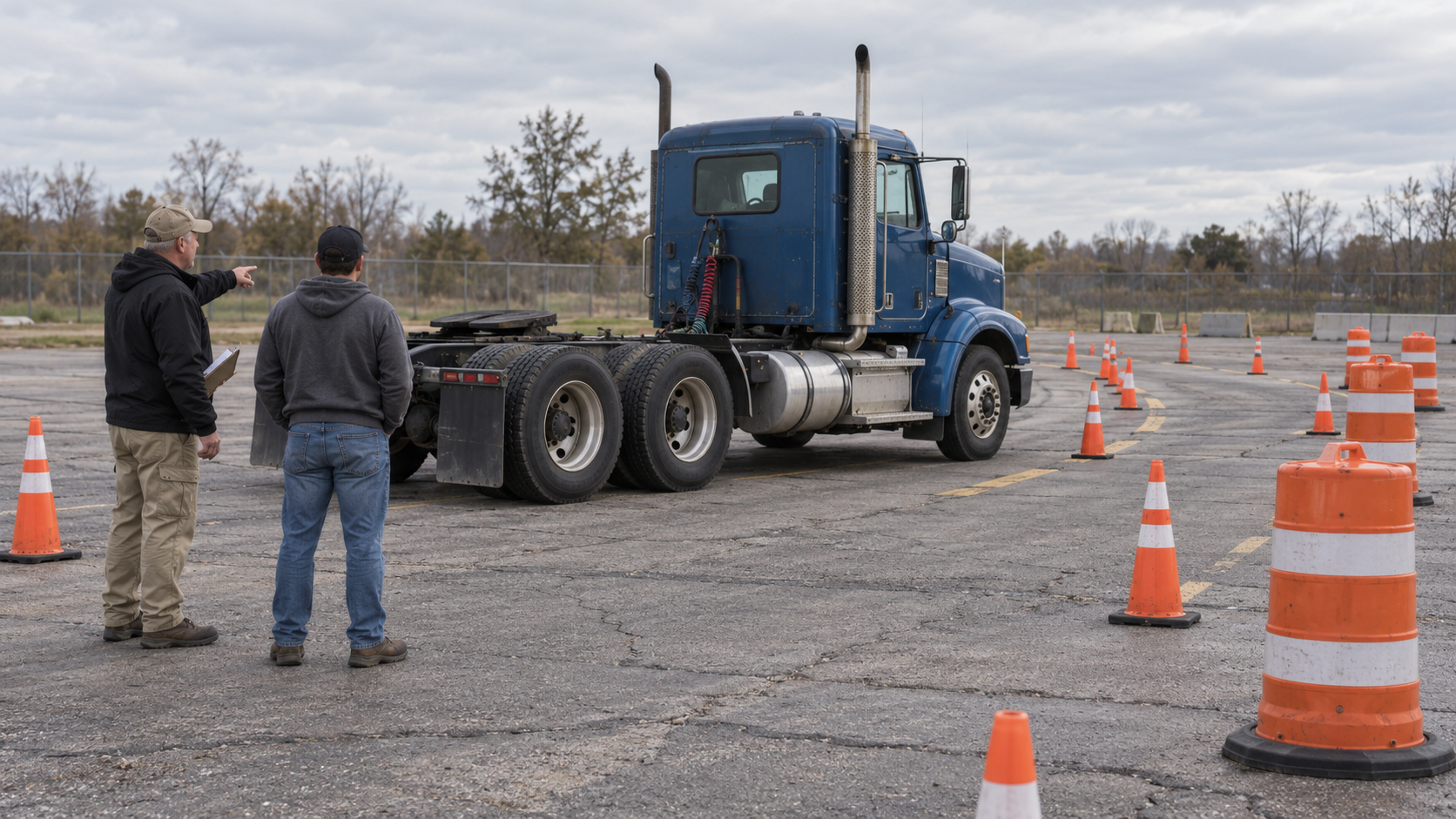
Work zones can introduce lane closures, sudden queues, uneven surfaces, temporary markings, narrow lanes, opposing traffic, workers on foot and equipment entering the roadway. A professional driver cannot control the layout or surrounding motorists, but can control approach speed, following space, observation and the timing of each steering input.
Temporary traffic control is the roadway, not a suggestion
49 CFR 392.2 requires every commercial motor vehicle to be operated under the laws, ordinances and regulations of the jurisdiction where it is traveling, unless an FMCSA rule requires a higher standard of care. That makes temporary regulatory signs, signals, markings and lawful directions part of the driver’s operating responsibility.
The current MUTCD Part 6 describes how temporary traffic-control zones guide road users. A typical zone may include an advance-warning area, a transition where traffic leaves its normal path, an activity area beside the work space and a termination area that returns traffic to normal. Drivers do not need to memorize engineering dimensions, but recognizing that sequence improves anticipation.
| Zone component | What may change | Driver response |
|---|---|---|
| Advance warning | Speed, lane status, shoulder use or expected stopping | Lift early, check mirrors, build space and locate the required lane |
| Transition | Cones or markings shift traffic laterally | Make one smooth lane movement and watch trailer tracking |
| Activity area | Workers, equipment, barriers, narrow lanes and changing surfaces | Hold a steady path, protect side clearance and expect intrusions |
| Termination | Temporary controls end and lanes reopen | Keep discipline until the truck is fully clear; accelerate gradually |
Use a five-step approach before the taper
- Look far enough ahead. Search beyond the vehicle immediately in front for warning signs, arrow displays, brake lights, lane shifts and workers.
- Release speed early. Come off the accelerator before the queue or lane restriction forces a hard brake application. Smooth deceleration gives following motorists more time to react.
- Check the whole vehicle. Scan both mirrors and note vehicles beside the tractor and trailer before the available lane narrows.
- Select the legal open lane. Follow the actual signs, markings, signals and flagger instructions. Navigation guidance does not override temporary control.
- Create an escape margin. Avoid running boxed in beside a barrier, another large vehicle or construction equipment when spacing allows a safer position.
FMCSA’s current truck and bus driver tips tell CMV drivers to slow down, maintain extra following space, prepare to stop, obey work-zone signs and signals, scan for changing traffic patterns and watch for workers and flag crews.
Drive for the queue you cannot yet see
One of the most dangerous work-zone events is not a cone strike—it is arriving at the back of stopped traffic with too little distance. A curve, crest, bridge structure, equipment or larger vehicle can hide the queue. Treat every warning of lane closure or flagger control as notice that traffic may be stopped beyond sight.
- Watch several vehicles ahead for brake-light waves rather than waiting for the nearest vehicle to stop.
- Leave added following space so a passenger vehicle entering the gap does not force an emergency brake application.
- Keep a transmission and speed combination that allows precise control without coasting.
- Recheck mirrors during every slowdown; an approaching vehicle behind may not recognize the queue.
- Do not use the shoulder or a closed lane to bypass traffic unless lawful traffic control directs that movement.
Follow flaggers and temporary signals deliberately
MUTCD Part 6 provides standardized flagger methods using STOP/SLOW paddles, flags and automated flagger assistance devices. A flagger station is positioned so approaching road users have stopping distance, but a commercial driver should never assume the available distance matches the truck’s current speed and load.
When shown STOP, brake in a straight line and stop at the indicated point without crowding the flagger. Hold the service brake and keep the vehicle secured. Proceed only when the authorized display or flagger signal clearly releases your direction. In a one-lane, two-way section, follow the pilot vehicle or instructed traffic flow and do not pass.
Never copy the movement of a passenger vehicle that ignores the signal. The truck driver remains responsible for reading the active control.
Manage lane shifts with mirrors and small steering inputs
A temporary lane can look wide at the tractor and still place the trailer close to a drum or barrier. Before entering the shift, center the tractor in the usable lane—not between old pavement marks—and confirm which markings are active.
- Reduce speed before steering. Braking hard during a lateral move uses traction the tires need for directional control.
- Look through the path. Aim toward the lane’s continuing center instead of staring at the closest cone.
- Use both mirrors. Alternate checks to compare tractor position, trailer off-tracking and the space to each barrier.
- Make small corrections. A sharp input can move the trailer toward the opposite edge after a delay.
- Account for tail swing. On tight curves, the rear corner can move outward while the rear axles track inside.
If the path does not provide legal clearance for the vehicle or permitted load, do not improvise by moving a barrier or entering a closed area. Stop at a safe location before the restriction when possible and contact dispatch or the responsible authority for a lawful route.
Protect workers and anticipate equipment
A worker looking toward the work space may not see the truck. A loader, dump truck or paving machine can enter the travel lane with limited visibility. Cover the brake, keep the vehicle centered and resist the urge to accelerate through an open-looking gap.
Orange drums and cones guide traffic; they are not a protective wall. Give them clearance, but never swerve across a lane line or into another vehicle to avoid a device at the last second. The safer correction is the one created by earlier speed reduction and observation.
Night, rain and temporary pavement demand another margin
Night work adds glare from work lights, reflective devices and wet surfaces. Temporary paint or tape can compete with old markings. Rain may conceal pavement edges, shallow drop-offs and standing water, while fresh asphalt can change tire response.
Slow before the confusing section, use low beams as conditions require, keep the windshield and mirrors clear and search for the next confirmed lane cue. If visibility becomes too poor to continue safely, follow 49 CFR 392.14: use extreme caution, reduce speed and discontinue operation when hazardous conditions become sufficiently dangerous, resuming only when the vehicle can be operated safely.
Have a plan for a breakdown inside the zone
If a mechanical problem develops, keep control and use the safest lawful location the truck can reach. Activate hazard warning flashers, follow official directions and notify the carrier. Do not walk into live traffic, stand between the vehicle and a barrier, or attempt roadside work beyond your training.
Once stopped, apply the parking brakes and secure the vehicle. Warning-device placement depends on the road and stopping location; review the patterns and timing in ProntoCDL’s CMV emergency equipment checklist. If the truck cannot safely clear a live lane, treat the situation as an emergency and contact the appropriate responders.
Practice work-zone thinking during CDL training
The federal Class A ELDT curriculum and Class B ELDT curriculum require hazard-recognition, visual-search and safety-procedure instruction for construction and work zones.
Build those skills in a closed practice area. Use cones to create a gentle taper, a narrowed straight section and an offset lane. At walking speed, practice looking through the path, checking both mirrors, holding the center and describing hazards aloud. Never create a practice layout on a public road or active jobsite.
Connect that exercise with ProntoCDL’s Class A ELDT guide, trip-planning guide and defensive-driving guide. Then reinforce signs, safe-driving concepts and vehicle control through the free CDL practice center.
Practical takeaways
- Begin slowing and scanning at the first work-zone warning, not at the first cone.
- Expect stopped traffic beyond every curve, crest and obstructed view.
- Obey active temporary signs, markings, signals and flagger directions.
- Choose the open lane early enough to make one controlled move.
- Use small steering inputs and alternating mirror checks through lane shifts.
- Protect extra space around workers, equipment, barriers and passenger vehicles.
- Keep speed low until the entire combination has cleared the work zone.
CDL work-zone driving FAQ
Is the posted work-zone speed always a safe speed for a commercial vehicle?
No. A posted limit is a legal maximum, not a promise that every speed up to that limit is safe. The driver must still account for traffic, visibility, lane width, surface condition, workers, equipment, vehicle weight and stopping distance.
Must a CDL driver obey a work-zone flagger?
Yes. Drivers must obey lawful traffic-control directions. A flagger using an authorized paddle, flag or automated device is part of the temporary traffic-control system. Stop where directed and do not proceed until the signal clearly permits movement.
Should a truck merge early or use both lanes to the merge point?
Follow the signs, signals, lane markings, flaggers and applicable local rules for that work zone. There is no safe universal answer for every layout. Once the required lane is clear, make one deliberate move with an adequate gap instead of forcing a late correction.
Can a commercial driver use the shoulder to pass a work-zone queue?
Not unless an authorized traffic-control device or official directs traffic there and the movement is legal. A shoulder can contain workers, disabled vehicles, equipment, soft edges or a reduced load-bearing surface.
Do all jurisdictions double fines in work zones?
No single federal rule makes every work-zone fine identical. Penalties and the conditions that activate them vary by jurisdiction. Read the posted notices and follow the laws of the place where the truck is operating.
What should a driver do if the truck develops a problem inside a work zone?
Keep control, warn surrounding traffic, follow posted or official directions and move only to the safest lawful location the vehicle can reach. Avoid stopping in a live lane when a safer option is available. Then secure the vehicle, notify the carrier and use emergency equipment according to the situation and applicable rules.
Make space before the lane gets narrow
Scan early, slow smoothly, follow the active control and keep the entire vehicle centered through every shift.
Start free CDL practice