
CDL Skid Control and Recovery: Prevention, Recognition and Practice
A skid begins when a driver asks the tires for more braking, steering or acceleration than the available traction can support. Recovery depends on recognizing which part of the vehicle is sliding, removing the cause and making measured inputs before the combination develops a dangerous angle.
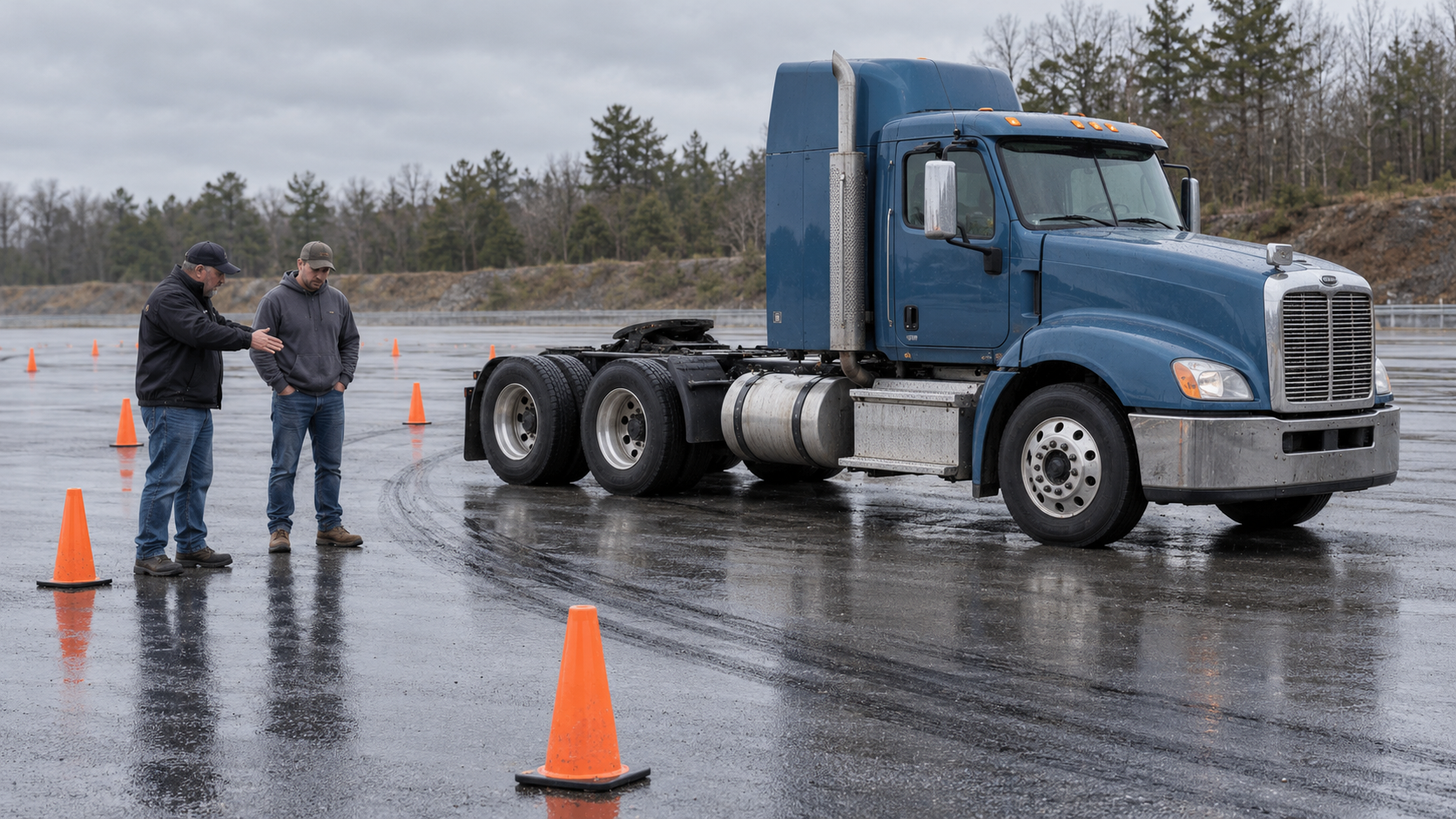
Skid recovery is an emergency skill, but prevention is the professional standard. Speed chosen before a curve, following distance, brake timing, tire condition and smooth control use determine whether the driver keeps a traction reserve when the road becomes slick.
The federal rule starts with speed reduction
49 CFR 392.14 requires extreme caution when snow, ice, sleet, fog, mist, rain, dust or smoke adversely affects visibility or traction. Speed must be reduced. If conditions become sufficiently dangerous, operation must stop and cannot resume until the commercial vehicle can be operated safely.
That rule does not supply one universal “safe” speed. A legal posted limit may still be too fast for polished ice, standing water, an empty trailer in crosswind, a heavy load on a curve or a downgrade with changing traction. The driver must keep reducing speed until steering, braking and available sight distance remain manageable—or stop at a safe place.
Four driver inputs commonly start a skid
| Traction demand | What can happen | Prevention |
|---|---|---|
| Overbraking | One or more wheel positions lock or ABS repeatedly activates while stopping distance grows | Slow earlier, brake progressively and preserve space |
| Oversteering | Tires cannot follow the commanded path; the tractor or trailer departs its intended line | Enter curves slower and use small, smooth steering inputs |
| Overacceleration | Drive tires spin and the tractor rear moves laterally | Feed power gradually, especially when light, turning or climbing on low traction |
| Excessive entry speed | Combined braking and cornering demand exceeds grip | Set speed before the curve, ramp, lane shift or downgrade |
Mechanical condition also changes the margin. Inadequate tread, improper inflation, contaminated brakes, unequal brake adjustment, suspension defects and poorly distributed cargo can make the vehicle less predictable. Connect skid prevention to the CDL tire inspection guide, air-brake inspection guide and cargo securement checklist.
Recognize which part of the vehicle lost traction
The first clue is often a mismatch between the control input and the vehicle’s response. Do not stare at the nearest hazard. Look toward the open path, use the mirrors and identify the behavior.
| Skid type | Likely clue | Immediate priority |
|---|---|---|
| Steering-axle skid | The truck continues straighter than intended even though the wheels are turned | Reduce the demand on the front tires; avoid adding steering or hard braking |
| Drive-wheel skid | The rear of the tractor begins moving sideways | Remove excess power or braking and keep the tractor aligned with the intended path |
| Trailer-wheel skid | The trailer moves laterally or its angle to the tractor begins increasing | Restore rolling traction and prevent the combination angle from growing |
| Hydroplaning | Steering becomes light or unresponsive as tires ride on water | Ease off power, hold a steady path and avoid abrupt braking or steering |
A combination can show more than one behavior at once. For example, excessive braking in a curve can reduce steering response while the trailer also moves outward. Vehicle configuration, load and road crown influence what the driver feels first.
Use a measured recovery sequence
- Look toward the safe path. Vision guides steering. Keep the widest available escape area in view instead of fixating on a barrier, ditch or oncoming lane.
- Remove the input that exceeded traction. Ease off excess throttle if the drive wheels spun. If excessive braking caused wheel lock or lateral movement, reduce the braking demand enough to let the tires roll and recover grip.
- Keep steering corrections small. Turn only as much as needed to align the vehicle with the intended path. A large correction can start a second skid in the opposite direction.
- Unwind the steering as traction returns. Do not hold the recovery angle after the tires grip again. Bring the wheels back toward the travel direction smoothly.
- Stabilize before adding another demand. Once the vehicle is aligned, adjust speed carefully and move to a safe stopping location if inspection is needed.
This is a decision framework, not a substitute for hands-on instruction. Manufacturer guidance, transmission type, ABS status, vehicle configuration and the cause of the skid affect the exact technique. A driver should never attempt to “practice” traction loss on a public road.
Steering-axle skid: stop asking for more turn
When the steering tires lose grip, adding steering angle usually makes the problem worse because the tires are already unable to provide the requested lateral force. Ease off the input that overloaded them, reduce speed without an abrupt weight transfer and wait for steering response to return. As the tires regain grip, keep the correction modest so the truck does not dart across the lane.
Entering a curve slowly enough is the strongest prevention. Complete major braking before the turn whenever conditions allow, then hold a controlled speed through the curve. The mountain-driving guide explains how entry speed, gear selection and brake-heat management fit together on grades and curves.
Drive-wheel skid: control the tractor’s rear angle
A power skid can begin when too much throttle spins the drive tires. A braking skid can begin when the drive wheels stop rolling. In either case, reduce the input that caused the traction loss and steer smoothly toward the intended path while watching how the tractor aligns.
Be ready to straighten the steering as soon as the tractor responds. Delayed straightening can send the rear the other way. Do not add heavy throttle to pull out of the skid and do not make a large steering correction simply because the rear moved quickly.
Trailer skid and jackknife development
When trailer wheels lose rolling traction, the trailer can move sideways and push against the fifth wheel. If the angle between tractor and trailer continues to grow, the combination is developing toward a jackknife. The driver’s goal is to restore rolling traction and keep the units aligned before that angle becomes unrecoverable.
- Release the excessive braking input that locked or overwhelmed trailer traction.
- Do not apply the trailer hand control as an anti-jackknife shortcut.
- Keep steering measured; a sudden tractor movement can increase the articulation angle.
- Use mirrors to judge trailer movement without losing sight of the road ahead.
- After recovery, stop safely and inspect tires, brakes, coupling equipment and cargo before continuing when the event could have caused damage or load shift.
If the combination has passed the point where a safe recovery path remains, prioritize protecting life and reducing impact severity. Avoid placing the tractor into opposing traffic or steering sharply enough to create a rollover.
Hydroplaning: make the controls quiet
Hydroplaning occurs when water separates a tire from meaningful pavement contact. Deep water, speed, tire tread and inflation all affect the risk. The warning can be light steering, a sudden change in engine sound, spray pattern or vehicle response.
Ease off the accelerator, hold the steering steady and avoid a hard brake application. Allow speed to decrease until the tires regain contact. Then make any necessary steering or braking change gradually. Never engage cruise control in conditions where changing traction requires immediate speed control.
ABS supports control but does not repeal physics
Antilock braking systems monitor wheel speed and rapidly modulate brake pressure to help prevent lockup. During an emergency stop with functioning ABS, apply firm, steady service-brake pressure and steer with controlled inputs; do not pump the pedal.
ABS does not guarantee a short stop on ice, eliminate trailer swing or make a fast curve safe. Check ABS warning lamps during the pre-trip sequence and report a lamp that fails its normal check or remains illuminated. Do not assume every unit in a combination has the same ABS status.
Build a skid-prevention routine before movement
- Check weather, temperature and route conditions before departure and during the trip.
- Inspect tread, inflation clues, wheel ends, brakes, suspension and ABS indicators.
- Confirm cargo is distributed and secured for stable handling.
- Increase following distance before traction becomes visibly poor.
- Brake, downshift and select curve speed while the vehicle is straight.
- Use one control at a time when grip is limited: avoid combining hard braking, sharp steering and strong acceleration.
- Stop operating when conditions become sufficiently dangerous under 49 CFR 392.14.
How skid control fits ELDT
The federal Class A ELDT curriculum and Class B ELDT curriculum both require instruction on skid causes, jackknifing, avoidance and recovery. They also cover maintaining directional control on slippery surfaces, emergency braking, evasive steering, off-road recovery, hydroplaning, brake failure, tire blowouts and rollovers.
Use ProntoCDL’s Class A ELDT guide or Class B ELDT guide to connect those topics with formal training, then reinforce speed, traction and emergency concepts in the free CDL practice center.
Practical takeaways
- Prevent the skid by selecting speed before the curve, grade or low-traction area.
- Recognize whether the steering axle, drive axles or trailer is losing the intended path.
- Look toward the safe path and remove the throttle, brake or steering input that exceeded traction.
- Use small corrections, then straighten promptly as grip returns.
- Do not use the trailer hand valve as a skid-recovery shortcut.
- With functioning ABS, use firm steady pressure in an emergency stop rather than pumping.
- Discontinue operation when conditions become too dangerous for safe CMV travel.
CDL skid-control and recovery FAQ
Does ABS prevent every commercial-vehicle skid?
No. ABS helps prevent wheel lock during braking, but it cannot create traction that the road does not provide or cancel the effects of excessive speed, steering, acceleration or lateral force. A driver can still lose directional control or hydroplane.
Should a driver pump the brakes during an ABS emergency stop?
No. When the vehicle has functioning ABS and an emergency stop is necessary, apply firm, steady brake pressure and keep steering inputs controlled. Pumping defeats the system’s rapid automatic pressure modulation. Follow the vehicle manufacturer and training-provider instructions.
Should a driver use the trailer hand valve to straighten a skid?
No. Applying the trailer hand control can lock trailer wheels and worsen a trailer skid or jackknife. It is not a routine anti-skid or anti-jackknife control. Recovery should focus on removing the input that caused traction loss and restoring directional control.
Is every skid recovered with the same steering move?
No. The correct response depends on which wheels lost traction, what caused the skid, road shape, vehicle configuration and available space. That is why a driver must first recognize the skid type and avoid a large automatic correction.
Does federal ELDT require a trainee to intentionally skid a truck?
The federal curricula require instruction and knowledge about skid causes, avoidance, recovery, jackknifing, hydroplaning and related emergencies. They do not require a trainee to create a hazardous skid on a public road. Any practical exercise must be controlled by a qualified provider in an appropriate training environment.
When must a commercial driver stop because of slippery conditions?
Under 49 CFR 392.14, speed must be reduced when hazardous conditions adversely affect visibility or traction. If conditions become sufficiently dangerous, CMV operation must be discontinued and may resume only when the vehicle can be operated safely.
Preserve traction before you need recovery
Slow early, keep control inputs smooth and leave enough space to solve the problem without demanding more grip than the road can provide.
Start free CDL practice