
CDL Off-Road Recovery Guide: Shoulders and Safe Reentry
When one side of a commercial vehicle drops off the pavement, the safest response is usually smaller and slower than instinct suggests: stabilize the truck, let speed fall, assess the shoulder and return only when the vehicle and traffic picture support one controlled move.
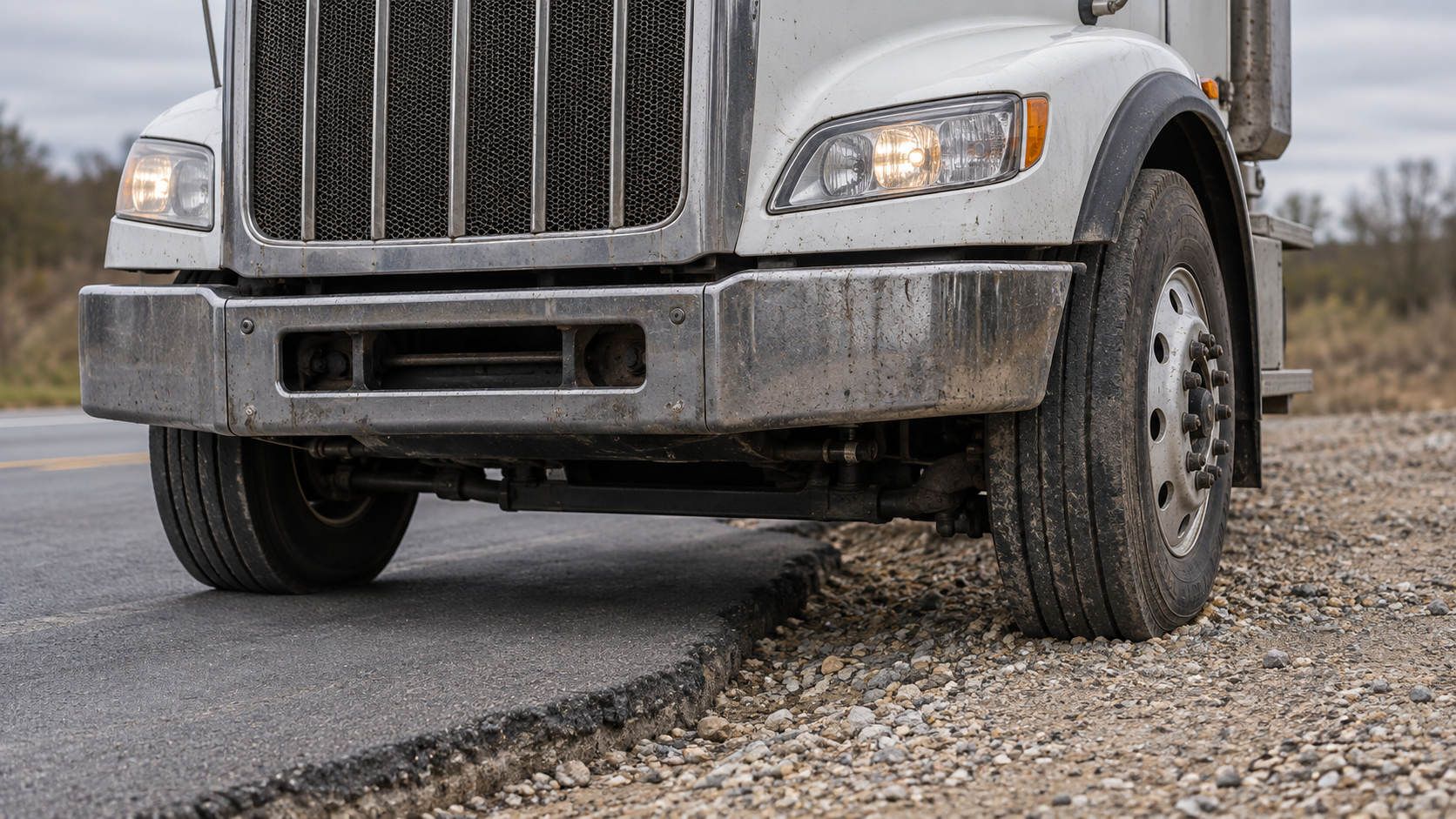
A pavement-edge departure can begin with a narrow lane, distraction, wind, a work-zone shift or an emergency avoidance maneuver. The first danger is the shoulder itself: it may be soft, sloped, narrow or interrupted. The second is the driver’s reaction. Hard braking or a sharp attempt to jump back onto the pavement can create a skid, trailer swing, rollover or a crossing into opposing traffic.
This guide separates three decisions that drivers often collapse into one: hold control, reduce speed and choose whether to stop or reenter. Practice belongs in a closed course with a qualified instructor. It should never be improvised in live traffic.
Federal CDL standards treat this as an emergency maneuver
49 CFR 383.111 requires all CMV operators to know when and how to make emergency maneuvers, specifically including evasive steering, emergency stops, off-road recovery, brake failure and blowout response. The same rule connects that knowledge with speed management, space management and hazard perception.
The federal Class B ELDT curriculum requires theory instruction in off-road recovery and requires behind-the-wheel trainees to know proper emergency-response techniques. The Class A ELDT curriculum covers the same subject for combination vehicles. That does not turn an online explanation into driving practice; it explains why an instructor should build recovery judgment after the trainee has mastered ordinary control.
The recovery sequence: stabilize, slow, assess, decide
| Phase | Driver priority | Avoid |
|---|---|---|
| Stabilize | Firm two-hand grip, eyes on the safe path, steady steering. | Snapping the wheel toward the pavement. |
| Slow | Ease off the accelerator; let speed fall before gentle braking. | Hard braking on loose, soft or sloped material. |
| Assess | Read shoulder width, firmness, slope, obstacles, traffic and trailer position. | Assuming every shoulder supports a loaded CMV. |
| Decide | Stop on a clear shoulder when possible; reenter only with a safe path and gap. | Returning because the lane feels safer without checking the transition. |
| Reenter | Use a deliberate climb onto pavement, then countersteer immediately. | Edging against the pavement lip or making a second large correction. |
1. Hold the path before changing it
Grip the wheel firmly with both hands and look where the truck needs to travel. Keep the steering input small enough to prevent a deeper departure without forcing the tire against the pavement edge. A calm, nearly parallel path gives the vehicle time to shed speed and gives the driver time to inspect the shoulder.
Avoid braking while making a large steering input. The current New York State Commercial Driver’s Manual, Section 2, warns that braking during a quick turn can lock wheels and lead to a skid. It also tells drivers not to turn more sharply than necessary because steering demand raises skid and rollover risk.
2. Reduce speed without upsetting the truck
Ease off the accelerator. Do not stab the service brake. A gravel, dirt or grass shoulder may provide less and less consistent traction than the pavement, and the left and right tires can be on different surfaces. Abrupt braking adds yaw and can pull the vehicle farther away from the intended path.
As a concrete study example, the current New York manual advises avoiding the brakes until speed has fallen to about 20 mph, if possible, and then braking very gently. That figure is not permission to drive down every shoulder at 20 mph. Shoulder width, slope, traffic, load, tire condition and vehicle response can demand a much lower speed or an immediate controlled stop.
3. Read the shoulder as a changing surface
Look well ahead and use the mirrors. A shoulder that seems firm beside the cab may narrow, soften or disappear near a culvert, bridge rail, ditch, mailbox, sign support, disabled vehicle or guardrail. Check whether the pavement lip is shallow enough for the steer tire to climb and whether the surface is crumbling at the edge.
On a combination vehicle, monitor where the trailer is tracking. The tractor and trailer may straddle different surfaces, and the trailer wheels may meet the pavement edge later and at another angle. A high center of gravity, liquid surge, shifting cargo or multiple trailers reduces the margin for an abrupt change. Review ProntoCDL’s weight-distribution guide and cargo-securement guide before treating load condition as separate from vehicle control.
4. Prefer a controlled stop when the shoulder is usable
The current CDL manual’s preferred sequence is straightforward: if the shoulder is clear, stay on it until the vehicle stops. Then signal, check mirrors and return only when traffic and the road edge allow it. Stopping separates speed reduction from the pavement climb and avoids turning one surprise into two.
Do not remain on a shoulder that is collapsing, too narrow, blocked or leading directly into a fixed object. If continuing off-road is the greater hazard, the driver may need to return before stopping. That decision must be based on the available escape path, current speed, traffic gap and full vehicle position—not embarrassment about leaving the lane.
5. If reentry is necessary, make one steer-countersteer action
At a suitably low speed, hold the wheel tightly and steer deliberately enough for the front tires to climb the pavement edge. Do not let the tire rub gradually along the edge while adding more steering. A tire that suddenly gains purchase can pull the truck across the lane.
As soon as both front tires are on the paved surface, countersteer promptly to align the truck with the lane. Think of the climb and countersteer as one connected action. The second input prevents the first input from continuing into another lane. Keep the correction measured; the goal is a stable lane position, not a rapid return to the lane center.
This resembles the discipline in ProntoCDL’s skid-control guide: remove the input that is destabilizing the vehicle, look toward the safe path and avoid a large secondary correction.
When reentry should wait
- The shoulder is wide and firm enough for a complete stop.
- Traffic beside the truck leaves no full-vehicle gap.
- The pavement edge is high, broken or sharply angled.
- The trailer position is unknown or it is tracking toward a ditch or obstacle.
- The load has shifted, a tire is damaged or the steering response is abnormal.
- The vehicle has stopped in a position that requires traffic control or recovery assistance.
If the vehicle stops on or near the traveled portion, activate the hazard warning system and follow the applicable emergency-equipment rules and fleet procedure. ProntoCDL’s CMV emergency-equipment checklist explains the federal warning-device basics.
Common errors that worsen a shoulder departure
- Immediate return: steering back before speed and traffic are under control.
- Hard braking: demanding maximum traction while the tires are split between surfaces.
- Pavement-edge scrubbing: holding the tire against the lip until it grabs unpredictably.
- Missing the countersteer: allowing the initial recovery turn to continue across the lane.
- Fixating on the edge: looking down instead of scanning the safe path and mirrors.
- Ignoring the trailer: recovering the tractor without knowing the combination’s full position.
- Accelerating to climb: adding speed and drive force when a controlled low-speed maneuver is needed.
A closed-course practice progression
- Begin with a parked vehicle and identify the steer-tire path, pavement lip and mirror views.
- Walk the intended track and mark the stabilize, slow, decision and reentry zones with cones.
- Practice verbal calls: “hold,” “ease off,” “shoulder clear,” “gap clear,” “steer,” “countersteer.”
- At instructor-approved walking speed, practice a shallow departure and stop on the shoulder.
- Only after repeatable stops, add low-speed reentry on a firm, engineered transition.
- Debrief steering timing, mirror use, path and trailer tracking before increasing complexity.
Never build a practice drop-off from loose material or use public-road shoulders. The training provider controls the site, vehicle, speed and progression. Use the Class A ELDT guide, Class B ELDT guide and free CDL practice center to reinforce the decision sequence between supervised sessions.
Practical takeaways
- Stabilize the vehicle before trying to restore lane position.
- Ease off the accelerator and avoid hard braking on a loose or split-friction surface.
- Use the time gained to inspect shoulder width, firmness, slope, obstacles, traffic and trailer path.
- When a clear, supportive shoulder allows it, stop before returning to the roadway.
- If reentry before stopping is necessary, slow substantially and wait for a full-vehicle gap.
- Use a deliberate pavement climb followed immediately by a measured countersteer.
- After recovery, stop safely and inspect tires, wheels, steering, suspension, cargo and coupling if contact or abnormal forces occurred.
CDL off-road recovery FAQ
What should I do first if my right wheels leave the pavement?
Keep a firm two-hand grip, look along the safe path and hold a steady direction. Ease off the accelerator and avoid an abrupt brake or steering input. The immediate goal is stability, not an instant return to the lane.
Should I steer back onto the road immediately?
Usually not. If the shoulder is clear and supports the vehicle, the current CDL manual advises staying on it until the vehicle stops, then signaling and checking mirrors before reentering. Return before stopping only when remaining off the road creates a greater hazard and a safe traffic gap and path exist.
Why is gradually edging a tire up the pavement edge risky?
A tire can scrub along the pavement lip and then climb or grab suddenly. That delayed response can produce a large lane-crossing correction. The cited CDL procedure instead describes one deliberate steering input to climb the edge followed immediately by a countersteer when both front tires are on pavement.
Should I brake on a gravel or soft shoulder?
Avoid hard braking. The current New York CDL manual says, if possible, to wait until speed has dropped to about 20 mph and then brake very gently to reduce the chance of a loose-surface skid. Conditions and vehicle behavior control; use the current manual for your licensing State and your instructor’s procedure.
What changes with a tractor-trailer?
The trailer may remain on pavement, follow the tractor onto the shoulder or track across the pavement edge at a different point. Avoid abrupt steering that can amplify trailer swing or rollover forces. Use mirrors to monitor the full combination, slow substantially and stop on the shoulder when it is safe to do so.
Is off-road recovery part of federal CDL and ELDT training?
Yes. 49 CFR 383.111 lists off-road recovery among the emergency maneuvers every CMV operator must know. The federal Class B ELDT curriculum requires instruction in off-road recovery, and the parallel Class A curriculum includes it within skid control, jackknifing and other emergencies.
Control first. Reentry second.
Build the judgment to slow, assess and choose the safest path before a shoulder departure becomes an overcorrection.
Start free CDL practice