
CDL Cargo Securement Guide: Tiedown Counts and Working Load Limits
A strap count alone does not prove that cargo is secure. Drivers must satisfy the minimum tiedown count, confirm enough aggregate working load limit, protect every contact point and apply any rule written for the commodity being hauled.
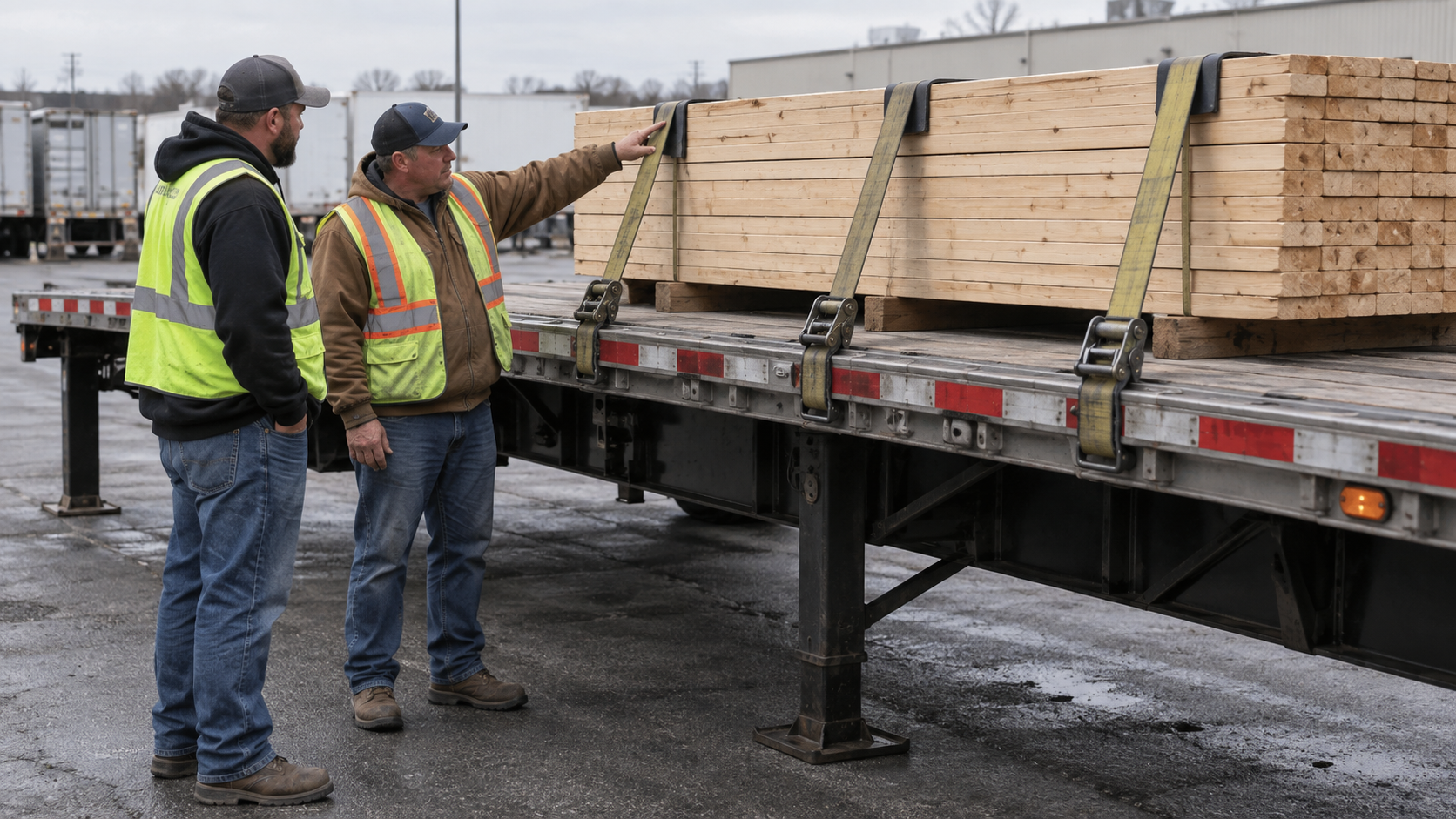
Two loads of the same length may need different securement because their weights, shapes, contact surfaces and forward blocking differ. Two tiedowns with the same printed rating may contribute differently to aggregate working load limit if their attachment paths differ. A professional securement plan therefore answers three separate questions: Is the cargo immobilized? Are there enough tiedowns? Does the complete system have enough rated capacity?
This guide explains the federal general rules for articles that are not subject to a more demanding commodity-specific method. It is a calculation and inspection companion to ProntoCDL’s cargo-securement reinspection checklist.
What federal CDL and ELDT standards expect
49 CFR 383.111 requires CDL knowledge of cargo principles, driver responsibility for securement and the effects of cargo on vehicle control. The federal Class A ELDT curriculum covers proper cargo securement, cargo-related inspections, weight distribution and load checks.
The operating duty appears in 49 CFR 392.9: a driver may not operate unless the cargo is properly distributed and adequately secured, operating equipment is secured, and the load does not block the driver’s view, movement, emergency-equipment access or exit.
Start with the performance the system must deliver
49 CFR 393.102 defines minimum performance criteria for securement devices and systems. The breaking-strength criteria address forces applied separately in these directions:
| Direction | Performance criterion | What it represents |
|---|---|---|
| Forward | 0.8 g deceleration | Hard braking or a rapid stop |
| Rearward | 0.5 g acceleration | Rearward force on the cargo |
| Lateral | 0.5 g acceleration | Turning or evasive movement |
For loads not fully contained within the vehicle structure, the securement system must also provide downward force equal to at least 20 percent of the article’s weight. These are system-performance requirements—not instructions to perform a road maneuver or improvised pull test.
Working load limit is not breaking strength
A tiedown assembly includes more than the visible strap or chain. Webbing, chain, hooks, ratchets, binders, winches, attachment fittings and anchor points work as one path. The system is not stronger than its controlling component.
- Breaking strength describes failure strength under the applicable test standard.
- Working load limit (WLL) is the rated capacity used for normal securement calculations.
- Aggregate WLL is the total contribution of the tiedowns in the securement system under the federal counting method.
Never substitute breaking strength for WLL or multiply a component rating by an assumed safety factor. Determine the legal WLL from the marking, manufacturer information and applicable federal tables, then follow a stricter carrier or equipment instruction when one applies.
Calculate the required aggregate WLL
Under 49 CFR 393.106, the aggregate WLL used to prevent movement must be at least one-half the weight of the article or group of articles.
Required aggregate WLL = cargo weight ÷ 2
A 12,000-pound article therefore needs at least 6,000 pounds of aggregate WLL before considering minimum tiedown count, blocking, special-commodity rules or a stricter procedure.
How much each tiedown contributes depends on its route:
| Tiedown path | Contribution to aggregate WLL |
|---|---|
| Vehicle anchor to an attachment point on the cargo | One-half of that tiedown’s WLL |
| Vehicle anchor, through/over/around cargo, then back to an anchor on the same side | One-half of that tiedown’s WLL |
| Vehicle anchor, through/over/around cargo, then to an anchor on the opposite side | The full WLL of that tiedown |
That distinction prevents a common error: adding every printed rating at full value even when the tiedown configuration contributes only half. Draw the path of each device, identify the controlling component and total only the contribution permitted by the rule.
Minimum tiedown count is a separate test
49 CFR 393.110 gives minimum counts for individual articles when general tiedown rules apply. When the article is not prevented from moving forward by a headerboard, bulkhead, other cargo or equivalent restraint, the basic count is:
| Article length and weight | Federal general minimum |
|---|---|
| 5 ft or shorter and 1,100 lb or less | 1 tiedown |
| 5 ft or shorter and more than 1,100 lb | 2 tiedowns |
| Longer than 5 ft through 10 ft | 2 tiedowns, regardless of weight |
| Longer than 10 ft | 2 for the first 10 ft, plus 1 for each additional 10 ft or fraction |
When effective restraint prevents forward movement, the federal general rule uses at least one tiedown for every 10 feet of article length or fraction. A State CDL manual, carrier, customer or site may use a stricter minimum. The current New York State CDL manual, for example, teaches a conservative two-tiedown minimum for flatbed cargo. Do not reduce an established operating standard merely because a narrow federal exception exists.
Work through both tests
The number rule and the capacity rule apply together. Use whichever demands the stronger system.
| General-rule example | Count result | Capacity result |
|---|---|---|
| 4-ft, 800-lb article; not blocked forward | Federal rule permits 1, unless a stricter rule applies | Aggregate WLL must be at least 400 lb |
| 4-ft, 2,500-lb article; not blocked forward | At least 2 | Aggregate WLL must be at least 1,250 lb |
| 8-ft, 7,000-lb article; not blocked forward | At least 2 | Aggregate WLL must be at least 3,500 lb |
| 22-ft article; not blocked forward | At least 4 | Aggregate WLL still must equal at least half the article weight |
| 22-ft article; effectively blocked forward | At least 3 under the general length rule | Aggregate WLL and every other applicable rule still apply |
These examples assume one individual article under the general rule. Bundled freight, multiple articles, vehicles, machinery, logs, lumber, metal coils and other commodities may require a different analysis.
Inspect every part of the securement path
49 CFR 393.104 requires securement devices, vehicle structures and anchor points to be capable and serviceable. Build the inspection from the deck outward:
- Vehicle structure: inspect the deck, rails, anchor points, pockets, posts, headerboard and associated mounting areas for damage or weakness.
- Dunnage and blocking: verify that dunnage, chocks, cradles, blocking and bracing fit the cargo and have no defect that compromises the system.
- Assembly rating: identify the WLL and the lowest-rated component in each tiedown path.
- Webbing or chain: reject damage or weakening that adversely affects performance. Follow the manufacturer, carrier and applicable standard rather than inventing a field repair.
- Hooks and fittings: confirm correct seating, alignment and engagement without side-loading or an improvised attachment.
- Tensioning device: confirm the winch, ratchet or binder is serviceable, closed and protected against release.
- Final path: verify the tiedown cannot loosen, unfasten, open or release in transit and does not contact heat, sharp metal or a moving component.
Knots are prohibited in tiedowns. A knot can damage fibers, change load distribution and make an assigned rating meaningless.
Use edge protection where abrasion or cutting can occur
Edge protection is required wherever a tiedown would be subject to abrasion or cutting at the cargo contact point. It must resist abrasion, cutting and crushing. Place it before final tensioning, keep it under the tiedown at the actual contact area and confirm it cannot walk away as the load settles.
An edge protector does not add WLL, repair damaged webbing or convert an unsuitable strap into a suitable one. Inspect the protector itself for cracks, deformation, sharp damage and a shape that no longer supports the tiedown.
Control cargo that can roll, tip or separate
Articles likely to roll require chocks, wedges, a cradle or an equivalent method that cannot unintentionally loosen. Adjacent articles secured by transverse tiedowns must be in direct contact or prevented from shifting toward each other. Securement has to control the cargo as a three-dimensional object—not merely press it toward the deck.
Ask what happens under braking, acceleration, a lane change, a curve and road vibration. If an article can telescope out of a bundle, rotate inside a strap, crush its dunnage or escape sideways beneath a tiedown, the visible strap count is not the real answer.
Check for commodity-specific rules before using the general formula
Sections 393.116 through 393.136 contain requirements for specific commodities, including logs, dressed lumber, metal coils, paper rolls, concrete pipe, intermodal containers, automobiles, heavy vehicles and equipment, flattened or crushed vehicles, roll-on/roll-off containers and large boulders. Those provisions take precedence when they add requirements for the commodity.
Identify the commodity before choosing equipment. A chain-and-binder method for heavy machinery cannot be copied blindly to lumber, pipe or coils. Follow the exact regulatory section, manufacturer instructions, carrier plan and any permit or customer requirements.
Reinspect after the load begins to move
Under 49 CFR 392.9, a truck or tractor driver generally must inspect the cargo and securement within the first 50 miles, then reexamine when changing duty status, after 3 hours of driving or after 150 miles—whichever comes first. The rule includes limited exceptions for sealed loads and cargo loaded in a way that makes inspection impracticable.
Those are trigger points, not permission to ignore a change before the clock expires. Stop sooner when a strap flaps, a cover changes shape, cargo settles, steering or handling changes, a binder moves, an anchor deforms or a mirror view suggests movement. Use ProntoCDL’s full reinspection routine for the stop itself.
A closed-yard securement calculation drill
- Give the trainee a fictional article length, weight, shape and forward-blocking condition.
- Provide rated tiedown, hook, winch and anchor information for several equipment choices.
- Have the trainee calculate the minimum count and required aggregate WLL separately.
- Ask the trainee to trace each tiedown path and state whether it contributes full or half WLL.
- Place serviceable and training-only defective components on a table; identify damage without installing the defective items.
- Walk around a stationary training load and identify edge-protection points, roll direction, dunnage, anchors and possible escape paths.
- Finish by planning the first-50-mile inspection and later recheck triggers.
Only qualified personnel should tension or release real securement, and stored energy must be considered before any device is handled. Connect the exercise to ProntoCDL’s Class A ELDT guide, the axle-weight guide and the free CDL practice center.
Practical takeaways
- Calculate tiedown count and aggregate WLL separately; satisfy both.
- Required aggregate WLL is generally at least one-half the weight of the article or group.
- Count full or half WLL according to the tiedown’s actual attachment path.
- Use the lowest-rated component in the assembly and never substitute breaking strength.
- Inspect the deck, anchors, dunnage, tiedowns, fittings and tensioners as one system.
- Use suitable edge protection wherever abrasion or cutting can occur.
- Apply rolling prevention and commodity-specific rules before relying on a general example.
- Reinspect within the first 50 miles and at every later regulatory or condition-based trigger.
CDL cargo-securement FAQ
Is working load limit the same as breaking strength?
No. Breaking strength is the force at which a component is expected to fail under a specified test, while working load limit is the maximum load assigned for normal securement use. Cargo calculations use working load limit, not breaking strength, and the lowest-rated component in an assembly can control.
Does meeting the one-half aggregate WLL rule prove a load is fully secured?
No. The securement system must satisfy both aggregate working-load-limit and minimum-tiedown-count requirements, plus rules for placement, rolling prevention, edge protection, vehicle structures and any commodity-specific requirements. Meeting one calculation does not excuse the others.
How many tiedowns does a 12-foot article need?
Under the federal general rule, an article longer than 10 feet that is not blocked against forward movement generally needs two tiedowns for the first 10 feet and one more for the remaining fraction, for a minimum of three. If effective blocking prevents forward movement, the count can differ. Commodity rules or stricter carrier and State procedures may require more.
Can a short, light article ever use one tiedown?
The federal general rule includes a narrow one-tiedown provision for an article 5 feet or shorter and 1,100 pounds or less when it is not otherwise prevented from forward movement. Some CDL manuals, carriers and sites use a two-tiedown minimum as a stricter operating rule. Follow every applicable rule and do not use the exception when another requirement controls.
Do edge protectors increase a strap’s working load limit?
No. Edge protection helps prevent abrasion or cutting where the tiedown contacts cargo, but it does not raise the tiedown or anchor rating. The protector itself must resist abrasion, cutting and crushing, and the complete securement system still needs adequate WLL and proper geometry.
What should a driver do if a tiedown tag or rating cannot be read?
Do not invent a rating. Determine the device’s legal WLL under the applicable federal tables, manufacturer identification and carrier procedure, or replace it with a correctly identified serviceable device. A damaged or weakened component must not be used when the defect adversely affects securement performance.
Count it. Rate it. Trace every path.
A securement plan is complete only when the cargo, hardware, attachment points and inspection schedule work as one system.
Start free CDL practice