
CDL Weight Distribution Guide: Axles, Scales and Sliding Tandems
A legal gross weight does not guarantee legal axle weights. Professional drivers must know which limits apply, read each scale line correctly, choose a safe correction and reweigh before an overloaded axle reaches the road.
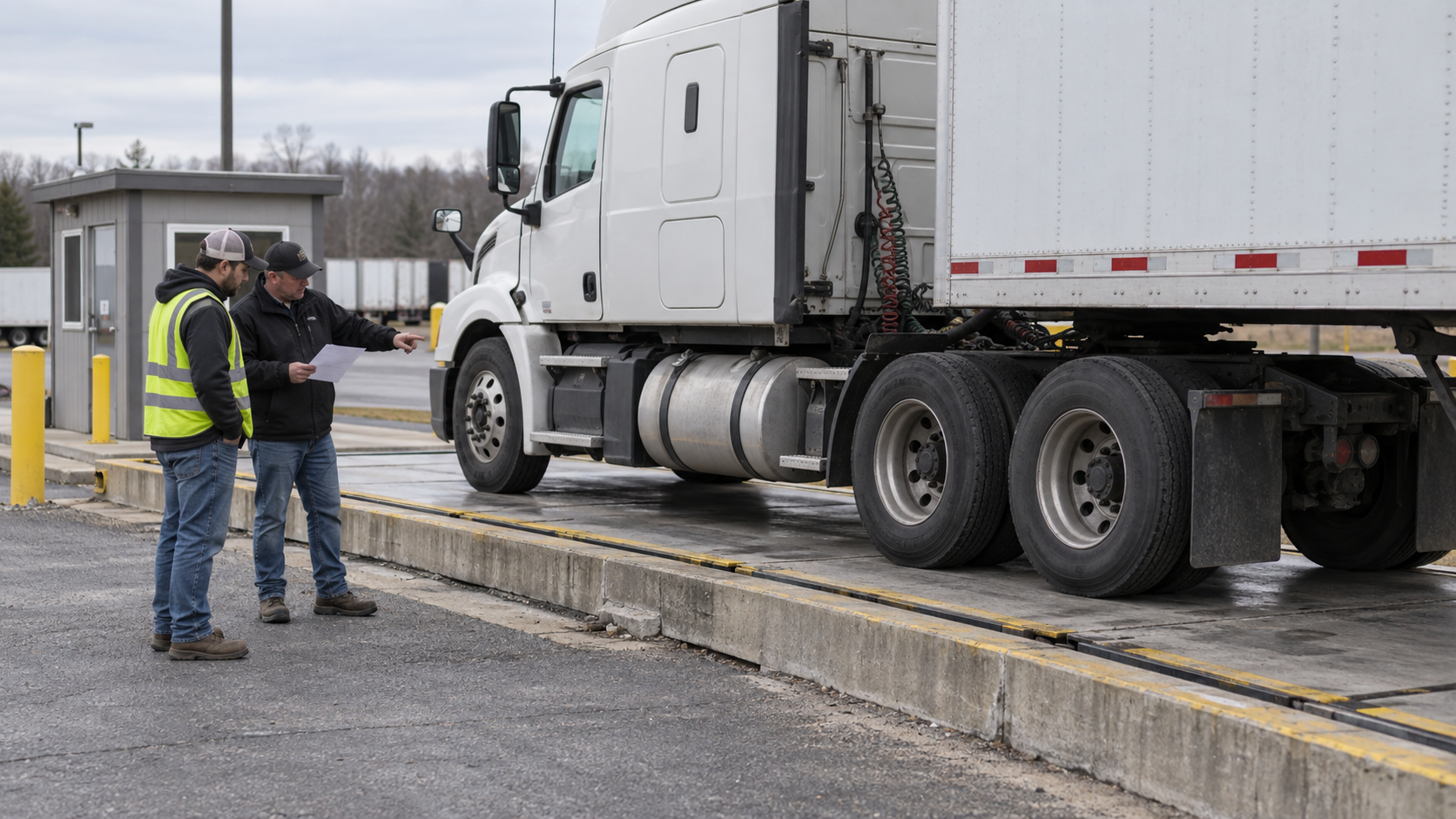
A load can be under 80,000 pounds in total and still place too much weight on a steer axle, drive tandem, trailer tandem, tire, suspension or coupling. The reverse is also important: seeing a familiar axle pattern does not prove that every route permits the same weight. State law, registration, permits, posted limits, equipment ratings and the federal Bridge Formula can all change the answer.
The practical habit is simple: identify every applicable limit, measure the actual axle weights, correct the distribution under an approved procedure, and use a new scale ticket to confirm the result.
What federal CDL training expects drivers to know
49 CFR 383.111 includes the principles of weight distribution and the relationship between cargo and vehicle control in the required driver knowledge areas. The federal Class A ELDT curriculum also covers cargo weight distribution, weigh stations and scales, vehicle size-and-weight limitations, bridge formulas and trip-planning restrictions.
Federal operating rules add a direct responsibility. Under 49 CFR 392.9, a driver may not operate a commercial motor vehicle unless the cargo is properly distributed and adequately secured. Weight compliance and securement therefore belong in the same departure decision.
Separate actual weight from rated capacity
A scale ticket reports what the vehicle weighs at that moment. Door labels, certification labels, tire sidewalls and component specifications report how much a vehicle or component is designed or rated to carry. A legal highway maximum does not increase a lower equipment rating.
| Term | What it means | Driver question |
|---|---|---|
| Gross vehicle weight (GVW) | Actual weight of one vehicle and its load | What does the vehicle weigh now? |
| Gross combination weight (GCW) | Actual combined weight of the powered unit, trailers and load | What does the complete combination weigh now? |
| Axle weight | Actual weight transmitted to the road by an axle or axle group | Is any individual group overloaded? |
| GVWR or GAWR | Manufacturer-rated maximum for a vehicle or axle system | Is the actual weight within the rating? |
| Tire load limit | Maximum load for the tire under its rating and operating conditions | Are the tires capable of carrying the measured load? |
| Registration or permit limit | Weight authorized for that vehicle and movement | Does the paperwork cover this weight and route? |
The lowest applicable limit controls. A 20,000-pound federal single-axle ceiling does not authorize 20,000 pounds on an axle, tires or suspension rated for less.
Know the federal Interstate baseline—and its limits
23 CFR 658.17 sets federal weight limits for the Interstate System and reasonable access. The familiar baseline figures are:
| Measure | Federal baseline | Important qualification |
|---|---|---|
| Single axle | 20,000 lb | A lower equipment, tire, registration, posted or other applicable limit can control |
| Tandem axle | 34,000 lb | The axle group must meet the tandem definition and all other limits |
| Gross weight | 80,000 lb | The Bridge Formula can require a lower weight for the axle count and spacing |
| Axle groups | Bridge Formula | Spacing and number of axles determine the maximum for the group being checked |
These numbers are not a universal permission slip. The FHWA Bridge Formula guide explains why axle spacing matters: spreading weight across more appropriately spaced axles reduces concentrated stress on bridge members. State rules, non-Interstate routes, local restrictions, posted bridges, seasonal rules, permits and grandfather provisions can produce a different result.
Before dispatch, connect the weight plan to ProntoCDL’s CDL trip-planning guide. The legal question is not only “What does the truck weigh?” but “Is that weight authorized on this exact route?”
Read the three main groups on a scale ticket
A common five-axle tractor-semitrailer ticket lists three platform readings:
- Steer axle: the tractor’s front axle. Its load affects steering response and is limited by the applicable law, tires, axle, suspension and vehicle ratings.
- Drive tandem: the tractor’s two rear drive axles. This group carries part of the tractor, the fifth-wheel load and part of the cargo load.
- Trailer tandem: the trailer axle group. Its share changes with cargo position and tandem position.
Add the three readings and compare the total with the ticket’s gross weight. If the numbers do not reconcile within the scale’s stated method or tolerance, ask the scale operator before making an adjustment. Then compare every line—not only the gross—with the route, registration, permit and equipment limits.
Understand what cargo position does to control
The current New York State Commercial Driver’s Manual, Section 3, explains that poor balance can make a vehicle unsafe even before a legal limit is reached. Too little weight on the front can reduce steering control. Too much can make steering difficult and damage the axle or tires. Too little weight on drive axles can reduce traction, while a high center of gravity increases rollover risk.
Freight should be loaded under the shipper’s, carrier’s and vehicle’s approved plan—not moved casually to chase a scale number. A concentrated coil, liquid, machine or pallet row behaves differently from evenly distributed freight. After any cargo change, inspect and restore the securement. ProntoCDL’s cargo-securement inspection checklist covers the related driver checks.
Choose the correction that matches the overweight group
Before touching a release handle, park on a suitable surface, prevent movement, confirm clearance and follow the carrier and manufacturer procedure. Tandems and fifth wheels can move suddenly, bind, or create crushing and clearance hazards.
| Adjustment | Typical weight effect | What else must be checked |
|---|---|---|
| Move trailer tandems forward | Typically shifts weight from the tractor drives toward the trailer tandem | Pin engagement, legal tandem position, wheelbase rules, mudflaps, rear overhang and trailer clearance |
| Move trailer tandems rearward | Typically shifts weight from the trailer tandem toward the tractor drives | Same checks, plus turning/off-tracking effects and route restrictions |
| Move sliding fifth wheel forward | Generally shifts weight from the drives toward the steer axle | Steer/tire ratings, cab-to-trailer clearance, landing-gear clearance, frame stops and locking mechanism |
| Move sliding fifth wheel rearward | Generally shifts weight from the steer toward the drives | Drive limit, trailer swing, landing-gear clearance and locking mechanism |
| Redistribute or remove cargo | Can change multiple groups and the center of gravity | Shipper approval, seal protocol, securement, load compatibility and new documentation |
“Typically” and “generally” matter. Suspension geometry, wheelbase, fifth-wheel location and cargo position change the result. There is no universal pounds-per-hole value. Use any carrier estimate only to plan a first adjustment, then reweigh.
A safe slide-and-reweigh sequence
- Diagnose the ticket. Mark the amount by which each group is over or under its applicable limit. Do not assume the gross is the only problem.
- Choose an approved correction. Contact dispatch, the shipper or a qualified supervisor when the load, seal, equipment or route makes the decision uncertain.
- Use a suitable location. Park on firm, level ground with room for the equipment to move and no person near the axle, frame, landing gear or pinch points.
- Follow the equipment procedure. Secure the vehicle, release the correct locking mechanism, move only as directed and stop before clearance becomes uncertain.
- Verify the locks. Visually confirm that the pins or jaws are fully engaged in the intended position. Never trust the handle position alone.
- Inspect connections and clearance. Check air and electrical lines, fifth-wheel and landing-gear clearance, tires, mudflaps and any component affected by the move. Review ProntoCDL’s fifth-wheel inspection guide when that assembly is involved.
- Reweigh. Obtain a new steer, drive, trailer and gross reading. A calculated estimate does not close the task.
- Keep the final ticket. Retain it under carrier procedure and make sure the route, permit and dispatch plan match the verified configuration.
Do not create a new hazard while solving a weight problem
- Never crawl beneath a trailer or place hands near a slider mechanism while the vehicle can move.
- Never hammer, pull or force a component contrary to the manufacturer or carrier procedure.
- Do not move a fifth wheel without confirming cab, frame, trailer and landing-gear clearance.
- Do not slide a tandem beyond the position allowed by the route or State.
- Do not break a seal or move freight without authorization and a securement plan.
- Do not leave the scale area with a known overload because a second scale “might read better.” Resolve the discrepancy where the vehicle can remain safely and legally stopped.
If the truck cannot be made compliant through an approved adjustment, the solution may require unloading freight, issuing new documents, obtaining a permit or selecting a different lawful route. Review ProntoCDL’s roadside inspection guide before a preventable weight problem becomes an enforcement problem.
A closed-yard scale-ticket practice drill
- Give the trainee a fictional three-line ticket showing steer, drive, trailer and gross weights.
- Provide a separate card with the vehicle ratings, tire limits, registration and route assumptions.
- Ask the trainee to identify every controlling limit and calculate the margin for each group.
- Have the trainee choose a correction and explain which direction weight is expected to move.
- Use a second fictional ticket to show the reweigh result and ask whether the move solved one overload but created another.
- Walk around a stationary training combination and identify slider locks, clearance points and no-go zones without moving the equipment.
Actual tandem or fifth-wheel movement should occur only under qualified supervision and the specific vehicle procedure. Connect the exercise to ProntoCDL’s Class A ELDT guide and reinforce the terminology in the free CDL practice center.
Practical takeaways
- Legal gross weight does not prove legal axle distribution.
- Compare actual scale readings with law, route, registration, permits, tires and vehicle ratings.
- Treat 20,000/34,000/80,000 as a qualified federal Interstate baseline, not a universal allowance.
- Read the steer, drive and trailer lines separately before planning a correction.
- Use tandem or fifth-wheel movement only under an approved procedure and after checking clearance.
- Never rely on a universal pounds-per-hole estimate.
- Reweigh after every adjustment and keep the final ticket under carrier procedure.
- Restore cargo securement and resolve route, seal or permit questions before departure.
CDL axle-weight and scale FAQ
Are 12,000 pounds on the steer axle and 34,000 pounds on each tandem a universal legal formula?
No. A 12,000-pound steer target is a common planning figure for some five-axle combinations, not a universal federal steer-axle limit. The legal and safe result depends on the route, State rules, Bridge Formula, tire ratings, axle and suspension ratings, registration, permits and manufacturer limits. Use the limits that apply to the actual vehicle and trip.
Can a truck be illegal even when its gross weight is below 80,000 pounds?
Yes. One axle or axle group can exceed its limit while the total remains below 80,000 pounds. The federal Bridge Formula can also produce a lower maximum for a particular axle spacing, and equipment, tire, registration, route or State limits may be lower.
Does sliding the trailer tandems change gross vehicle weight?
Sliding tandems normally redistributes existing weight between the tractor drive group and trailer tandem; it does not materially change the shipment’s total weight. Moving the tandems forward typically shifts weight from the tractor drives toward the trailer tandem, while moving them rearward typically shifts weight from the trailer tandem toward the tractor drives. Reweigh after every adjustment because the result varies.
How many pounds does one tandem-pin hole move?
There is no reliable universal pounds-per-hole number. Hole spacing, suspension geometry, wheelbase, cargo position and trailer design all affect the result. Carrier experience may provide an estimate for a specific trailer, but the scale—not the estimate—confirms the new axle weights.
Can a driver check the weight of a sealed load?
Yes. The current CDL manual explains that sealed loads may prevent a cargo inspection but drivers can still check gross and axle weights. Follow the carrier, shipper, customer and security procedure before breaking any seal or opening the trailer.
What should a driver do after finding an overweight axle or gross weight?
Keep the vehicle in a safe, legal location and contact the carrier or shipper. The approved solution may involve redistributing cargo, adjusting the tandem or fifth wheel, removing freight, correcting paperwork, obtaining a permit or changing the route. Reweigh and verify securement and clearance before proceeding.
Weigh every group. Correct the cause. Confirm the result.
A final scale ticket is the proof that a planned adjustment produced a compliant distribution.
Start free CDL practice