
ELDT Hours Guide: Federal Minimums, Proficiency and Training Records
Federal Entry-Level Driver Training is built around completed curriculum, a passing theory score and demonstrated behind-the-wheel proficiency—not one universal number of classroom or driving hours. Understanding that distinction helps applicants compare schools without confusing a program schedule with the federal minimum.
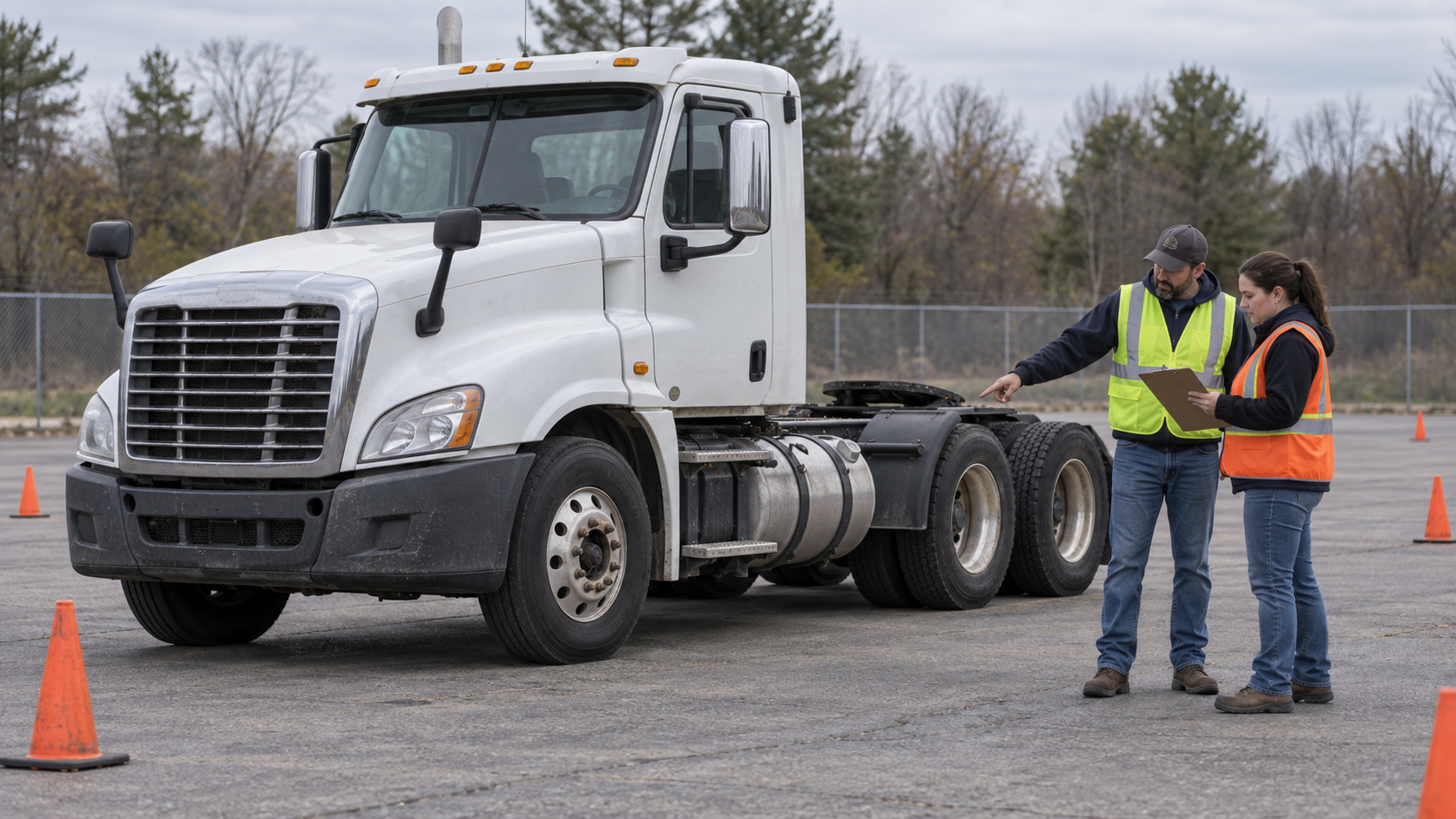
“How many ELDT hours do I need?” sounds like a simple question, but it combines several different requirements. FMCSA sets the federal curriculum and completion standards. A state, school, employer, grant or insurance program may add a scheduled-hour requirement. A useful answer separates those layers before a student signs an enrollment agreement.
The federal rule is not permission to rush. A provider must teach every required topic and a trainee must meet every required outcome. A student who needs more time to control the vehicle safely needs more instruction, even though the federal appendix does not prescribe a fixed hour total.
The short answer: no single federal ELDT hour minimum
The federal Class A ELDT curriculum and corresponding Class B curriculum say there is no required minimum number of instruction hours for the theory portion. They also say there is no required minimum number of instruction hours for the behind-the-wheel portion.
That does not mean ELDT is optional or undefined. The training provider must cover all required theory topics. For a curriculum with behind-the-wheel instruction, the instructor must cover all required range and public-road elements and determine that the trainee is proficient in each skill.
| Federal completion gate | What the rule requires | What it does not establish |
|---|---|---|
| Registered provider | Training must come from a provider listed on the FMCSA Training Provider Registry for the applicable curriculum. | Registration does not make every provider schedule identical. |
| Theory assessment | An overall score of at least 80% after all required theory topics are covered. | No single federal classroom-hour total. |
| Behind-the-wheel proficiency | The instructor must teach and document proficiency in every required range and public-road element. | No single federal driving-hour total and no automatic pass based on attendance. |
| Registry record | The provider submits completion data to the TPR after the curriculum is completed. | A paper certificate alone does not replace the electronic record used for test eligibility. |
ELDT applies to specific first-time and upgrade transactions
Current FMCSA applicability guidance covers drivers who first obtain a Class A or Class B CDL, upgrade an existing Class B CDL to Class A, or first obtain a passenger, school bus or hazardous-materials endorsement, unless a listed exception applies. The federal requirements generally apply when the relevant commercial learner’s permit was issued on or after February 7, 2022.
Applicants should match the exact transaction to the correct curriculum. ProntoCDL’s Class A, Class B and HazMat ELDT resources explain those pathways. The ELDT readiness checklist helps confirm that the provider and completion record match the test you plan to take.
Three standards replace a universal clock
1. The provider must cover the whole curriculum
A provider cannot treat the federal topic list as a menu. Every required unit in the applicable appendix must be covered. For Class A, that includes theory subjects such as basic operation, safe operating procedures, advanced operating practices, vehicle systems and reporting malfunctions, and non-driving activities.
2. Theory requires an overall score of at least 80%
49 CFR 380.609 requires a driver-trainee to complete theory training and receive an overall assessment score of at least 80 percent. The federal threshold is a completion standard, not a study target. A trainee who barely clears it but cannot explain air brakes, space management or vehicle inspection should keep studying before the permit or skills-test phase.
3. Behind-the-wheel training ends with documented proficiency
For curricula that include behind-the-wheel instruction, attendance is not enough. The instructor must determine that the trainee is proficient in every required skill. Class A training divides this work between a range and a public road. The range portion develops vehicle control in a protected environment; public-road training applies those skills in traffic, turns, lane changes, grades, visual search and other real operating conditions.
Proficiency is individualized. One student may need extra repetitions on coupling or alley docking; another may need more public-road coaching on speed selection or lane position. A responsible program has room for both.
Simulators and observation do not replace ELDT driving
Simulation, video and observation can be useful preparation, but the federal Class A and Class B curricula are explicit: simulators cannot be used to conduct behind-the-wheel training or to demonstrate proficiency. Required BTW work takes place in an actual commercial motor vehicle appropriate for the class or endorsement.
Ask a school to separate these categories when it quotes “driving time”:
- Individual wheel time: the trainee is operating the vehicle.
- Group observation: another student is driving while the trainee watches.
- Simulation: a training aid that may reinforce concepts but is not federal BTW time.
- Range time: actual-vehicle exercises on a controlled practice area.
- Public-road time: actual-vehicle operation on public roads with the instructor.
A headline course total is difficult to compare until those hours are separated.
Common credential paths have different training components
| Credential transaction | Federal ELDT components | Federal completion standard |
|---|---|---|
| First Class A CDL | Class A theory, range and public-road training. | At least 80% theory score plus proficiency in all Class A BTW elements. |
| First Class B CDL | Class B theory, range and public-road training. | At least 80% theory score plus proficiency in all Class B BTW elements. |
| Class B to Class A upgrade | Class A upgrade theory and BTW curriculum. | At least 80% theory score plus proficiency in all upgrade BTW elements. |
| First passenger or school bus endorsement | Applicable endorsement theory and BTW curriculum. | At least 80% theory score plus proficiency in required endorsement BTW elements. |
| First hazardous-materials endorsement | HazMat theory curriculum. | At least 80% theory score; the federal H curriculum has no BTW component. |
A driver may need more than one curriculum. A first-time Class B applicant preparing to operate a school bus, for example, should confirm the base-license, passenger and school-bus requirements rather than assuming one completion record covers everything.
What the provider reports and retains
Under 49 CFR Part 380, Subpart G, a registered provider reports completion information to the Training Provider Registry by midnight of the second business day after training is completed. The submission identifies the trainee, the completed training and the provider and includes the required certification.
Providers also retain supporting records. The federal record-retention rule covers items such as training materials, instructor qualification documentation, the trainee’s theory and BTW records, and range self-certifications where applicable. The curricula require providers to document the total number of BTW clock hours, even though they do not prescribe a universal minimum.
Before reserving a test, ask the provider to confirm the exact name, license or permit information and completed curriculum that will be submitted. The trainee does not self-report federal completion to the TPR.
Why schools still advertise fixed-hour programs
A course can have a legitimate fixed schedule even when the federal rule has no universal hour minimum. The schedule may be designed to satisfy:
- a state licensing or school-approval rule;
- a workforce grant or financial-aid condition;
- an employer, insurer or apprenticeship standard;
- accreditation or program-quality requirements;
- time for classroom, range, road, observation and testing logistics.
Ask the school to identify which hours are legally required, which are part of its curriculum design and which are individual actual-vehicle practice. “FMCSA registered” describes the provider’s federal status; it does not prove that every student receives the same amount of wheel time or that every program serves the same job goal.
Questions to ask before enrolling
- Which exact TPR curricula will you report? Match each one to the license class and endorsements you need.
- How is the advertised time divided? Request separate totals for theory, observation, simulation, range wheel time and public-road wheel time.
- How many students share each truck and instructor? A long day does not guarantee much individual practice.
- What happens if proficiency takes longer? Understand extra-practice availability, cost and scheduling before signing.
- What vehicle will be used for training and testing? Transmission, air-brake and vehicle-type choices may affect CDL restrictions.
- When do you submit completion records? Build the two-business-day federal reporting window into the testing plan.
- Which additional requirements apply? Confirm state, funding and employer standards separately from the federal ELDT floor.
A practical ELDT completion plan
- Define the CDL class, upgrade and endorsements required for the intended job.
- Check whether ELDT applies to each transaction and identify the correct curriculum.
- Verify the provider’s current TPR listing before paying.
- Use the state CDL manual and study-guide routine to prepare for theory assessments.
- Track your own range and road skills, not merely days attended.
- Ask for focused practice on any skill that is not yet repeatable and safe.
- Confirm the TPR submission before relying on a skills- or knowledge-test appointment.
Practical takeaways
- Federal ELDT does not impose one universal minimum number of theory or BTW hours.
- No hour minimum does not mean no standard: all required topics, an 80% theory score and documented BTW proficiency still apply.
- Simulators and observation can support learning but do not replace required actual-vehicle BTW training.
- A school’s 160-hour or other fixed schedule may be valuable, but ask which authority or program created it.
- Compare individual range and public-road wheel time, class size, equipment and extra-practice policy.
- Verify the provider’s TPR listing and the exact curriculum it will submit.
- Allow for the provider’s federal reporting window before a test appointment.
ELDT hours and proficiency FAQ
How many ELDT hours are required by the federal rule?
The federal ELDT curricula do not set one minimum number of theory or behind-the-wheel hours. A registered provider must cover the required curriculum, the trainee must earn at least 80 percent on the theory assessment, and the instructor must determine and document proficiency in every required behind-the-wheel skill.
Is a 160-hour CDL course required by FMCSA?
No. A 160-hour schedule may come from a school, state, grant, employer, accreditor or program design, but it is not a universal FMCSA minimum. Confirm every separate requirement that applies to your license, funding and job plan.
What score is required on ELDT theory assessments?
The driver-trainee must receive an overall theory-assessment score of at least 80 percent. Providers may use written or electronic assessments and may require a higher internal standard.
Can simulator time count as ELDT behind-the-wheel training?
No. The federal curricula state that simulators cannot be used to conduct behind-the-wheel training or to demonstrate proficiency. Range and public-road training must occur in an actual commercial motor vehicle appropriate for the curriculum.
Does HazMat ELDT require behind-the-wheel hours?
The federal Hazardous Materials endorsement curriculum is theory-only. A first-time H endorsement applicant covered by ELDT must complete that theory curriculum with a registered provider before taking the state knowledge test.
How quickly must a provider report ELDT completion?
A registered provider must submit the required certification information to the Training Provider Registry by midnight of the second business day after the trainee completes the training. Verify that the record is present before scheduling around a test date.
Train for safe, repeatable performance.
Use the federal standards to compare programs, then build the knowledge and vehicle-control skills your CDL path actually requires.
Start free CDL practice