
CDL Tanker Endorsement Guide: N vs. X, Tank Sizes and Test Rules
“It is liquid, so I need tanker” is too broad. “It is in totes, so I do not” can be dangerously narrow. The federal rule turns on the vehicle, each tank’s rated capacity, the combined rated capacity and whether hazardous-material qualification is also required. Use the numbers and cargo documents—not the trailer’s silhouette—to decide what credential belongs on the CDL.
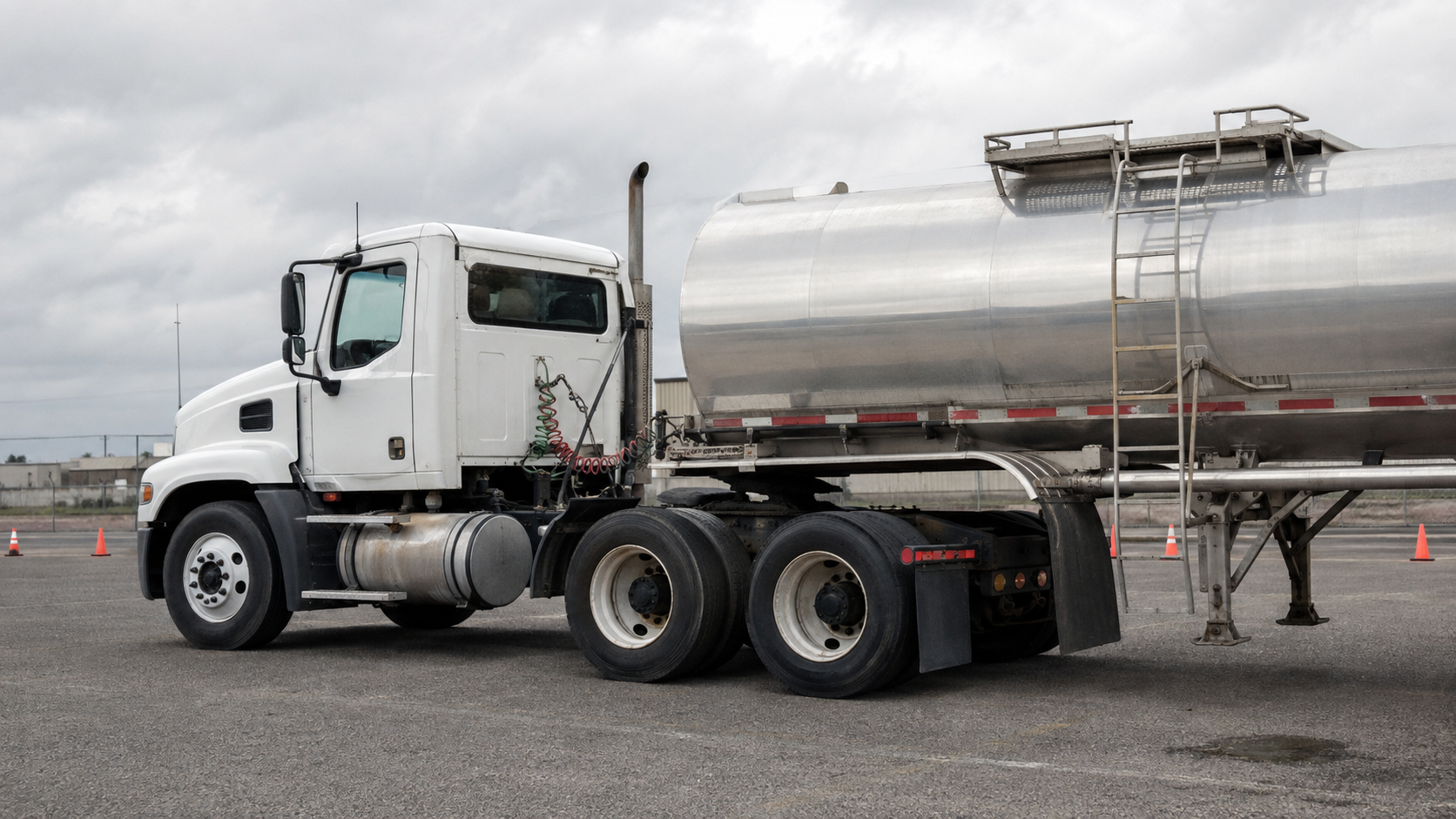
The starting point is the federal definition in 49 CFR 383.5. A tank vehicle is a commercial motor vehicle designed to transport liquid or gaseous material in one or more tanks that meet the stated capacity thresholds and are permanently or temporarily attached to the vehicle or chassis.
49 CFR 383.93 requires a State-issued endorsement to operate a tank vehicle and specifies a knowledge test for N. 49 CFR 383.119 identifies the tanker subjects the applicant must understand.
The federal tank-vehicle threshold in plain language
Use this two-part capacity test:
- Individual tank size: the relevant tank or each tank being aggregated has a rated capacity of more than 119 gallons.
- Aggregate tank size: the qualifying tank capacities total 1,000 gallons or more.
Both numbers matter. “More than 119” means a 120-gallon tank clears the individual threshold, but it does not create an N requirement by itself because the aggregate is still below 1,000. A single 1,000-gallon transportation tank clears both thresholds. Rated capacity—not the number of gallons currently loaded—is the comparison used by the definition.
| Example configuration | Federal threshold result | Why |
|---|---|---|
| One 1,200-gallon cargo tank | Meets tank-vehicle capacity test | The individual tank exceeds 119 gallons and the aggregate exceeds 1,000. |
| Two loaded 500-gallon IBCs | Meets when the tanks fit the attachment/guidance conditions | Each tank exceeds 119 gallons and together they total 1,000. |
| Four loaded 250-gallon tanks | Meets when properly counted as part of the CMV configuration | Every tank exceeds 119 gallons and the aggregate is 1,000. |
| One 999-gallon transportation tank | Does not meet this federal capacity test | The aggregate rated capacity is below 1,000 gallons. |
| Ten 100-gallon tanks | Does not meet this federal definition | No individual tank has a rated capacity greater than 119 gallons. |
| Empty 1,500-gallon storage tank not designed for transportation, temporarily on a flatbed | Specifically excluded from the definition | Section 383.5 contains this narrow storage-container exception. |
This table addresses only the federal tank-vehicle endorsement definition. It does not decide CDL class, vehicle weight, cargo securement, hazardous-material status, placarding, State licensing or whether a particular container is approved for transportation.
Portable tanks and IBCs can count
A permanent cargo tank is the easy case. Portable configurations require closer attention. FMCSA guidance on loaded IBCs says the definition covers a vehicle carrying one tank with a rated capacity of at least 1,000 gallons or multiple tanks that each exceed 119 gallons and together total at least 1,000 gallons when they are permanently or temporarily attached to the vehicle or chassis.
FMCSA also answers yes when asked whether an unattached tote or portable tank of at least 1,000 gallons requires the tank-vehicle endorsement. The safe workflow is to obtain the container’s rated capacity, count every qualifying tank in the shipment and check the current FMCSA guidance and State licensing instructions. Do not infer capacity from physical dimensions or a familiar product name.
N, H and X are different qualifications
49 CFR 383.153 standardizes the endorsement codes:
- N — Tank vehicle: the driver has qualified for tank-vehicle operation.
- H — Hazardous materials: the driver has qualified for the hazardous-materials endorsement.
- X — Tank and hazardous materials: the driver holds the combined tank-vehicle and hazardous-material qualifications.
The product does not have to be hazardous for N to apply. Food-grade oil, milk, water or another non-hazardous liquid can still be in a qualifying tank vehicle. Conversely, the shape of a tanker does not by itself prove H is required; hazardous-material classification, quantity and placarding rules are separate questions.
When a shipment needs both tank-vehicle and hazardous-material qualifications, the CDL shows X rather than treating N alone as sufficient. Review shipping papers, container specifications and the carrier’s compliance determination before dispatch. Continue with the ProntoCDL hazmat transport guide for the separate document, placard and safety workflow.
What the N endorsement test covers
The federal rule requires a knowledge test, not a separate federal N skills test. Section 383.119 says the applicant must understand:
- Causes, prevention and vehicle-handling effects of cargo surge
- Proper braking when the tank is empty, full or partially full
- Handling differences among baffled, compartmented and non-baffled tanks
- Tank-vehicle types and construction
- How product density changes surge behavior
- Effects of road grade and curves at different fill levels
- Proper use of emergency systems
- Retest and marking requirements for DOT-specification tank vehicles
- Other safe operating practices
Study from the current commercial driver manual issued or adopted by your licensing State. The State knowledge test implements the federal subject areas, but wording, application steps, fees and retest procedures can differ.
Why liquid surge changes driving technique
Liquid keeps moving after the vehicle changes speed or direction. During braking, forward surge can push against the tank after the initial deceleration. When accelerating or shifting, the movement can reverse. Side-to-side movement in a curve adds to the rollover risk already created by a tank vehicle’s center of gravity.
Baffles contain openings that slow longitudinal liquid movement but do not eliminate it. Compartments divide the load into separate sections and change the timing and amount of movement. A smooth-bore tank has no internal baffles to slow surge, so gentle control inputs and added stopping space become especially important. Learn the actual tank configuration before moving the vehicle.
A partly filled tank generally gives the liquid more room to move. “Half full” is not automatically safer than full or empty. Enter curves below the posted maximum when the vehicle, load, weather or road requires it; brake early and smoothly; and avoid abrupt steering. The endorsement exam is testing whether the driver connects tank construction and fill level to vehicle control.
Federal ELDT: N alone versus an X plan
The federal ELDT credential list covers first-time Class A and Class B CDLs, a Class B-to-A upgrade, and first-time passenger (P), school bus (S) and hazardous materials (H) endorsements. It does not list N as a stand-alone ELDT trigger. The FMCSA Training Provider Registry applicability page reflects the same scope.
That means adding N alone does not require a federal ELDT course. If the goal is X and the applicant is obtaining H for the first time, H theory training from a registered provider must be completed before the State administers the H knowledge test, unless an exception applies. The applicant must also satisfy the separate hazardous-material eligibility and security process.
ELDT completion is only one step. It does not replace the State’s N or H knowledge test or cause an endorsement to appear automatically. Use the ELDT readiness checklist to verify provider records and testing sequence.
How to add N without missing a step
- Confirm the job and equipment. Identify the CDL class, tank configuration, rated capacities and whether hazardous materials will be transported.
- Read the State manual. Study the tank-vehicle section and the State’s application, identity, fee and renewal requirements.
- Separate N from H. If the work may require X, plan for H ELDT, the H knowledge test and the security-eligibility process instead of studying only N.
- Practice the federal topics. Explain surge, fill level, tank construction, braking, curves, grades and emergency systems without relying on answer-letter memorization.
- Pass the required knowledge test or tests. Federal rules call for a knowledge test for N; the State issues the endorsement after its requirements are met.
- Verify the credential. Check the physical or temporary CDL and the driver record before accepting a tank assignment.
CLP tanker practice has a cargo restriction
N is one of the endorsements allowed on a commercial learner’s permit. However, section 383.153 limits the CLP holder to an empty tank vehicle. The trainee may not operate a tank vehicle that previously carried hazardous material unless it has been purged of residue. The required supervising CDL holder, matching qualifications and all other permit restrictions still apply.
This is a common study trap: being allowed an N code on the CLP does not mean the learner may practice with a partial non-hazardous load. Build behind-the-wheel familiarization around a compliant empty vehicle and the carrier’s training controls.
A practical tanker study routine
- Memorize the threshold correctly: more than 119 gallons per counted tank and at least 1,000 gallons aggregate.
- Sort six capacity examples: decide whether each configuration meets both parts of the definition and explain why.
- Draw the endorsements: N for tank, H for hazmat, X for both.
- Compare tank interiors: baffled, compartmented and smooth bore.
- Explain three load states: empty, full and partially full, with braking and curve implications.
- Review mistakes by concept: capacity, credential, construction, surge, braking or ELDT.
Use the ProntoCDL surge glossary entry to lock in the core concept, then work through the free CDL study-plan guide and the practice center.
Practical takeaways
- Do not decide by trailer appearance; check the CMV definition and rated tank capacities.
- Apply both thresholds: each counted tank must exceed 119 gallons, and the aggregate must reach 1,000 gallons.
- Loaded IBCs and portable tanks can create an N requirement.
- N covers tank vehicles; X combines tank and hazardous-material qualifications.
- The federal N requirement is a knowledge test, not a separate N skills test.
- N alone does not trigger federal ELDT, but first-time H qualification for X does.
- An N-endorsed CLP permits practice only in an empty, compliant tank vehicle.
- Study surge, fill level, tank construction, braking, curves, grades and emergency systems as one vehicle-control problem.
Frequently asked questions
Does every truck carrying liquid require a tanker endorsement?
No. The federal tank-vehicle definition uses both tank size and aggregate capacity. The tank or tanks must have an individual rated capacity of more than 119 gallons, and the aggregate rated capacity must be at least 1,000 gallons. The CMV must also fit the definition in 49 CFR 383.5. State licensing rules and hazardous-material requirements still need a separate check.
What is the difference between an N and an X endorsement?
N authorizes operation of qualifying tank vehicles. H authorizes hazardous-material transportation when that endorsement is required. X is the standardized CDL code for the combination of tank-vehicle and hazardous-material endorsements. A driver carrying a non-hazardous qualifying bulk liquid may need N without H; a qualifying tank shipment of placarded hazardous material generally calls for the combined qualifications represented by X.
Do I need federal ELDT to add an N tanker endorsement?
Federal ELDT rules do not list N as a credential that independently triggers entry-level driver training. They cover first-time Class A or B CDLs, a Class B-to-A upgrade, and first-time P, S or H endorsements. If the plan includes first-time H qualification for an X endorsement, the H theory-training requirement applies before the State H knowledge test. A State may add its own procedures.
Can a tanker CLP holder practice with liquid cargo?
No. Under 49 CFR 383.153, a CLP holder with an N endorsement may operate only an empty tank vehicle and may not operate a tank vehicle that previously carried hazardous material unless it has been purged of residue. The accompanying driver and all other CLP rules still apply.
Can loaded IBC totes create a tanker-endorsement requirement?
Yes. FMCSA guidance says loaded intermediate bulk containers or other tanks can count when the capacity thresholds are met. Multiple tanks must each exceed 119 gallons and together total at least 1,000 gallons; a single qualifying tank of at least 1,000 gallons can also meet the definition. Confirm rated capacities from reliable documentation rather than estimating from appearance.
Does an empty highway tank trailer still count as a tank vehicle?
A cargo tank trailer remains a vehicle designed to transport liquid or gas even when empty, so the tank-vehicle qualification does not disappear simply because the load was delivered. The regulation separately excludes an empty storage-container tank not designed for transportation, rated at least 1,000 gallons, when temporarily attached to a flatbed. Hazardous-material residue can create additional requirements.