
Alley Dock Backing: 7 CDL Practice Tips for Better Control
Alley docking is a low-speed control exercise, not a race. The most repeatable results come from a consistent setup, tiny steering corrections and a willingness to stop before uncertainty becomes a boundary strike.
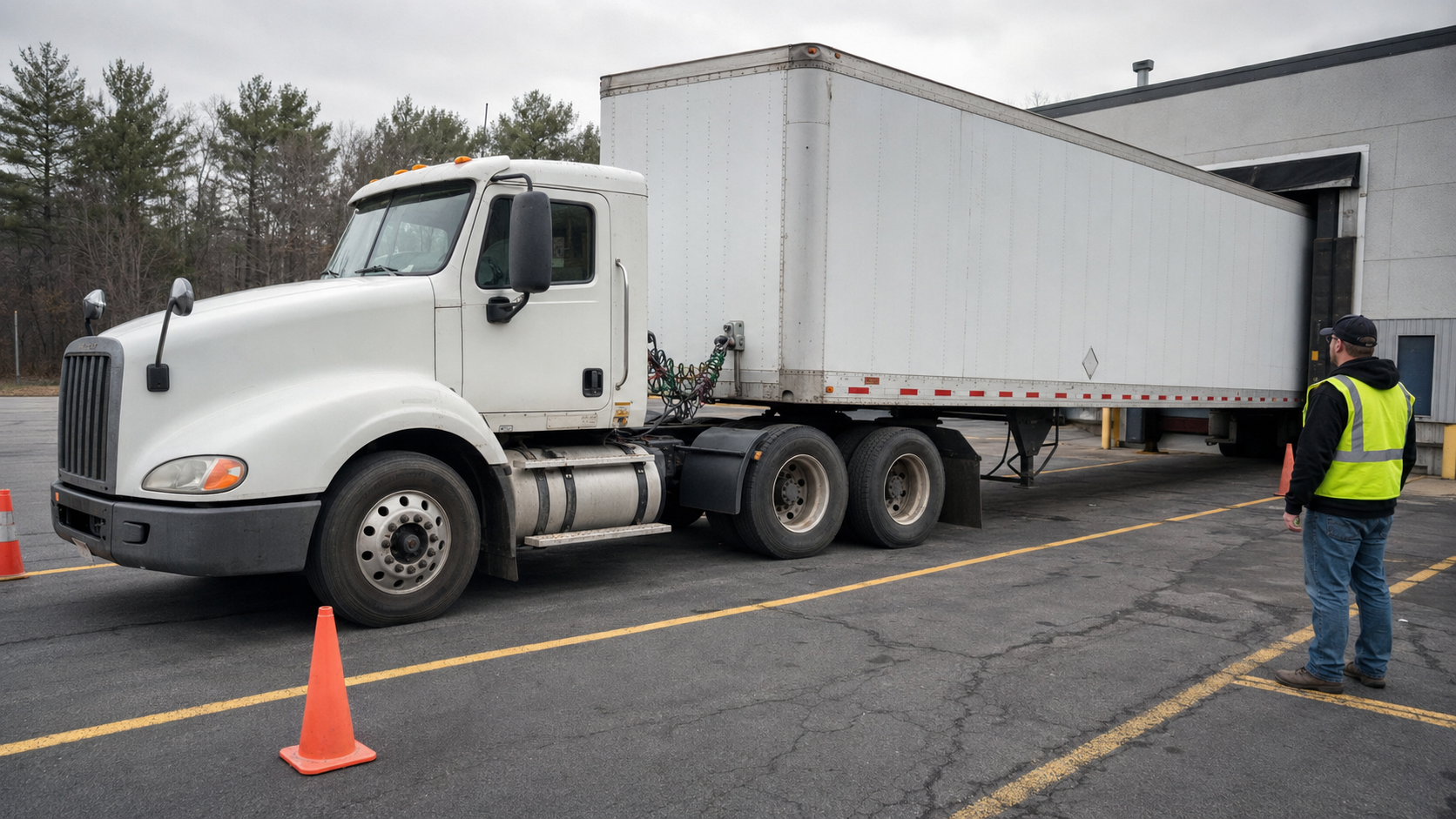
1. Make the setup repeatable
Use the same reference points approved by your instructor and match the test vehicle’s dimensions. A good setup gives the trailer room to rotate without forcing a dramatic late correction.
2. Back at idle speed
Cover the brake and move slowly enough to process both mirrors. Speed turns a small alignment error into a large one before you can respond.
3. Watch the trailer, not only the tractor
The trailer path is the main event. Track the landing gear, trailer sides and rear corner while checking the tractor’s clearance and front swing.
4. Use both mirrors deliberately
Alternate mirrors on a rhythm. The sight side provides more information, but the opposite mirror can reveal trailer drift or a boundary you are approaching.
5. Correct early and in small amounts
A small early correction is easier to unwind than a large late correction. Give the trailer time to respond before adding more steering.
6. Stop and GOAL
Get Out And Look whenever permitted and needed. Place the transmission in neutral, set the parking brakes and secure the vehicle according to the test and school procedure before leaving the seat.
7. Use pull-ups strategically
A pull-up is a control tool. Straighten the combination, restore space and restart from a position you understand. Know how your state scores pull-ups and boundary errors.
Diagnose the decision before repeating the maneuver
Illustrative exercise: a learner reaches the target area but makes several corrections without knowing which one changed the trailer path. During the next supervised drill, work on one objective, such as recognizing drift early. Stop when position or clearance is uncertain, inspect the path and reset. Record observation, correction and result after each attempt.
Is a successful final position enough to explain why the maneuver improved?
No. Identify what the learner observed and which controlled decision helped. A repeatable method is more useful than a lucky final position.
Practical takeaways
- Consistency in setup matters more than memorizing one steering count.
- Slow speed creates time to see and correct.
- Track both trailer path and tractor swing.
- Stop when uncertain and use a permitted GOAL.
- Practice with the same state test dimensions and rules you will face.
Continue with the ProntoCDL Practice Center, review key terms in the CDL Glossary, or open the Study Guides.
Frequently asked questions
Should I turn the wheel faster to make the trailer react?
Large rapid steering inputs often create overcorrection. Use deliberate inputs and wait long enough to observe the trailer response.
Is a pull-up an automatic failure?
Scoring varies by jurisdiction. A controlled pull-up may cost fewer points than a boundary strike; follow your state manual and examiner instructions.
Can I get out and look during the test?
Rules vary. Learn the exact state procedure, including how to secure the vehicle before leaving the seat.
Why does the same reference point stop working?
Vehicle wheelbase, trailer length, seat position, mirror adjustment and initial setup can all change the geometry.