
CDL Alcohol Rules: 0.02 vs. 0.04 & the Four-Hour Rule
Federal CDL alcohol rules use several boundaries for different purposes. Four hours controls pre-duty use, 0.02 starts a test-result removal period, 0.04 is prohibited conduct, and Part 392 can still bar operation when any alcohol is detected on duty. Treating those rules as one “legal limit” creates dangerous mistakes.
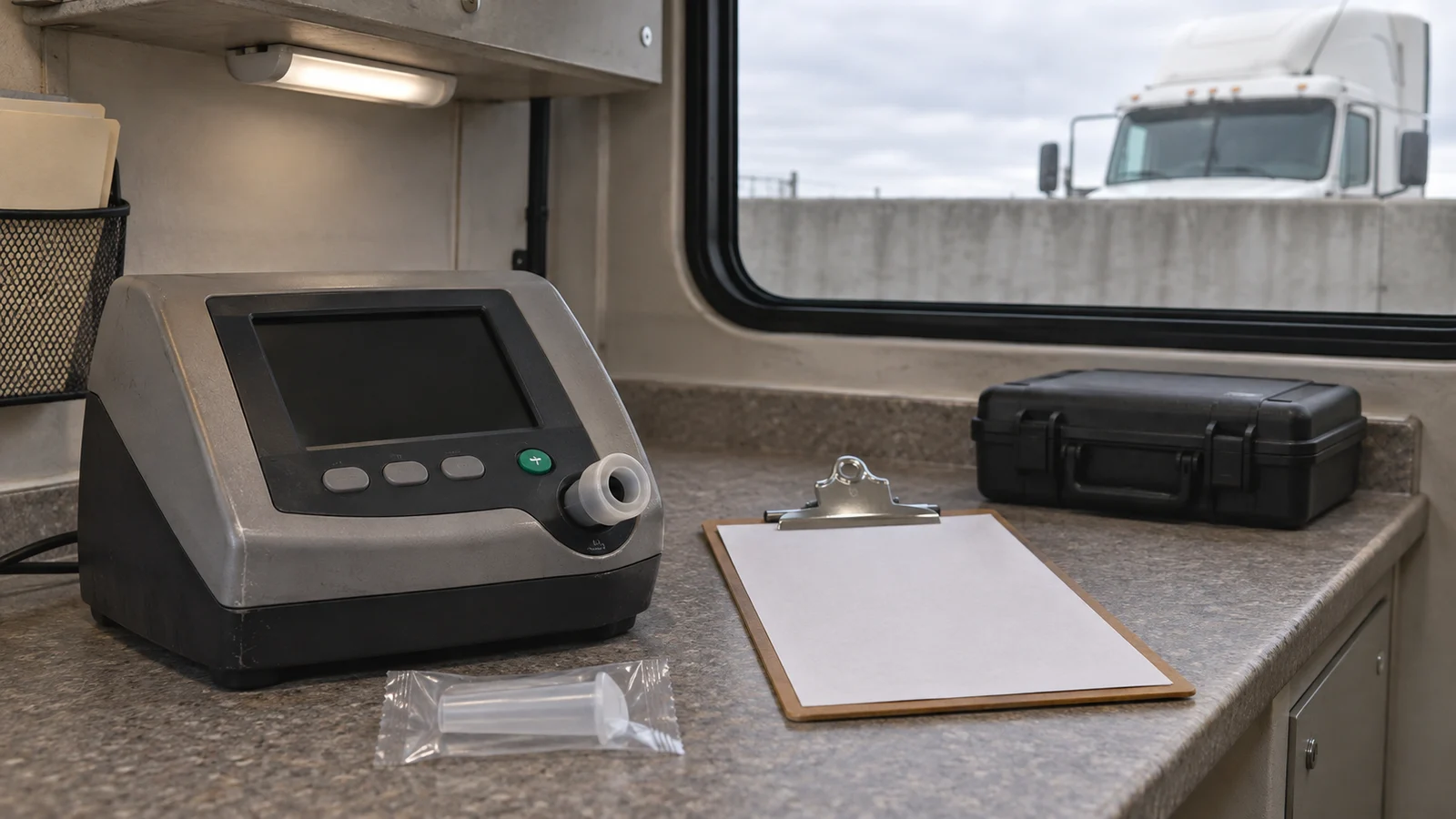
A CDL is not governed by the ordinary passenger-car idea that a driver is safe until a single blood-alcohol threshold is reached. FMCSA rules regulate when alcohol may be used, what work a driver may perform, what a DOT breath result means and what process follows a violation.
The safest planning rule is simple: if there is any question about alcohol, do not report ready for safety-sensitive work. Contact the carrier before touching the truck, inspecting equipment, accepting dispatch or beginning another covered function. Federal minimums do not replace professional judgment or a stricter lawful company policy.
The four federal boundaries drivers confuse
| Boundary | What it controls | Immediate consequence |
|---|---|---|
| Four hours after alcohol use | Pre-duty timing under 49 CFR 382.207 | No safety-sensitive functions during that period |
| Any on-duty use or detected presence | Operational prohibition under 49 CFR 382.205 and 392.5 | Do not remain on duty, operate or control a CMV |
| 0.02 to below 0.04 | DOT alcohol-test result under 49 CFR 382.505 | Removal until the next regular duty period and at least 24 hours |
| 0.04 or greater | Prohibited conduct under 49 CFR 382.201 | Removal plus the DOT SAP and return-to-duty process |
Each line answers a different question. A driver cannot use “I was below 0.04” as a defense for drinking two hours before work. Likewise, four hours passing does not guarantee a driver is unimpaired or that no alcohol will be detected.
What counts as alcohol use?
49 CFR 382.107 defines alcohol broadly as the intoxicating agent in beverage alcohol and certain other low-molecular-weight alcohols. “Alcohol use” means drinking or swallowing a beverage, liquid mixture or preparation—including medication—that contains alcohol.
That definition is why a professional driver should review liquid medicines, tonics and similar products before a shift. The label, dose and timing matter. A lawful over-the-counter purchase is not automatically compatible with safety-sensitive work, and a medication concern may also require discussion with a medical professional.
Do not use home calculations, body weight, coffee, food or a cold shower to predict readiness. Alcohol elimination varies, and none of those shortcuts changes the federal timing rule or a measured DOT result.
The four-hour pre-duty rule is a minimum—not a clearance
Under 49 CFR 382.207, a driver may not perform safety-sensitive functions within four hours after using alcohol. An employer with actual knowledge of use within that period may not allow the driver to begin or continue those functions.
The period runs from the last alcohol use, not from the start of a meal, the time a social event began or when the driver went to sleep. If the last drink was at 2:00 a.m., the federal four-hour boundary does not arrive until 6:00 a.m. That still does not establish that the driver is fit, unimpaired or alcohol-free at 6:01.
Carrier policy may require a longer interval or prohibit alcohol for a greater period before scheduled work. A driver must satisfy both the applicable federal minimum and the employer’s lawful policy.
Safety-sensitive work starts before the truck moves
The Part 382 definition covers the period when a driver is actually performing, ready to perform or immediately available to perform covered work. It includes waiting to be dispatched unless relieved from duty, inspecting or servicing a CMV, time at the controls, most time in or on the vehicle, loading or unloading activities and attending a disabled vehicle.
This means “I did not drive yet” is not a reliable defense. A pre-trip inspection, coupling check, loading task or dispatch-ready period can be safety-sensitive. ProntoCDL’s employer road-test guide and post-trip inspection guide show how much professional driving work happens outside actual highway movement.
On-duty alcohol use is prohibited
49 CFR 382.205 prohibits alcohol use while performing safety-sensitive functions. Section 392.5 is broader in operational terms: a driver may not use alcohol, be under its influence or have any measured concentration or detected presence while on duty, operating or in physical control of a CMV.
The rules do not create a “small amount is allowed on duty” exception. A driver who discovers an alcohol-containing product was used, feels residual effects or is uncertain about readiness should stop before performing covered work and contact the designated employer representative.
Why 0.02 and 0.04 lead to different outcomes
Result below 0.02
A DOT screening result below 0.02 does not trigger the specific 24-hour removal rule in Section 382.505, and Part 40 does not require a confirmation test at that level. But it should not be described as an automatic federal permission to operate. Part 392’s on-duty prohibition, actual fitness, carrier policy and the facts of the event still apply.
Result from 0.02 through 0.039
49 CFR 382.505 requires removal from safety-sensitive functions until the start of the driver’s next regularly scheduled duty period, and at least 24 hours must have elapsed after the test. Both conditions matter.
Example: a test is administered Monday at 9:00 a.m. The driver’s next regular duty period begins Tuesday at 7:00 a.m. Twenty-two hours have passed, so the driver still cannot return at 7:00. If the next regular duty period instead begins Wednesday at 7:00 a.m., the driver does not automatically return Tuesday at 9:00 just because 24 hours passed; the rule points to the next regularly scheduled duty period and sets 24 hours as the minimum.
A 0.02-to-below-0.04 result does not by itself trigger federal SAP evaluation or return-to-duty testing. Part 382 also says the employer may not take additional action under that part based solely on a result below 0.04, apart from the required removal. The employer may have independent authority under a lawful policy or other law.
Result of 0.04 or greater
49 CFR 382.201 prohibits reporting for or remaining on safety-sensitive duty at an alcohol concentration of 0.04 or greater. This is not a 24-hour-only situation. The driver must be removed and complete the DOT Substance Abuse Professional evaluation, prescribed education or treatment, return-to-duty test and follow-up plan before resuming covered work.
ProntoCDL’s Clearinghouse and CDL-downgrade guide explains how prohibited status and return-to-duty milestones affect the commercial driving privilege.
Possession in the cab is a separate problem
49 CFR 392.5 generally prohibits a driver from being on duty or operating a CMV while possessing specified wine, beer or distilled spirits. The rule provides limited exceptions for alcohol properly manifested and transported as cargo and for alcohol possessed or used by bus passengers.
An unopened personal bottle in a sleeper compartment is not automatically protected merely because it is sealed or not being consumed. Drivers should keep personal alcohol out of the CMV and follow cargo documentation and carrier procedures when alcohol is part of a legitimate shipment.
Testing situations and timing
Alcohol testing may arise from random selection, reasonable suspicion, a qualifying post-accident event, return-to-duty or follow-up requirements. The timing rules differ:
- Random alcohol testing: conducted just before, during or just after safety-sensitive work. See the random-testing guide.
- Reasonable suspicion: based on trained, specific and current observations made in the safety-sensitive window. See the reasonable-suspicion guide.
- Post-accident: depends on the crash and citation criteria; alcohol attempts stop after eight hours. See the post-crash response guide.
- Return-to-duty and follow-up: occur only after a violation and SAP process, under directly observed testing requirements.
A company test conducted under separate authority should be clearly identified. Employers should not call every alcohol screen a DOT test or apply DOT paperwork to a non-DOT test.
What a driver should do when directed to test
- Stop covered work safely. Secure the vehicle and follow the employer’s instructions without driving yourself to the site if impairment is a concern.
- Report promptly. Failure to appear within a reasonable time or failure to remain through completion can become a refusal.
- Provide required identification. Cooperate with the screening and confirmation procedures without altering the form or device.
- Follow the technician’s sequence. A screening concentration of 0.02 or greater requires a confirmation test after the required waiting interval under Part 40 procedures.
- Do not resume duty on your own. Wait for the designated employer representative to provide a documented return instruction.
- Record genuine problems. Note site closure, equipment failure, medical needs or contradictory directions and contact the employer immediately.
49 CFR 382.211 prohibits refusing a required test. A refusal is not a way to avoid an uncertain result; it is its own violation and requires removal and the return-to-duty process.
Safe planning before a shift
- Count the federal four hours from the last alcohol use, not from when the evening began.
- Use a longer personal buffer; four hours is not a metabolism calculator or fitness guarantee.
- Review liquid medicines and other preparations that may contain alcohol.
- Keep personal alcoholic beverages out of the CMV.
- If you are uncertain, notify the carrier before inspection, dispatch readiness, loading or driving.
- Never rely on coffee, food, exercise or a shower to “clear” alcohol.
- Do not confuse a 0.02 removal with a 0.04 violation or the separate Part 392 prohibition.
- Do not drive while fatigued or ill simply because alcohol rules are satisfied; use the fatigue-management guide for that separate decision.
Practical takeaways
- No safety-sensitive function is allowed within four hours after alcohol use.
- Safety-sensitive work includes readiness, inspections, loading and other duties—not only driving.
- On-duty use or detected presence is prohibited; 0.04 is not a general “legal limit” for CMV work.
- A DOT result from 0.02 to below 0.04 requires the next regular duty period and at least 24 hours.
- A result of 0.04 or greater triggers removal and the full SAP return-to-duty process.
- A result below 0.02 does not override Part 392, fitness concerns or a stricter carrier policy.
- Personal alcohol possession in the cab is generally prohibited, subject to narrow cargo and passenger exceptions.
- A refusal is a separate violation, not an alternative to completing the test.
CDL alcohol-rules FAQ
Can a CDL driver drink alcohol four hours before going on duty?
No. Federal rules prohibit a covered driver from performing safety-sensitive functions within four hours after using alcohol. Four hours is a minimum boundary, not a promise that every person will be fit or alcohol-free at that time.
What happens if a CDL alcohol test is 0.02 but below 0.04?
The driver may not perform safety-sensitive functions until the start of the next regularly scheduled duty period and at least 24 hours have passed since the test. That result alone does not trigger the federal SAP return-to-duty process, though lawful carrier policy may impose separate consequences.
What happens at an alcohol concentration of 0.04 or higher?
A result of 0.04 or greater is prohibited conduct under 49 CFR 382.201. The driver must be removed from safety-sensitive work and complete the DOT Substance Abuse Professional and return-to-duty process before resuming covered functions.
Does an alcohol result below 0.02 automatically clear a driver to operate?
Not necessarily. Part 382 does not impose the 24-hour test-result removal rule below 0.02, but 49 CFR 392.5 separately prohibits alcohol use, impairment and any measured or detected alcohol presence while on duty, operating or in physical control of a CMV. Fitness and carrier policy still matter.
May a CDL driver keep unopened alcohol in the cab?
Generally no while on duty or operating a CMV. Section 392.5 prohibits possession of specified alcoholic beverages, with limited exceptions for properly manifested cargo and alcohol possessed or used by bus passengers.
Is refusing a required alcohol test the same as testing at 0.04?
A refusal is a separate DOT violation with the same immediate safety consequence: removal from safety-sensitive functions and completion of the SAP return-to-duty process before covered work can resume.
Continue with the reasonable-suspicion testing guide, the 2026 random-testing guide and the Clearinghouse return-to-duty guide.