
CDL Reasonable-Suspicion Testing: Signs, Timing & Rights
Reasonable-suspicion testing is not a guess, a punishment or a substitute for medical judgment. It is a defined FMCSA process that starts with current, observable facts, a trained supervisor and a safe decision about whether a CDL driver may continue safety-sensitive work.
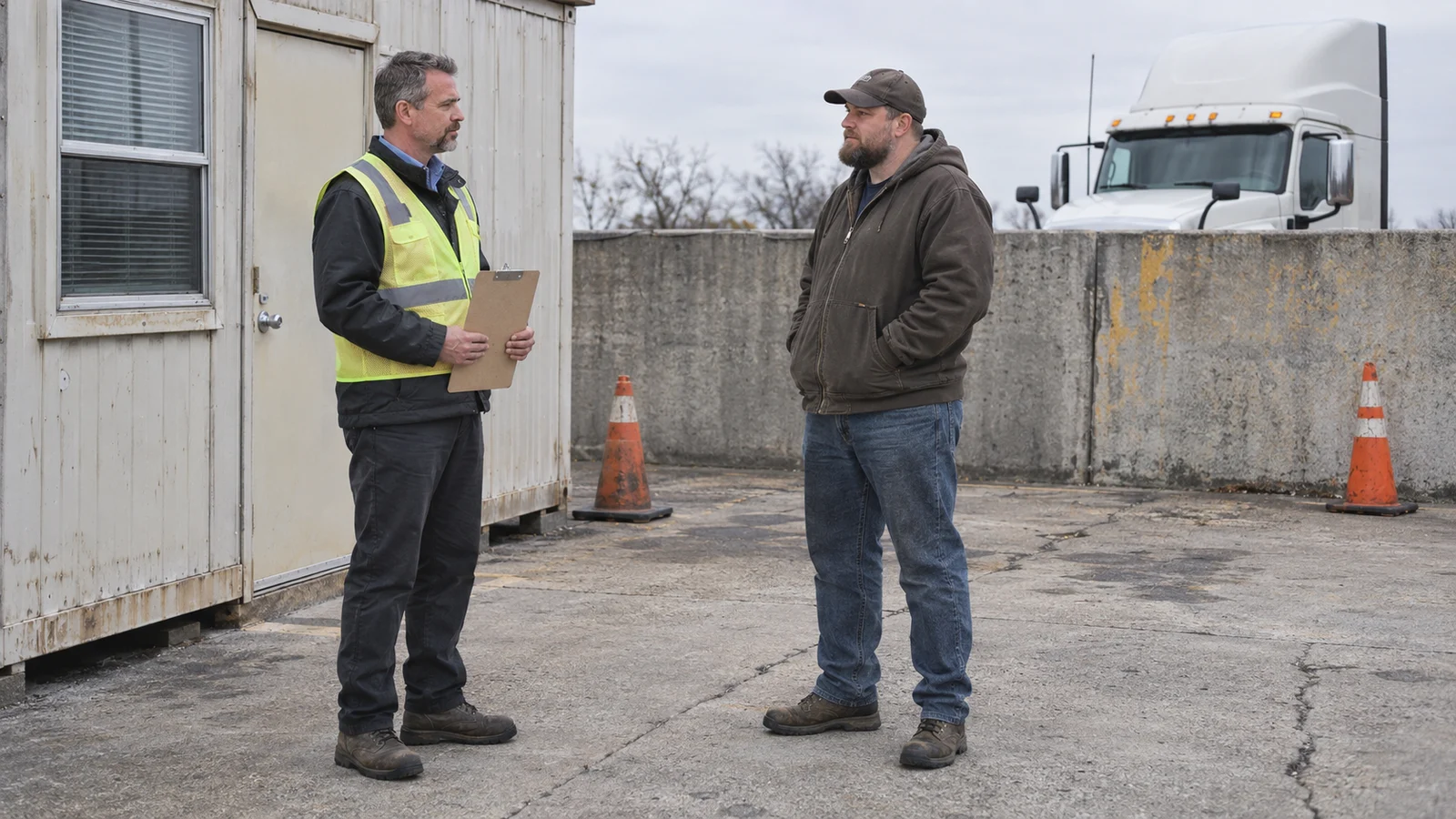
A driver can be tired, ill, overheated, injured, anxious or affected by medication without violating a DOT drug-and-alcohol rule. That is why the federal standard is not “the supervisor feels something is wrong.” Under 49 CFR 382.307, the employer’s decision must be built from specific, contemporaneous and articulable observations about appearance, behavior, speech or body odors.
The process also differs from random testing. A computer-based selection triggers a random test; observed conduct triggers reasonable suspicion. It differs from a crash-based test, too. The post-crash testing guide explains the separate event criteria and deadlines.
What “specific, contemporaneous and articulable” means
Specific means the observer can identify concrete facts rather than a label. “The driver was impaired” is a conclusion. “The driver repeatedly lost balance, spoke unusually slowly and could not follow a simple dispatch instruction” describes conduct another person can understand.
Contemporaneous means the observations are current and connected to the testing decision. An old rumor, a past violation or an off-duty social-media post does not replace present observations made within the federal testing framework.
Articulable means the trained observer can explain what was seen, heard or smelled in clear language. The observations do not have to prove which substance is involved. Supervisors are not expected to diagnose a condition; they are expected to recognize indicators, protect safety and use the correct process.
| Useful observation | Weak or incomplete statement |
|---|---|
| Uncharacteristic slurred speech during a face-to-face dispatch conversation | “He seemed off” |
| Repeatedly stumbled while walking across level pavement and dropped paperwork twice | “She looked impaired” |
| Strong alcohol odor on the driver’s breath during a current safety-sensitive period | “Someone said he was drinking” |
| Sudden agitation, disorientation and inability to complete a familiar task | “Bad attitude” |
No single example automatically proves misuse, and symptoms can have non-drug causes. A supervisor should evaluate the whole pattern, apply training objectively and respond to a possible medical emergency first. Calling emergency services for an acute health event does not have to wait for a testing decision.
Who may make the decision?
The required observations must be made by a supervisor or company official trained under 49 CFR 382.603. The federal minimum training is at least 60 minutes on alcohol misuse and at least 60 additional minutes on controlled-substances use. It must cover physical, behavioral, speech and performance indicators.
Federal rules do not require recurrent supervisor training, but a carrier may choose refreshers, scenario reviews and written decision aids. The goal is consistent, fact-based action—not turning supervisors into clinicians or police investigators.
FMCSA guidance says one qualified supervisor or company official may make the observations. A second trained observer can be a useful business practice when available, but waiting for one should not delay a necessary safety response. A report from a customer, shipper or coworker can alert the company to a concern, yet it does not replace the trained official’s required observations. The trained person should promptly make a direct, fair assessment.
The person who decides that reasonable suspicion exists for an alcohol test may not conduct that alcohol test. This separation protects the integrity of the observation and testing roles.
Alcohol and drug timing are not identical
Reasonable-suspicion alcohol observations must occur during, just before or just after the driver performs safety-sensitive functions. The employer may direct the alcohol test only in that same safety-sensitive window. Controlled-substances observations are not subject to that identical alcohol timing restriction; FMCSA guidance explains that they may be made while the driver is on duty.
| Requirement | Alcohol | Controlled substances |
|---|---|---|
| Observation basis | Specific, current facts about appearance, behavior, speech or body odors | Same; may also include signs of chronic or withdrawal effects |
| Observation/test window | During, just before or just after safety-sensitive functions | Prompt action based on current observations while the driver is on duty |
| Federal timing markers | Document delay after 2 hours; stop attempts after 8 hours | No 32-hour reasonable-suspicion deadline; report within a reasonable time and collect promptly |
| Decision maker conducts test? | No | Collection follows Part 40 procedures |
If an alcohol test is not administered within two hours after the determination, the employer must prepare and retain a record explaining why it was not promptly administered. If it is not completed within eight hours, attempts must stop and the employer must document the reason.
The 32-hour controlled-substances deadline drivers often remember belongs to certain post-accident tests. Section 382.307 does not create a 32-hour cutoff for reasonable suspicion. Delay still matters: the driver must report within a reasonable time, and the collection should occur as soon as practicable so the test remains connected to the observations.
What should happen at the worksite
- Protect the scene. Prevent the driver from starting or continuing a safety-sensitive function while the concern is evaluated. Secure the vehicle and load without creating a confrontation.
- Move to a private setting. Use a quiet location with another manager nearby if appropriate. Avoid public accusations, group questioning or discussing medical information in front of coworkers.
- Describe the decision plainly. State the observed facts and the employer’s direction to test. Do not demand a confession or ask the driver to diagnose the cause.
- Arrange safe transport. A driver suspected of impairment should not drive to the collection site. Follow the carrier’s escort and return-transport procedure.
- Contact the authorized collection site. Confirm the site can perform the required DOT test and provide the correct paperwork without unnecessary delay.
- Document the observations. Record facts, times, location, safety-sensitive activity, witnesses, notification, transport and collection-site issues.
A professional conversation is firm but neutral. Testing is not proof of a violation, and the supervisor should not announce a predicted result. The employer should also consider whether the driver needs medical attention, especially when symptoms include confusion, chest pain, breathing difficulty, weakness, collapse or other urgent signs.
The written record and its deadline
The supervisor or company official who made the observations must create and sign a written record. Section 382.307 requires completion within 24 hours of the observed behavior or before the test results are released, whichever occurs first.
A defensible record separates observation from interpretation. It should include the date and precise time; location; the safety-sensitive function involved; what the observer saw, heard or smelled; changes across the encounter; the decision time; which test was ordered; notification and transport details; and any reason for an alcohol-test delay. Avoid slang, character judgments and copied boilerplate that does not describe this event.
These records are sensitive testing-program documents, not ordinary dispatch notes. Carriers should control access and retain them under the applicable Part 382 recordkeeping rules. They are also distinct from the records described in ProntoCDL’s driver qualification file checklist.
What the driver should do
- Stop the safety-sensitive task when directed and place equipment in a safe condition.
- Listen for the test type, collection location, escort plan and person to contact.
- Proceed with the employer’s transport arrangement and cooperate with Part 40 collection procedures.
- State an urgent medical need immediately. Testing and medical evaluation may require separate actions.
- Do not leave the worksite or collection process without clear authorization. Failure to appear or remain can create a refusal issue under 49 CFR 40.191.
- Write down times, instructions and relevant facts after complying if you believe the process was incorrect. Use the employer’s review channel rather than arguing at the collection site.
A reasonable-suspicion order is not permission to drive while unfit. It is also not a final finding. The driver should preserve safety, complete the directed process and allow the regulated result and employer procedures to determine the next step.
When testing is delayed or not completed
If the alcohol test is unavailable, the absence of a result does not automatically clear the driver for safety-sensitive work. When the supervisor’s behavioral, speech and performance observations indicate alcohol impairment, the employer must not permit covered work until an alcohol test shows a concentration below 0.02 or 24 hours have elapsed after the reasonable-suspicion determination.
Without an alcohol test, Part 382 generally does not allow additional action against the driver based solely on behavior and appearance, apart from that safety restriction. An employer may have independent authority under company policy or other law, but it should not mislabel that separate action as a DOT test result.
For a controlled-substances test, a collection-site problem should be escalated immediately to the designated employer representative. The driver should remain available and follow a new authorized instruction. The employer should document delays and preserve the connection between the current observations and prompt testing.
What happens after the test?
A negative result does not prove the supervisor acted improperly; it means the regulated test did not establish the tested violation. The carrier may still need to address fatigue, illness, medication side effects, a medical qualification issue or a performance problem through the correct non-DOT process. The driver fatigue guide explains why legal hours and actual alertness are separate questions.
A verified positive drug result, an alcohol result at or above a prohibited level, or a refusal triggers removal from safety-sensitive functions and the DOT return-to-duty process. A driver may not use a later random or pre-employment test as a shortcut. ProntoCDL’s Clearinghouse and CDL-downgrade guide covers prohibited status, Substance Abuse Professional steps and return-to-duty reporting.
Practical takeaways
- Use current, observable facts—not rumor, diagnosis, bias or a vague feeling.
- A trained supervisor must make the required observations; one qualified observer is sufficient.
- The minimum supervisor course is 60 minutes for alcohol plus 60 minutes for controlled substances.
- Alcohol observations and testing are limited to the safety-sensitive work window.
- For alcohol, document a delay after two hours and stop attempts after eight hours.
- Do not import the post-accident 32-hour drug-test deadline into reasonable suspicion.
- Arrange safe transport; do not ask a possibly impaired driver to drive to the collection site.
- Sign the observation record within 24 hours or before results are released, whichever is earlier.
- A test order is not a positive result, but failing to cooperate can become a refusal.
- Consider medical emergencies and non-drug causes while still protecting safety.
CDL reasonable-suspicion testing FAQ
What creates reasonable suspicion for a CDL drug or alcohol test?
A trained supervisor or company official must rely on specific, contemporaneous and articulable observations concerning the driver’s appearance, behavior, speech or body odors. A hunch, rumor, personality conflict or one unexplained performance problem is not the federal standard.
Does a reasonable-suspicion test mean the driver already violated a rule?
No. The test is an evidence-gathering safety step, not a positive result by itself. A confirmed violation depends on the regulated test result or a refusal determination, although an employer may temporarily remove the driver from safety-sensitive work while the process is completed.
How fast must a reasonable-suspicion alcohol test occur?
The employer should administer it promptly. If it is not administered within two hours after the determination, the employer must document the reason. After eight hours, attempts must stop and the employer must document why the test was not completed.
Is there a 32-hour deadline for a reasonable-suspicion drug test?
No. The 32-hour limit is associated with FMCSA post-accident controlled-substances testing, not reasonable-suspicion testing. For reasonable suspicion, the driver must report within a reasonable time and collection should occur as soon as practicable while the observations remain current.
Who may make the reasonable-suspicion decision?
The required observations must be made by a supervisor or company official trained under 49 CFR 382.603. One qualified observer is sufficient under FMCSA guidance. For an alcohol test, the person who makes the reasonable-suspicion determination may not conduct that test.
What training does a CDL supervisor need?
The federal minimum is at least 60 minutes on alcohol misuse plus at least 60 additional minutes on controlled-substances use, including physical, behavioral, speech and performance indicators. Federal rules do not require recurrent training, though refresher practice can support consistent decisions.
Build the full testing picture with the 2026 random-testing guide, the pre-employment testing guide and the Clearinghouse return-to-duty guide.