
CDL Random Drug & Alcohol Testing Guide: 2026 Rates
Random testing is designed to be unpredictable, but the rules behind it are structured. CDL drivers should understand who belongs in the pool, why repeat selections are possible, when alcohol testing is allowed and what “proceed immediately” means after notification.
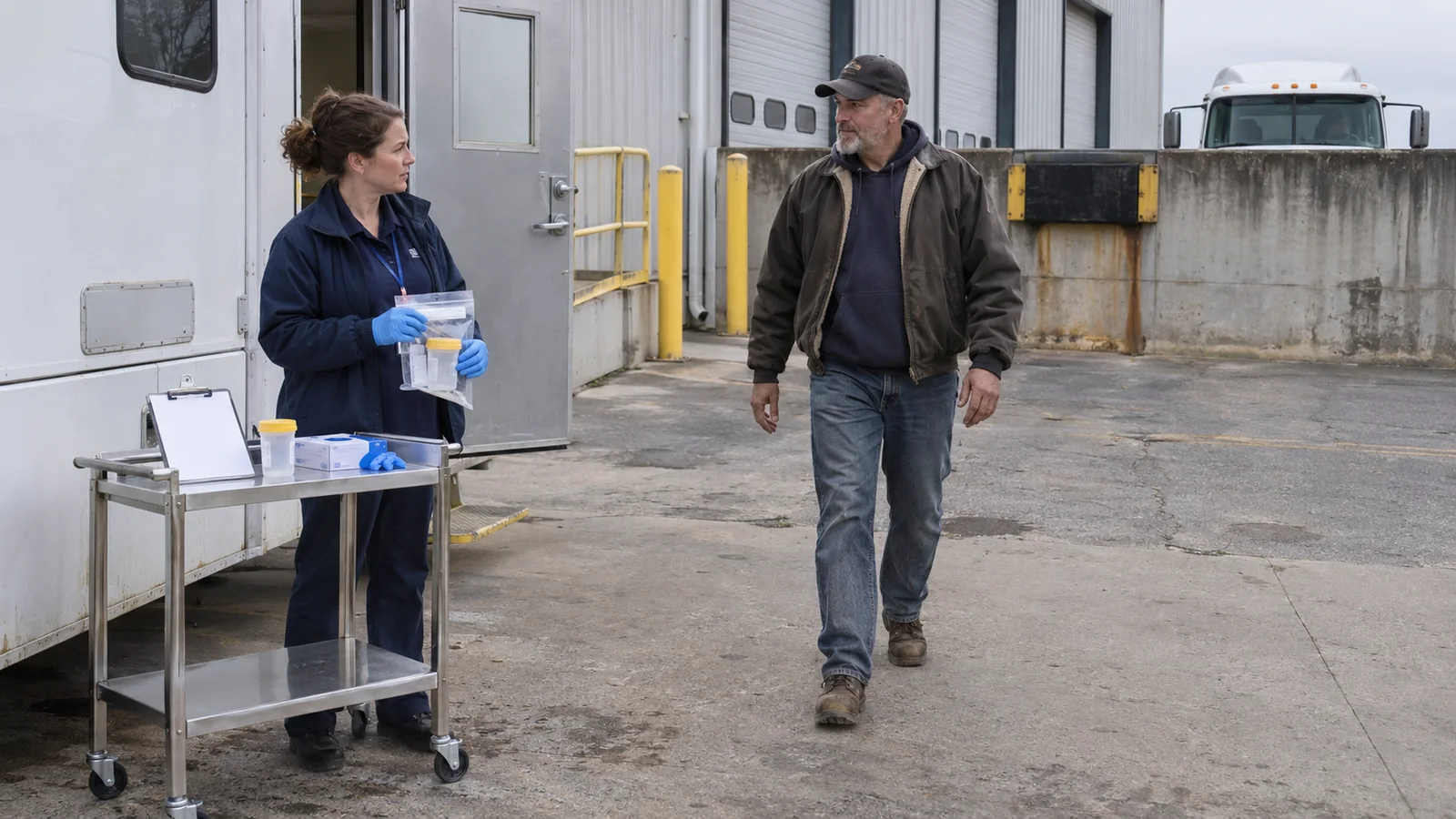
A random-test notice is not an accusation and it is not the same as a reasonable-suspicion test. The driver is selected from a covered pool by a scientifically valid method, with each eligible driver receiving an equal chance during each selection period. The surprise is part of the federal deterrence system.
For motor carriers and drivers subject to 49 CFR 382.305, random testing continues after hiring. It is separate from the pre-employment test, post-accident testing, reasonable-suspicion testing and return-to-duty or follow-up testing. ProntoCDL's pre-employment drug-test guide explains the hiring-stage requirement.
2026 FMCSA random testing rates
The U.S. Department of Transportation's current 2026 rate table lists the FMCSA minimum annual rate at 50 percent for controlled-substances tests and 10 percent for alcohol tests. The percentages apply to the average number of covered driver positions in the employer's program during the calendar year.
| FMCSA random program | 2026 minimum annual rate | What the percentage measures |
|---|---|---|
| Controlled substances | 50% | Completed random drug tests compared with the average number of covered driver positions |
| Alcohol | 10% | Completed random alcohol tests compared with the average number of covered driver positions |
These rates do not mean that an employer must select 50 different people out of every 100 drivers. They describe the number of completed tests the program must reach. Because every driver returns to the eligible pool for the next selection, a person may be selected more than once and another person may not be selected during that calendar year.
The rates are federal minimums. An employer may operate at a higher rate, and the FMCSA Administrator can change the industry minimum under the process in Section 382.305. Drivers and carriers should check the DOT rate page each calendar year instead of relying on an old handbook or a percentage remembered from another DOT agency.
Who belongs in the FMCSA random pool?
The pool covers people who perform an FMCSA-regulated safety-sensitive function requiring a CDL. The deciding factor is the function, not the title. Full-time, part-time, intermittent, casual, relief and temporary drivers may all belong in the pool when they operate covered commercial motor vehicles.
Only covered employees belong in the DOT pool. A company may have a separate testing policy for mechanics, warehouse workers or non-CDL vehicle operators, but non-DOT testing must remain separate and may not be represented as DOT testing. Mixing ineligible workers into the regulated pool can distort the selection base and program rate.
A covered driver who works for two separate motor carriers is generally included in each employer's program. Selection by one employer does not remove the driver from the other employer's pool. Within one employer, special rules address employees whose duties fall under more than one DOT agency.
How random selection is supposed to work
Section 382.305 requires a scientifically valid selection method, such as a traceable computer-based random-number generator or random-number table matched to employee identifiers. Each covered driver must have an equal chance each time selections occur, and each selected driver must be tested within that selection period.
Random does not mean a supervisor chooses the “most suspicious” driver, volunteers are requested, names are drawn informally or the same convenient shift is tested on a predictable schedule. Those approaches undermine equal selection. If observed conduct creates reasonable suspicion, that is a different testing basis with its own supervisor-training and documentation requirements.
A second selection shortly after the first can still be valid. True random selection includes repeats. The useful question is not “Was I tested recently?” but “Did the program use an equal-chance method for every covered driver in this selection period?” Drivers should not assume that a repeat selection proves retaliation or error.
Unannounced and spread throughout the year
Random tests must be unannounced, and testing dates must be spread reasonably throughout the calendar year. A fleet cannot wait until late December and run a predictable year-end testing event simply to catch up. The employer or its consortium/third-party administrator should make selections and monitor completion during the year.
Many programs select quarterly or more often. The exact cycle may vary, but the selected driver must complete the test during the period for which the selection was made. A specimen counts toward the year in which it was collected, not the later date when a Medical Review Officer verifies the result.
Selection information should be handled discreetly. Advance notice to drivers or widespread knowledge of the selection list destroys the surprise on which the program depends. Drivers may know the company has a random program, but they should not know when their individual selection will occur.
What to do when you are notified
The regulation requires the employer to direct a notified driver to proceed to the test site immediately. DOT best-practice guidance explains that “immediately” does not create a two-hour grace period: after notification, the driver's actions should lead directly to specimen collection.
- Listen to the exact instruction. Confirm the authorized collection location, test type and any safe vehicle-parking or transport direction.
- Proceed without personal stops. Do not stop for food, errands, fuel that is not operationally necessary or an attempt to delay collection.
- Protect safety. A driver operating a CMV should follow the employer's on-road notification procedure and reach the designated location without an abrupt or unlawful maneuver.
- Bring required identification. Use the identification and paperwork specified by the employer or collection site; do not alter chain-of-custody documents.
- Remain until released. Leaving the collection process early can become a refusal issue under Part 40.
- Document a genuine problem. If a road closure, crash, medical emergency or collection-site issue prevents timely arrival, contact the employer's designated representative immediately and record the facts.
A driver who disputes the selection should not self-declare the test invalid. DOT employee guidance uses the practical rule “comply, then complain.” Complete the directed test unless doing so is impossible or unsafe, then use the employer's compliance channel to raise a documented concern.
Drug-test timing and alcohol-test timing are different
Random controlled-substances testing may occur while the driver is on duty. The driver does not have to be behind the wheel at the moment of notification. Random alcohol testing is narrower: it may occur only just before, during or just after the driver performs a safety-sensitive function.
| Situation | Random drug test | Random alcohol test |
|---|---|---|
| Driver on duty but doing paperwork | May be directed under the program | Only if timing is tied to a safety-sensitive function as the rule requires |
| Driver about to operate a covered CMV | May be directed | Permitted just before the safety-sensitive function |
| Driver actively performing covered work | May be directed with safe reporting instructions | Permitted during the safety-sensitive function |
| Driver just finished covered work | May be directed while on duty | Permitted just after the safety-sensitive function |
| Driver on vacation or other legitimate extended absence | Do not give advance notice merely to schedule around the absence | Outside the required safety-sensitive timing |
Random testing is also different from the post-accident decision. After a qualifying crash, separate triggers and time limits apply. See the CDL post-crash response guide rather than treating the event as an ordinary random selection.
Unavailable drivers and missed selection periods
An employer should have a written procedure for a driver who is selected but legitimately unavailable. DOT best practices say a driver who has not yet been notified because it is a scheduled day off can be tested on the next shift within the same selection cycle. Long-term absence should be documented, and the program must still meet its required rate through additional selection if necessary.
The critical line is notification. Once the driver is notified, failure to appear as directed, leaving the site before completion or refusing to cooperate can be treated as a refusal under 49 CFR 40.191. A dispatcher's workload, a preferred route or a planned delivery is not a driver-created exemption.
If the collection site is closed, cannot locate the order or gives contradictory instructions, the driver should contact the designated employer representative while remaining available. The employer—not the driver or collector acting alone—makes the regulatory refusal determination in the circumstances assigned to the employer.
Owner-operators and consortium pools
An owner-operator who is the only driver-employee and is not leased to a motor carrier cannot create a one-person “random” pool. FMCSA guidance requires participation through a consortium that places the driver in a pool with at least two covered employees. The consortium or C/TPA may manage selections and notices, but the owner-operator still carries employer responsibilities.
Written notification procedures matter especially when the selected person is also the company owner. The procedure should identify who sends the notice, how the selected owner-operator acknowledges it, where the test occurs and who evaluates a failure to appear. A program cannot preserve surprise if the owner-operator controls the selection result before notification.
What a positive result or refusal changes
A verified positive drug result, a qualifying alcohol violation or a refusal is not resolved by taking another ordinary random test. The driver must be removed from safety-sensitive functions and follow the applicable Substance Abuse Professional and return-to-duty process before covered work can resume.
For FMCSA-regulated drivers, reportable violations and return-to-duty milestones also interact with the Drug and Alcohol Clearinghouse. ProntoCDL's Clearinghouse and CDL-downgrade guide explains prohibited status, SAP steps and reinstatement. The driver qualification file checklist shows which hiring and qualification records are separate from drug-and-alcohol program records.
Practical takeaways for CDL drivers
- For 2026, FMCSA's minimum annual random rates are 50% for controlled substances and 10% for alcohol.
- The percentage is a program testing rate, not a guarantee that each driver will be selected once.
- A scientifically valid equal-chance method can select the same driver more than once.
- Random tests must be unannounced and spread reasonably throughout the year.
- After notification, every action should lead directly and safely to the collection site.
- Random alcohol testing is limited to just before, during or just after safety-sensitive work.
- Part-time, relief and temporary CDL drivers remain in the pool when they perform covered functions.
- A one-driver owner-operator generally needs a consortium pool rather than a one-person selection system.
- A refusal or positive result triggers removal and the return-to-duty process; another random test is not a shortcut.
CDL random testing FAQ
What are the FMCSA random drug and alcohol testing rates for 2026?
For calendar year 2026, the minimum annual FMCSA rates are 50 percent of the average number of covered driver positions for controlled-substances testing and 10 percent for alcohol testing. These are employer program rates, not a promise that exactly half of individual drivers will be selected.
Can the same CDL driver be randomly selected more than once?
Yes. Every covered driver must have an equal chance each time selections are made. After one selection, the driver remains eligible for later selections, so one driver may be selected several times while another is not selected during that year.
How quickly must a driver report after random-test notification?
The employer must require a selected driver to proceed to the test site immediately. Immediate means the driver’s actions after notification lead directly to collection. A driver on the road should follow the employer’s safety and routing instructions without adding personal stops or avoidable delay.
Can a random alcohol test be conducted while a driver is off duty?
No. Under 49 CFR 382.305, random alcohol testing is limited to just before, during or just after the driver performs a safety-sensitive function. Random controlled-substances testing has different timing and may occur whenever the driver is on duty.
Do part-time and relief CDL drivers belong in the random pool?
Yes, when they perform FMCSA-covered safety-sensitive functions. Pool eligibility is based on the covered function, not full-time status or job title. Non-DOT workers must not be mixed into the DOT random pool.
Must a one-driver owner-operator join a consortium?
An owner-operator who employs only himself or herself and is not leased to another motor carrier must participate through a consortium that places the driver in a random selection pool with at least two covered employees. The owner-operator remains responsible for program compliance.
Preparing for a new carrier? Review the pre-employment testing guide, organize qualification records with the employment-history guide, and keep each testing category separate from the road test and DQ-file process.