
CDL Post-Crash Guide: Scene Safety, Testing and Records
The first minutes after a commercial-vehicle crash are not the time to improvise. Check people, prevent a second collision, notify emergency services and the carrier, preserve objective facts, and stay available while the employer determines whether federal post-accident testing applies.
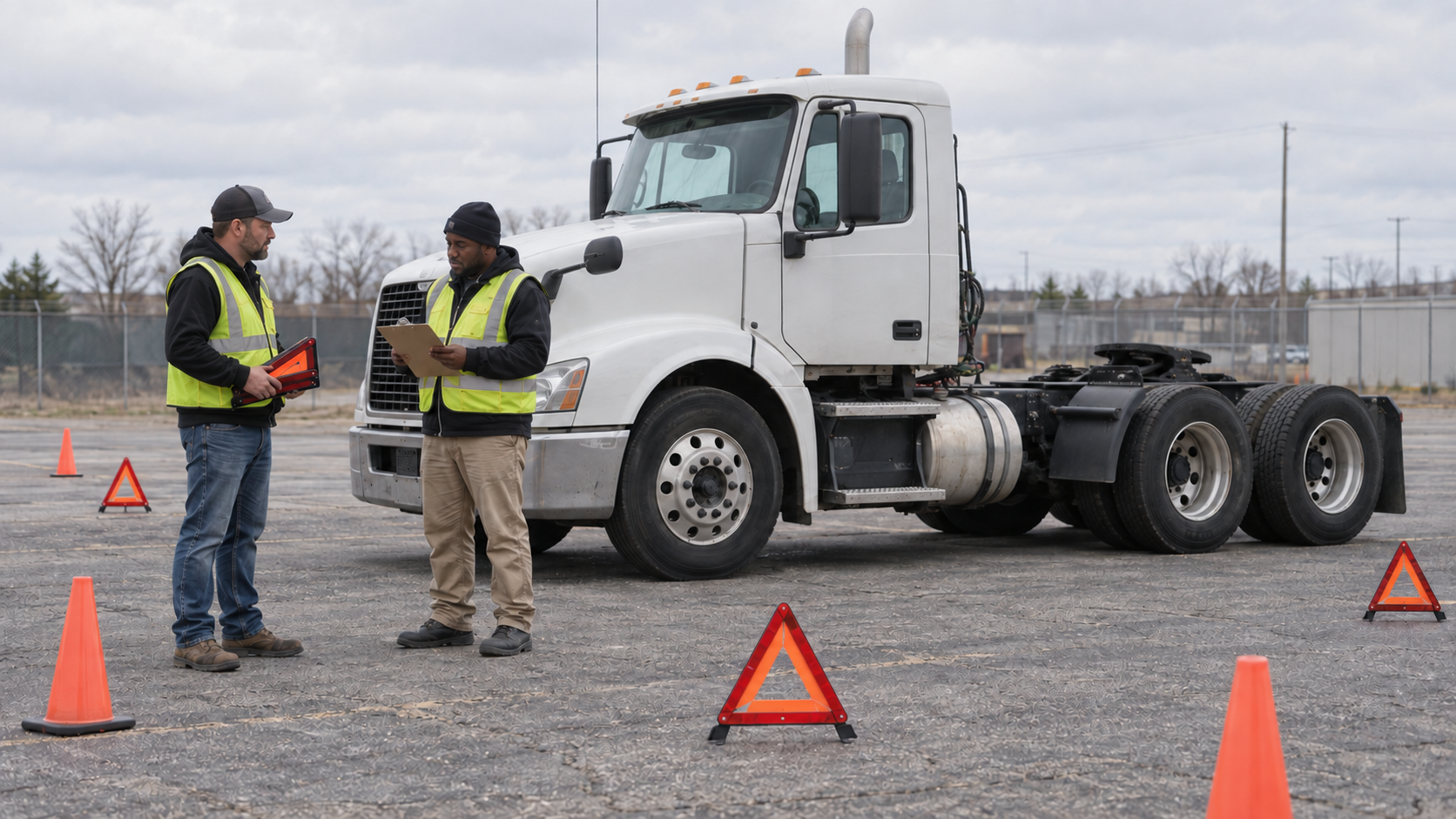
A professional response has two tracks. The driver manages immediate life safety and communicates accurate facts. The carrier handles testing decisions, reporting, insurers, records, recovery and return-to-service instructions. Neither track should delay urgent medical care.
Why post-crash response belongs in CDL training
The federal Class A ELDT curriculum requires post-crash instruction. It specifically covers assessing the driver’s physical condition, notifying authorities, obtaining medical help, protecting the scene, using flashers and warning devices, moving operable vehicles after minor crashes when appropriate, using a fire extinguisher if necessary and understanding drug and alcohol testing.
That list is a sequence of priorities, not a script for every scene. A fuel leak, fire, hazardous-material release, unstable cargo, live traffic, downed electrical line or serious injury changes what is safe. Follow emergency responders and do not enter a danger area to collect a photograph or piece of equipment.
The first safe actions
- Stop and assess yourself. Check for pain, bleeding, disorientation and whether you can move safely. Do not walk into traffic or step into spilled material.
- Call emergency services. Give the road, direction, nearest marker and known injuries or hazards. If you cannot call, clearly assign the task to a capable person.
- Protect people from a second impact. Activate hazard flashers and follow lawful directions about moving an operable vehicle from a travel lane after a minor crash.
- Report immediate hazards. Tell dispatch and responders about fuel, smoke, fire, cargo, placards, damaged batteries, unstable equipment or a blocked lane.
- Notify the carrier. Use the company’s emergency number and give facts: location, injuries, vehicles, cargo condition, police response and whether towing appears necessary.
- Remain available. Keep the carrier updated about medical transport, law-enforcement instructions and any citation because those facts affect the testing decision.
Use flashers and warning devices correctly
When a CMV is stopped on the traveled portion or shoulder for a reason other than a necessary traffic stop, 49 CFR 392.22 requires immediate hazard-flasher use. Warning devices generally must be placed as soon as possible and within 10 minutes, with different placement patterns for two-way roads, divided roads, curves, hills and sight obstructions.
Do not treat the 10-minute limit as an instruction to walk into an active lane. Call for assistance when fire, traffic, terrain, injury or a spill makes placement unsafe. Never use a flame-producing warning device near leaking flammable liquid or gas. Review the layouts and equipment checks in ProntoCDL’s CMV emergency-equipment guide.
Know the federal meaning of “accident”
Every collision matters, but the Federal Motor Carrier Safety Regulations use a specific threshold. Under 49 CFR 390.5T, an accident involves a CMV operating on a highway in commerce and results in at least one of these:
- a fatality;
- bodily injury followed by immediate medical treatment away from the scene; or
- disabling damage to any motor vehicle that requires transport away by a tow truck or another motor vehicle.
“Disabling damage” means damage that prevents a vehicle from leaving the scene in its usual manner in daylight after simple repairs. The definition excludes certain limited conditions, including tire disablement without other damage, even when no spare is available. State reporting, police, employer and insurance requirements may still apply when an event does not meet the federal threshold.
Federal post-accident testing decision table
49 CFR 382.303 places the testing duty on the employer. The driver must communicate promptly and follow the employer’s instructions.
| Crash result | CMV driver citation? | Federal employer test? |
|---|---|---|
| Human fatality | Yes or no | Yes, for each surviving covered driver who was performing safety-sensitive functions |
| Injury with immediate treatment away from the scene | Qualifying moving-violation citation within the applicable window | Yes |
| Injury with immediate treatment away from the scene | No qualifying citation | No under § 382.303 |
| Disabling damage requiring any involved motor vehicle to be towed | Qualifying moving-violation citation within the applicable window | Yes |
| Disabling damage requiring a tow | No qualifying citation | No under § 382.303 |
For alcohol testing, the citation window is eight hours. For controlled-substances testing, it is 32 hours. The employer may also have a separate lawful company policy, but it should not be confused with a federally required test.
The testing clock and driver availability
- As soon as practicable: both required tests should be arranged without avoidable delay.
- Two hours: if the required alcohol test is still incomplete, the employer records why it was not promptly administered.
- Eight hours: attempts to administer the federal alcohol test stop, and the employer documents the reason.
- Thirty-two hours: attempts to administer the federal controlled-substances test stop, and the employer documents the reason.
A driver subject to testing must remain readily available, but the rule does not delay emergency medical treatment or prevent the driver from leaving long enough to obtain help. Do not assume a police-administered test automatically closes the employer’s process; law-enforcement results can satisfy the federal requirement only when the regulatory conditions are met and the employer obtains the results.
Under 49 CFR 382.209, a driver required to take the post-accident alcohol test may not use alcohol for eight hours after the accident or until the test is completed, whichever occurs first.
Document facts without creating new risk
Once immediate hazards and medical needs are controlled, collect information only from a safe location and within company policy. Record:
- date, time, road, direction, nearest exit or marker and weather;
- names and contact information for involved drivers and witnesses;
- vehicle, trailer and cargo identifiers without posting them publicly;
- responding agency, report number, tow company and citation information;
- visible vehicle, roadway, cargo and property conditions; and
- the times dispatch, emergency services and the testing contact were notified.
Photograph only when it is safe and permitted. Capture wide scene context, lane position, traffic controls, vehicle sides, damage areas and cargo condition without moving evidence. Save dashcam footage through the approved process. State observations rather than guessing speed, cause or fault, and do not post scene information to social media.
Log the time accurately
Driving status ends when the truck stops, but the rest of the scene is not automatically off-duty. The federal definition in 49 CFR 395.2 includes time attending a disabled CMV, obtaining assistance and traveling to and completing carrier-directed post-accident testing as on-duty time.
Make the appropriate duty-status change and add a concise ELD annotation using the carrier’s procedure. Preserve fuel, toll, tow, police and testing records that may support the timeline. If the device is damaged, use the backup process in the ProntoCDL ELD malfunction guide.
Do not make your own return-to-service decision
Before the truck moves, confirm law enforcement has released it, no out-of-service condition applies and the carrier has authorized the next step. A post-crash check should cover steering, brakes, wheels and tires, lights, glass and mirrors, coupling equipment, frame and suspension, fluids, air or electrical lines, cargo securement and anything near the impact area.
A truck that rolls is not necessarily roadworthy. Leaks, shifted cargo, hidden tire or wheel damage and bent steering or suspension parts can worsen after movement. Use qualified inspection or towing rather than driving back to the terminal on hope. Related preparation is available in the roadside-inspection guide and engine-compartment inspection guide.
What the carrier must preserve
49 CFR 390.15 requires a motor carrier to keep an accident register for three years after each federally defined accident. It must identify the date, location, driver, injury and fatality counts and whether hazardous materials other than fuel from vehicle tanks were released. Copies of reports required by a State, another government entity or an insurer must also be kept.
The driver’s job is to give the carrier complete, accurate source information. Keep the police report number, testing instructions and medical or tow details together so the safety team can reconcile the event without relying on memory.
A closed-yard response drill
- Park a training vehicle on a closed pad and establish a simulated shoulder with cones.
- Have the trainee assess personal condition, state the location and make a mock emergency call.
- Practice activating flashers and selecting the correct warning-device pattern without entering live traffic.
- Give the trainee three scenarios: fatality, treatment away from scene and tow-away damage. Add or remove a driver citation and ask whether federal testing applies.
- Practice the carrier notification using only verified facts and times.
- Finish with an ELD duty-status choice, vehicle no-go decision and document checklist.
Never stage a drill on an open road or intentionally damage equipment. Pair the exercise with the Class A ELDT guide and reinforce the regulations in ProntoCDL’s free CDL practice center.
Practical takeaways
- Check people and call for help before collecting information.
- Prevent a second crash with flashers, safe positioning and warning devices.
- Report injuries, towing, citations, leaks, cargo and location facts promptly.
- Do not assume every collision triggers a federal test—or that no citation means no carrier action.
- Remain available for testing without delaying necessary medical care.
- Log scene attendance, assistance and carrier-directed testing accurately.
- Preserve objective evidence and avoid guesses, fault statements and social posts.
- Move the truck only after legal release, a safety check and carrier authorization.
CDL post-crash FAQ
Does every crash require a federal DOT drug and alcohol test?
No. Under 49 CFR 382.303, a fatal crash requires testing of a surviving covered driver who was performing safety-sensitive functions regardless of whether that driver was cited. For a crash involving immediate medical treatment away from the scene or disabling damage requiring a tow, federal testing is required only when the CMV driver receives a qualifying moving-violation citation within the applicable window. A carrier may have additional lawful testing policies.
How soon must post-accident testing happen?
Required tests must be completed as soon as practicable. If an alcohol test is not completed within two hours, the employer must document the reason; attempts stop after eight hours. Attempts to complete a required controlled-substances test stop after 32 hours, with the employer documenting why it was not completed promptly.
Can an injured driver leave for medical care before testing?
Yes. Federal rules do not require necessary medical attention to be delayed. A driver may also leave long enough to obtain emergency help. When able, the driver should stay in contact with the carrier and remain readily available for required testing.
Should a commercial vehicle be moved after a minor crash?
Protect life first and follow law-enforcement directions and applicable State or local law. The federal Class A ELDT curriculum teaches moving on-road vehicles out of travel lanes in minor crashes to prevent another collision, but only when the driver can do so safely and the vehicle is operable. Do not move a vehicle when injuries, hazardous materials, unstable cargo or serious damage make movement unsafe.
How should crash-scene time appear on the driver log?
Driving time ends when the vehicle stops. Time spent attending a disabled CMV, obtaining assistance or traveling to and completing carrier-directed post-accident testing generally falls within the federal definition of on-duty time. Record the actual activity accurately and follow the carrier’s ELD annotation procedure.
How long must a motor carrier keep the federal accident register?
A motor carrier must retain its accident register for three years after each accident that meets the federal definition. The register includes the date, location, driver, injury and fatality counts, hazardous-material release information and copies of required reports.
Make the response sequence automatic.
Protect life, prevent the next collision, report facts and stay available for the carrier’s instructions.
Start free CDL practice