
CDL Air Tank Drain Guide: Moisture, Oil & Freeze Prevention
Air reservoirs store braking energy, but they also collect water and compressor oil. A safe drain routine removes contamination, reveals developing problems and protects the system before cold weather turns moisture into ice.
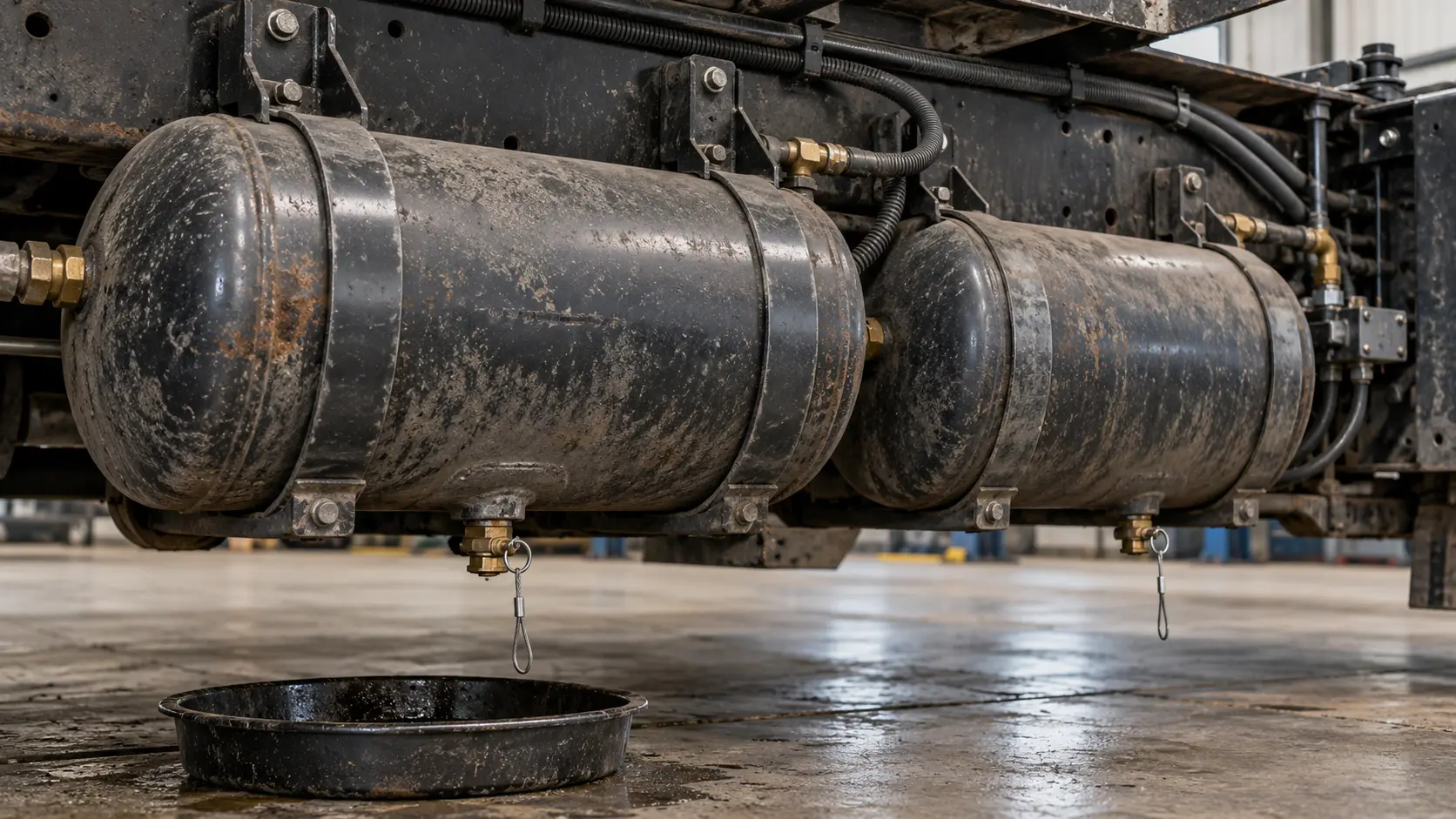
A commercial vehicle's compressor does more than move air. It also introduces heat, water vapor and sometimes a small amount of oil into the air system. As compressed air cools in the reservoirs, moisture condenses and settles at the low points. The current New York CDL Manual, Section 5 warns that accumulated water can freeze in cold weather and cause brake failure.
Federal equipment rules recognize the need to remove that contamination. Under 49 CFR 393.50(d), every required reservoir must have a manually operable condensate drain valve. An automatic drain is allowed only when it can also be operated manually or a separate manual drain method remains available.
This is a driver inspection and operating guide, not a repair procedure. Reservoir locations, drain designs, air-dryer systems and service intervals vary. Use the manufacturer's instructions and the carrier's maintenance program for the actual vehicle.
Understand what the reservoirs are doing
The compressor supplies pressurized air, the governor controls its loading cycle and the reservoirs store air so the brakes can respond without waiting for the compressor. A typical heavy truck may have a supply or “wet” tank followed by primary and secondary service reservoirs. Trailers, dollies and specialty vehicles can add separate tanks.
Do not identify a tank only by its physical position. Plumbing layouts differ, and one cylindrical shell may contain divided compartments. Review the vehicle diagram, labels and manufacturer information so every reservoir and manual drain point is accounted for.
A complete air-system inspection connects the tanks to the rest of the system. ProntoCDL's air-brake test guide covers pressure buildup, governor operation, leak rates, low-air warning and spring-brake application. The dashboard gauge guide explains how to read the dual pressure circuits during startup and operation.
Know manual and automatic drain types
A manual drain is normally fitted at the reservoir's lowest point. Common controls include a quarter-turn valve, a pull cable or a lanyard connected to a spring-loaded valve. The control should be accessible from an approved position and should return or close positively after use.
Automatic drains release collected water and oil without the driver opening a valve for every cycle. Some include heating elements for cold-weather service. “Automatic” does not mean “ignore it.” A blocked, frozen, disconnected or leaking automatic drain can still leave contamination in the tank or waste system pressure.
| Drain system | Driver-level check | Condition to report |
|---|---|---|
| Quarter-turn valve | Accessible handle, secure body, free movement and complete closure | Stuck handle, damaged fitting, continuous leakage or contamination that will not clear |
| Pull cable or lanyard | Correct routing, usable reach, intact connection and positive valve return | Frayed or missing cable, snagging route, valve that stays open or no discharge when contamination is suspected |
| Automatic drain | Secure installation, protected wiring or air lines and no active leak | Damage, freeze-up, repeated wet tanks, electrical fault or continuous air loss |
The manual means matters even on an automatically drained system. It lets qualified personnel verify reservoir contents and drain the tank when the automatic device is not performing correctly.
Secure the vehicle before opening a drain
Choose a level, ventilated work area away from moving traffic. Apply the parking brakes, place the transmission in neutral and follow the carrier's wheel-chock and key-control procedure. Keep bystanders clear of the discharge path.
Use eye protection and gloves specified by the employer. Condensate can contain oil, rust and debris, and the first release may be forceful. Stand to the side of the outlet rather than placing a face or hand beneath it. Use a catch container when the facility requires one, and dispose of oily water under the site's environmental procedure.
Do not crawl under a truck from the ground just to reach a valve. An air suspension can lower, a vehicle can roll and unsupported components can move. If the drain cannot be operated from a designed lanyard or safe exterior position, move the task to a proper service bay with approved support and energy-control procedures.
Use a repeatable manual-drain sequence
The exact order should follow the vehicle manual. A practical routine uses a written tank map so none are skipped:
- Identify every reservoir. Confirm the supply, primary, secondary and any trailer or auxiliary tanks installed on the vehicle.
- Check the drain hardware before use. Look for loose mounts, damage, corrosion, chafed lanyards and evidence of an existing leak.
- Position safely. Stay outside the discharge path and outside any unsafe under-vehicle area.
- Open the drain deliberately. Use the installed quarter-turn control or lanyard; do not strike the valve or pull it sideways.
- Allow the discharge to clear. Observe whether water, oily mist, sludge or clean air appears. Do not touch or taste the material.
- Close and verify. Release or close the control fully, then listen for continued air loss.
- Repeat for every tank. Do not assume draining the wet tank empties the primary and secondary reservoirs.
- Record an abnormal finding. Note the tank, amount and appearance of contamination, valve condition and any pressure or leakage symptom.
The current New York manual instructs drivers to drain manually operated tanks at the end of each day. That is useful CDL knowledge, but the operating schedule for a particular truck remains a vehicle- and program-specific instruction. Automatic drains, air dryers, duty cycle, climate and carrier maintenance policy can change the service plan.
Read the discharge as evidence, not a diagnosis
Some water or light oily residue can appear in normal service. The important questions are how much is present, how often it returns and whether the system shows other symptoms.
- Repeated large water discharge can point to heavy condensation, an ineffective air dryer, a failed automatic drain or a service interval that is too long.
- Heavy oil discharge can indicate a compressor, dryer or plumbing problem that needs maintenance evaluation.
- Rust flakes or sludge can signal internal contamination or corrosion.
- No discharge from a tank expected to contain condensate can mean the tank is dry, but it can also mean a blocked or frozen valve. Do not force or heat it.
- Air that continues escaping after closure is a leak, not a successful drain.
Report observable facts rather than guessing at a failed part: “primary reservoir released approximately one cup of dark oily water and the lanyard valve continued leaking after release” is more useful than “bad compressor.” Maintenance can then inspect the dryer, compressor, drain and reservoir as a system.
Cold weather turns moisture into an operating hazard
Ice can block a drain or restrict an air passage. That is why water removal belongs in cold-weather preparation before the overnight low drops below freezing—not after a valve has frozen.
If a drain is frozen, do not use an open flame, torch or improvised heater. Reservoirs and nearby lines can contain oil residue, plastic components and pressurized air. Move the vehicle only under an approved safe procedure and have qualified maintenance thaw and inspect the system.
Some vehicles use heated automatic drains or an alcohol evaporator. These are installed-system features, not an invitation to pour alcohol or another additive into the air system. Use only the fluid, fill method and service procedure approved by the equipment manufacturer. The CDL manual also notes that daily drainage is still needed with an alcohol evaporator unless the system has automatic drains.
Include trailer and auxiliary reservoirs
A tractor inspection does not account for every tank in a combination. The trailer may have its own reservoirs and automatic or manual drains. Converter dollies, lift equipment and other air-powered accessories can add more storage and more low points.
Secure the combination and follow the equipment procedure before touching trailer drain hardware. Keep tractor-to-trailer air connections clean and correctly routed; ProntoCDL's air-lines and glad-hands guide covers seals, fittings, chafing, kinks and coupling checks.
Never release a parking-brake system merely to make a drain easier to reach. If access is unsafe, mark the equipment out for proper service instead of creating a rollaway or crush hazard.
Rebuild pressure and verify the system after draining
Each open drain reduces stored air. Before driving, confirm every valve is closed, start the vehicle under the manufacturer's procedure and rebuild pressure while watching both service-circuit gauges. Listen for leakage and verify that pressure rises normally.
Then perform the required vehicle-specific checks. A reservoir drain does not prove acceptable leakage, low-air warning, spring-brake operation, governor cut-in or cut-out, pressure buildup or service-brake response. Those functions need their own controlled test sequence.
Under 49 CFR 392.7, a CMV must not be driven until the driver is satisfied that service brakes, parking brakes and other listed equipment are in good working order. A drain valve that will not close, slow pressure recovery, an active low-air warning or an unexplained pressure loss is a stop-and-report condition.
Use precise language in CDL training
The federal Class A ELDT curriculum includes air-brake controls and the pre-trip, post-trip and en route inspection duties. A useful training explanation names the component, condition and safety purpose:
“These air reservoirs are securely mounted with no damage or leaks. Each tank has a manual drain at the low point. I would drain accumulated water and oil using the manufacturer and carrier procedure from a safe position, then close the valves, rebuild pressure and complete the air-brake checks before driving.”
State skills-test scripts and scoring vary. Do not open a drain during an examination unless the examiner's procedure calls for it. Demonstrate only the actions requested, and never trade safe vehicle securement for memorized words. ProntoCDL's skills-test guide explains how inspection, basic control and road testing fit together.
Practical takeaways
- Map every reservoir and drain point on the actual truck, trailer and auxiliary equipment.
- Federal rules require a manual drain method even when an automatic drain is installed.
- Secure the vehicle on level ground and keep clear of pressurized discharge.
- Never crawl into an unsafe under-vehicle space to reach a drain.
- Drain every manual reservoir on the required vehicle and carrier schedule.
- Report the amount and appearance of contamination instead of guessing at the failed part.
- Treat a stuck, frozen or continuously leaking drain as a defect.
- Do not use an open flame or unapproved additive on a frozen air system.
- Close all drains and rebuild air pressure before attempting to move.
- Complete the full air-brake checks; draining alone does not prove the system is safe.
CDL air-reservoir FAQ
Why do commercial-truck air tanks need to be drained?
Compressed air can carry water vapor and compressor oil into the reservoirs. That material collects at low points, reduces useful air volume, can promote corrosion and may freeze in cold weather. Draining removes the accumulated condensate and creates an opportunity to spot an abnormal amount of water or oil.
How often should a CDL driver drain manual air tanks?
Follow the vehicle manufacturer, carrier maintenance program and applicable licensing manual. The current New York CDL manual directs drivers to drain manual tanks at the end of each day. Equipment with functioning automatic drains may use a different service routine, but every reservoir still must retain a manual means of draining under federal equipment rules.
Do automatic air-tank drains eliminate every manual check?
No. Federal rules require a manually operable drain or a separate manual means even when an automatic drain is installed. Drivers should know which reservoirs use automatic drains, inspect accessible components and follow the manufacturer and carrier procedure for manual verification or service.
Is a little water or oil from an air reservoir always a defect?
A small amount of condensate can occur in normal service. Repeated heavy water discharge, a large amount of oil, thick contamination, a valve that will not open or close, or a persistent leak deserves an exact defect report and maintenance evaluation. One drain event by itself is not a complete compressor diagnosis.
Can I crawl under a truck to reach a drain valve?
Do not enter an unsafe under-vehicle space. Use an accessible lanyard or valve from the approved position, or have the reservoir serviced in a proper bay under the carrier’s lockout and support procedure. Never rely only on an air suspension, jack or parking brake to protect a person under a vehicle.
What should I do after draining the reservoirs?
Close every manual drain completely, rebuild air pressure and confirm the system responds normally. Watch both pressure gauges and warning devices, listen for leakage and complete the vehicle-specific air-brake checks required before driving. Draining reservoirs does not replace the full leak, warning, pop-out, buildup and brake-response tests.
Connect tank care to the complete air-brake check
Review pressure, leaks, warnings and brake response in ProntoCDL's air-brake test guide, then reinforce the concepts with the CDL study guides and free practice center.