
CDL Air Lines and Glad Hands: A Pre-Trip Inspection Guide
A tractor and trailer can be mechanically coupled while their brakes remain one damaged seal or poorly routed hose away from trouble. A deliberate air-line inspection confirms the right connections, a leak-free seal and enough protected movement for the combination to turn without stretching, kinking or dragging the lines.
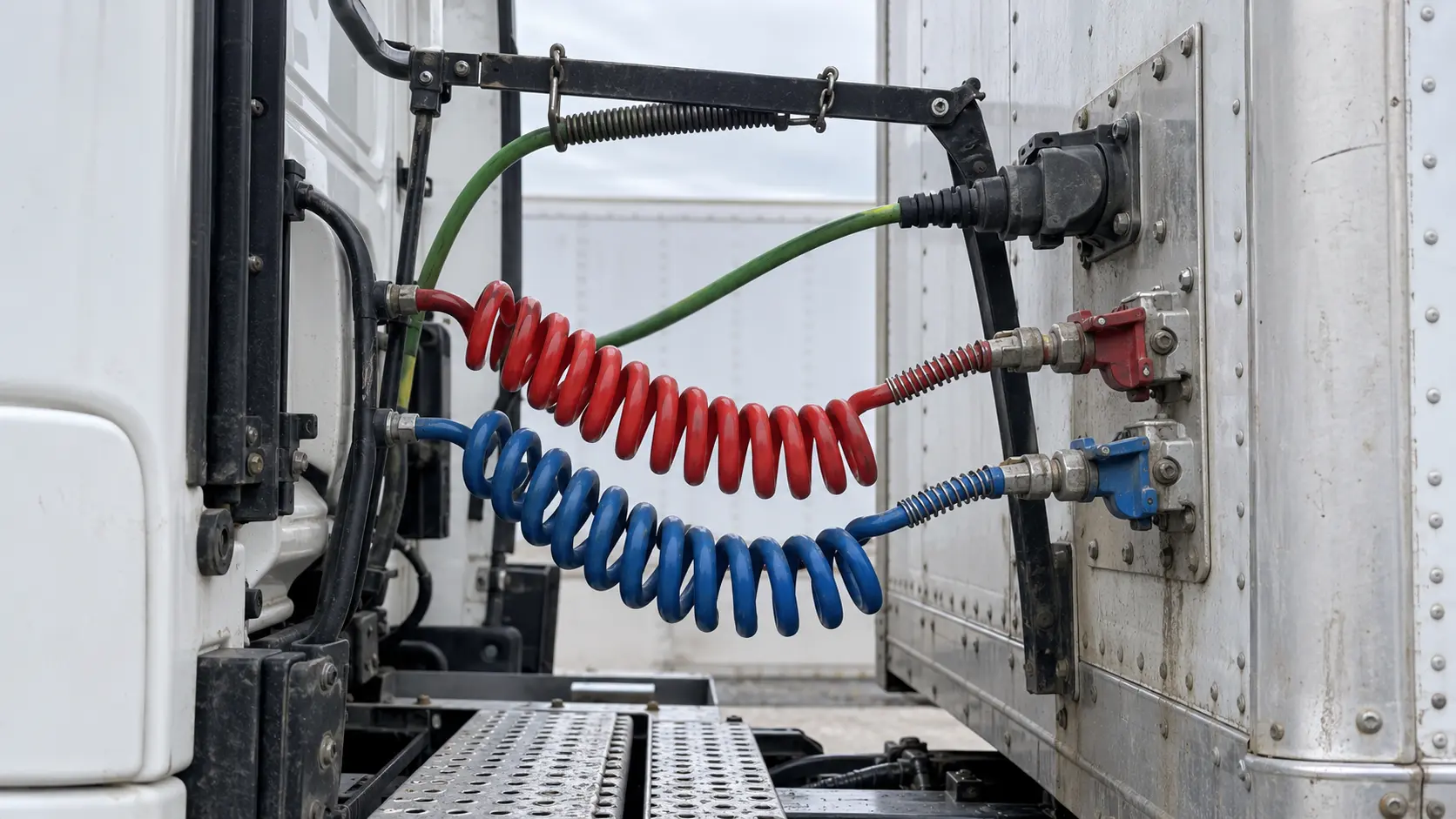
This guide focuses on the flexible brake-air connections between a highway tractor and an air-braked trailer. It complements the ProntoCDL fifth-wheel coupling inspection and the in-cab air-brake test guide. Use all three: a good hose inspection does not prove the fifth wheel is locked, and a normal gauge test does not make damaged external hardware acceptable.
Know what each connection does
A typical tractor-trailer uses two air connections plus a separate electrical connection. The service line carries the control signal that applies the trailer service brakes. The emergency or supply line supplies reservoir air and supports the trailer’s emergency-braking function. The electrical pigtail powers lighting and other trailer electrical circuits; it is not an air hose.
Blue commonly marks the service connection and red commonly marks the emergency or supply connection. Treat those colors as identification aids, not a substitute for understanding the equipment. Paint fades, hoses are replaced and specialized equipment varies. Match the hose function, tractor connection and trailer coupler according to the vehicle markings and approved coupling procedure.
Why the inspection is required
49 CFR 392.7 says a commercial motor vehicle may not be driven until the driver is satisfied that listed equipment is in good working order. The list includes service brakes and trailer brake connections. For intermodal equipment, the same section expressly calls out air-line connections, hoses and couplers among the components the driver must inspect.
49 CFR 393.45 requires brake hoses to be long and flexible enough for normal movement without damage; secured against chafing, kinking and other mechanical damage; protected from exhaust heat; and connected without leaks, constrictions or conditions that harm brake performance. 49 CFR 393.43 supplies the federal breakaway and emergency-braking baseline for air-braked combinations.
The federal Class A ELDT curriculum requires instruction and proficiency in pre-trip inspection and in coupling, inspecting and uncoupling combination vehicles. Your vehicle manufacturer, employer and State testing authority may prescribe a more detailed sequence.
Secure the combination before touching a connection
Park on firm, level ground, set the parking brakes, secure the transmission and control the ignition key. If the trailer is not already coupled, follow the complete coupling procedure before relying on its air system. Chock wheels when the procedure, conditions or carrier policy requires it.
Do not place your body between a tractor and trailer that could move. Treat connected air lines as pressurized. Wear the required eye protection and gloves, and keep your face away from a coupler when connecting or disconnecting it. Never test for a leak with a flame, and do not loosen a fitting to “see whether air is there.”
A repeatable air-line and glad-hand inspection
- Identify all three paths. Locate the service air line, emergency or supply air line, and electrical pigtail. Confirm that each reaches the correct connection and that no line is crossed through another in a way that can bind.
- Start at the tractor. Check each hose where it attaches to the tractor. Look for a loose fitting, cracked support, exposed reinforcement, fresh rub mark, sharp bend or strain at the end fitting.
- Follow the entire hose body. Inspect every visible coil or straight section for cuts, abrasions, flat spots, swelling, weather checking, burns, crushed areas and improvised repairs.
- Inspect spring guards and end fittings. Guards should protect the hose where it meets the fitting. The fitting should be secure and aligned without a tight bend, damaged threads or evidence of twisting.
- Check routing and support. The lines need enough usable length for normal turning and articulation, but they must stay clear of the catwalk, frame edges, fifth wheel, exhaust and other heat or pinch points. A tender, spring or support should be intact where the equipment uses one.
- Inspect each glad hand. Check the body and locking ears for cracks, distortion or missing material. Verify the two halves are fully mated and locked rather than resting partly together.
- Examine the seal area. A visible rubber seal should be seated, flexible-looking and free of cuts, chunks, dirt or ice. Do not pry at a pressurized connection. If the procedure requires separation, exhaust pressure and secure the equipment first.
- Look at the trailer-side mounting. Couplers, brackets and bulkhead fittings should be tight and undamaged, with no movement marks, corrosion severe enough to weaken support or air line rubbing on the trailer face.
- Charge the system as instructed. After the connections are complete and the cab is occupied, charge the trailer according to the vehicle procedure. Listen for leakage from a safe position and watch the air gauges for abnormal behavior.
- Finish with functional tests. Complete the required leakage, low-air warning, spring-brake, tractor-protection and service-brake checks for the vehicle. Then recheck that the hoses remain supported and clear.
Read slack and routing as a moving system
A parked, straight combination shows only one position. During a turn, the distance and angle between tractor outlets and trailer couplers change. A hose that looks tidy when centered can become tight in one direction; a long unsupported hose can drop onto the catwalk or catch an edge in the other.
Do not create slack by wrapping a hose around another line, a grab handle or the electrical cable. Do not stretch coils to their limit or let them carry the weight of a broken support. When the approved inspection procedure permits, evaluate routing through the combination’s expected articulation without placing anyone in a pinch zone. Stop if a line pulls tight, rubs, kinks or contacts heat.
Check the glad-hand seal without hiding a defect
A good coupling has compatible faces, clean mating surfaces, intact seals and locking features that hold the halves squarely together. A cocked coupler, folded seal, grit, ice or damaged locking ear can leak even when the hose looks perfect. Audible hissing, bubbling from an approved leak-detection solution, unexplained pressure loss or a coupler that moves abnormally all require attention.
Do not smear grease, adhesive or household sealant on the connection, and never wrap a leaking glad hand with tape. Those shortcuts can collect contamination, attack the seal material or conceal damage. Use the correct replacement part and approved maintenance procedure.
Separate the air lines from the electrical pigtail
The electrical cable often shares the same working space and deserves its own check. Verify that its plug is fully seated and secured, its weather protection is intact and the cable is supported without being twisted around the air hoses. Inspect the visible jacket for cuts, crushed areas, exposed conductors or heat damage.
After the connection check, verify required trailer lamps and ABS indication through the vehicle’s normal procedure. The ProntoCDL truck-lighting inspection guide explains a full lamp-and-reflector walkaround.
What to say during a CDL inspection
State procedures and vehicle layouts vary. Point to the actual components and explain what you are checking instead of reciting colors alone. A concise inspection description could be:
“The trailer service and emergency air lines are connected to the correct couplers. The glad hands are fully locked, their seals and locking ears are intact, and the connections show no leaks. The hoses and fittings have no cuts, abrasions, bulges, kinks or improper repairs. They have enough supported clearance for normal movement and do not rub the catwalk, sharp edges or exhaust. The electrical pigtail is separately connected and secured.”
Follow the examiner’s direction before operating valves, entering the cab or disconnecting any line. A spoken inspection does not replace the required in-cab air-brake tests.
Stop and report these findings
- An audible or confirmed air leak at a coupler, hose, fitting or trailer bulkhead.
- A glad hand that is cracked, distorted, partly connected, missing a locking feature or unable to hold a sound seal.
- A missing, cut, hardened, displaced or contaminated rubber seal that cannot be corrected by the approved procedure.
- A hose with exposed reinforcement, a deep cut, flattened section, swelling, heat damage, kink, constriction or improvised repair.
- A line that is stretched tight, dragging, caught, unsupported or contacting the catwalk, fifth wheel, sharp metal, exhaust or another heat source.
- A loose end fitting, broken tender or bracket, or trailer-side fitting moving in its mount.
- Abnormal pressure loss, failure to charge the trailer correctly or an unsatisfactory brake response during the functional checks.
Describe the exact line, location and evidence. Record unresolved safety defects through the carrier’s process; the post-trip and DVIR guide shows how a precise report supports the next driver and maintenance team.
Common inspection mistakes
- Calling the hoses “red and blue” without naming their functions. A professional inspection connects color, function and the correct coupler.
- Checking only the connection faces. Hose bodies, end fittings, spring guards, supports and trailer mounts also fail.
- Judging slack only while straight. The lines must accommodate the combination’s normal movement without damage.
- Ignoring a small hiss. A connection leak is a brake-system defect, not background noise.
- Twisting lines together for neatness. Bundling can create binding, abrasion and strain during turns.
- Stopping after a visual check. Complete the vehicle-specific pressure and brake-response tests before departure.
Practical takeaways
- Secure the combination and stay out of the pinch zone before handling connections.
- Identify the service, emergency or supply, and electrical paths by function—not color alone.
- Trace each air line from tractor fitting to trailer coupler in one consistent direction.
- Check both extremes: enough length for normal movement and enough support to prevent rubbing, dragging, heat contact or snagging.
- Treat every confirmed leak, constriction, damaged coupler or unsafe hose route as a defect requiring correction.
- Pair the external inspection with the complete air-brake component check and in-cab tests.
CDL air-line and glad-hand FAQ
Which air line is the service line on a tractor-trailer?
Blue commonly identifies the service line, which carries the control signal produced by the brake pedal or trailer hand control. Red commonly identifies the emergency or supply line, which charges the trailer reservoirs and supports the emergency system. Color is a strong visual aid, but identify each line by its function, coupler and vehicle markings because equipment can be faded, repaired or configured differently.
What should I check on a glad hand during a CDL pre-trip?
Check that the couplers are compatible, fully joined and locked, with intact rubber seals and no visible cracks, broken locking ears, loose hardware, contamination or audible leakage. The attached hoses and fittings should also be secure, undamaged and free of kinks or constrictions.
Can I use grease on a leaking glad-hand seal?
Do not improvise with grease, tape or sealant. Contamination can damage rubber components or mask a faulty seal. Follow the vehicle and carrier procedure for cleaning or replacing the correct seal, and have an unresolved leak evaluated before travel.
How much slack should tractor-trailer air lines have?
There is no single driver-measured slack number in the cited federal rules. The lines must be long and flexible enough for normal vehicle movement without damage, while their routing and support must prevent chafing, kinking, heat contact and snagging. Verify the actual combination through its permitted articulation and follow manufacturer or carrier specifications.
Is a leak at a glad hand acceptable if the air-pressure test passes?
No visible or audible connection leak should be dismissed. Federal rules require brake connections to be free of leaks, constrictions and other conditions that could hurt braking performance. Stop the test, identify the source and obtain the proper correction.
Should I disconnect the air lines to inspect the seals?
Only when the coupling or inspection procedure calls for it and the combination is secured against movement. Air lines may be pressurized, and disconnecting the supply line can apply trailer emergency brakes. Follow the vehicle, training-provider and carrier procedure rather than opening a charged connection casually.
Make every connection part of one complete inspection.
Trace the hoses, verify the couplers, test the system and explain what each component does.
Start free CDL practice