
CDL ABS Warning Lights: Tractor, Trailer and Safe Braking
An ABS lamp is not a decorative dashboard light. Its startup sequence confirms that the warning circuit can illuminate, and a lamp that stays on identifies a fault that may remove anti-lock control from part of the combination. A professional driver knows which unit each lamp represents, records what the lamp did and never confuses a warning with normal ABS activation.
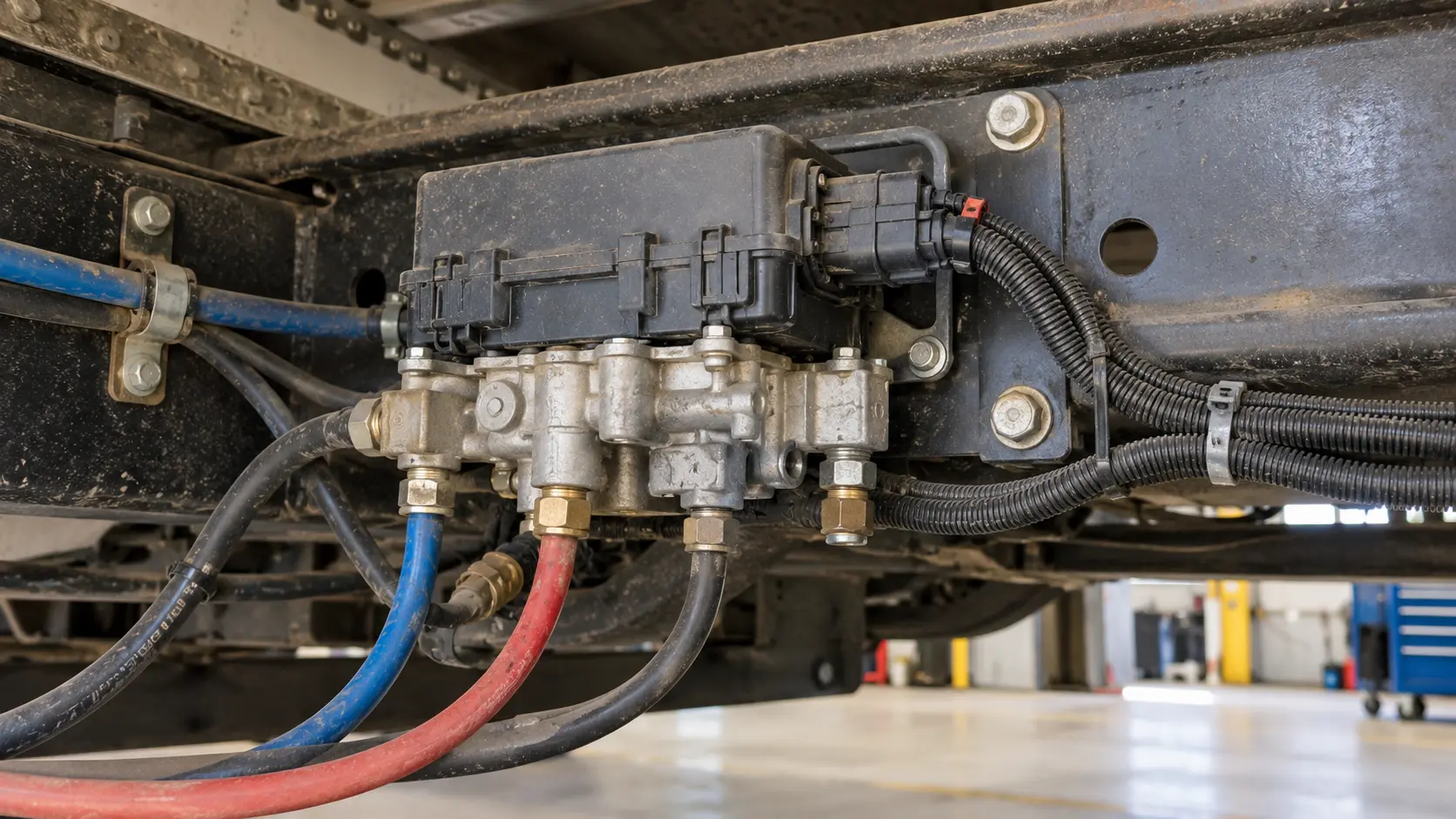
ABS is part of the service-brake system, but it has a specific job: it senses wheel rotation and adjusts brake force to help prevent wheel lock during braking. It cannot create traction, repair worn brakes or make an unsafe speed safe. Use this guide with the ProntoCDL air-brake test guide and air-brake component inspection; the ABS lamp check does not replace leakage, pressure, adjustment or brake-response checks.
What the federal ABS rules cover
49 CFR 393.55 establishes the operating-equipment baseline. With limited exceptions, air-braked truck tractors manufactured on or after March 1, 1997 must have ABS. Other air-braked commercial vehicles—including applicable trucks, buses, semitrailers, converter dollies and full trailers—manufactured on or after March 1, 1998 must also have ABS.
The same rule addresses malfunction circuits and indicators. Applicable tractors and single-unit vehicles need a circuit that can signal a malfunction in their own ABS. Applicable towing vehicles manufactured on or after March 1, 2001 must be able to receive a towed-vehicle malfunction signal and display it through a separate trailer ABS lamp in the cab. Trailers manufactured on or after March 1, 1998 that are subject to the rule need an exterior ABS malfunction lamp.
FMVSS No. 121 supplies the detailed performance requirements. The tractor lamp must illuminate for a lamp-function check when the ignition is switched on, then turn off after the check unless a malfunction or stored malfunction message remains. The exterior trailer lamp is yellow, normally located on the left side near the rear side-marker lamp, and must perform its own function check when power is first supplied while the vehicle is stationary.
Know which lamp reports which unit
| Indicator | What it reports | Where to check |
|---|---|---|
| Tractor ABS lamp | A malfunction affecting the tractor’s own anti-lock response or control signals. | Instrument panel, in clear view of the driver. |
| Trailer ABS lamp in cab | A malfunction signal received from one or more connected towed units on applicable newer equipment. | Instrument panel; separate from the tractor ABS lamp. |
| Exterior trailer ABS lamp | A malfunction detected by that trailer’s ABS controller. | Yellow lamp on the trailer’s left side, normally near the rear side-marker lamp. |
Older vehicles and voluntarily equipped units may not match every manufacture-date rule or display arrangement. Before operating unfamiliar equipment, identify the symbols and normal sequence in the manufacturer’s information. Do not assume that one dark lamp proves every ABS unit in a multi-vehicle combination is working.
A repeatable ABS startup check
- Secure the vehicle. Park on firm, level ground, apply the parking brakes, secure the transmission and control the key before walking around the equipment.
- Inspect visible wiring first. At the tractor-to-trailer connection, confirm that the electrical pigtail is fully seated and supported. Look for cuts, crushed conduit, exposed conductors, loose plugs or routing against sharp edges and heat. The air-lines and glad-hands guide covers the complete connection area.
- Locate the tractor and trailer lamps. Identify the tractor ABS warning and, when equipped, the separate trailer ABS warning in the cab. Locate the exterior trailer lamp before the power-up check.
- Switch the ignition to the approved test position. Observe each in-cab lamp through its function check. Do not start moving simply to force a lamp change unless the manufacturer and carrier procedure specifically requires and permits it.
- Verify the exterior trailer lamp. With a helper or another safe method allowed by the carrier, confirm that it illuminates when first powered and then follows the vehicle’s normal sequence. Never stand where the combination could roll or articulate.
- Record the result precisely. Note which lamp failed to illuminate, stayed on, returned after going out or behaved differently from the equipment procedure. “ABS light on” is less useful than “yellow trailer ABS lamp remained on after startup check.”
- Complete every normal brake test. Check air pressure, warning devices, leakage, spring-brake operation and service-brake response. A successful lamp check cannot prove that foundation brakes, hoses or chambers are safe.
What normal startup behavior looks like
On newer equipment, the yellow ABS lamp commonly illuminates briefly as a bulb or circuit check and then goes out. The current New York CDL manual notes that some older systems may keep the lamp on until the vehicle travels above approximately 5 mph. That exception is a reason to know the equipment—not a reason to drive an unverified combination around a yard.
A lamp that never comes on may be just as important as one that stays on. A failed lamp, missing trailer power or broken signal circuit can hide an ABS problem. Check the electrical connection and report the missing function check rather than treating darkness as a pass.
A warning lamp is not an ABS activation lamp
Normal ABS activation during a hard stop does not command the yellow malfunction lamp to flash. The driver may feel vibration or pulsing, hear system operation or notice the vehicle maintaining better directional control, but the warning lamp’s purpose is to report a malfunction.
If a lamp illuminates while driving, choose a safe place to stop and assess the situation. Note whether the service brakes also pull, feel weak, respond late, overheat or produce another warning. An ABS fault does not automatically mean total brake loss, but it may leave one or more wheels without anti-lock control. Notify the carrier and obtain the required maintenance decision.
How to brake with functioning ABS
During an emergency stop with functioning ABS, apply firm, steady service-brake pressure and keep steering controlled. Do not pump the brake pedal. The controller senses wheel behavior and rapidly changes brake pressure at the controlled wheels.
ABS does not necessarily shorten every stop. It is designed to help prevent lockup and preserve control, especially during hard braking. Speed, following distance, tire condition, road surface, load distribution and the condition of every foundation brake still determine whether the vehicle can stop safely. Review the skid-control and recovery guide for the difference between anti-lock support and available traction.
Inspect the hardware behind the warning
A driver’s visual inspection cannot diagnose fault codes, but it can find evidence that explains a warning. From a safe position and without entering an unsafe under-vehicle area, look for:
- A loose or damaged tractor-to-trailer electrical plug, socket or cable.
- Chafed sensor wiring, broken conduit, stretched harnesses or connectors hanging without support.
- Corroded, contaminated or partly disconnected electrical connectors.
- A damaged ECU or modulator mount, missing fastener or impact mark.
- Air lines rubbing the ABS assembly, kinked near a valve or pulled tight by suspension movement.
- A missing, broken, obscured or inoperative exterior trailer lamp.
Do not unplug an ABS controller, probe terminals, erase fault codes or move sensor wiring while the vehicle is energized unless you are trained and authorized. Qualified diagnostics should identify the stored fault and verify the repair.
What to say during a CDL inspection
Testing procedures vary by State and vehicle. Point to the actual indicators and explain the sequence you expect. A clear description could be:
“I will identify the tractor and trailer ABS malfunction lamps. With the vehicle secured, I will turn the ignition on and verify that each required lamp illuminates for its function check and then goes out according to the vehicle procedure. A lamp that does not illuminate, remains on or returns while driving indicates a fault that I will report. ABS supports control during hard braking, but it does not replace the normal air-brake inspection.”
On a trailer, identify the exterior yellow indicator from a safe standing position. Do not step into traffic, crawl beneath unsecured equipment or move the combination solely to demonstrate a lamp unless directed under a safe testing procedure.
Stop and report these findings
- A required tractor, trailer-cab or exterior trailer ABS lamp that never illuminates during its function check.
- A lamp that remains on after the normal check or returns while the combination is moving.
- Different trailer indications inside and outside the cab, suggesting a power or signal-path problem.
- A damaged, missing or obscured exterior lamp or a damaged electrical pigtail, socket, harness or connector.
- Loose ABS hardware, exposed wiring, broken conduit, unsupported lines or impact damage near the controller and modulator.
- Any ABS warning accompanied by weak braking, pulling, excessive pedal travel, abnormal air loss, smoke, odor, heat or mechanical noise.
Report the vehicle, trailer, lamp location, exact sequence and any braking symptoms. Use the post-trip and DVIR guide to turn the observation into a repairable defect description.
Common ABS inspection mistakes
- Watching only one dashboard light. A combination can have separate tractor and trailer warnings plus the exterior trailer lamp.
- Assuming a dark lamp means “good.” If the lamp never performs its function check, the indicator or its circuit may be defective.
- Calling every yellow brake warning “ABS.” Identify the actual symbol and unit; low-air and service-brake warnings communicate different hazards.
- Believing ABS makes pumping necessary. With functioning ABS, firm and steady pressure lets the system modulate the brakes.
- Ignoring the trailer electrical connection. The trailer needs correct power and signal continuity for its ABS and malfunction indication.
- Treating the warning as the diagnosis. The lamp identifies a system fault; a qualified technician must locate its cause.
Practical takeaways
- Identify the tractor, in-cab trailer and exterior trailer ABS indicators before departure.
- Verify that required lamps illuminate for their function check and then follow the equipment’s normal shutdown sequence.
- Report both a lamp that stays on and a lamp that never comes on.
- Inspect the electrical pigtail, visible harnesses, connectors, supports and exterior indicator without entering an unsafe position.
- Use firm, steady braking with functioning ABS; do not pump the pedal.
- Complete the full brake inspection because ABS cannot compensate for worn, contaminated, leaking or poorly adjusted brakes.
CDL ABS warning-light FAQ
Does an illuminated ABS lamp mean the service brakes have completely failed?
Not by itself. An ABS warning identifies a fault in the antilock system or its signal circuit; the conventional service brakes may still apply. The warning still requires inspection because anti-lock control may be unavailable at one or more wheels, and a separate brake defect may also exist.
Should a CDL driver pump the brakes when ABS activates?
No. With functioning ABS, use firm, steady brake pressure during an emergency stop and keep steering inputs controlled. The system modulates brake pressure faster than a driver can. Pumping the pedal can reduce the benefit of ABS.
Where is the trailer ABS warning lamp?
Newer towing vehicles may have a separate trailer ABS malfunction lamp in the cab. A federally required exterior trailer indicator is yellow and normally mounted on the trailer’s left side near the rear side-marker lamp. Exact placement and startup behavior can vary with vehicle age and design.
What if the ABS lamp never comes on during the startup check?
A lamp that never illuminates does not prove the system is healthy. It may indicate a failed bulb or LED, lost power, damaged circuit or another fault that prevents the warning from being displayed. Report it and have the system evaluated.
Why can a tractor have two ABS warning lamps in the cab?
One lamp reports a malfunction in the tractor’s own ABS. On applicable newer towing vehicles, a separate trailer ABS lamp receives a malfunction signal from the connected towed unit. Identify both before departure so a warning can be assigned to the correct vehicle.
Can a driver continue with an ABS warning lamp on?
Do not dismiss the warning or make a blanket decision from the lamp alone. Stop in a safe place if it appears while moving, check for other brake symptoms, notify the carrier and follow the vehicle and maintenance procedure. Any weak braking, pulling, abnormal pressure, smoke, overheating or mechanical damage requires immediate safe shutdown.
Know which unit is warning you before the combination moves.
Check the lamps, inspect the connections, complete the brake tests and report the exact sequence.
Start free CDL practice