
CDL Tire Blowout Response: Steering, Speed and Safe Stopping
A tire failure can announce itself with a bang—or only a thump, vibration or sudden change in steering. The useful response is short enough to remember: control the wheel, keep a steady path, avoid abrupt braking, let the truck slow, then stop where the vehicle and driver can be protected.
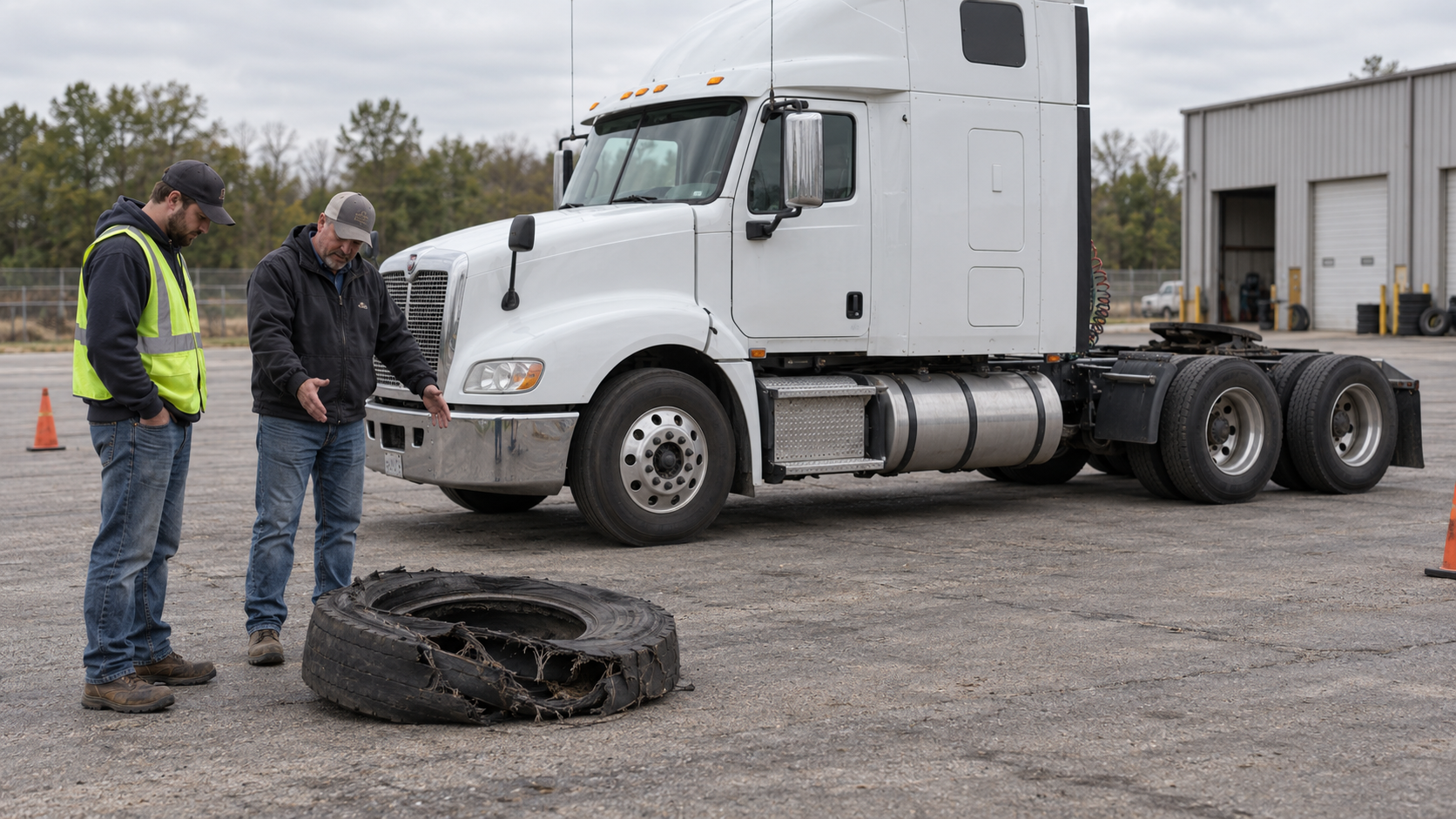
The first seconds are about directional control, not diagnosing the exact tire position from the driver’s seat. Stabilize the vehicle before making a large speed or lane change. Then stop, protect the scene and inspect only from a place where doing so does not expose you to traffic.
Know the warning signs before the emergency
A blowout is not always a movie-style explosion. Current commercial-driver handbook guidance identifies sound, vibration and feel as the main clues. Treat a sharp report, repeating thump, heavy vibration, new pull, heavy steering or unusual rear movement as a possible tire failure until you can stop and check.
| Clue | What it may mean | Driver priority |
|---|---|---|
| Loud bang or pop | A rapid pressure loss or tread failure, even if the truck has not reacted yet | Assume the sound may be yours; hold a steady path |
| Rhythmic thump or vibration | A flat, separated tread or damaged wheel-end area | Avoid abrupt controls and begin a controlled slowdown |
| Heavy steering or pull | Possible steer-tire failure | Use both hands and resist the pull without overcorrecting |
| Rear movement or fishtail sensation | Possible drive- or trailer-tire failure, or secondary damage | Keep the unit aligned and do not add a sharp brake or steering input |
Mirrors can confirm debris, smoke, a damaged mudflap or a change in trailer tracking, but do not let mirror checking pull your eyes away from the escape path. A dual-tire failure can be subtle enough that a complete stop-and-look inspection is the only reliable confirmation.
The first-seconds response
- Hold the steering wheel firmly with both hands. A steer-tire failure can pull hard enough to turn the wheel. Keep your upper body supported by the seat and belt while making a measured correction.
- Keep the truck on its intended path. Look far ahead toward the open lane or safest escape area. Resist the pull without making a sudden move across a lane.
- Come off the accelerator. Allow speed to begin decreasing. Do not add speed as a memorized “blowout trick.”
- Avoid an abrupt brake application. Hard braking while the truck is unstable can worsen the pull, create a skid or increase combination angle. If a collision is not immediately unavoidable, let the truck stabilize and slow first.
- Brake gently once stable and slower. Signal when useful, continue scanning and move to the safest available stopping location without cutting sharply across traffic.
This sequence tracks the tire-failure section in the New York State Commercial Driver’s Manual, Section 2, an official current state manual in the national CDL testing system. FMCSA also tells applicants to use their own State’s CDL manual for licensing preparation. Always follow the specific vehicle manufacturer, employer and training-provider procedures when they add vehicle-specific detail.
Why “add throttle” is the wrong universal rule
Drivers sometimes hear that acceleration transfers weight or helps a truck drive through a blowout. That slogan can be misapplied as a direction to gain speed during an emergency. The handbook sequence reviewed here does not tell drivers to accelerate. It says to hold the wheel firmly, avoid braking until the vehicle has slowed, then brake gently and stop.
The safer study cue is control, coast, then controlled braking. Ease off the accelerator, keep the path stable and let speed come down before braking gently. If traffic, a barrier or another immediate hazard changes the available choices, preserve life and take the least dangerous action rather than following any slogan mechanically.
Steer, drive and trailer failures do not feel identical
Steer-tire failure
The steering wheel may pull or feel suddenly heavy. Use a firm two-hand grip and enough steering correction to stay in the lane, but avoid snapping the wheel away from the failed side. A large correction can put the truck into adjacent traffic or start a secondary loss of control when the vehicle responds.
Drive-tire failure
A driver may hear a bang and feel thumping or vibration with less change at the steering wheel. Keep the tractor aligned, reduce power and watch the mirrors only as traffic permits. Debris from a failed drive tire can damage air lines, mudflaps, quarter fenders, fuel-system guards or adjacent tires.
Trailer-tire failure
A trailer failure may be visible in a mirror as debris, smoke or a tracking change. Maintain combination alignment and avoid a sudden brake or lane-change input. The trailer may still roll, but continued travel can turn one failed tire into wheel, hub, brake, suspension, cargo or body damage.
Choose the stopping place, not just the shoulder
The nearest edge of pavement is not automatically safe. When the truck remains controllable, scan for a location with firm support, sight distance and as much separation from live lanes as conditions allow. Avoid stopping where the truck blocks a curve, hill crest, ramp gore, narrow bridge or active work zone.
- Activate four-way flashers during the controlled slowdown when doing so will help warn other road users.
- Stop as far from moving traffic as the safe surface allows, straighten the units and apply the parking brakes.
- Before opening the door, check mirrors for traffic and decide whether exiting is safer than remaining belted in the cab.
- If the vehicle is stopped on the traveled portion or shoulder, follow the carrier’s emergency plan and the applicable warning-device rules explained in the CMV emergency equipment checklist.
- Call dispatch, qualified roadside service or emergency services as the situation requires. Give the route, direction, nearest marker and which side of the truck is exposed.
Inspect only after the scene is protected
Do not step into a live lane to identify the failed tire. If there is no protected way to inspect, stay in the safest available location and request help. When inspection is safe, approach from the non-traffic side when possible and look before touching anything; a failed tire, wheel or brake can be hot and unstable.
| Area | Look for | Decision |
|---|---|---|
| Failed tire | Loss of pressure, exposed cords, tread separation, torn sidewall or missing material | Do not continue until the tire is repaired or replaced by qualified service |
| Companion dual | Overload signs, cuts, scuffing, heat, low pressure or trapped debris | Never assume the second tire is undamaged |
| Wheel and hub | Cracks, bent components, loosened fasteners, oil or grease, heat or unusual position | Report exact observations; do not improvise a roadside wheel repair |
| Air, brake and suspension area | Cut hoses, hanging parts, displaced chamber hardware, broken spring or damaged air bag | Keep the vehicle stopped for qualified evaluation |
| Body and cargo | Damaged mudflap, quarter fender, fairing, load contact or cargo movement | Inspect securement before any authorized movement |
Federal 49 CFR 393.75 prohibits operating a motor vehicle with certain tire defects, including exposed belt or ply material, tread or sidewall separation, specified audible or feelable leaks and insufficient tread depth. A driver cannot turn a controlled stop into a decision to continue merely because the truck can still move.
Prevention starts with a tire-centered inspection
Under 49 CFR 392.7, a CMV may not be driven unless the driver is satisfied that specified equipment, including tires, is in good working order. Use the CDL tire inspection guide to check inflation, tread, damage and dual spacing systematically.
- Check cold inflation with an accurate gauge and use the fleet or manufacturer specification for the load and tire.
- Look for cuts, bulges, exposed material, separation, embedded objects and uneven wear.
- Inspect the inside sidewalls and the space between duals, not only the easy-to-see outer faces.
- Check valve stems, caps, wheel fasteners, rims and hubs for damage or leakage clues.
- Reinspect after a hard curb or pothole impact and during en-route stops.
- Match speed and load to tire, vehicle and route limits; heat, underinflation and overload reduce the safety margin.
Connect tire condition with the rest of the vehicle. The wheel and rim inspection guide covers fasteners, cracks and hub leaks, while the cargo securement checklist helps identify load movement that can follow a violent tire failure.
How tire-failure response fits ELDT
The federal Class A ELDT curriculum and Class B ELDT curriculum require instruction on proper responses to tire blowouts as part of skid control, recovery and other emergencies. The curricula also require pre-trip, en-route and post-trip inspection instruction.
Use ProntoCDL’s Class A ELDT guide or Class B ELDT guide to connect the emergency sequence with formal training, then reinforce recognition and decision-making in the free CDL practice center.
Practical takeaways
- Treat a bang, repeated thump, heavy vibration or new steering pull as a possible tire failure.
- Hold the wheel firmly with both hands and look toward the safest available path.
- Ease off the accelerator; do not accelerate because of a memorized blowout slogan.
- Avoid abrupt braking while the truck is unstable; brake gently after it has slowed and stabilized.
- Choose a protected stopping place and decide whether exiting the cab is safe before opening the door.
- Inspect every tire and nearby component; do not assume a surviving dual makes the vehicle safe to continue.
- Build blowout response into ELDT study, but practice emergency decisions only with qualified instruction in a controlled environment.
CDL tire blowout response FAQ
Should a CDL driver slam on the brakes after a tire blowout?
Normally, no. A sudden hard brake application can increase the loss of control. Hold the wheel firmly, keep the truck on its intended path, come off the accelerator and allow the vehicle to slow. Once it is stable and slower, brake gently and move to the safest available stopping place. An immediate collision threat can require a different emergency choice.
Should a driver accelerate through a tire blowout?
No. The commercial-driver guidance reviewed for this article says to hold the steering wheel firmly and stay off the brake until the vehicle has slowed; it does not direct drivers to add speed. Protect directional control and ease off the accelerator rather than treating acceleration as a universal blowout technique.
Can a truck keep driving after one tire in a dual assembly fails?
Do not assume the remaining tire makes continued travel safe. A failed dual may damage the companion tire, wheel, air lines, suspension or bodywork, and the remaining tire may be overloaded. Stop safely, inspect from a protected position and follow carrier and qualified roadside-service procedures before moving again.
How does a steer-tire failure feel different from a drive-tire failure?
A failed steer tire can make steering feel heavy and pull or twist the wheel. A rear-tire failure may produce a bang, thumping, vibration or lateral movement, and sometimes provides fewer steering clues. The first priority is the same: firm control, a steady path and gradual deceleration.
Does ABS prevent or fix a tire blowout?
No. ABS helps keep wheels from locking during braking, but it does not prevent a tire from losing air or separating. It cannot restore the failed tire. Once the truck is stable enough to brake, use the normal controlled technique for the specific vehicle and follow manufacturer guidance.
Is tire-blowout response part of federal ELDT?
Yes. The federal Class A and Class B entry-level driver training curricula require instruction on appropriate responses to CMV emergencies, specifically including tire blowouts. The curricula also connect emergency response with directional control, braking, inspections and hazard perception.
Make the first seconds automatic
Use one calm study cue: control the wheel, hold the path, let speed fall, then brake gently and stop where the scene can be protected.
Start free CDL practice