
CDL Pre-Employment Drug Test Guide: Test, Query & Start Date
A CDL hiring file can look complete while two separate federal gates remain open: the DOT controlled-substances test and the Drug and Alcohol Clearinghouse query. Drivers and carriers need to know what each step proves—and what must happen before the first dispatch.
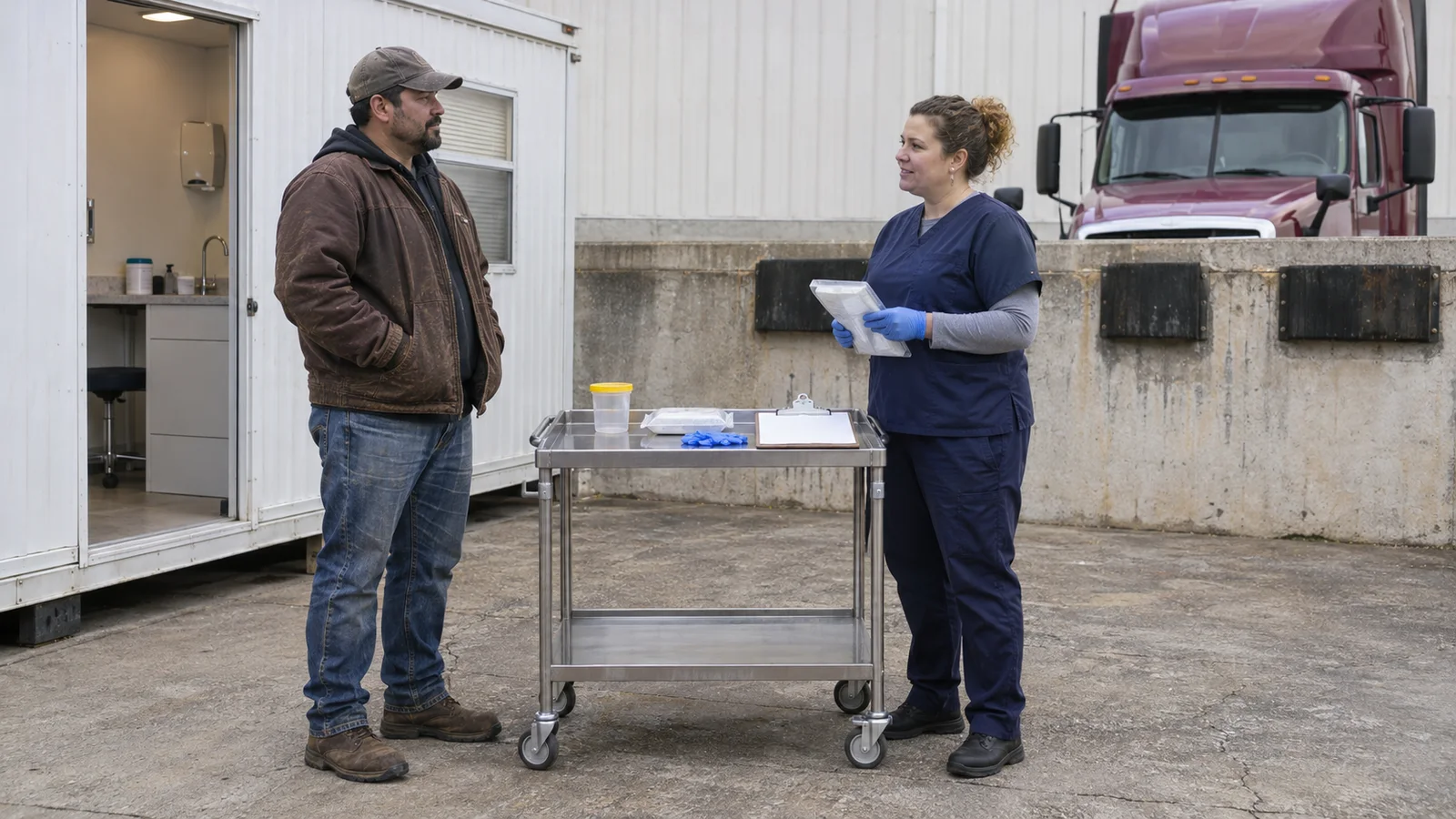
For a driver subject to 49 CFR Part 382, a job offer, valid CDL and completed road test do not by themselves authorize regular safety-sensitive work. The employer must complete the applicable pre-employment drug-testing and Clearinghouse steps before using the driver in covered operations.
The two steps are related but not interchangeable. A drug test addresses the current specimen collected for that hiring decision. A Clearinghouse query checks the federal record for reported violations and whether the driver is prohibited from safety-sensitive functions because a return-to-duty process remains unresolved.
Two clearances, two different questions
| Hiring control | What it answers | What the employer needs |
|---|---|---|
| DOT pre-employment controlled-substances test | Did the collected specimen produce a verified negative result under the DOT process? | A verified negative result from the Medical Review Officer or C/TPA, unless the documented prior-program exception applies |
| Pre-employment Clearinghouse query | Does the federal record show a violation or a current prohibition from safety-sensitive work? | A completed full query, specific electronic driver consent and a result that permits covered work |
A carrier should track both gates separately. “Test scheduled” is not the same as “verified negative,” and “consent requested” is not the same as “query completed.” A start date should not be confused with authorization to drive.
Who is covered by the federal testing program?
Part 382 generally applies when a driver operates a commercial motor vehicle on public roads that requires a CDL. FMCSA explains that the program reaches interstate and intrastate motor carriers, public agencies and other organizations that employ CDL drivers. An owner-operator who employs only himself or herself is still both an employer and a driver for Part 382 purposes.
The trigger is the covered driving function, not the label on the business card. A mechanic, temporary driver, relief driver or manager who will operate a CDL-required CMV may enter the program. Conversely, a person who holds a CDL but is hired only for work that never involves a covered safety-sensitive function is not automatically subject to a pre-employment Part 382 test solely because the credential exists.
The verified-negative rule before covered work
Under 49 CFR 382.301, the employer generally may not allow the driver to perform safety-sensitive functions until it has received a controlled-substances result from the Medical Review Officer or consortium/third-party administrator indicating a verified negative result.
The word verified matters. A collection-site receipt only proves that a collection occurred. A rapid screen, applicant-provided laboratory page or verbal statement is not a substitute for the final DOT result communicated through the regulated process. The driver should follow the employer's collection instructions, bring the requested identification and keep the collection documentation without trying to interpret or alter the chain-of-custody process.
Applicants should also distinguish a DOT test from an employer's separate company-authority test. A carrier may have additional workplace policies, but those policies must remain distinct from the federal DOT program. Ask which test is being ordered and which result is still pending.
The prior-program exception is narrow
A recent job or recent test does not automatically eliminate the new employer's testing duty. Section 382.301 allows an exception only when all required conditions are satisfied:
- The driver participated in a compliant controlled-substances testing program within the previous 30 days.
- While in that program, the driver either was tested within the past six months or participated in the random testing program for the previous 12 months.
- The employer ensures that no prior employer of which it has knowledge has a covered violation record for the driver within the previous six months.
- The employer contacts the testing program and obtains the required participation, program-compliance, qualification, refusal, testing-date and recent-result information.
If the employer cannot verify the required facts, the rule directs it to conduct a new pre-employment test. The exception is an employer compliance decision supported by records; it is not a waiver the applicant can create by presenting an old test result.
The Clearinghouse full query and electronic consent
49 CFR 382.701 requires a pre-employment Clearinghouse query before an employer uses a covered driver in safety-sensitive work. This is a full query, not the limited query commonly used for annual checks. It can disclose detailed reported violation and return-to-duty information.
The driver must provide specific electronic consent in the Clearinghouse. Under 49 CFR 382.703, the employer may not permit safety-sensitive work if the driver refuses the required consent. Refusing one employer's request does not itself give another employer access; consent is tied to the requesting employer and query.
Applicants can prevent avoidable delay by registering with accurate CDL information, monitoring the email address connected to the account and responding to the correct employer's consent request. Never approve an unfamiliar request merely to clear a notification. Confirm the carrier name and hiring contact first.
Road test timing is a special case
FMCSA guidance allows a motor carrier to administer the federal employer road test to a prospective driver before the pre-employment controlled-substances test. Separate Clearinghouse guidance says the pre-employment query also does not have to precede that road test because it occurs before the driver is hired for safety-sensitive work.
This narrow timing guidance does not convert the road test into a first revenue trip. The carrier still cannot dispatch the driver in regular covered service before the required negative result and pre-employment query are complete. ProntoCDL's employer road-test guide explains what the test evaluates and how its certificate fits into the qualification file.
Pre-employment alcohol testing is optional
Federal Part 382 requires the pre-employment controlled-substances test but makes pre-employment alcohol testing optional. If a carrier chooses to conduct the alcohol test, it must apply the policy consistently to covered safety-sensitive employees, test after a contingent offer, follow Part 40 procedures and receive a result below 0.04 before the person begins safety-sensitive functions.
This optional pre-employment rule should not be confused with random, post-accident, reasonable-suspicion, return-to-duty or follow-up alcohol-testing requirements. Those arise from different events and standards.
What a prohibited Clearinghouse result means
A driver with prohibited status cannot perform a covered safety-sensitive function. Ordering another ordinary pre-employment test does not erase the underlying record. The driver must address the violation through the applicable Substance Abuse Professional and return-to-duty process, and the required information must be reported before status can change.
ProntoCDL's Clearinghouse status and CDL-downgrade guide explains prohibited status and reinstatement at a higher level. If an applicant believes the record is inaccurate, the applicant should use the Clearinghouse's record-review and correction channels rather than asking a recruiter to ignore it.
A practical applicant timeline
- Finish the driver application: provide accurate license, address, experience and employment history using the 3-year and 10-year application guide.
- Confirm Part 382 coverage: ask whether the position operates a CDL-required CMV on public roads.
- Use the assigned collection site: follow the employer's instructions and keep the collection receipt.
- Register or verify Clearinghouse access: make sure the CDL details and contact information match the current record.
- Approve only the correct full-query request: verify the employer before providing electronic consent.
- Track status precisely: distinguish collected, pending MRO review, verified negative, query pending and query complete.
- Do not self-dispatch: wait for the carrier's confirmation that all hiring gates are complete before performing regular covered work.
- Organize the rest of the file: use the driver qualification file checklist and understand the separate former-employer safety-history investigation.
Practical takeaways
- The DOT test and the Clearinghouse full query are separate pre-employment controls.
- A collection receipt is not a verified negative result.
- A pre-employment query requires specific electronic driver consent in the Clearinghouse.
- The prior-program test exception works only when every timing and verification condition is documented.
- FMCSA permits a prospective-driver road test before these hiring steps, but not regular dispatch before clearance.
- Pre-employment alcohol testing is optional under Part 382 and must be administered consistently if chosen.
- An unresolved prohibited status requires the return-to-duty process; another ordinary test is not a shortcut.
- Drivers should confirm the requesting employer before approving a Clearinghouse consent request.
CDL pre-employment testing FAQ
Does a negative pre-employment drug test replace the Clearinghouse query?
No. They are separate hiring controls. A covered employer generally needs a verified negative DOT controlled-substances result and a completed pre-employment full Clearinghouse query showing that the driver is not prohibited before using the driver in covered safety-sensitive work.
Can a carrier accept a drug test that a previous employer ordered?
Not simply because the applicant has a recent result. The carrier may use the narrow exception in 49 CFR 382.301 only when every participation, timing, qualification and verification condition is met and documented. Otherwise, it must conduct a new pre-employment controlled-substances test.
Does the driver have to consent to a pre-employment Clearinghouse query?
Yes. A pre-employment query is a full query, and the driver must provide specific electronic consent in the Clearinghouse before detailed information is released. Without the required consent, that employer may not permit the driver to perform a safety-sensitive function.
Can a carrier conduct a road test before the drug test and Clearinghouse query are complete?
FMCSA guidance says a prospective-driver road test may occur before the pre-employment drug test and before the pre-employment Clearinghouse query. That limited timing guidance does not authorize dispatching the driver on a first trip before the required clearances are complete.
Is a pre-employment alcohol test always required for a CDL job?
No. Federal Part 382 makes pre-employment alcohol testing optional. If an employer chooses it, the employer must test covered employees consistently, use Part 40 procedures after a contingent offer and require a result below 0.04 before safety-sensitive work begins.
What should an applicant do if the Clearinghouse shows prohibited status?
The applicant should review the record in the Clearinghouse and follow the applicable return-to-duty process. A new negative pre-employment test alone does not erase an unresolved violation or replace the Substance Abuse Professional and return-to-duty steps.
Preparing for a carrier onboarding appointment? Start with the employment-history guide, then use the DQ-file checklist to keep testing, query, medical and driving records in their correct categories.