
CDL Bus Interior Inspection: Seats, Aisles, Standees & Baggage
A bus interior can look orderly while hiding a loose seat, blocked aisle or unsecured bag. A disciplined inspection follows the passenger path from the entrance to every seat, storage area and exit.
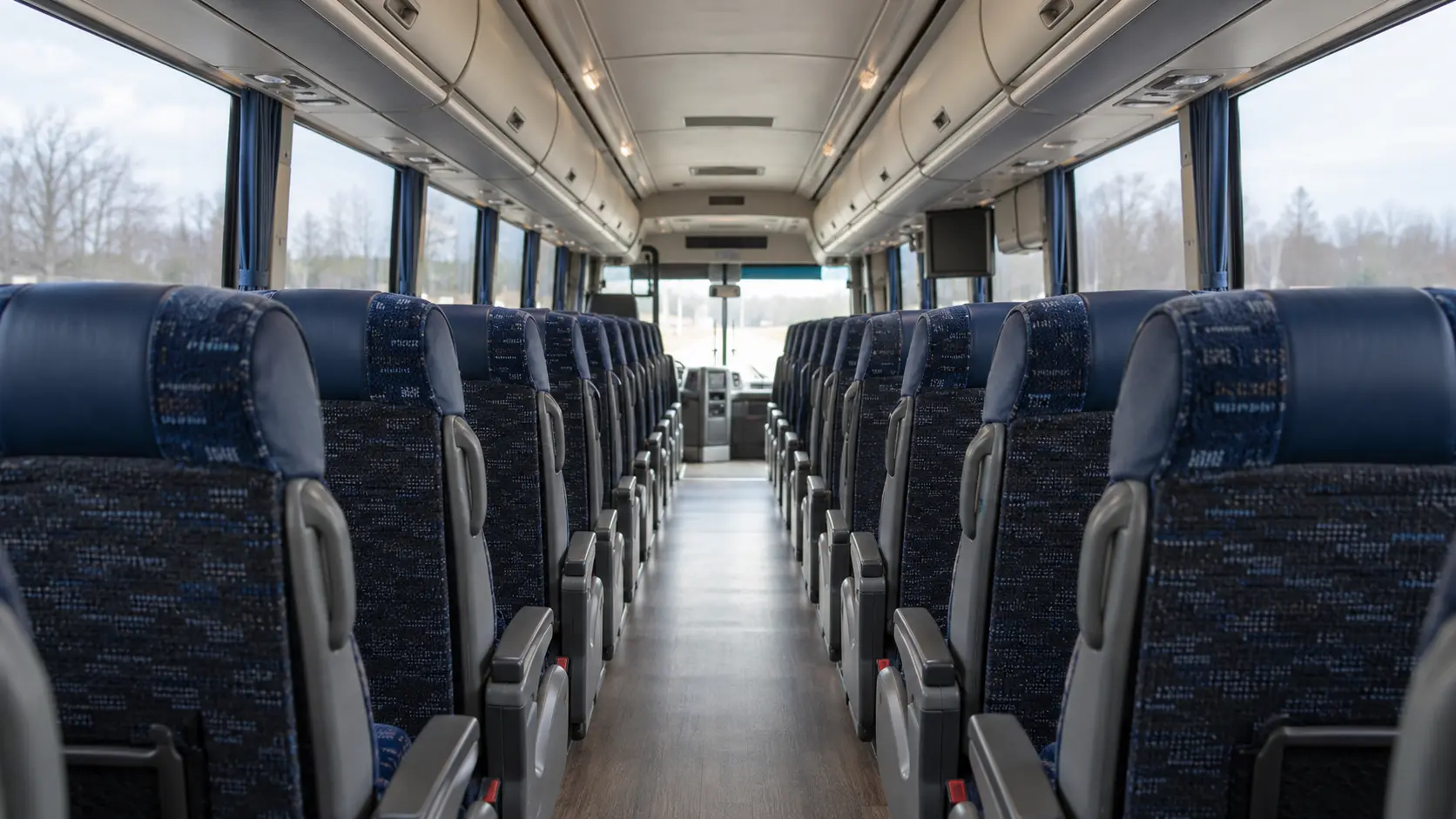
The federal operating rule is direct. Under 49 CFR 392.62, a bus may not be driven unless standees remain behind the required boundary, aisle seats meet the applicable rule, and baggage or freight is stowed and secured. The loading arrangement must leave the driver free to operate the bus, keep every occupant's access to exits unobstructed and protect people from falling or displaced articles.
Two equipment rules add specifics. 49 CFR 393.90 addresses the standee line or equivalent boundary on buses designed for standing passengers. 49 CFR 393.91 requires permitted aisle seats to fold automatically and leave a clear aisle when unoccupied, and it prohibits operating a bus with any seat not securely fastened.
The federal Passenger Endorsement Training Curriculum connects those rules to real driver work. P-endorsement ELDT includes passenger interiors and seats, interior and exterior luggage compartments, left-behind packages, tampering clues, baggage handling and the securement of mobility devices and related equipment.
This routine complements ProntoCDL's bus emergency-exit inspection, Passenger and School Bus endorsement guide and post-trip and DVIR guide.
Secure the bus before inspecting the cabin
Park on level ground, set the parking brake and place the transmission in the condition required by the vehicle and carrier procedure. Keep passengers off the bus during the pre-trip unless an approved procedure directs otherwise. Turn on interior lighting when needed, but do not let a bright ceiling lamp replace a flashlight check beneath seats and along mounting points.
Start at the entrance and work in one direction. A consistent route prevents a good-looking front cabin from distracting you from a problem behind the last row. Note the bus type: a transit bus designed for standees, an intercity motorcoach with overhead and underfloor storage, and a school bus with fixed bench seating do not have identical equipment.
1. Inspect every passenger seat as installed equipment
Look at the seat frame, legs, floor or wall mounting points, fasteners, cushion, seatback, armrests and any grab handle. The seat must remain securely fastened to the vehicle. Watch for a rocking frame, missing or backed-out hardware, cracked weld, pulled floor material, bent support, sharp edge, exposed padding or a cushion that is no longer retained.
Apply only the controlled hand pressure allowed by the inspection procedure. A driver check is not a destructive load test. If the frame moves relative to the floor or side structure, record the exact seat location—such as “right side, row four, aisle position”—and do not conceal the problem by assigning a different passenger to it.
Check the usable space around the seat. A broken recline mechanism, deployed leg rest or loose armrest can intrude into the aisle. Seat-belt webbing, where installed, should not trail across the walking path. Follow the manufacturer and operator procedure for the installed restraint system rather than assuming every bus uses the same design.
2. Prove the aisle remains clear from front to rear
Stand at the front and sight down the aisle, then walk the entire length. Look for luggage, cleaning supplies, trash containers, loose floor mats, seat parts, charging cords and personal items. Check the floor for lifted covering, soft areas, liquid, ice or debris that could cause a fall.
A clear aisle is more than empty floor at departure. Nothing should be able to roll, slide or fall into it under normal braking or turning. Confirm that doors on overhead compartments stay closed, loose service items have designated secure storage and passenger belongings can be placed without narrowing the path to an exit.
Connect this check to the emergency-exit routine. An exit can operate perfectly and still be unusable if a bag, mobility-device component or damaged seat blocks the approach.
3. Check foldaway aisle seats without creating an aisle obstruction
If the bus has seats that extend into the aisle, identify which ones are original approved equipment. Federal rules do not permit a conventional fixed chair in the aisle. A permitted aisle seat must be designed and installed to fold automatically and leave a clear aisle when it is unoccupied.
Operate the seat under the approved procedure. It should deploy without binding, support its intended occupant and return fully without being tied, wedged or pushed by hand into a partial position. Inspect its hinges, latch, return mechanism and mounting hardware. Report a weak return, damaged hinge or seat that remains in the aisle.
Do not improvise extra capacity with portable chairs, coolers or cushions. Capacity decisions belong to the rated and approved seating arrangement, not to available floor space.
4. Verify the standee boundary on buses designed for standing passengers
A transit-style bus may be designed and constructed to carry standees. The required contrasting line or other means identifies the space forward of which standing passengers are prohibited. The federal rule also calls for a clearly posted notice near the front. The purpose is to preserve the driver's working space and view.
Confirm that the line or approved boundary is visible and has not been hidden by a mat, repair, dirt or added equipment. Check the associated sign. Then look at the actual passenger space: stanchions, handholds and floor area should be serviceable under the vehicle and carrier procedure, and no stored item should encourage a passenger to stand forward of the boundary.
The boundary does not authorize unsafe crowding behind it. Apply the vehicle's rated capacity, operator policy and applicable State or local passenger rules. If the bus is not designed for standees, an empty aisle is not standing-passenger space.
5. Inspect overhead racks and enclosed compartments
Follow each rack or compartment from front to rear. Inspect supports, attachment points, panels, hinges, latches, nets, doors and trim. Look for a sagging rack, loose fastener, cracked panel, sharp edge, failed latch or evidence that a door opens during motion.
Place baggage only where the design and operator procedure allow it. An item that protrudes into the aisle, rests against an emergency release or can fall during a turn is not safely stowed. Heavy or irregular items may need underfloor storage even when they physically fit overhead.
Do not use tape, cord or a passenger's hand to keep a defective door closed. Empty the affected compartment and report the defect. During the final walk-through, confirm that every used door is fully latched and that no strap, handle or garment hangs into the aisle.
6. Check underfloor luggage bays and exterior doors
From outside, inspect the bay doors, hinges, support struts, latches, seals and surrounding structure. Control each door through its travel and stay clear of an unsupported panel. The compartment should be reasonably clean and dry, with no sharp damage, loose hardware, fluid contamination or evidence that contents have shifted against the door.
Load with weight distribution and safe handling in mind, using the vehicle and carrier instructions. Keep articles from damaging wiring, lines or compartment equipment. Before closing, account for tools and make sure no person is in or near the bay. Close and positively latch every door, then check it again from the outside.
The ELDT security sweep includes interior and exterior luggage compartments, left-behind packages and signs of tampering. Do not open, move or reach around a suspicious item. Isolate the area and follow the carrier's security and notification procedure.
7. Secure baggage, mobility devices and service items
Think about what each item could do during hard braking, a sharp turn or a crash. Secure passenger bags and containers in the designated area. Keep the driver's pedals, controls, seat movement and sight lines free. Protect the service-door area and the approach to every emergency exit.
Wheeled mobility devices and related equipment require their approved tie-down positions and securement systems. Follow training and the installed instructions; do not substitute a baggage strap, seat belt or improvised knot. Oxygen and other associated apparatuses also need the handling and securement method taught by the carrier and applicable accessibility procedure.
Cleaning supplies, chocks, fire extinguishers and driver gear count too. “Company equipment” does not make a loose object safe. Return each item to its bracket, cabinet or other designated restraint before the bus moves.
8. Finish with a security sweep and driver-seat view
Walk the cabin again after loading and before departure. Look beneath seats, in seat pockets, along the rear area, inside restrooms where equipped and in storage compartments. Identify left-behind packages, unusual wires, disturbed panels or other signs of tampering without handling a suspicious item.
From the driver's seat, confirm that no passenger, bag or equipment occupies the prohibited forward space or interferes with controls and mirrors. Look down the aisle and toward the service door. If the loading arrangement changes at an intermediate stop, repeat the relevant checks rather than relying on the morning inspection.
Turn observations into clear go/no-go decisions
| Finding | Why it matters | Driver action |
|---|---|---|
| Seat frame moves at its mount | Federal rule prohibits operating with a seat not securely fastened | Identify the seat, restrict use and report for qualified repair |
| Foldaway seat remains in aisle | Unoccupied aisle seat must fold and leave a clear aisle | Do not operate until the aisle is restored and defect resolved |
| Standee line or notice obscured | Passengers may enter the driver's protected space | Restore visibility and follow carrier defect procedure |
| Bag blocks exit approach | Occupant access to exits must remain unobstructed | Move and secure it in an approved location before departure |
| Overhead door will not latch | Contents can fall or move into occupants or aisle | Empty the compartment and report the failed closure |
| Unidentified package left behind | Security sweep requires attention to abnormal or unattended items | Do not handle it; isolate and follow notification procedure |
A precise report names the component, location and failure: “left row, seat six, rear floor mount moves with hand pressure,” or “right overhead compartment above row three opens after latching.” “Interior problem” gives maintenance too little to act on.
Use CDL test language without memorizing an unsafe script
For a CDL inspection, point to the actual component and explain what you are checking. A useful sequence is: passenger seats are securely mounted and free of unsafe damage; aisle and exit paths are clear; any aisle seat folds as designed; the standee boundary is visible where applicable; and baggage and equipment are stowed so they cannot interfere with the driver, exits or occupants.
The current New York CDL skills-test manual reinforces the seat check for coach and transit buses: look for broken seat frames, seats securely attached to the floor and cushions securely attached to the frames. Test wording and scoring vary by State, so use the current manual and examiner instructions for the licensing jurisdiction.
Practical takeaways
- Secure the bus and inspect the cabin in the same direction every time.
- Check every seat frame, mount, cushion and aisle-side part for security and damage.
- Keep the complete aisle and every exit approach clear—not merely passable.
- Verify an unoccupied aisle seat folds automatically out of the aisle.
- On standee-equipped buses, keep standing passengers behind the visible boundary.
- Inspect overhead and underfloor storage, then positively latch every used door.
- Secure baggage, mobility devices and company equipment in their designated systems.
- Finish with a left-behind-item and tampering sweep without handling suspicious objects.
- Repeat the relevant checks whenever passengers or baggage change during the trip.
- Report the exact location and failure mode, and do not improvise seating or securement.
Bus interior inspection FAQ
May a bus operate with a passenger seat that feels loose?
No. Federal regulation states that a bus may not be operated if any seat is not securely fastened to the vehicle. Mark the exact seat location, keep passengers away from it and follow the carrier procedure for removing the bus from service or obtaining a qualified repair.
Are all aisle seats prohibited on a commercial bus?
Aisle seats are allowed only when they are designed and installed to fold automatically and leave a clear aisle when unoccupied. A portable chair, a seat that stays extended or any improvised seating in the aisle does not meet that rule.
What is the standee line?
On a bus designed to carry standing passengers, the standee line or other approved indicator marks the area forward of which a standing passenger may not ride. Federal rules require standees to remain rearward of that boundary so they do not interfere with the driver.
Can a passenger keep a suitcase or mobility device in the aisle?
Not when it restricts driver movement, blocks access to an exit or could fall or shift into an occupant. Use the designated storage or securement location and follow the vehicle and carrier procedures, including the approved restraint system for a wheeled mobility device.
Should a driver open every underfloor luggage bay during the pre-trip?
Inspect the compartments assigned for use under the carrier and vehicle procedure. Verify that doors, latches and contents are secure and that nothing suspicious, damaged or left behind is overlooked. Do not enter a compartment or reach around an unidentified item.
Is a clean aisle enough to pass the bus-interior inspection?
No. The inspection also covers seat attachment and condition, foldaway aisle-seat operation, the standee boundary where applicable, baggage and mobility-device securement, luggage compartments, exit access and a final security sweep for unusual or left-behind items.
Clear the path before passengers board.
Secure seats, an open aisle and controlled baggage give the driver room to work and passengers a safer trip.
Start free CDL practice