
CDL Vehicle Fire Response Guide: Stop, Evacuate and Act Safely
A commercial-vehicle fire can grow faster than a driver can diagnose it. The safest sequence is control the vehicle, stop in a safer place, get everyone out, call emergency services and fight only a small fire when the correct equipment, training and escape path are all present.
Smoke in a mirror, a hot electrical smell, a sudden temperature rise or a glowing wheel end is not a cue to finish the next mile. It is a cue to find a safer stop while the vehicle still responds normally. The priorities are people first, scene safety second and equipment last.
This guide turns federal emergency-equipment and post-crash training requirements into a practical response. It does not replace emergency-dispatch instructions, hazardous-material response procedures, vehicle instructions or carrier policy.
Know the warning signs before flames appear
A fire may announce itself through odor, heat, smoke, a warning light or an unusual gauge reading. During routine mirror checks, look for smoke from the tractor, trailer, tires, brakes and cargo area. Do not dismiss a burning-rubber smell, repeated circuit failure or a hot wheel as a maintenance issue that can wait.
| Warning sign | Immediate priority | Avoid |
|---|---|---|
| Smoke or flame in a mirror | Signal, slow smoothly and find an open stopping area. | Continuing to the next exit without knowing whether the fire is spreading. |
| Electrical odor or arcing | Stop, shut down and evacuate; report the electrical signs. | Resetting a breaker or replacing a fuse repeatedly. |
| Hot tire, hub or brake | Stop away from buildings, brush and other vehicles. | Touching the assembly or parking beside combustible material. |
| Cargo smoke or heat | Keep people back and tell dispatchers what the shipping papers identify. | Opening cargo doors, especially with hazardous materials. |
1. Move off the roadway without creating another emergency
Use mirrors, signal and decelerate smoothly. Choose an open area away from buildings, trees, dry brush, parked vehicles and crowds. The current New York State Commercial Driver’s Manual, Section 2, specifically warns drivers not to pull into a service station. Fuel pumps and nearby vehicles can turn a manageable incident into a much larger one.
Stop as far from moving traffic as the site safely permits. Shut off the engine. Set the parking brakes only if doing so will not put heat-sensitive equipment into a dangerous condition; a suspected brake or wheel fire requires extra caution. Do not crawl under, climb onto or walk behind a burning vehicle.
2. Evacuate and call emergency services
Get every occupant out and move well away from the vehicle and traffic. If possible, move upwind so smoke travels away from people. Call 911 and give the road, direction, mile marker or nearest cross street; describe the tractor, trailer or bus; and report visible smoke, flame, injuries, fuel leaks and cargo information.
If hazardous materials may be present, say so immediately and follow the emergency-response information and dispatcher instructions. Do not approach the vehicle to retrieve shipping papers after evacuation if heat, smoke or fire makes that unsafe.
3. Protect the scene only from a safe position
49 CFR 392.22 requires the hazard warning signal to be activated immediately when a covered CMV stops on the traveled portion or shoulder for a reason other than a necessary traffic stop. Warning devices normally must be placed as soon as possible and within 10 minutes. Standard two-way-road placement is one device about 10 feet from the vehicle and two about 100 feet in each direction, with different patterns for hills, curves, one-way roads and divided highways.
Those distances do not require a driver to walk into fire, smoke, leaking fuel or moving traffic. Stay away when placement cannot be done safely and tell emergency dispatchers that the vehicle is obstructing traffic. Never use a flame-producing signal close enough to a flammable-liquid or gas leak to create a fire or explosion risk. Review the full patterns in ProntoCDL’s CMV emergency-equipment checklist.
4. Decide whether extinguisher use is safe
An extinguisher is not a reason to remain beside a growing truck fire. It is a limited tool for an early, small fire when the driver has the right agent, understands the equipment and can keep a clear retreat path. Stay upwind, keep as much distance as the extinguisher allows and aim at the base or source of the fire rather than at the top of the flames.
- Do not attempt it when flames are spreading, smoke is heavy, heat blocks the approach, the fire is near a fuel tank, a tire may rupture, hazardous cargo is involved or the escape route could close.
- Engine compartment: avoid opening the hood. Opening it feeds oxygen and can expose the driver to a flash of flame. From a safe position, agent may be directed through louvers, the radiator or from underneath.
- Box or van trailer: keep cargo doors shut. Opening them supplies oxygen. Keep clear and wait for firefighters, especially when hazardous materials may be involved.
- Electrical or burning liquid: use an appropriate B:C or A:B:C extinguisher. Do not use water on gasoline or energized electrical equipment.
- Re-ignition: assume a fire can restart after visible flame disappears. Continue to a safe distance and wait for the fire department.
Federal extinguisher requirements are the baseline
49 CFR 393.95 requires covered commercial vehicles to carry fire extinguishers. A CMV transporting placarded hazardous material must carry an extinguisher rated at least 10 B:C. Other covered trucks, truck tractors and buses need either one extinguisher rated at least 5 B:C or two rated at least 4 B:C each.
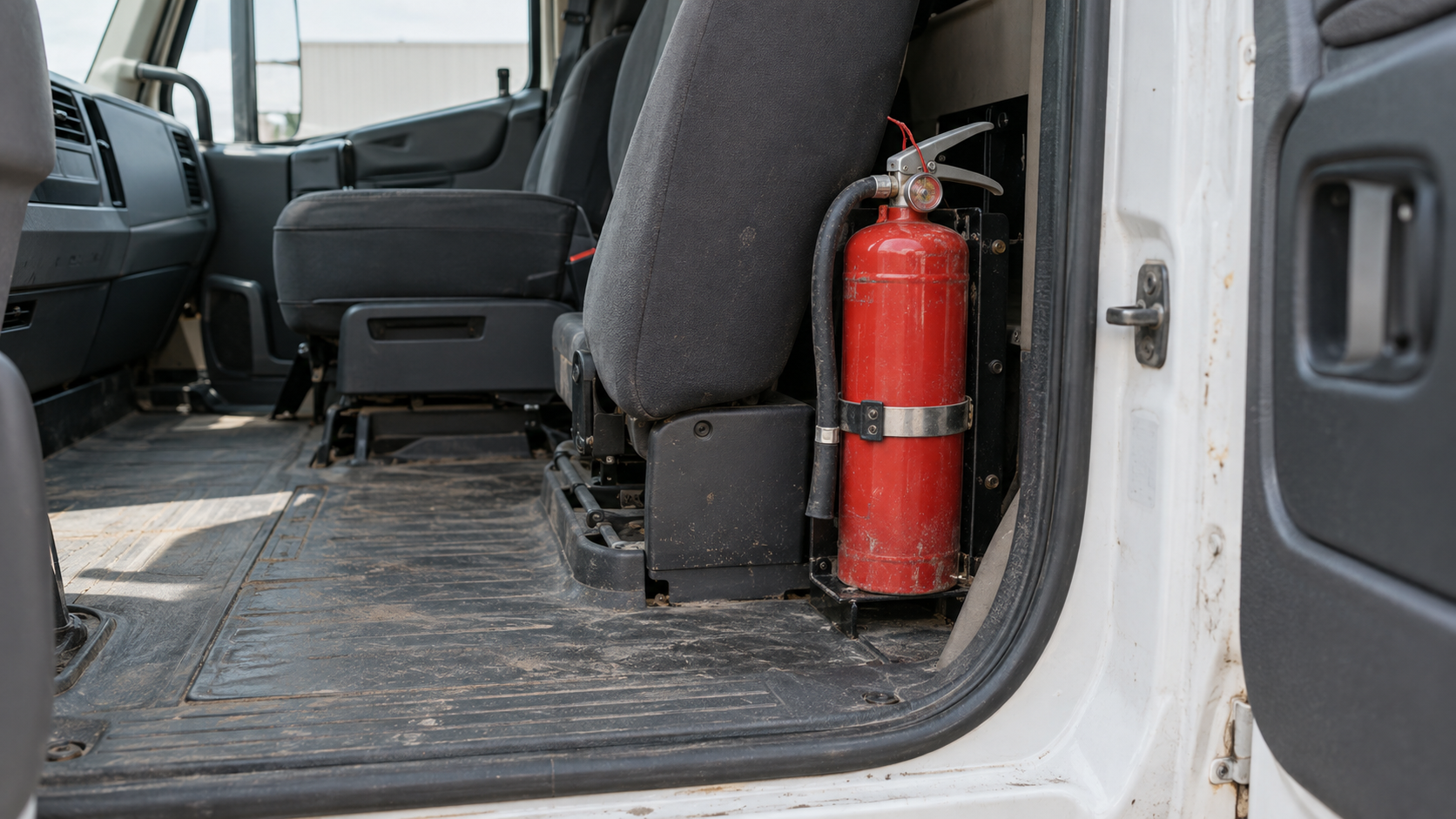
The extinguisher must be labeled, charged, readily accessible and securely mounted. A bottle loose behind a seat or buried under cargo may meet neither the rule nor the moment. Inspect the gauge or charge indicator, safety pin, hose, seal, bracket and access during the pre-trip. The related emergency-equipment guide explains the full inspection routine.
What ELDT expects drivers to understand
The federal Class A ELDT curriculum requires post-crash instruction in assessing physical condition, notifying authorities, protecting the area, arranging emergency medical assistance, activating flashers, placing reflective triangles and properly using a fire extinguisher when necessary. The lesson is a decision sequence, not simply how to pull a pin.
Instructors can safely reinforce that sequence with a parked vehicle: identify the extinguisher, read its rating, remove and replace it in the bracket, point out exits and rehearse a location report. Live-fire work belongs only in a controlled program with qualified personnel and suitable equipment.
After the fire is out
Do not restart or move the vehicle simply because the flame is gone. Fire can damage wiring, air lines, tires, wheels, brakes, fuel systems, structural parts, cargo and hazardous-material packaging. Wait for emergency responders and follow carrier instructions. The vehicle needs an appropriate inspection and repair decision before returning to service.
Document what the driver observed, when warning signs began, where the vehicle stopped and which equipment was used. If the event meets the federal definition of an accident or triggers testing, reporting or record duties, use ProntoCDL’s post-crash response guide. Preserve electronic-log and dispatch records as directed.
Prevention begins with the pre-trip
- Inspect wiring, batteries and connections for damage, looseness, exposed conductors and repeated fuse problems.
- Check fuel tanks, lines and caps for leaks and confirm the exhaust system is secure and clear of combustible material.
- Inspect tires for inflation, damage and dual-tire contact; use the CDL tire inspection guide.
- Look for dragging brakes, hot hubs and debris around wheel ends during en-route checks.
- Secure cargo and keep flammable material away from heat sources; ventilate cargo when its requirements call for it.
- Confirm the extinguisher is properly rated, charged, sealed, mounted and immediately accessible.
- Review the fuel and exhaust inspection guide before treating leaks or loose heat shields as minor defects.
Practical takeaways
- Treat smoke, unusual heat and burning odors as stop-now warning signs.
- Choose an open stopping area away from fuel pumps, buildings, brush and other vehicles.
- Evacuate, move away and call emergency services before trying to protect equipment.
- Report the exact location and any cargo, fuel-leak or hazardous-material information.
- Place warning devices only when the route to them is safe.
- Do not open an engine hood or cargo-box door to investigate a fire.
- Use an extinguisher only on a small fire with the correct agent, training and a clear retreat path.
- Assume re-ignition is possible and keep the vehicle out of service until it is properly inspected.
CDL vehicle fire response FAQ
What should a CDL driver do first after noticing smoke or fire?
Keep control, move off the roadway to an open area when it is safe, stop, shut down the engine, evacuate everyone and call 911. Give the exact location, vehicle description and any known cargo or hazardous-material information. Move away from smoke, traffic, fuel and the vehicle.
Should I open the hood during an engine fire?
Not if it can be avoided. Opening the hood can feed the fire with oxygen and expose the driver to flame. The current CDL manual advises directing extinguishing agent through louvers, the radiator or from underneath only when that can be done from a safe position.
Should I open a trailer or cargo-box door to inspect a fire?
Generally no. Opening a box supplies oxygen and can intensify the fire. The current CDL manual specifically says to keep cargo doors shut, especially when hazardous materials may be involved, and to wait for firefighters.
What fire extinguisher does a commercial truck need?
Under 49 CFR 393.95, a placarded hazardous-material vehicle needs an extinguisher rated at least 10 B:C. Other covered trucks, truck tractors and buses need one extinguisher rated at least 5 B:C or two rated at least 4 B:C each. The equipment must be properly labeled, charged, readily accessible and securely mounted.
When should a driver try to extinguish a vehicle fire?
Only consider it when the fire is small and contained, the correct extinguisher is available, you know how to use it and a clear escape route remains behind you. Stay upwind and at a safe distance. If the fire is spreading, smoke is heavy, a tire or fuel tank is involved, hazardous materials are present or conditions are uncertain, move away and wait for firefighters.
Do I place warning triangles while the truck is burning?
Life safety comes first. Activate hazard flashers when the vehicle stops, if possible. Federal rules normally require warning devices as soon as possible and within 10 minutes for a CMV stopped on the traveled portion or shoulder, but do not approach a fire, smoke or leak to place them. Never use a flame-producing signal near a flammable liquid or gas leak.
Prepare before smoke appears.
Build the inspection knowledge and emergency sequence that help protect people when seconds matter.
Start free CDL practice