
CDL Trailer Door Inspection: Hinges, Latches & Security
A trailer door is part closure, part cargo barrier and part moving machinery. The inspection is complete only when the panel, hinges, locking system, seals and surrounding trailer structure work together—and every handle and latch is secured before the vehicle moves.
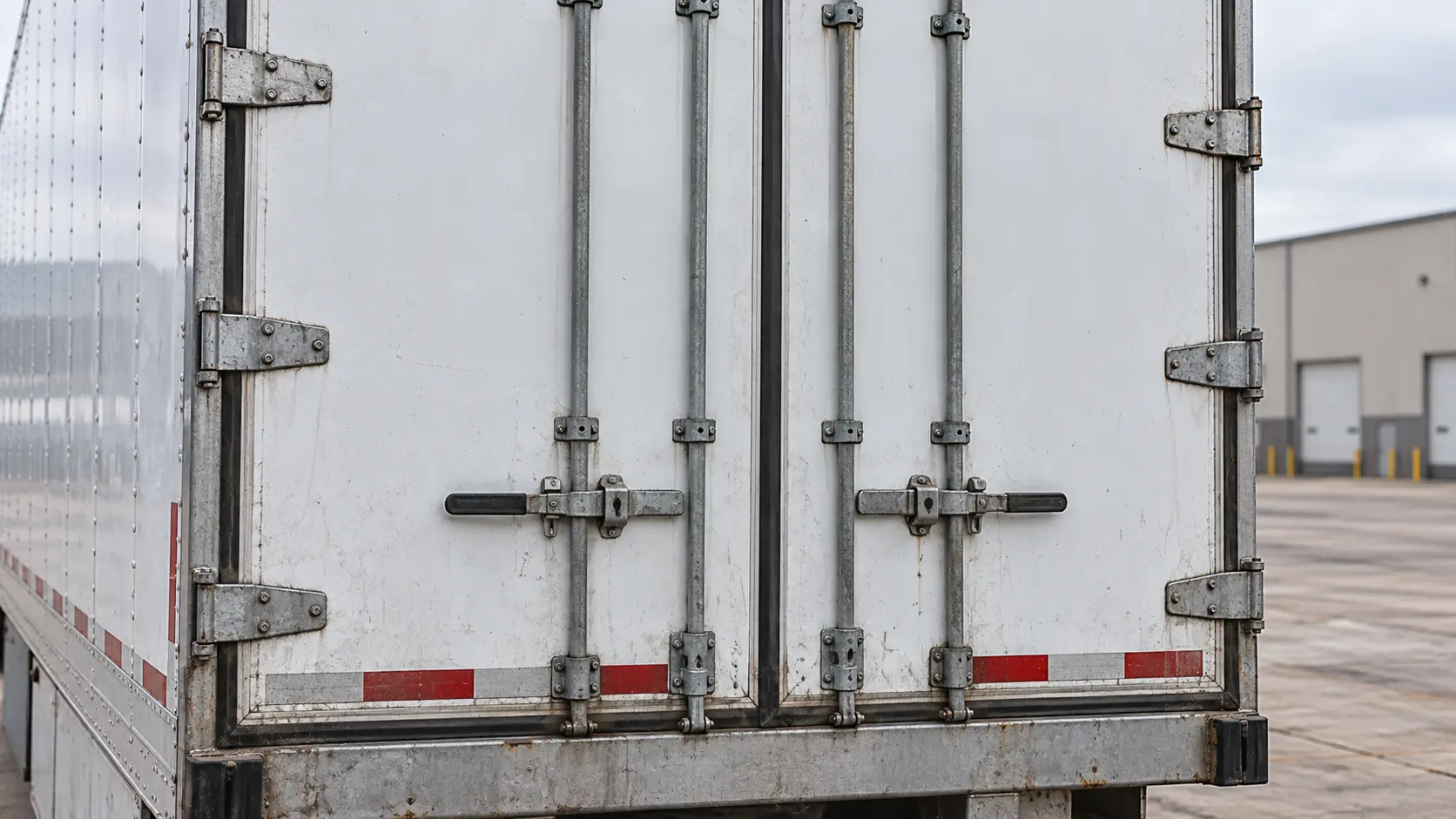
49 CFR 392.9 directly requires a commercial vehicle’s doors, tailgate, tailboard and related equipment to be secured before operation. The federal cargo rules also require cargo to be contained, immobilized or secured so it cannot fall or shift enough to harm stability. This guide turns those requirements into a repeatable exterior check. Use it with the cargo-securement guide, trailer-lighting guide and post-trip and DVIR guide.
Start with the trailer structure, not the lock
Stand far enough back to see whether the door opening is square. Compare the top and bottom gaps, center seam and outer edges. A door that suddenly needs force may be reacting to a bent panel, sagging hinge, distorted rear frame, damaged threshold or cargo pressure—not simply a dry latch.
Look at the rear header, corner posts, sill and threshold. Check for collision damage, torn metal, cracked welds, loose fasteners, severe corrosion and fresh rub marks. If the frame has shifted, otherwise intact locking bars may not align with their keepers.
A repeatable swing-door inspection
- Secure the vehicle and control the area. Set the parking brakes, follow the facility’s dock and wheel-restraint procedures, and keep people outside both door swing paths.
- Inspect each panel. Look for punctures, deep bends, separated skins, loose edges and bulges. A bowed panel may indicate shifted cargo behind it.
- Follow every hinge. Check hinge blades, pins, bushings, bolts, welds and the door/frame material around them. Look for missing retainers, lifted fasteners, cracks, sag and polished movement marks.
- Trace each locking bar. The rod should be present, reasonably straight and retained by secure guides. Inspect brackets, welds and bushings for cracks or looseness.
- Check cams and keepers. Top and bottom cams must enter their matching keepers. Watch for bent cams, spread keepers, missing bolts and contact marks showing incomplete engagement.
- Check the handle and retainer. Confirm the handle seats fully and is captured by its keeper, latch or lock. A loose handle can rotate a bar and release the door.
- Inspect the seals. Check the center, perimeter and bottom seals for tears, missing sections, trapped debris and folds that prevent full closure.
- Finish with the whole closure. Both doors should be closed in the correct order, all cams engaged, all handles retained and any required lock or seal correctly installed.
Component, defect and consequence
| Inspection point | Damage clue | Why it matters |
|---|---|---|
| Door panel and frame | Bulge, twist, separated skin, uneven gaps | May show impact damage, shifted cargo or a distorted opening |
| Hinges and pins | Missing fastener, cracked leaf, lifted weld, sag | Door can drop, bind or separate during movement |
| Locking bars and guides | Bent rod, loose guide, cracked bracket | Cams may not remain aligned with their keepers |
| Cams and keepers | Partial engagement, spread or broken hardware | The door can release even when the handle appears near its holder |
| Handles and retainers | Handle will not seat, keeper missing, improvised tie | Vibration can rotate the mechanism and open the door |
| Seals and threshold | Torn seal, debris, bent sill, daylight at a closed edge | May prevent closure and expose cargo to water, dust or contamination |
Open a swing door without entering the hazard zone
Before releasing any handle, look for bowed panels, strained hardware, leaking material or sounds of cargo movement. Stand to the side, keep your body out of the sweep and maintain control of the handle. Never position yourself directly behind a door that may be under pressure.
Release hardware in the manufacturer or carrier sequence. Open the first door slowly enough to stop if cargo presses against it. Secure each open door in its holdback before approaching the opening or dock. Wind can turn an unsecured door into a moving hazard.
If a seal is present, verify the number and authorization before breaking it. The sealed-load exception in 49 CFR 392.9 can limit the driver’s obligation to open and inspect cargo when ordered not to open the vehicle, but it does not make visible exterior door defects acceptable.
Roll-up and side doors need a different check
A roll-up door uses panels, hinges, tracks, rollers, cables, counterbalance components and a bottom latch. Inspect what is visible from the ground. Panels should travel in the tracks without severe skew, rollers should remain captured, and the latch must fully secure the door closed. A frayed cable, damaged track or door that will not remain raised requires qualified service.
Counterbalance springs and cables can store dangerous energy. Do not loosen brackets, cut cables, wind springs or work beneath a door that may fall. For curbside cargo-compartment doors, verify hinges, latches, locks and any required security seal, then confirm the closed door does not project into traffic.
Door security is not cargo securement by itself
49 CFR 393.100 requires cargo to be prevented from leaking, spilling, blowing, falling or shifting enough to affect stability or maneuverability. Closing the doors does not correct poor weight distribution, missing blocking or inadequate restraints.
A sided vehicle may use adequately strong walls as part of a compliant containment method under 49 CFR 393.102, but that depends on cargo position, wall strength and the full securement system. A door should not be treated as a substitute for required blocking, bracing, dunnage or tiedowns.
En-route and post-trip checks
At a safe stop, scan the door gaps, locking bars and handles for movement. Check for a broken seal, displaced keeper, fresh rub mark, leaking cargo or panel bulge. Federal cargo-reinspection timing still applies when the load is accessible and the rule does not exempt the operation. The cargo reinspection checklist explains the first-50-mile and recurring checks.
At post-trip, report new binding, damage or water entry while the details are fresh. Record the trailer number, door and side, the exact component, whether it closes and latches, and what moved or failed. Do not rely on wire, rope, a bungee cord or an improvised bar as a substitute for functioning hardware.
CDL test language that shows understanding
For a vehicle-inspection test, point to the cargo doors and explain that they are in good condition, securely closed, latched or locked, with hinges and latches not broken or missing. If a seal is required, state that it is present and verified. For a rear door, add that the locking bars are secure and the door will not open during travel.
The current Class A ELDT curriculum requires pre-trip, en-route and post-trip inspection instruction and behind-the-wheel inspection proficiency. It also includes cargo handling and securement theory. A memorized phrase is useful only when it matches the actual equipment in front of you.
Practical takeaways
- Inspect the opening and surrounding trailer structure before focusing on the lock.
- Trace every hinge, locking bar, cam, keeper, handle and retainer.
- Keep your body outside the swing path and treat a bulging door as possible cargo pressure.
- Secure open swing doors in their holdbacks; never trust wind or door weight to hold them.
- Do not service roll-up springs or cables or stand beneath an unstable door.
- Remember that a seal documents control; it does not prove safe latching.
- Closing the doors does not replace required cargo containment and securement.
- Report the exact component, location, condition and movement instead of writing only “door broken.”
CDL trailer door inspection FAQ
What should a CDL driver inspect on trailer swing doors?
Check each door panel, hinge, hinge pin, locking bar, cam, keeper, handle, handle retainer, seal and the surrounding header, posts and threshold. Look for missing parts, cracks, bending, loose fasteners, movement marks and hardware that does not fully engage.
Do federal rules require trailer doors to be secured?
Yes. Under 49 CFR 392.9, a driver may not operate and a carrier may not require or permit operation unless tailgates, tailboards, doors, tarpaulins, spare tires and other operating equipment are secured.
Is a security seal proof that the trailer doors are safely latched?
No. A seal indicates control or tamper status; it does not prove that the cams are in their keepers, the handles are retained, the hinges are sound or the door frame is intact. Inspect permitted exterior hardware even when the load is sealed.
Can a driver open a bulging trailer door to inspect the cargo?
Not without a controlled unloading plan. A bowed door, strained latch or shifting noise can mean cargo is pressing against the closure. Keep clear of the swing path and ask the carrier or facility to manage the hazard with suitable equipment and personnel.
How should a roll-up trailer door be checked?
Inspect the panel sections, tracks, rollers, cables, springs, bottom seal, pull strap and latch from a safe position. Do not stand beneath a door that will not stay up, repair a high-tension spring or cable, or continue with a door that cannot be secured closed.
What should a driver write in a trailer-door defect report?
Identify the trailer, door and side; name the component; describe the condition and movement; and record whether the door can close, latch and remain secured. “Right rear lower cam misses keeper and handle will not seat” is more useful than “door broken.”
Practice the closure check as a system.
Start with the frame, trace every hinge and locking part, control the opening hazard and finish by confirming every handle is retained.
Start free CDL practice