
CDL Parking Brake Inspection: Controls, Holding Test & Defects
A parking brake is more than a knob on the dashboard. A complete check identifies the installed system, proves that the correct brakes apply and verifies controlled holding before the truck enters traffic.
Federal 49 CFR 392.7 says a commercial motor vehicle must not be driven until the driver is satisfied that the parking brake and other listed safety equipment are in good working order. The equipment standard in 49 CFR 393.41 requires an applicable parking-brake system capable of holding the vehicle or combination stationary under the loading and grade conditions covered by the rule.
Those requirements create two related questions: did the control cause the intended brakes to apply, and can the applied system hold the vehicle as required? A dashboard control that moves is not proof of either result.
This guide explains a driver-level inspection for common air-braked power units and combinations, while also addressing hydraulic and mechanical systems. The exact test sequence comes from the current licensing-State CDL manual, the vehicle manufacturer and the carrier's approved procedure.
Understand the three brake functions
Service, parking and emergency braking are separate functions even when they share valves, chambers, foundation brakes or controls.
| Function | Primary purpose | Normal driver use |
|---|---|---|
| Service brake | Slows and stops the moving vehicle during ordinary driving | Applied with the foot pedal |
| Parking brake | Holds a stopped vehicle or combination against movement | Applied when parking and during an approved holding check |
| Emergency brake feature | Provides braking after specified service-system failures | Used only under the installed system's emergency procedure |
On many air-braked vehicles, powerful springs apply rear foundation brakes when air is released from the spring-brake chambers. Air pressure holds those springs back during normal travel. That shared hardware does not turn a parking-brake application into the normal way to stop a moving truck.
The automatic spring-brake pop-out check is not the same as the parking-brake holding check. One evaluates control response as pressure falls; the other evaluates whether a deliberately applied parking system holds. Review the complete sequence in ProntoCDL's air-brake test guide.
Identify every installed parking control
Begin with the vehicle secured in the designated inspection area. Sit in the normal driving position, fasten the belt and identify the controls before touching them.
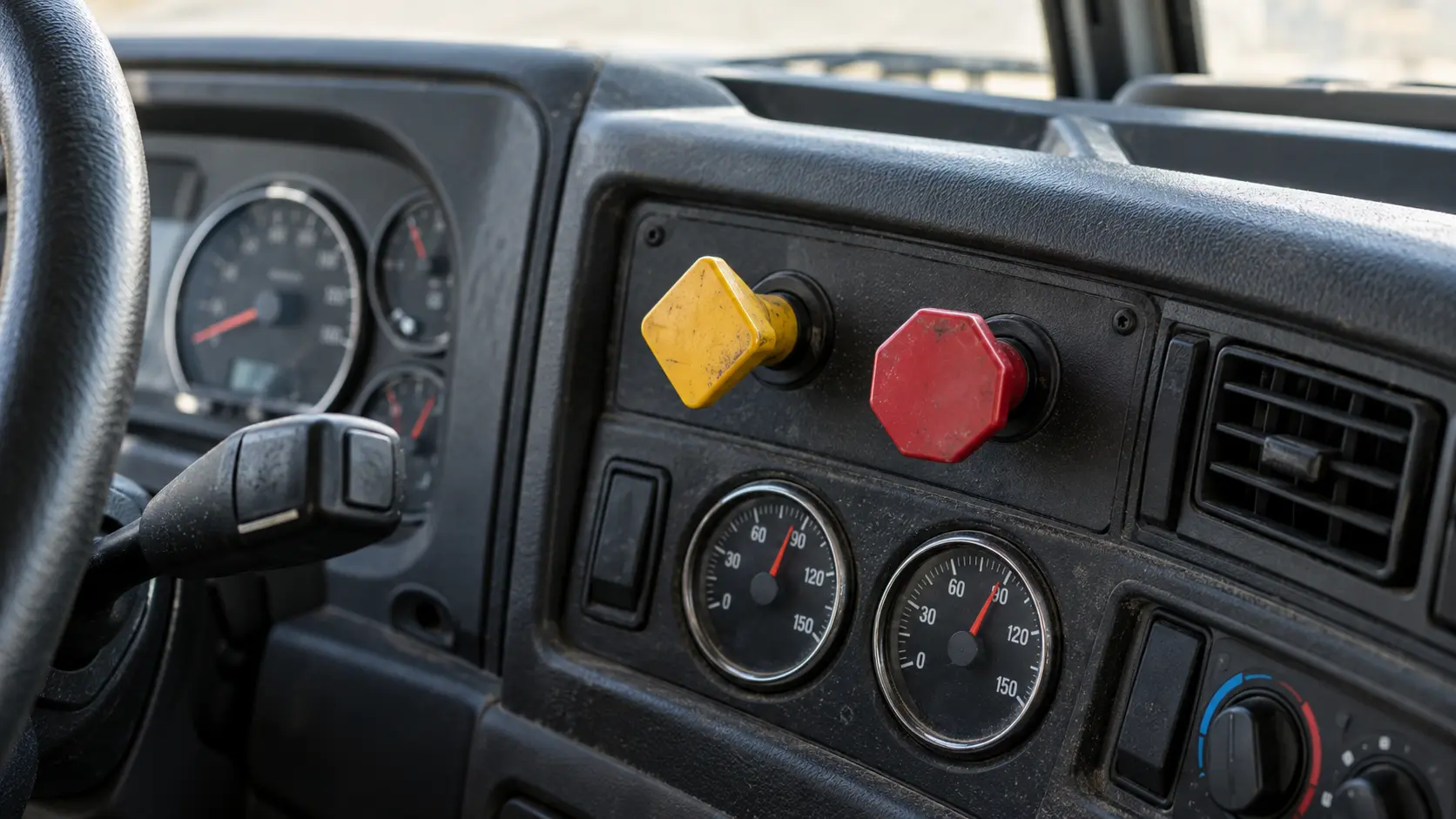
- Yellow diamond push-pull control: commonly applies and releases the power unit parking brakes on newer air-braked vehicles.
- Red octagonal push-pull control: commonly controls trailer air supply through the tractor-protection system. Pulling it out normally exhausts the trailer supply and applies trailer emergency or spring brakes on modern equipment.
- Lever or pedal: may operate a cable, driveline or other mechanical parking brake, especially on older or hydraulic-braked vehicles.
- Special bus or emergency-release control: may release spring brakes temporarily from an isolated reserve. It is not a normal parking control and has limited energy.
Do not memorize colors without understanding the system. The current New York CDL manual, for example, identifies the yellow diamond knob as the parking-brake control on newer air-braked vehicles and treats the red control as trailer air supply. Other vehicle-specific layouts require their own approved instructions.
Inspect before applying the control
A safe test begins outside the drive path. Choose firm, level ground or the site's designated brake-test surface. Keep people, equipment and obstacles clear. Verify that doors are closed, the seat and mirrors are adjusted, the belt is fastened and the transmission can be placed in the approved low forward gear without unexpected movement.
Check the control for secure mounting, correct shape and color, damage and free movement. It should apply, latch and release as designed. A knob that pulls off the shaft, will not remain out, binds, leaks loudly or moves without a corresponding brake response needs attention before the truck moves.
From safe exterior positions, inspect visible parking-brake components as part of the complete brake walkaround:
- spring-brake chambers securely mounted, with no dents, severe corrosion or broken clamps;
- air hoses and fittings free of audible leaks, abrasion, kinks and contact damage;
- pushrods, slack adjusters and foundation-brake parts present and secure where visible;
- driveline parking-brake hardware, cables, levers and mountings secure when installed; and
- no oil, grease, brake fluid or damaged friction hardware that could defeat holding.
Never enter beneath an unsupported vehicle, release spring brakes for inspection or place hands near a linkage that can move. Use approved shop support and qualified maintenance personnel when the driver's safe view is not enough. ProntoCDL's air-brake component inspection explains the visible chamber, hose and slack-adjuster checks.
Perform a controlled power-unit holding check
Use the current State and equipment procedure. A common CDL-manual sequence is:
- Confirm the test area and path are clear.
- Fasten the seat belt and keep firm control of the service brake.
- Apply the power-unit parking brake.
- On a combination, release the trailer parking brake only when the approved procedure directs, so the power-unit system is tested separately.
- Select the specified low forward gear.
- Release the service brake carefully and gently test against the parking brake using idle or the minimum force allowed by the procedure.
- Stop immediately after confirming the brake holds; return the controls to the safe condition.
The goal is not to overpower the brake. Excess throttle, a long pull or repeated loading adds heat and stress while reducing control. The expected result is a restrained vehicle with no continuing roll. If the truck creeps, surges through the brake or moves farther than the procedure permits, reapply the service brake, secure the vehicle and report the defect.
A successful check on level ground does not authorize parking carelessly on any grade. Before leaving the vehicle, follow the vehicle and carrier procedure for transmission position, parking-brake application, steering-wheel direction and wheel chocks where required.
Test tractor and trailer holding separately
On a typical tractor-semitrailer, the examiner or carrier procedure may require two controlled checks. For the tractor check, the tractor parking brakes are applied while the trailer parking brakes are released. For the trailer check, the tractor parking brakes are released while the trailer system is applied. Each check isolates the system expected to hold.
That separation matters. Testing both systems together can hide a weak power-unit or trailer parking system because the other unit carries the load. It can also produce a misleading pass when only one set of brakes actually applied.
Use the dashboard controls exactly as the installed system requires. Do not treat a trailer hand valve as a parking brake, leave it applied while parked or use it to replace the approved trailer-brake test. The hand valve normally operates trailer service brakes and may not provide a dependable parked condition if air leaks away.
After each test, restore the combination to a secure condition before changing controls. If either unit fails to hold, do not compensate by relying on the other unit for the trip. The defect belongs in the repair process.
Air pressure changes what the controls can do
Spring brakes generally apply when their release air is exhausted and release when adequate air pressure reaches the chambers. Low pressure can therefore cause automatic application. That is a warning and emergency behavior, not a substitute for a planned parking routine.
Before releasing parking brakes, confirm adequate system pressure and normal gauge behavior under the approved startup check. A control that will not stay pushed in at low pressure may be responding as designed. Continuing to cycle it will not repair an air-loss problem.
Do not press the service-brake pedal while spring brakes are applied unless the manufacturer and approved procedure specifically require it. On some systems, combining spring and service force can damage brake components. The safest habit is to follow the stated sequence, not improvise with both applications.
Hydraulic and mechanical parking brakes need the same proof
A hydraulic-braked commercial vehicle may use a foot pedal, hand lever, electric-hydraulic mechanism or separate mechanical parking brake. Identify the device, check its mounting and linkage, verify that it applies and remains applied, and perform the controlled holding check prescribed for that vehicle.
Do not confuse a hydraulic service-brake leak test with the parking-brake test. Pumping and holding the service pedal checks one system; applying the parking control and gently testing vehicle movement checks another. Both may be required.
A driveline parking brake acts through the transmission or driveshaft rather than at each wheel. Inspect the visible drum, rotor, cable and linkage only from safe positions. Oil contamination, a loose mount, a stretched cable or missing retaining hardware can prevent holding even when the cab lever feels normal.
Recognize a defect before it becomes a rollaway
Stop and report any of these conditions:
- the control will not apply, latch, remain applied or release predictably;
- no brake response occurs when the control is actuated;
- the truck or trailer does not hold during the approved low-force test;
- air leaks from the control, valve, hose, chamber or fitting;
- a chamber, cable, lever, mounting bracket or foundation-brake part is damaged or loose;
- one unit in a combination holds only because the other system is still applied; or
- the brake drags after release, produces abnormal heat or makes the vehicle resist movement.
The federal periodic-inspection criteria in Appendix A to Part 396 identify a parking-brake defect when no brakes apply upon actuation of the parking control. That is a clear minimum failure, not the entire driver decision. A system that applies but cannot hold under the required condition is also not ready for service.
Write a precise report: vehicle, unit, control position, test condition and observed result. “Tractor parking brake applied; trailer released; unit moved forward at idle during approved hold check” gives maintenance more value than “parking brake weak.” Use ProntoCDL's post-trip and DVIR guide for end-of-day reporting.
Use parking brakes every time you park
The parking brake should be part of a repeatable securement sequence, not an afterthought when the ground looks steep. Stop in a legal, stable location; hold the service brake; place the transmission in the required position; apply the parking system; verify the vehicle is held; and use wheel chocks or other securement when the regulation, equipment, carrier or site procedure requires them.
Before leaving the cab, look at the controls rather than relying on habit or sound. On return, inspect the area around the vehicle before releasing the brake. A truck can be held safely and still have a new obstacle, person or vehicle in its path.
Never depend on the transmission alone, a trailer hand valve or curb contact to hold a commercial vehicle. Each is different from a functioning parking-brake system.
Practice for the CDL inspection without memorizing blindly
Federal CDL knowledge standards specifically include parking brakes, and federal skills standards require operational brake-system checks. The Class A ELDT curriculum also requires pre-trip and post-trip instruction tied to sections 392.7 and 396.11 and introduces trainees to braking and parking controls.
For test preparation, practice three connected statements:
- Identify: name the correct control and the unit it affects.
- Inspect: explain what secure, undamaged and leak-free condition looks like.
- Prove: describe and perform the approved holding check safely.
Do not memorize one tractor's knob position as if it applies to every bus, straight truck or older vehicle. Learn the principle, then learn the actual equipment used for training and testing. ProntoCDL's three-part CDL skills-test guide explains how the inspection connects to basic control and the road test.
Practical takeaways
- Identify the installed parking, trailer-supply and special-release controls before operating them.
- Keep service, parking and emergency-brake functions conceptually separate.
- Inspect controls, visible chambers, hoses, linkages and mounts before the holding check.
- Conduct the test only on the approved surface with the path clear and the seat belt fastened.
- Use low gear, idle or the minimum approved force and stop when holding is confirmed.
- Test tractor and trailer systems separately when the current procedure requires it.
- Never use the trailer hand valve as a parked-vehicle substitute.
- Do not cycle a spring-brake control to overcome low pressure or an air leak.
- Stop and report any failure to apply, hold, remain applied or release predictably.
- Secure the vehicle with the full parking procedure every time, including required chocks.
CDL parking brake FAQ
What does the yellow parking-brake knob control?
On a typical newer air-braked truck or tractor, the yellow diamond-shaped push-pull control applies and releases the power unit parking brakes, which commonly use spring brakes. Control layout and system interaction can vary, so identify the installed controls from the vehicle instructions and current CDL manual.
Is the red trailer-air-supply knob the trailer parking brake control?
The red control normally supplies or exhausts air in the trailer system and operates through the tractor-protection and trailer emergency system. Pulling it out commonly applies trailer spring or emergency brakes on modern equipment, but its primary identity is trailer air supply. Use the exact vehicle and State test procedure rather than treating color alone as a complete system explanation.
How do I test a commercial vehicle parking brake?
In a controlled area, secure the cab, fasten the seat belt, clear the path, apply the brake being tested, select the approved low gear and gently test against the brake at idle or the minimum force specified by the current manual and equipment procedure. Stop immediately if the vehicle moves unexpectedly. Combination-vehicle procedures commonly test the power unit and trailer separately.
Can I test the parking brake on a hill?
Do not make a grade the first place you discover a defect. Perform the approved holding check on firm, level ground or the designated test surface, with a clear path and qualified supervision when required. The federal performance requirement addresses holding on grades where the vehicle operates, but the driver check must be conducted without creating an uncontrolled-roll hazard.
Are the parking brake and emergency brake the same system?
They are different functions even when they share spring-brake hardware or a control. The parking system holds a stopped vehicle. Emergency-brake features provide braking after certain service-system failures. Do not use the parking control as a substitute for normal service braking except under the vehicle manufacturer’s emergency procedure.
What parking-brake defects mean the vehicle should not be driven?
Do not drive when the control will not apply, remain applied or release as designed; no brakes apply; the vehicle does not hold during the approved test; a spring-brake chamber, hose, valve, linkage or mounting part is damaged or leaking; or the system releases or applies unpredictably. Secure the vehicle and follow the carrier’s defect-reporting and repair process.
Prepare beyond one brake check
Review the complete air-brake sequence, then reinforce inspection language and safety concepts with ProntoCDL's CDL study guides and free practice center.