
CDL Manual Transmission Guide: Double-Clutching, Downshifts & E Restriction
Manual shifting is vehicle control, not a speed contest. Build a repeatable sequence that matches engine speed, road speed and the correct gear while preserving steering, space and attention.
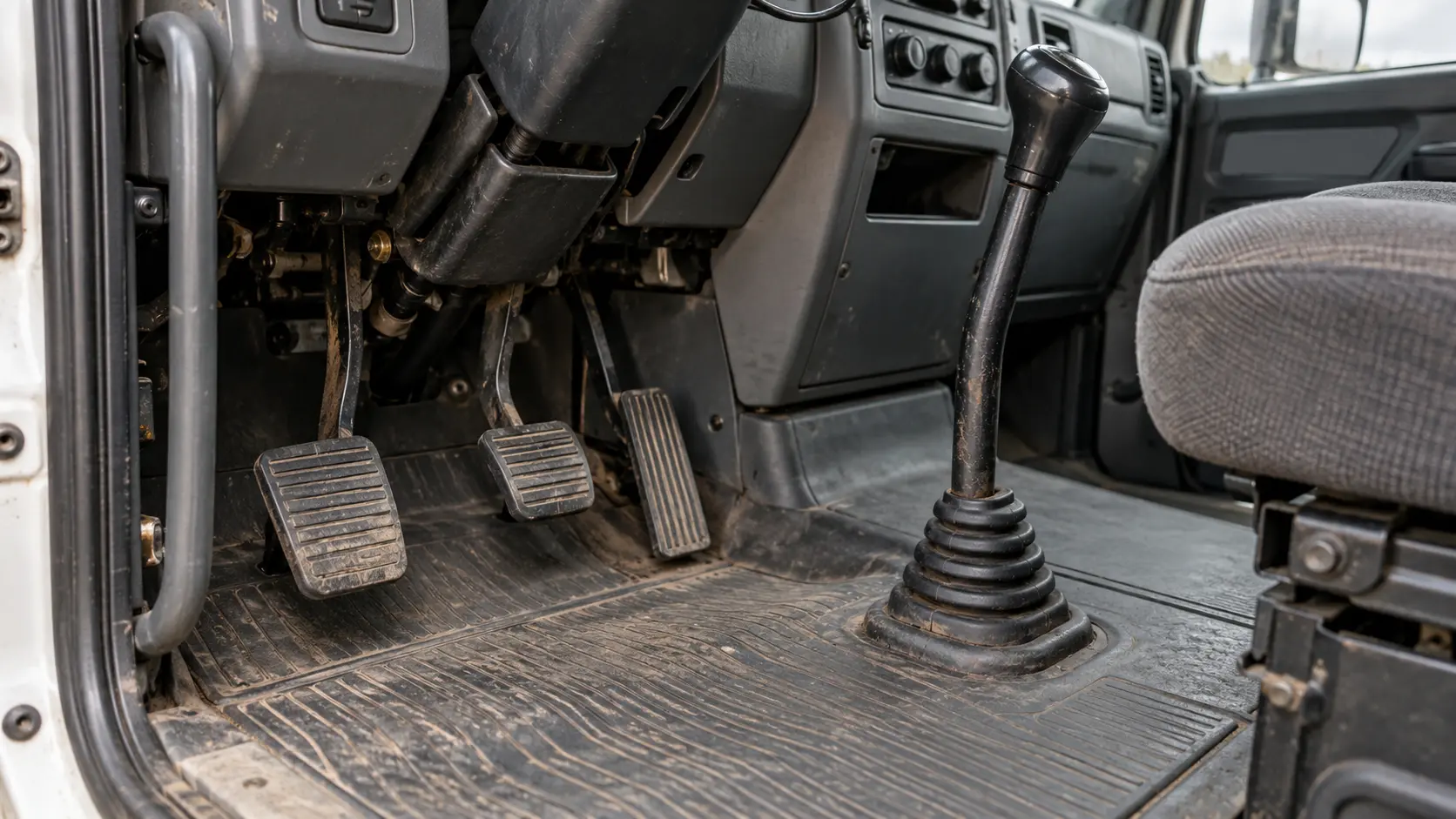
The federal CDL definition is precise. A manual transmission under 49 CFR 383.5 uses a driver-operated clutch activated by a pedal or lever and a gear-shift mechanism operated by hand or foot. Other transmissions are treated as automatic for the standardized restriction code—even if the transmission's internal hardware can shift mechanically like a manual.
That distinction affects the credential. Under 49 CFR 383.95, an applicant who performs the CDL skills test in an automatic must receive a restriction against operating a manual-transmission CMV. The restriction is commonly shown as E.
This guide explains the control skills behind a conventional nonsynchronized heavy-truck manual. Exact shift patterns, RPM ranges, splitter controls and test expectations depend on the actual vehicle, manufacturer and licensing State. Practice only with a qualified instructor in an authorized training environment.
Manual shifting connects three speeds
A clean shift happens when three things agree closely enough for the transmission to accept the next gear:
- Road speed: how fast the truck is moving.
- Engine speed: the RPM shown on the tachometer.
- Gear speed: the rotational speed the transmission needs for the selected ratio.
The clutch separates engine torque from the transmission during the shift. Neutral lets the driver change the transmission-side speed before selecting the next ratio. The accelerator raises engine speed for a downshift; time and reduced throttle let speed fall for an upshift.
A driver who moves the lever before those speeds are compatible may hear grinding or feel resistance. The correct response is not more force. Return to neutral, rebuild the speed match and try again.
Know the controls before the truck moves
Start in a secured vehicle with the parking brakes applied and the transmission in neutral. Identify every control used by the installed transmission:
- the clutch pedal and its normal free movement;
- the gearshift lever and complete shift pattern;
- the range selector for low and high ranges;
- the splitter control when the transmission provides split ratios;
- the tachometer and the manufacturer's operating RPM range; and
- the speedometer and approximate road-speed range for each gear.
Do not assume every 9-, 10-, 13- or 18-speed transmission uses the same pattern or selector sequence. A lever position that means one gear in low range can represent a different gear after the range change. Review the vehicle diagram and demonstrate the pattern with the engine off under instructor supervision.
Include the clutch linkage, pedal security, floor area and transmission controls in the cab inspection. Nothing should obstruct full pedal movement. ProntoCDL's dashboard gauge guide explains how to combine RPM, pressure and warning-lamp information during startup.
Use the clutch pedal for two separate jobs
The clutch has a normal disengagement range used while shifting and, on many heavy trucks, a clutch brake near the bottom of pedal travel. The clutch brake helps stop transmission input rotation when selecting a starting gear from a complete stop. It is not intended to be driven against during ordinary moving shifts.
Pressing the pedal to the floor on every rolling shift can engage the clutch brake, add wear and make the next gear harder to select. Use the pedal depth and technique specified for the actual vehicle. At a stop, hold the service brake, allow the driveline to settle and select the starting gear without forcing the lever.
Avoid resting a foot on the clutch pedal after the shift. Light continuous pressure can reduce clamping force or load the release components. Once the gear is engaged and the clutch is released, place the foot where it cannot ride the pedal.
Double-clutch an upshift as one smooth rhythm
The current official CDL manual describes the basic heavy-truck upshift in five actions:
- Release the accelerator while pressing the clutch enough to shift into neutral.
- Release the clutch in neutral.
- Let engine and gear speed fall toward the RPM required by the next higher gear.
- Press the clutch again while moving the lever into the higher gear.
- Release the clutch and apply the accelerator smoothly.
The two clutch applications create the name “double-clutching.” The neutral interval is short but purposeful. Rush it and the RPM may still be too high. Wait too long and engine speed may fall below the next gear's range, especially while climbing.
Use the tachometer and the known gear-speed relationship while learning. Engine sound becomes a helpful cue with practice, but sound alone should not replace an understanding of the vehicle's operating range.
Downshifting requires an intentional RPM increase
A lower gear needs the engine and transmission to turn faster at the same road speed. The downshift sequence therefore adds a controlled accelerator input while the transmission is in neutral:
- Release the accelerator, press the clutch and shift to neutral.
- Release the clutch.
- Raise engine speed to the RPM needed for the lower gear.
- Press the clutch again and select the lower gear.
- Release the clutch smoothly and apply power as needed.
Too little RPM produces resistance because the engine side is slow. Too much RPM can cause harsh engagement and driveline shock. The goal is a controlled match, not a dramatic throttle blip.
Downshift before the truck becomes too slow for its current gear and before the desired lower gear's road-speed range is lost. On an upgrade, waiting until the engine lugs can make recovery harder because speed continues to fall during neutral.
Select the gear before the hazard
Gear selection belongs in the approach plan. Slow and choose the correct gear before entering a curve, beginning a steep downgrade, crossing a rough area or joining traffic that requires controlled acceleration.
For a curve, complete the braking and downshift while the truck is straight. Enter at a speed that lets the truck remain stable with light power available. Searching for a gear while turning divides attention and can create an abrupt driveline input when tire traction is already managing cornering force.
For a downgrade, choose the safe speed and gear before the descent. Do not rely on a mid-grade downshift after speed has built. A missed shift on a steep grade can leave the truck in neutral and remove engine braking when it is most needed. Review the full descent plan in ProntoCDL's mountain-driving guide.
Coordinate range and splitter changes deliberately
Multi-range transmissions reuse lever positions. A range selector prepares the next group of gears; a splitter divides a ratio into smaller steps on transmissions that provide that function.
Learn when the selector must be preselected and when the shift actually occurs. Moving a selector randomly while searching for a gear makes the transmission state harder to understand. During training, call out the current gear, next gear and selector position before the shift until the sequence becomes consistent.
| Situation | Driver's planning focus | Common error |
|---|---|---|
| Low-to-high range change | Preselect as instructed, then move through neutral into the correct reused slot | Forgetting the selector and returning to a low-range ratio |
| Split shift | Use the installed preselect-and-throttle or clutch procedure | Moving the lever unnecessarily or skipping the torque break |
| Upgrade | Shift before RPM collapses and keep the neutral interval short | Waiting until the engine lugs |
| Downgrade | Select the controlling gear before descent | Attempting a lower gear after speed builds |
Manufacturer instructions control the exact mechanics. The table describes the planning logic, not a universal selector sequence.
Recover from a missed gear without forcing it
A missed shift is a control problem only if the driver lets it become one. Keep both hands available for their jobs: steer steadily, avoid looking down at the lever and use a calm recovery sequence.
- Return the lever to neutral.
- Release the clutch so the engine can change transmission input speed.
- Read road speed and RPM.
- Match engine speed for a gear appropriate to the truck's current speed.
- Clutch and attempt the gear again without force.
If the truck has slowed significantly, the original target gear may no longer be correct. Recovery follows current road speed, not the driver's earlier plan. On an upgrade, that often means choosing a lower gear.
Never stare at the shift pattern while moving. If the gear cannot be recovered promptly and safely, use the vehicle-specific safe-stop procedure, communicate with the instructor and secure the truck in an appropriate location.
Avoid habits that reduce control or damage equipment
- Do not force the lever. Resistance means the speed match, selector state or target gear needs correction.
- Do not ride the clutch. Keep the foot clear after engagement.
- Do not use the clutch brake during rolling shifts. Use the specified pedal travel for the installed equipment.
- Do not coast in neutral. Maintain a gear appropriate for speed and conditions so power and engine braking remain available.
- Do not shift during a curve when it can be completed beforehand. Set speed and gear on the approach.
- Do not chase a gear on a downgrade. Start down in the controlling gear.
- Do not use grinding as a learning method. Reset in neutral and correct the match.
- Do not copy another truck's RPM numbers blindly. Learn the vehicle you are driving.
Build skill in a controlled progression
The Class A ELDT curriculum requires theory instruction in shifting procedures, including upshifting and downshifting on multi-speed dual-range transmissions when appropriate. Its public-road curriculum requires demonstrated proficiency in safe and fuel-efficient shifting.
A productive practice progression is:
- Controls with the engine off: identify the pattern, range, splitter, clutch travel and neutral.
- Starting and stopping: choose the starting gear, engage smoothly and stop without rushing the transmission.
- Single upshifts: repeat one clean transition using consistent RPM and timing.
- Single downshifts: practice the neutral RPM increase at controlled road speed.
- Range transitions: add the selector only after basic lever and clutch rhythm is stable.
- Road integration: combine shifting with mirror checks, signals, steering, space and speed planning.
- Hazard setup: prepare the correct gear before curves, grades and traffic changes.
Measure progress by control, not by the number of shifts completed. A slightly slower clean shift that preserves the lane and space is better training than a quick shift that steals attention from traffic.
Understand the E restriction before test day
The skills-test vehicle determines more than comfort. If it is automatic under the federal definition, the State must place the manual-transmission restriction on the CDL. An automated manual can still count as automatic for this rule because the definition requires the specified driver-operated clutch and gear selector.
Choose the test vehicle based on the equipment you are qualified and prepared to operate. Do not select a manual only to avoid a restriction if shifting control is not ready for the inspection, basic-control and road portions of the test. A stalled engine, missed gear or loss of lane control can outweigh the credential benefit.
If a CDL already carries E, the process to remove it is handled by the licensing State and generally involves demonstrating skills in a qualifying manual-transmission CMV. Confirm permit, vehicle, appointment, testing and document requirements directly with the State before scheduling. ProntoCDL's CDL restrictions guide explains how E fits with the air-brake, tractor-trailer and passenger restrictions.
Practical takeaways
- Learn the exact shift pattern, RPM range, range selector and splitter on the actual truck.
- Treat each shift as a match among road speed, engine speed and gear speed.
- Use two controlled clutch applications when double-clutching.
- Let RPM fall for an upshift and raise it deliberately for a downshift.
- Select the safe gear before curves and downgrades.
- Keep the clutch brake out of ordinary rolling shifts.
- When a gear is missed, reset in neutral and match the truck's current speed.
- Never force the lever, ride the clutch or look down while moving.
- Integrate shifting with mirrors, lane position, space and traffic awareness.
- Know whether the test vehicle will produce an E restriction before test day.
CDL manual transmission FAQ
What makes a CMV transmission “manual” for the federal CDL restriction?
For the standardized federal restriction, a manual transmission uses a driver-operated clutch activated by a pedal or lever and a gear-shift mechanism operated by hand or foot. Other transmissions, including automated manual transmissions that do not give the driver that clutch-and-shift combination, are treated as automatic for restriction purposes.
Do all heavy-truck manual transmissions require double-clutching?
Many conventional nonsynchronized heavy-truck manuals are taught with double-clutching, but equipment designs differ. Follow the manufacturer, training provider and licensing-State procedure for the test vehicle. Do not apply one shift method blindly to every transmission.
What should I do if I miss a gear?
Do not force the lever. Keep steering control, remain calm, return the lever to neutral, release the clutch, match engine speed to road speed and try the appropriate gear again under your instructor’s procedure. If speed continues to fall, the correct recovery gear may be lower than the gear you originally selected.
Should I downshift while already in a curve or on a steep downgrade?
Plan the gear before the hazard. Slow and select the appropriate gear before entering a curve or starting down a grade. Shifting during the curve can interrupt traction and attention; trying to find a gear after speed builds on a downgrade can leave the truck in neutral when control is needed most.
What is the E restriction on a CDL?
The E restriction prohibits operation of a CMV equipped with a manual transmission. Under 49 CFR 383.95, a State must place it on a CDL when the applicant performs the skills test in a vehicle with an automatic transmission as defined by the federal rule.
Can an automated manual transmission avoid the E restriction?
No. For the federal restriction code, every transmission other than the rule’s defined manual transmission is considered automatic. A transmission that shifts gears mechanically but lacks the required driver-operated clutch and gear-shift mechanism does not qualify as manual for this purpose.
Connect shifting to the full skills test
Review the three CDL test segments, then reinforce vehicle-control concepts with ProntoCDL's CDL study guides and free practice center.