
DOT Urine Drug Test for CDL Drivers: Collection, Split Specimen & Shy Bladder
A DOT urine drug test is more than a cup and a laboratory result. Part 40 assigns specific duties to the driver, collector, laboratory, medical review officer and employer. Knowing the sequence helps CDL drivers comply without confusing a collection-site concern with a refusal—or a laboratory finding with a verified result.
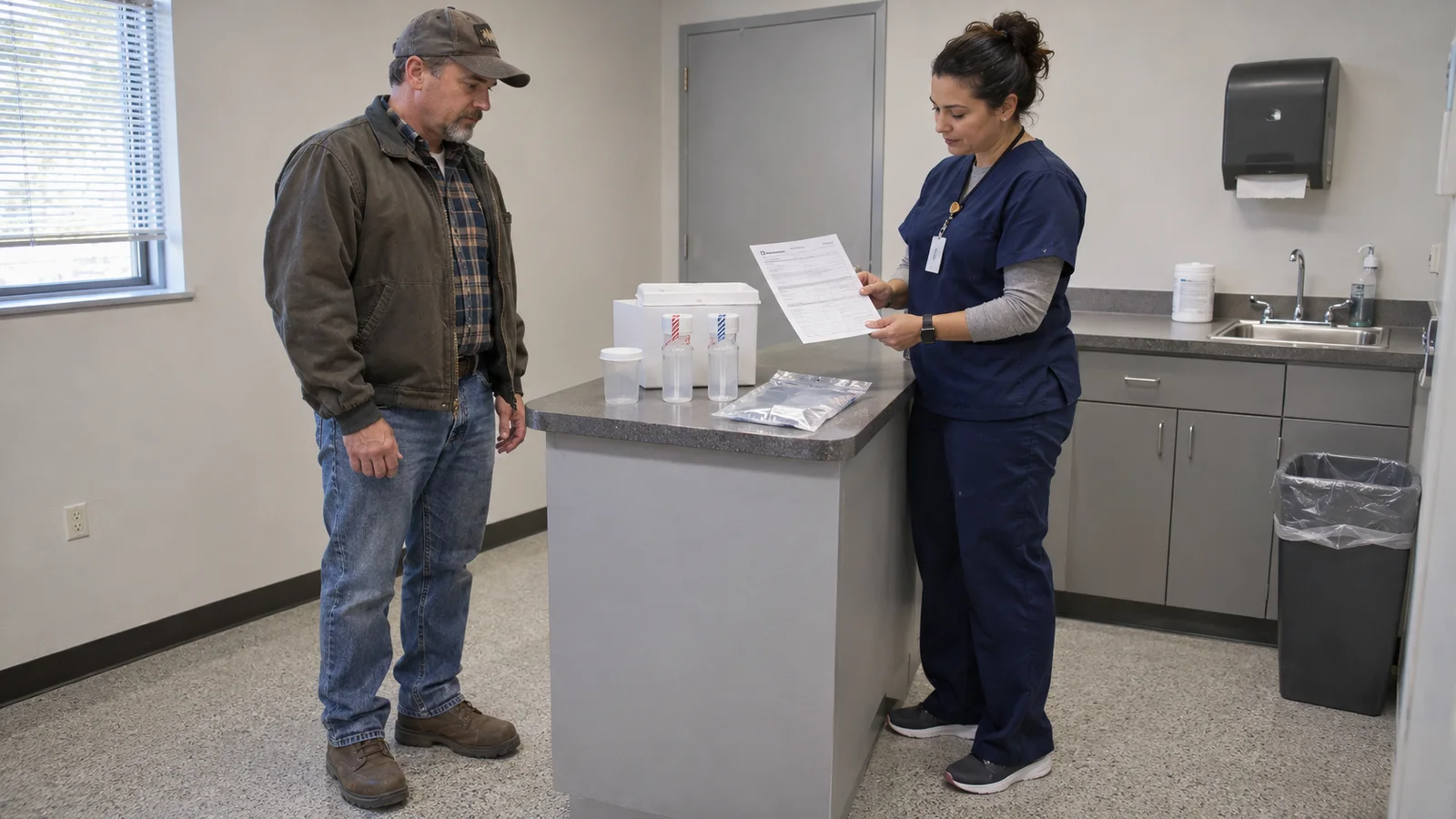
This guide follows the federal urine-collection rules used when a DOT-regulated employer orders that specimen type. The process can apply to pre-employment, random, post-accident, reasonable-suspicion, return-to-duty and follow-up tests. Collectors document events, medical review officers evaluate laboratory and medical information, and employers make the refusal determinations assigned to them.
Part 40 also contains a separate oral-fluid framework. The procedures are not interchangeable, so this article stays focused on urine. Follow the specimen type and instructions supplied by the employer and qualified collection site.
The five-stage collection process
| Stage | What happens | Driver focus |
|---|---|---|
| 1. Check-in | The collector confirms the order, DOT authority and identity. | Arrive as directed with acceptable original photo ID. |
| 2. Preparation | Outer garments are secured, hands are washed and a sealed container is selected. | Follow directions and keep the collection area controlled. |
| 3. Specimen | The driver provides at least 45 mL in one void; routine collections normally preserve privacy. | Return the container promptly without flushing. |
| 4. Integrity checks | The collector checks volume, temperature and appearance. | Stay present and ask factual questions before signing. |
| 5. Split and seal | The collector prepares primary and split bottles, applies seals and completes the CCF. | Watch, initial the seals and verify contact information. |
Before the collection begins
Under 49 CFR 40.61, the collector begins without undue delay and requires positive identification. A government-issued photo ID such as a driver license is acceptable. An employer-issued photo ID is also acceptable, except for an owner-operator or other self-employed person. A fax or photocopy is not.
If the driver lacks acceptable ID, the collector contacts the designated employer representative, or DER, for verification. A co-worker cannot simply vouch for the driver. The collector explains the basic procedure and, if asked, provides identification showing the collector's name and employer.
The collector directs the driver to remove outer clothing that could conceal a tampering item and leave items such as a coat, hat, briefcase or purse in an agreed place. The driver may keep a wallet and request a receipt for belongings. Refusing a required direction can create a refusal issue, so a genuine concern should be stated calmly while the driver continues to cooperate.
Handwashing, container selection and privacy
49 CFR 40.63 requires the collector to verify Step 1 of the federal Custody and Control Form, or CCF. The driver washes and dries their hands, then is not given additional access to water or other material that could alter the specimen until it is returned.
The collector either selects or allows the driver to select an individually wrapped or sealed collection container. It is opened with both people present. The two specimen bottles remain sealed until after the driver provides the specimen.
For a routine urine collection, the driver normally enters the collection room alone. The instructions are to provide at least 45 mL, not flush and return the container as soon as the void is complete. Directly observed and monitored collections are limited to situations authorized by Part 40; they are not the default for every CDL applicant or employee.
Volume and temperature checks
The collector confirms that the single specimen contains at least 45 mL. Separate voids cannot be combined. If the volume is insufficient, the collector begins the procedures in 49 CFR 40.193.
The temperature must be read no later than four minutes after the container is handed over. The acceptable range is 32–38 °C, or 90–100 °F. The collector records the finding. A temperature outside that range requires an immediate additional collection under Part 40 and notice to the DER.
Temperature is a specimen-integrity check, not a diagnosis and not a final result. The collector also notes unusual color, odor or other signs of possible tampering. When a second collection is required, the collector documents the reason and processes the specimens as the regulation directs.
How the primary and split bottles are prepared
Every DOT urine collection is a split-specimen collection. Under 49 CFR 40.71, the collector performs these steps in the driver's presence:
- Pour at least 30 mL into the primary, or A, bottle.
- Pour at least 15 mL into the split, or B, bottle.
- Secure both caps and apply tamper-evident seals.
- Date the seals.
- Have the driver initial the seals to certify that both bottles contain the specimen provided.
The driver should confirm that the seals are attached to both bottles and that identifying information on the employee copy is accurate. Refusing to initial does not erase the collection; the collector records it on the CCF and completes the process.
When direct observation is required
49 CFR 40.67 identifies the reasons for a directly observed urine collection. They include return-to-duty and follow-up tests, certain invalid or negative-dilute findings communicated through the MRO, a required observed collection that was previously missed, an out-of-range temperature, apparent tampering or conduct clearly indicating attempted substitution or adulteration.
The employer or collector explains the regulatory reason, depending on who initiated the observation. A new CCF is used and marked as observed. Under the current urine procedure, the observer must be the same sex as the employee, and the rule provides a DER process when a suitable observer is not immediately available.
A driver should comply with a lawful direction, remember names and times, and document any concern afterward through the employer, MRO or appropriate DOT agency. Interfering at the site can create a separate refusal issue.
Shy bladder: insufficient volume is not automatically a refusal
If the driver cannot provide 45 mL, the collector discards the insufficient specimen unless an integrity problem requires different handling. For a continued urine collection, the collector urges the employee to drink up to 40 ounces of fluid, reasonably distributed over up to three hours from the first unsuccessful attempt. Declining to drink is not itself a refusal.
The driver must remain at the site and make the required attempt. Leaving early or refusing another attempt is documented and reported to the DER, who makes the employer's refusal decision. If the driver still cannot provide enough within three hours, the collector ends the collection and notifies the DER.
After consulting the MRO, the DER directs the employee to obtain an evaluation within five days from a licensed physician acceptable to the MRO and qualified for the relevant medical issue. The physician evaluates whether a medical condition could have prevented a sufficient specimen. An unrelated independent test does not replace this process.
Laboratory finding versus MRO verification
A non-negative laboratory finding is not automatically the final result reported to the employer. The medical review officer reviews the laboratory information and gives the driver an opportunity to discuss a legitimate medical explanation. The driver should respond promptly and provide requested prescription documentation through the MRO's secure process.
Testing and fitness-for-duty rules remain separate. A prescription may explain a laboratory finding while the medication or condition still requires a medical-qualification or on-duty safety review. ProntoCDL's prescription-medication guide explains those roles.
The 72-hour split-specimen right
If the MRO verifies a positive test or a refusal based on adulteration or substitution, 49 CFR 40.153 requires notice of the right to test the split specimen. The driver has 72 hours from notification to make the request. It may be verbal or written under 49 CFR 40.171.
A timely request directs the primary laboratory to send the unopened split bottle to a second HHS-certified laboratory. The employer must ensure the testing occurs and may not delay it until the driver pays. Ultimate cost allocation can depend on policy or agreement, but prepayment is not a condition for processing.
The split procedure tests the integrity of the original result; it is not a new specimen collected from the driver. Part 40 does not authorize extra DNA testing. A driver who wants the split tested should contact the MRO immediately and keep the date, time and proof of the request.
Collection-site mistakes to avoid
- Do not bring only a photocopy of ID. Carry an acceptable original photo ID.
- Do not leave because the wait is inconvenient. Confirm instructions with the collector and DER first.
- Do not add water, combine voids or handle the bottles. Follow the controlled procedure.
- Do not flush unless directed. The collector controls the room until the specimen is accepted.
- Do not turn a suspected error into a refusal. Comply, note facts and use the review channel afterward.
- Do not ignore the MRO. Missed calls delay review and leave less time to gather documentation.
- Do not miss the split deadline. Contact the MRO within 72 hours if you want the B bottle tested.
Practical takeaways
- Report when directed and remain until the collector says the process is complete.
- A routine urine collection normally provides privacy; observation requires a regulatory reason.
- The minimum volume is 45 mL in one void.
- Temperature is read within four minutes; the acceptable range is 90–100 °F.
- Primary and split bottles come from the same specimen and are sealed in the driver's presence.
- An insufficient specimen begins a defined process; it is not automatically a refusal.
- A laboratory finding is reviewed by an MRO before verification.
- The split-request window is 72 hours after MRO notification.
- Document concerns after complying; never create a refusal by walking away or obstructing the collection.
For specific triggers, review ProntoCDL's pre-employment guide, random-testing guide and reasonable-suspicion guide.
DOT urine drug-test FAQ
How much urine is required for a DOT drug test?
A DOT urine collection requires at least 45 mL in a single void. The collector divides it into at least 30 mL for the primary bottle and at least 15 mL for the split bottle.
What temperature must a DOT urine specimen be?
The collector reads the temperature within four minutes. The acceptable range is 32–38 °C, or 90–100 °F. An out-of-range result triggers additional procedures.
Can a CDL driver leave during a shy-bladder procedure?
No. Leaving before completion can be reported for a refusal determination. During a continued urine collection, the driver is given up to three hours from the first unsuccessful attempt and must remain available at the site.
Is every DOT urine drug test directly observed?
No. Routine collections normally provide privacy. Direct observation is required only in specified situations, including return-to-duty and follow-up tests, certain laboratory findings, an out-of-range temperature or clear signs of attempted tampering.
What is the split specimen?
It is the second sealed bottle prepared from the same collection. After an MRO verifies a positive result or a refusal based on adulteration or substitution, the employee generally has 72 hours to request testing of the split at a second HHS-certified laboratory.
Must a driver pay before the split specimen is tested?
No. A timely request cannot be delayed while payment is collected. The employer must ensure the test occurs, although it may seek reimbursement under a lawful policy or agreement.
Official sources and scope
This educational guide was reviewed November 11, 2026 against current 49 CFR Part 40, including §§ 40.61, 40.63, 40.65, 40.67, 40.71, 40.153, 40.171 and 40.193, plus the U.S. Department of Transportation's employee drug-and-alcohol testing guidance. It is general regulatory education, not legal or medical advice. Follow the current regulation and directions from the employer, collector, MRO and qualified medical professionals in the actual case.