
CDL Pintle Hook Inspection: Drawbar Eyes & Safety Chains
A pintle connection is more than a hook around an eye. The mount, hook body, latch, drawbar, articulation, safety devices and service connections must work as one secure system before a full trailer or converter dolly moves.
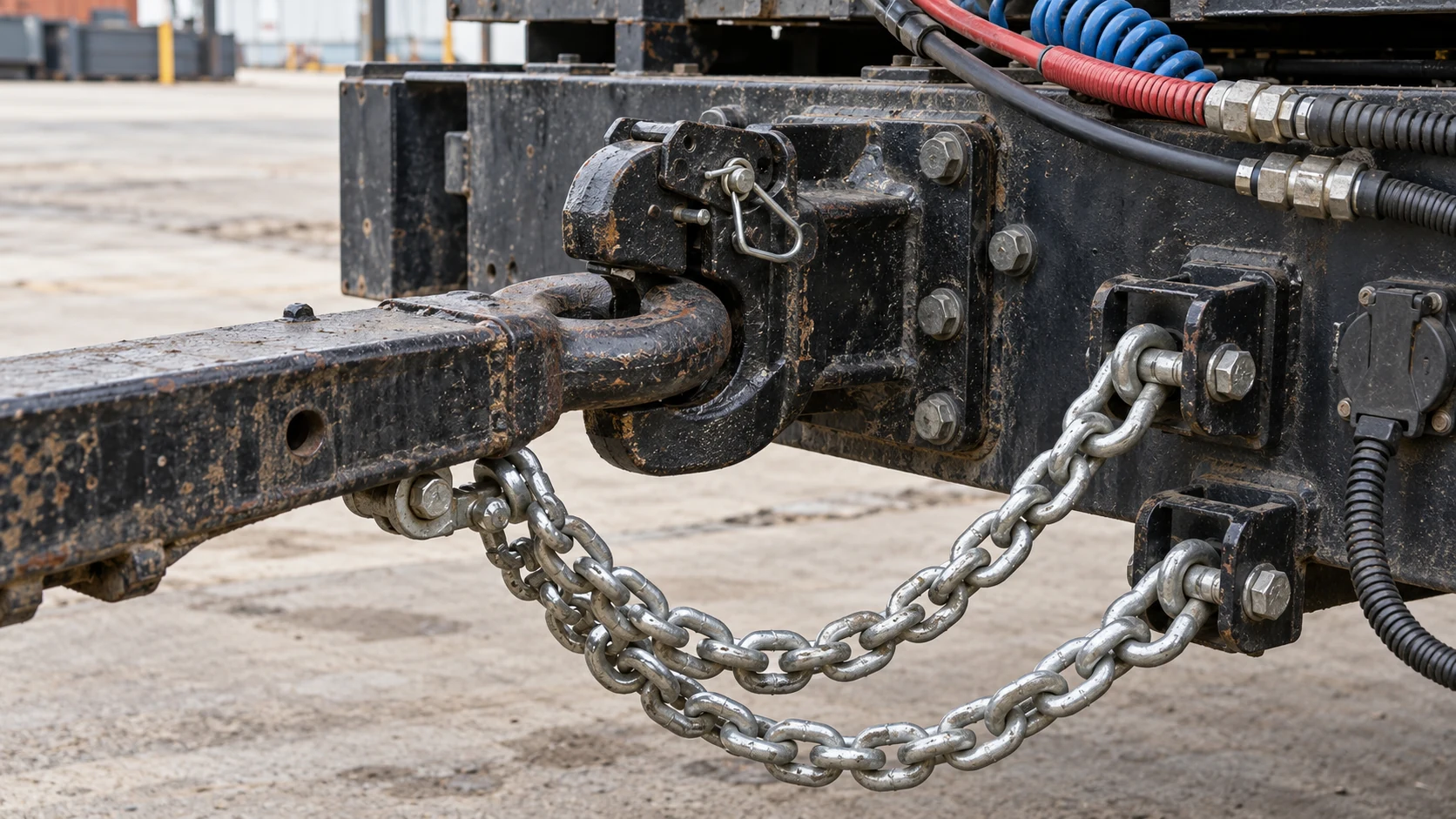
49 CFR 393.70 sets federal requirements for full-trailer tow-bars, pintle-hook mounting and safety devices. It requires a structurally adequate, securely mounted connection with adequate articulation, no excessive slack and a locking device that prevents accidental separation. This guide turns those requirements into a driver-level inspection route. Pair it with ProntoCDL's fifth-wheel inspection guide, air-line and glad-hand guide and doubles and triples endorsement guide.
Know the parts before naming defects
| Component | Job | Driver inspection focus |
|---|---|---|
| Pintle hook | Supports and captures the drawbar or towbar eye | Cracks, distortion, wear, unauthorized welds and secure mounting |
| Latch and retainer | Prevents the eye from escaping the hook | Fully closed position, positive lock, intact pin or keeper and free operation |
| Drawbar or towbar eye | Transfers towing force through the connection | Cracks, wear, deformation, attachment welds and fasteners |
| Tongue or towbar | Connects the trailer structure to the coupling eye | Cracks, bends, slider locks, stops, looseness and cylinder or hose leaks |
| Safety chains or cables | Help keep the trailer connected and support the towbar after a primary failure | Correct independent attachment, condition, secure hooks and necessary turning slack |
| Air and electrical connections | Operate trailer brakes, ABS and lighting | Correct routing, secure couplers, no leaks, chafing, stretching or ground contact |
1. Secure the combination before entering the coupling area
Inspect on firm, level ground when practical. Apply the parking brakes, place controls in the safe position prescribed for the equipment, shut down or isolate movement as required and keep unauthorized people clear. Never put your body between units that could roll, pivot or settle. A visual coupling check is not permission to work beneath unsupported equipment.
Begin wide. Confirm the towing unit and trailer are aligned without obvious twist, the tongue is not resting on the ground and the connection is not carrying an abnormal side load. Look for fresh scrape marks, displaced hardware or a leaning mount before moving close.
2. Follow the pintle mount into the frame
The hook must not be treated as an isolated casting. Follow its mounting plate, bolts, brackets, reinforcement and crossmember into the vehicle frame. Federal rules require reinforcement or bracing sufficient to prevent undue frame distortion, and the periodic-inspection standards reject missing or ineffective fasteners, loose mounting, cracks from attachment points and a cracked crossmember that supports the pintle hook.
Use a light and compare both sides. Rust trails around a bolt, polished metal between mating surfaces, a shifted washer or a widening paint line can indicate movement even when the fastener remains present. Report the location and evidence precisely; do not tighten structural fasteners unless that work is assigned and specified.
3. Inspect the hook body, horn and latch
Trace the complete casting or forging, including the lower horn, throat, upper latch and hinge area. Stop for any crack, a visibly insecure latch or a welded repair to the pintle-hook assembly. The federal periodic standard also rejects a horn section reduced by more than 20 percent, but a driver should not invent a percentage by eye. Describe flat spots, grooves, missing material and deformation, then have qualified maintenance measure questionable wear.
Confirm the latch is fully closed around the eye and that the installed retaining pin, clip or positive lock is present and seated. A pin resting in the hole without its keeper, a latch held by wire or a replacement bolt that does not match the design is not a completed connection.
4. Check the drawbar eye and tongue as one load path
Inspect the entire visible circumference of the eye for cracks, elongation, severe grooves, heat damage or deformation. Continue along the eye mount, attachment welds, fasteners and tongue. The periodic-inspection standards reject cracks in the eye or its attachment welds, missing or ineffective fasteners and an eye worn more than 20 percent.
On an adjustable drawbar or tongue, verify the latching mechanism is effective and each required stop is present. Look for cracks, abnormal movement and leaking air or hydraulic components. Keep hands out of pinch points; use the equipment's approved check rather than rocking or cycling a mechanism while someone is inside the articulation zone.
5. Judge articulation and slack without guessing
The connection needs enough movement for normal turns, grade changes and road crown, but it must not have excessive slack. Look for binding, a latch riding on the eye, metal interference, fresh impact marks or a hose route that will tighten before the mechanical joint reaches its normal limit.
If the fleet procedure calls for a controlled tug or movement check, clear the area, connect the necessary service lines, use the lowest controlled force and follow the equipment-specific sequence. A tug does not replace the visual inspection, and a visually damaged or incompletely locked coupling should not be tugged merely to see whether it holds.
6. Inspect safety devices independently of the primary hook
For full trailers and converter dollies, section 393.70 requires one or more safety devices that prevent the towed unit from breaking loose if the towbar fails or disconnects. The safety device generally may not attach to the pintle hook or the device to which the towbar is attached. Use the designed reinforced frame points, not the hook, latch, mounting bolt or an improvised hole.
Federal rules require no more slack than necessary for proper turning and require the arrangement to keep the towbar from dropping to the ground after failure or disconnection. Inspect every link, cable strand, hook, clevis, pin and retainer. The periodic standard rejects missing or unattached devices, chains with measurable section loss, kinked or broken cable strands, improper clamps and improvised repairs made with welding, wire, small bolts, rope or tape.
Do not assume that crossing chains is a universal substitute for the approved arrangement. Verify the attachment pattern, turning clearance and towbar support against the equipment design and carrier procedure.
7. Trace air and electrical lines through the full turning envelope
Identify the service and emergency air connections and the electrical connection. Confirm couplers are fully seated, seals do not leak and cables are supported without kinks, chafing or contact with the tongue or pavement. Leave enough working length for turns without allowing loops to drag or snag.
Then perform the required brake, light and ABS checks for the equipment. A mechanically secure pintle connection does not make the combination road-ready if trailer brakes, lamps or ABS power are unavailable. 49 CFR 392.7 specifically requires the driver to be satisfied that coupling devices and trailer brake connections are in good working order before driving.
Driver check and maintenance inspection are connected
The driver's pre-drive inspection does not replace scheduled maintenance or the annual inspection. Under 49 CFR 396.3, the motor carrier must systematically inspect, repair and maintain vehicles under its control, with parts and accessories kept in safe and proper operating condition. A clear driver report—component, location, condition and when it was observed—helps the carrier make that maintenance decision.
Defects that call for a stop and report
- Any crack in the pintle-hook assembly, drawbar eye, tongue, attachment weld, mount or supporting crossmember.
- A latch that will not close securely or a missing, damaged or improvised retainer.
- Loose mounting, missing or ineffective fasteners, or visible movement between mounting surfaces.
- A welded pintle-hook repair or obvious heat-straightening.
- Severe wear, missing material, deformation or a questionable eye-to-hook fit.
- An ineffective adjustable-drawbar latch, a missing stop or abnormal slider movement.
- A missing, unattached, badly worn or improperly repaired safety device.
- Chains or cables connected to an unapproved point or unable to support the towbar as designed.
- Air leaks, damaged hoses, an insecure electrical connection or routing that cannot tolerate a normal turn.
Practice a precise CDL inspection explanation
Name the part, condition, security and safety purpose in one short statement. For example: “The pintle hook is securely mounted to the reinforced crossmember with no cracks, loose or missing hardware or unauthorized welds. The drawbar eye is fully seated; the latch and retainer are closed and secure. The safety chains are attached at approved independent frame points, have no damaged links or improper repairs, contain only the slack needed for turning and will support the towbar if the primary connection fails.”
Adapt that explanation to the actual vehicle. CDL skills-test procedures and terminology vary by State and equipment, while federal Class A ELDT requires instruction and proficiency in coupling, inspecting and uncoupling combination units as applicable.
Practical takeaways
- Inspect the whole load path: frame, mount, hook, latch, eye, tongue and trailer structure.
- Verify a positive latch and retainer; never accept wire, rope or an improvised bolt as a coupling lock.
- Use only approved, independent safety-device attachment points.
- Allow necessary turning slack without letting chains, cables or service lines drag.
- Report wear with observable evidence instead of guessing a percentage.
- Keep clear of pinch zones and never enter between units that can move.
- Finish with brake, ABS, light and final walkaround checks before road movement.
Pintle hook inspection FAQ
Is a pintle hook the same as a fifth wheel?
No. A pintle hook closes around a drawbar or towbar eye, often called a lunette eye. A fifth wheel locks around a semitrailer kingpin. Both are coupling devices, but their parts, inspection points and connection procedures are different.
What keeps a pintle-hook connection from opening?
The hook body carries the drawbar eye, while the closed latch and its positive locking or retaining device prevent accidental opening. Inspect the exact system installed and confirm every latch, pin and retainer is fully seated before movement.
Can safety chains attach to the pintle hook?
As a general federal rule for full trailers and converter dollies, the safety device must attach independently of the pintle hook or other primary towbar attachment. Use the designed frame attachment points; do not improvise around the hook, latch or mounting bolts.
Must commercial-trailer safety chains always be crossed?
49 CFR 393.70 does not create one universal crossing instruction for every compliant configuration. It focuses on secure attachment, strength, necessary turning slack and preventing the towbar from dropping. Follow the equipment design, manufacturer instructions and carrier procedure without changing the approved attachment path.
How much slack should safety chains have?
No more than is necessary for the vehicles to turn properly. Too little can bind or overload the connection in a turn; too much can let the towbar drop or allow excessive movement. Check the complete turning envelope using the approved procedure.
Is a welded repair on a pintle hook acceptable?
A welded repair to the pintle-hook assembly is a rejection item under the federal minimum periodic-inspection standards. Drivers should not grind, weld, heat, bend or field-repair a questionable hook; identify the defect and have qualified maintenance evaluate it.
Make every coupling check a complete load-path check.
Train your eyes to follow the connection from frame to trailer—and to stop before movement when any link is uncertain.
Start free CDL practice