
CDL Doubles and Triples Endorsement Guide: T Test and Safety
The T endorsement is more than a letter on a CDL. It confirms that the driver understands how an extra articulation point changes coupling, inspection, off-tracking, braking, sway and rollover risk. This guide turns the federal test outline into a practical study and equipment-check routine—without confusing driver qualification with permission to run triples on every road.
49 CFR 383.93 requires a State-issued endorsement for drivers who operate double or triple trailers. The federal testing requirement is a specialized knowledge test. The standardized code printed on a qualified driver’s CDL is T, as listed in 49 CFR 383.153.
The regulation does not promise that a T-endorsed driver may pull triples anywhere. Licensing qualification, vehicle configuration and route legality are separate questions. State laws, posted limits, approved networks, combination length, weight and carrier operating authority must all be checked before dispatch.
What the T endorsement does—and does not do
| Question | Federal answer | Practical meaning |
|---|---|---|
| What vehicle type does T cover? | Double/triple trailers | The driver has passed the specialized knowledge test for multiple-trailer combinations. |
| Is a separate T skills test required? | No separate federal T skills test | The driver may still need the correct CDL class, ELDT and a CDL skills test for the underlying license. |
| Can T appear on a CLP? | No | Federal rules allow only P, S and N endorsements on a commercial learner’s permit. |
| Does T authorize every route? | No | Jurisdictional operating rules and route restrictions still control where a combination may travel. |
| Does T replace Class A? | No | The endorsement and CDL class serve different purposes; verify both for the actual GCWR and towed-unit ratings. |
This distinction prevents two costly mistakes: assuming a Class A CDL automatically includes doubles, or assuming the T code overrides a local equipment or route restriction. Check the license, the power unit, every trailer, the converter gear and the planned route as one assignment.
What the federal T knowledge test covers
49 CFR 383.115 identifies five knowledge areas for the double/triple-trailers endorsement:
- Assembly and hookup: the correct procedures for connecting the units.
- Trailer order: proper placement of the heaviest trailer.
- Handling and stability: off-tracking, steering response, driver feedback, braking, oscillatory sway, rollover and yaw stability.
- Traffic effects: slower grades, longer passing time, blocked freeway entry, splash and spray, aerodynamic buffeting, view blockage and lateral placement.
- Operating practices: safe procedures not otherwise listed.
The test is not merely a vocabulary check. A strong answer connects each physical effect to a driving or inspection decision. If the last trailer can magnify a steering input, the driver should make smoother lane changes. If additional joints increase the number of possible separation points, every coupling and air connection deserves a deliberate verification.
Know the equipment between the trailers
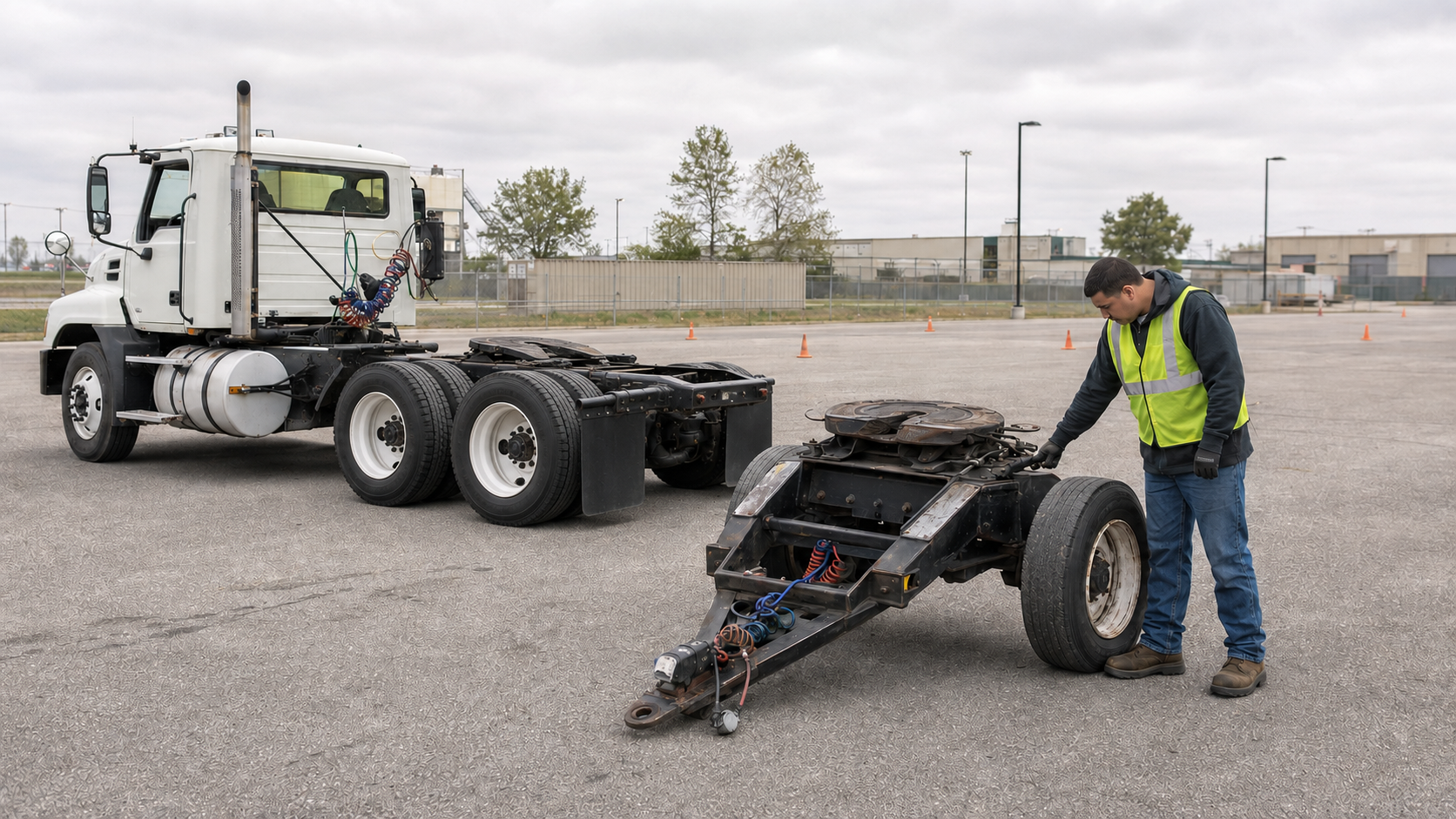
A converter dolly turns the front of a semitrailer into the rear portion of a full-trailer arrangement. Depending on the equipment, it can include a drawbar or tow eye, pintle-hook connection, safety chains or cables, its own axle and tires, a fifth wheel, air reservoir and brake system, air hoses, electrical cable and support hardware.
Do not reduce the inspection to “pintle hook locked.” The dolly has several systems that must work together:
- Mechanical connection: drawbar and eye condition, pintle-hook closure and security, safety devices, mounting hardware and visible damage.
- Upper coupling: fifth-wheel mounting, plate condition, release mechanism, kingpin engagement and the absence of a visible gap where the equipment requires full plate contact.
- Air system: correctly routed and connected hoses, closed drains, charged brakes, no obvious abrasion or leaks and shutoff valves positioned for the completed combination.
- Electrical system: plug fully seated, cable supported with turning clearance and no exposed conductors or crushed sections.
- Running gear: tires, rims, fasteners, hub condition, suspension, brakes, lights and reflectors inspected like other vehicle components.
Equipment designs differ. The manufacturer’s instructions, carrier procedure and current State CDL manual control the precise coupling and uncoupling sequence. Never stand between units that can move, try to muscle an unsafe dolly into place or rely on air pressure alone to secure equipment.
A connection-by-connection doubles inspection
Use a front-to-rear route so the combination’s extra joints do not create extra omissions:
- Start with the tractor and first semitrailer. Complete the normal vehicle inspection, including the tractor-to-first-trailer fifth wheel, kingpin, release arm, air lines, electrical cable and landing gear. The ProntoCDL fifth-wheel inspection guide provides a focused review.
- Inspect the rear of the first trailer. Check the pintle-hook assembly, mounting structure, air and electrical outlets, lights and required shutoff-valve positions for a trailer that is feeding another unit.
- Trace the converter dolly. Verify the drawbar connection, locking and safety devices, frame, support hardware, air and electrical routing, fifth wheel, axle, tires, suspension and brakes.
- Check dolly-to-rear-trailer coupling. Inspect the fifth-wheel lock around the kingpin, release mechanism, plate contact, air and electrical connections and landing-gear position.
- Finish at the last trailer. Verify the rear shutoff valves are in the correct terminal position, inspect lights and reflectors and confirm the entire rear door and cargo area are secure.
- Test the completed system. Charge the air system, listen for leaks, verify service and emergency brake response with the approved procedure, check lamps and perform controlled pull tests only after confirming the area is clear.
Open-versus-closed shutoff-valve questions are common on exams because the logic matters: air must continue through intermediate units but remain contained at the rear of the final trailer. Trace the actual air path rather than memorizing an isolated answer letter. Review hose, chamber and brake-hardware clues in the air-brake component guide.
Why trailer order matters
Section 383.115 specifically includes proper placement of the heaviest trailer. In a doubles combination, the general stability principle is to place the heavier semitrailer immediately behind the tractor and the lighter unit to the rear. The tractor provides the most direct control over the first trailer, while movement can become amplified toward the back of the combination.
This is not permission to rearrange loads casually. Trailer compatibility, axle weights, cargo securement, hazmat segregation, customer requirements and carrier procedures can affect the assignment. The driver’s job is to recognize an unsafe or unexplained configuration before moving and obtain a compliant plan.
Rearward amplification: why smooth steering matters
A small steering correction at the tractor can grow as it travels through each articulation point. The last trailer can move laterally more sharply than the tractor—a behavior often described as rearward amplification or the “crack-the-whip” effect. Sudden lane changes, evasive steering and entering a curve too fast can make the rear unit sway or roll even when the tractor feels manageable.
Build three habits around that physics:
- Look farther ahead. Early hazard detection leaves room for gradual braking and one smooth steering plan.
- Reduce speed before curves. Braking after the combination is already turning can upset several units at once.
- Make deliberate lane changes. Check mirrors through the entire movement and avoid rapid counter-steering that can whip the last trailer.
Wind, spray, pavement changes and aerodynamic buffeting from large vehicles can also disturb the rear unit. Increase space and reduce speed when conditions make precise tracking harder.
Off-tracking, stopping distance and traffic planning
Every trailer follows a shorter path through a turn than the unit ahead of it. A multi-trailer combination therefore needs a carefully planned turn with enough room for the rearmost wheels—without swinging into another lane unnecessarily or striking a curb, sign, vehicle or pedestrian area.
The longer combination also changes passing and merging decisions. Acceleration may be slower, the time required to clear another vehicle is longer and the driver must account for the entire rear unit before returning to the lane. On grades, speed differences can surprise other motorists. Use early signals, stable lane position and enough following space to avoid last-second inputs.
More axles and connections do not guarantee shorter stops. Brake adjustment, heat, traction, load distribution, reaction time and the behavior of every unit affect the result. Keep the combination straight during firm braking when possible, and do not use a trailer hand control as a routine anti-jackknife device.
Does federal ELDT apply to the T endorsement?
Federal Entry-Level Driver Training rules do not list T as a credential that independently requires ELDT. The current FMCSA Training Provider Registry applicability page identifies first-time Class A and Class B CDLs, Class B-to-A upgrades and first-time P, S and H endorsements. 49 CFR 380.603 reflects that scope.
That does not mean a new driver can skip ELDT and go directly to doubles. If the applicant first needs a Class A CDL, the Class A ELDT and skills-test sequence may apply. After the underlying CDL is issued, the State can add T when its knowledge-test and administrative requirements are met. Use the ProntoCDL ELDT readiness checklist to separate the license-class steps from endorsement steps.
A special case: saddle-mount combinations
Multiple trailers are not the only configurations that can create the endorsement question. In FMCSA’s guidance on double and triple saddle-mount combinations, the agency says T is required when the combination has more than one point of articulation, a GCWR of 26,001 pounds or more, and a combined GVWR above 10,000 pounds for the vehicles being towed. Use the actual ratings and articulation points rather than assuming that an unusual vehicle-delivery configuration is exempt.
Can T be placed on a CLP?
No. Section 383.93 says the only endorsements allowed on a commercial learner’s permit are passenger (P), school bus (S) and tank vehicle (N). T is not on that list. This is different from the previous tanker topic: N can appear on a CLP with strict cargo restrictions, while T is a CDL-only endorsement code.
State agencies decide their scheduling, fees, retest and document-issuance processes. Confirm whether the State allows an applicant to take the T knowledge test during the same visit as other CDL transactions and when the endorsement becomes effective.
A seven-session T endorsement study plan
- Credential map: explain the difference among Class A, T qualification and route legality.
- Equipment map: label the first trailer, pintle hook, drawbar, converter dolly, dolly fifth wheel, air lines, electrical connections and rear trailer.
- Airflow map: trace air through every unit and explain intermediate versus last-trailer shutoff-valve positions.
- Coupling check: recite a safe front-to-rear inspection without inventing shortcuts around the manufacturer’s sequence.
- Handling day: explain off-tracking, rearward amplification, sway, rollover and longer passing time.
- Scenario day: solve curve, grade, merge, wind, wet-road and emergency questions by applying the physics.
- Exam rehearsal: complete mixed questions, review every miss by concept and repeat weak topics from the current State manual.
Pair the free CDL study routine with the ProntoCDL practice center. Treat practice questions as diagnostic tools, not as the official State exam or a substitute for the current manual.
Practical takeaways
- T is the standardized CDL code for double/triple-trailers qualification.
- The federal T requirement is a knowledge test; it does not replace the underlying CDL class or skills test.
- T cannot be placed on a CLP.
- T alone does not trigger federal ELDT, but a first-time Class A applicant may need Class A ELDT.
- The endorsement does not make triples legal on every route.
- Inspect every articulation point, air connection, electrical connection, shutoff valve and safety device.
- Place the heavier trailer in the more stable forward position unless a compliant equipment or operating plan requires otherwise.
- Slow before curves and use smooth steering because motion can amplify toward the last trailer.
Frequently asked questions
What does the T endorsement allow a CDL driver to operate?
The standardized T code shows that the driver passed the double/triple-trailers knowledge test. It qualifies the driver for that vehicle type, but it does not make triples legal on every road or replace the correct CDL class. The carrier and driver must still verify State law, route limits, equipment rules and the exact combination.
Is there a separate federal skills test for the doubles and triples endorsement?
No. Under 49 CFR 383.93, the federal testing requirement for the double/triple-trailers endorsement is a knowledge test. A first-time Class A applicant still must satisfy the Class A knowledge, ELDT and skills-test requirements, and a State may have additional administrative procedures.
Can the T endorsement be placed on a commercial learner’s permit?
No. Federal rules allow only P, S and N endorsements on a CLP. The T code is a CDL endorsement, so an applicant should confirm the State’s testing and issuance sequence before scheduling a doubles or triples knowledge test.
Does adding a T endorsement require federal ELDT?
T alone is not one of the credentials that independently triggers federal Entry-Level Driver Training. ELDT applies to first-time Class A or B applicants, Class B-to-A upgrades and first-time P, S or H endorsements. A driver who needs a first Class A CDL before adding T may therefore need Class A ELDT even though T itself is not an ELDT credential.
Should the heavier trailer be first or last in a doubles combination?
Federal test standards specifically require applicants to know proper placement of the heaviest trailer. Model CDL guidance generally places the heavier semitrailer immediately behind the tractor because rearward amplification makes the last unit more vulnerable to sway and rollover. Follow the current manual and operating procedures for the exact equipment.
Does a T endorsement automatically make triple trailers legal nationwide?
No. The endorsement proves driver qualification; it is not route authorization. Triple-trailer operation, combination length, weight, equipment and approved routes can vary by jurisdiction. Verify every planned route with the carrier and the responsible State agencies before dispatch.
Can a saddle-mount combination require a T endorsement?
Yes, in some configurations. FMCSA guidance says double or triple saddle-mount combinations require the endorsement when there is more than one articulation point, the GCWR is at least 26,001 pounds and the combined GVWR of the towed vehicles exceeds 10,000 pounds.