
CDL Seat Belt Rules: Drivers, Passengers and Sleeper-Berth Restraints
A commercial-truck restraint system is more than a buckle beside the seat. Safe use depends on the correct rule for the occupant’s location, a functional belt and anchor system, proper fit, and a routine that begins before the vehicle moves.
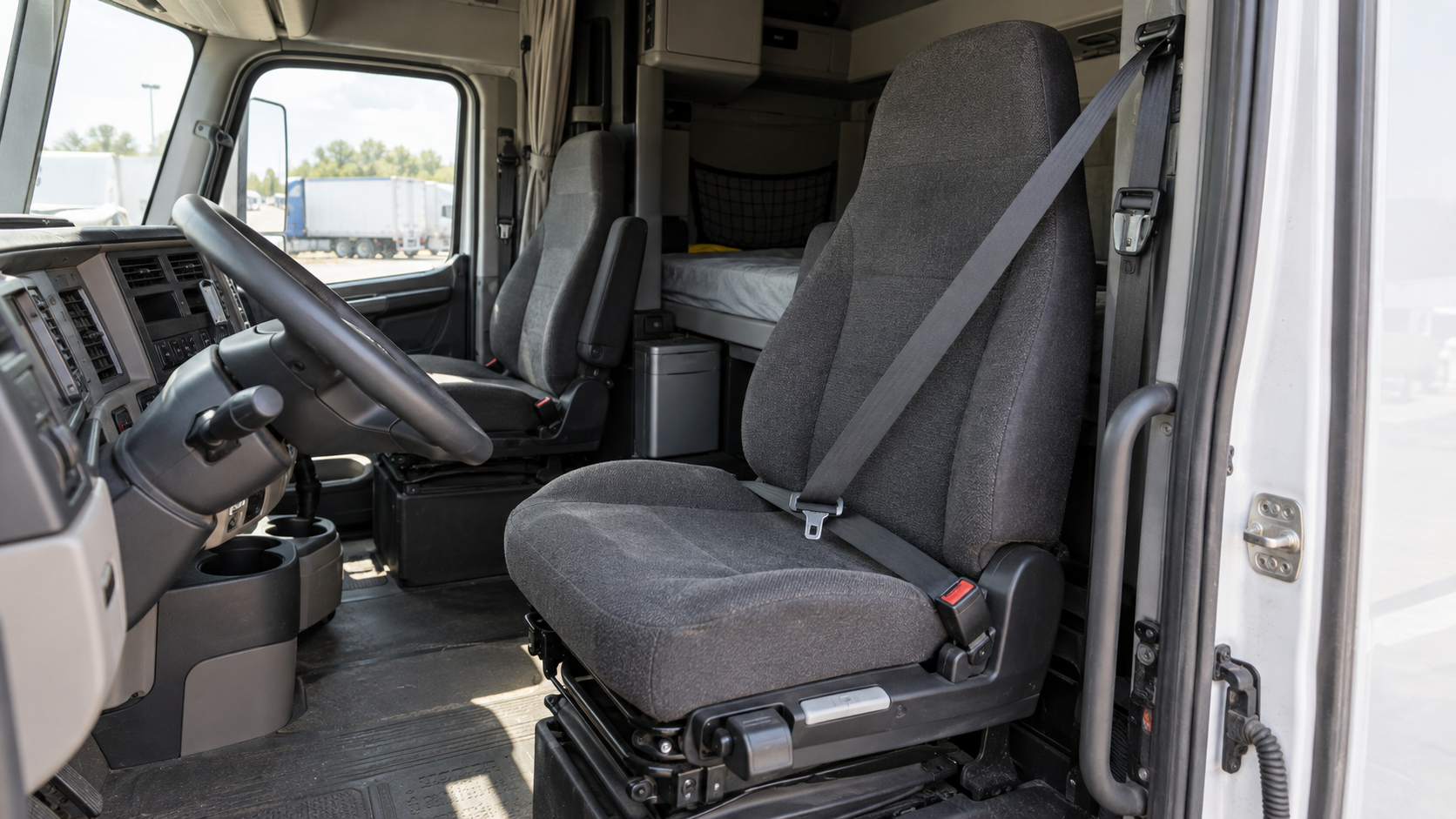
This guide focuses on federal requirements for interstate commercial motor vehicle operations. State law, vehicle type and carrier policy may add obligations. The core principle is simple: use every restraint for its designed occupant position, and never move the truck with a known safety defect.
The driver rule is direct
49 CFR 392.16(a) prohibits a driver from operating a commercial motor vehicle that has a seat belt assembly installed at the driver’s seat unless the driver is properly restrained. The same section prohibits a motor carrier from requiring or permitting that operation.
“Properly restrained” is important. Clicking the latch while routing the shoulder portion behind the back, placing the lap portion across the abdomen or leaving excessive slack defeats the way the system manages crash forces. Buckle before releasing the parking brake, not after the truck reaches the road.
Property-carrying vehicle passengers must use installed belts
Section 392.16(b) applies to other occupants of a property-carrying commercial motor vehicle. The driver and carrier may not operate or permit operation when another occupant is not properly restrained by the belt installed at that seat.
This means a co-driver, trainer, mechanic or authorized passenger seated in the cab is not exempt because the vehicle is large or the trip is short. The driver should confirm that every seated occupant is belted before movement. Also verify that each passenger is authorized under the carrier’s rules and applicable federal requirements.
Seat belt and sleeper restraint: two different systems
| Occupant position | Federal requirement | Practical check |
|---|---|---|
| Driver’s seat | Driver must be properly restrained by the installed seat belt under 392.16(a) | Webbing, latch, retractor, anchors, fit and seat mounting |
| Other installed seat in a property-carrying CMV | Each occupant must use the belt installed at that seat under 392.16(b) | Correct belt for that exact seating position; no shared or improvised belt |
| Sleeper berth | Covered sleeper-equipped vehicles must have a system preventing occupant ejection during deceleration under 393.76(h) | Restraint present, correctly attached, maintained and used as designed |
A sleeper berth is not an unrestrained lounge while the vehicle is moving. 49 CFR 393.76(h) requires a motor vehicle manufactured on or after July 1, 1971 and equipped with a sleeper berth to have a means of preventing ejection of the sleeper occupant during deceleration. The system must be designed, installed and maintained to withstand a total forward force of at least 6,000 pounds.
That sleeper equipment rule is not permission to substitute a bunk restraint for a cab seat belt. A person riding in a seat uses that seat’s belt. A person occupying the berth uses the berth’s designed restraint according to the manufacturer and carrier instructions.
Modern truck seats and anchors are regulated equipment
49 CFR 393.93 sets equipment requirements for seats, belt assemblies and anchorages by vehicle type and manufacturing date. Trucks and truck tractors manufactured on or after July 1, 1971 generally must conform to the applicable federal motor vehicle safety standards for belt installation and anchorages.
Do not relocate an anchor, substitute an unapproved buckle or defeat the retractor to make a belt feel more comfortable. Air-ride seat travel, swivel features and adjustable upper anchors must work with the installed restraint geometry. Repairs and replacements should follow the vehicle and restraint manufacturer’s specifications.
A one-minute restraint inspection
Add the belt and seat to the in-cab portion of every pre-trip. Use this repeatable sequence:
- Webbing: Pull the belt far enough to inspect both edges for cuts, heavy fraying, burns, contamination or stitching damage.
- Routing: Confirm the webbing is not twisted, trapped behind trim or rubbing across a sharp edge.
- Latch and buckle: Insert the latch plate, listen and feel for engagement, then tug firmly. Release and confirm normal operation.
- Retractor: Let the belt rewind smoothly and verify it removes slack. A sharp pull should activate the locking function as designed.
- Anchors: Look for loose fasteners, cracked brackets, corrosion, damaged trim or movement at upper and lower mounting points.
- Seat: Confirm the seat is securely mounted, adjusts and locks, and does not interfere with belt routing.
- Sleeper system: On a sleeper tractor, inspect the berth restraint’s webbing or net, attachment points, latch and storage condition.
Do not disassemble a pretensioner, retractor or anchor assembly during a driver inspection. Report the exact symptom and keep the vehicle out of service when the restraint cannot properly secure an occupant under the applicable rule or carrier procedure.
Fit the belt to the driver, not around the driver
FMCSA’s commercial-driver safety-belt guidance recommends placing the lap belt low against the thighs and hips, with the shoulder belt crossing the center of the shoulder and chest. Use the seat and upper-anchor adjustments provided by the manufacturer to improve fit.
- Remove twists before latching.
- Keep the lap portion below the soft abdomen.
- Keep the shoulder portion away from the neck without placing it under the arm.
- Pull out bulky objects that prevent the lap belt from lying close to the body.
- Allow the retractor to remove slack after adjusting the seat.
- Recheck fit after changing drivers or seat height.
The FMCSA safety-belt presentation illustrates the recommended lap and shoulder placement.
Seat belts help the driver remain in control
A restraint is not only protection after a collision begins. It helps keep the driver at the steering wheel and controls during evasive braking, a tire failure, side impact or rollover. Bracing with one hand cannot replace a properly worn three-point belt.
The cab’s size does not eliminate ejection or interior-impact risk. FMCSA’s current CMV seat-belt campaign reminds large-truck and bus drivers and other vehicle occupants to buckle up consistently.
Common shortcuts that are not proper restraint
- Buckling the belt behind the body to silence a warning
- Routing the shoulder belt under the arm or behind the back
- Using one belt for two occupants
- Letting a passenger ride on the floor, bunk edge, cabinet or other non-seat location
- Clipping or tying the webbing to stop the retractor
- Continuing to use a belt or sleeper restraint damaged in a crash
- Assuming yard speed, a short trip or a bobtail move removes the requirement
Seat-belt use is taught and checked
The Class A ELDT curriculum and Class B ELDT curriculum require training providers to teach the federal rule governing proper use of seat belt assemblies. Practice the complete in-cab sequence through ProntoCDL’s Class A ELDT guide and free practice center.
Seat-belt use is also listed among the applicable driver items in CVSA Level I, II and III inspections. The ProntoCDL roadside-inspection guide explains how those levels differ and how to organize the rest of the driver record.
Practical takeaways
- Buckle the driver before the parking brake is released.
- Confirm every other occupant in an installed seat uses that seat’s belt.
- Keep lap webbing low on the hips and the shoulder belt across the chest and shoulder.
- Inspect webbing, latch, retractor, anchors and seat mounting every operating day.
- Inspect and correctly use the separate sleeper-berth restraint in team operations.
- Report damaged restraint equipment precisely; never improvise a repair.
- Treat yard moves and short trips with the same buckle-first routine.
CDL seat belt and sleeper-restraint FAQ
Does federal law require a commercial driver to wear the seat belt?
Yes. Under 49 CFR 392.16(a), a driver may not operate a commercial motor vehicle equipped with a belt at the driver’s seat unless the driver is properly restrained. A carrier may not require or permit that unbelted operation.
Must a passenger buckle up in a property-carrying commercial vehicle?
Yes when a seat belt assembly is installed at that occupant’s seat. Section 392.16(b) prohibits operation of the property-carrying CMV unless every other occupant is properly restrained by the installed belt assembly.
Is a sleeper-berth restraint the same as a seat belt?
No. A seat belt restrains an occupant seated in the cab. For covered sleeper-equipped vehicles, 49 CFR 393.76 requires a separate system designed to prevent ejection of a sleeper occupant during deceleration. Each system must be used only as designed.
Can a driver wear the shoulder belt behind the back or under the arm?
No. That is not proper restraint and can concentrate crash forces on vulnerable areas. The shoulder belt should cross the center of the shoulder and chest, while the lap portion stays low against the hips and upper thighs.
What seat-belt defects should be reported before driving?
Report cut or badly frayed webbing, a latch that will not hold or release correctly, a retractor that leaves excessive slack, damaged or loose anchors, twisted routing, a damaged buckle, or an insecure seat. Follow the carrier and manufacturer repair process.
Is seat-belt use part of CDL training and roadside inspections?
Yes. Federal Class A and Class B ELDT curricula require instruction on the proper-use rule in 49 CFR 392.16. CVSA’s current Level I, II and III descriptions also include the seat belt among applicable driver inspection items.
Make buckling the first control
Inspect the restraint, adjust the seat, buckle correctly and confirm every occupant before the truck moves.
Start free CDL practice