
CDL Asthma & COPD Guide: DOT Physical and Lung Records
Asthma or chronic obstructive pulmonary disease does not create an automatic federal CDL disqualification. The controlling question is functional: is a respiratory dysfunction likely to interfere with safe control of a commercial motor vehicle? A well-prepared driver helps the certified medical examiner answer that question with an accurate symptom history, treatment information, current function and useful pulmonary records.
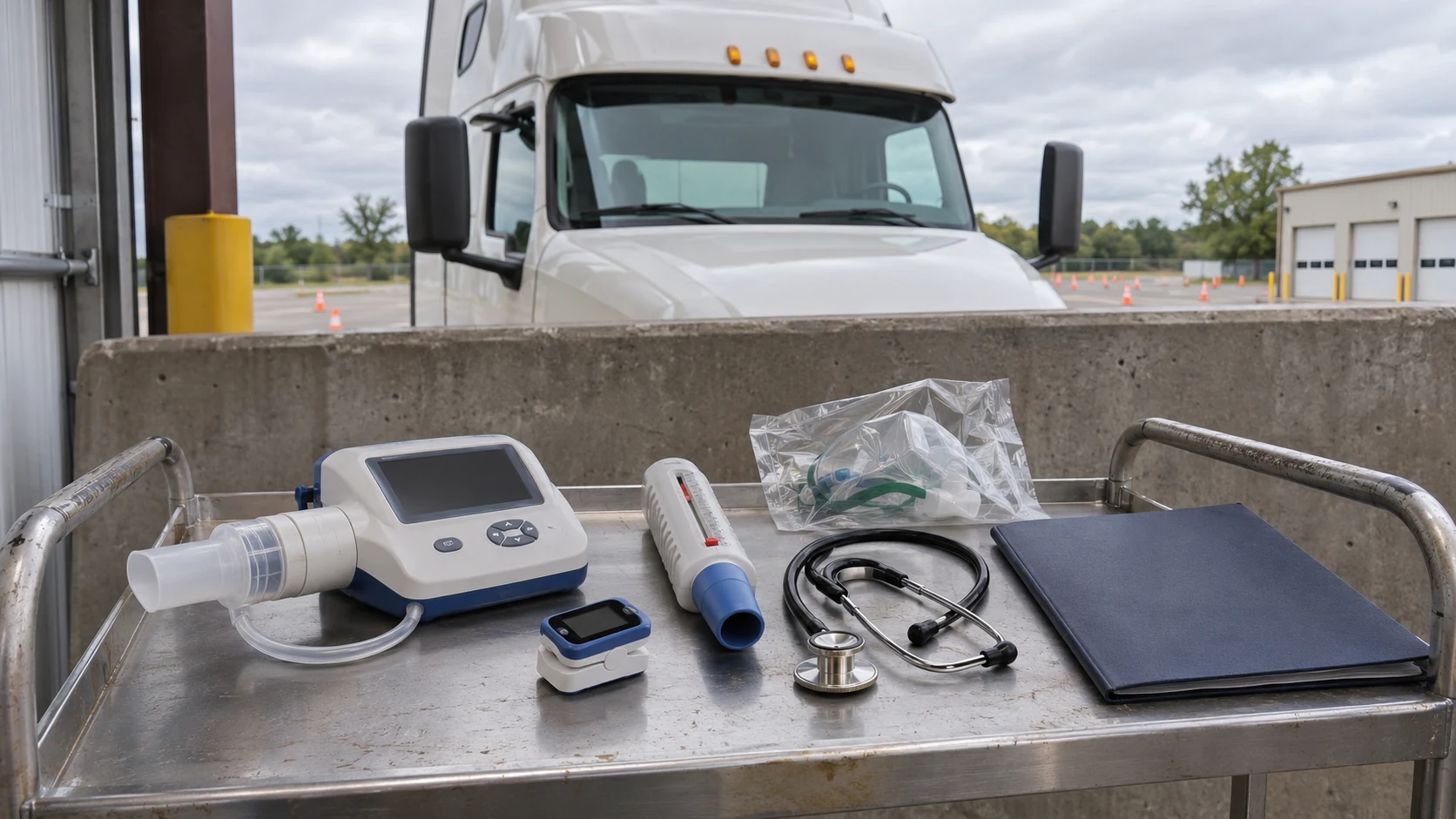
The binding interstate rule is 49 CFR 391.41(b)(5). It requires a driver to have no established medical history or clinical diagnosis of a respiratory dysfunction likely to interfere with the ability to control and drive a CMV safely. The regulation does not name asthma or COPD as an automatic failure and does not prescribe one universal spirometry value, inhaler limit or certification period for either diagnosis.
The medical advisory criteria identify emphysema, chronic asthma and chronic bronchitis among conditions that can interfere with oxygen exchange. When a possible undiagnosed or inadequately treated respiratory dysfunction may interfere with safe CMV control, the examiner should confer with the treating clinician or recommend specialist evaluation and therapy.
FMCSA's Medical Examiner's Handbook 2024 Edition supplies guidance to examiners. It replaced previous handbook editions. The handbook and advisory criteria help explain the regulation, but the regulation is binding and the qualification decision remains individualized.
The safety question is bigger than a diagnosis label
Commercial driving demands sustained attention, repeated cab entry and exit, vehicle inspection, coupling or cargo work, and the physical reserve to respond to an emergency. Respiratory disease can matter when cough, wheeze, shortness of breath, low oxygen, fatigue, medication effects or a sudden attack threatens those tasks.
| Evidence area | What it helps the examiner understand |
|---|---|
| Current symptoms | Whether cough, wheeze, chest tightness, sputum or breathlessness is controlled at rest, during exertion and while working |
| Exacerbation history | Frequency, severity, triggers, emergency treatment, hospitalization and recovery since the last examination |
| Functional capacity | Ability to walk, climb, inspect, couple, load and respond without unsafe respiratory limitation |
| Treatment stability | Whether the plan is effective, available on the road and free of side effects that impair alertness or control |
| Objective findings | What examination, spirometry, pulmonary-function testing, oxygen measurement or imaging shows when those records are clinically relevant |
The examiner is not choosing between “diagnosed” and “healthy.” The task is to decide whether the present condition and its treatment create a likelihood of unsafe driving. A stable history with reliable treatment may look very different from recent attacks, progressive exertional symptoms or an unexplained episode of near-collapse.
Asthma: frequency, severity and predictability matter
Asthma generally involves reversible airway obstruction and may be treated effectively with bronchodilators, corticosteroids and other therapies. FMCSA's handbook also recognizes a wide range of severity, from essentially asymptomatic disease to potentially fatal attacks. The examiner is directed to consider how frequent and severe the attacks are and whether the attacks or the prevention and treatment regimen may interfere with safe CMV operation.
Prepare a plain timeline rather than saying only that asthma is “controlled.” Include:
- the date and circumstances of the most recent attack;
- how often rescue medication is needed and whether use has increased;
- nighttime symptoms, urgent visits, emergency treatment, oral-steroid courses or hospitalization;
- known triggers such as cold air, smoke, dust, fumes, exertion or seasonal allergens;
- whether symptoms occur while driving, walking around the vehicle, climbing into the cab or handling freight;
- whether the driver has ever become confused, fainted or lost functional control during an episode; and
- how the maintenance plan prevents attacks and how rescue treatment is carried and used.
A peak-flow diary or inhaler record can add context when the treating clinician already uses one, but no single home number replaces the medical examiner's full review. Bring records that show the pattern honestly; do not start, stop or borrow medicine just to change the examination-day appearance.
COPD: hidden limitation can matter before severe breathlessness
The handbook describes COPD as a group of conditions with chronically reduced maximal expiratory flow, most often chronic bronchitis, emphysema or a combination. It notes that COPD can develop gradually and that a person may lose substantial lung function before noticing shortness of breath on exertion. Its cardinal symptoms are chronic cough, sputum production and dyspnea on exertion.
For qualification, FMCSA tells the examiner to consider whether the nature and severity of COPD is likely to interfere with safe CMV control. The handbook specifically flags unstable conditions such as chronic respiratory failure, continuing cough with cough syncope, and hypoxemia at rest. “Cough syncope” means loss of consciousness associated with coughing; it is not the same as an ordinary cough.
Drivers should describe function with concrete examples: how far they can walk, whether stairs or a complete pre-trip causes breathlessness, whether they need recovery time after coupling, and whether heat, cold, altitude, smoke or diesel exhaust changes symptoms. Report recent worsening, new swelling, chest pain, dizziness, confusion, low oxygen readings or repeated infections to the treating clinician promptly. Those findings may involve more than COPD and should not be self-diagnosed at a certification visit.
Testing is selected to answer a medical question
Neither 49 CFR 391.41(b)(5) nor the current handbook creates one mandatory spirometry test or one pass/fail lung-function cutoff for every asthma or COPD case. The medical examiner may request more information when symptoms, examination findings or an incomplete history leave the safety question unresolved. A pulmonologist may use spirometry, complete pulmonary-function testing, oxygen measurement, exercise assessment or imaging depending on the condition.
Bring the final reports that already exist or that the examiner specifically requests. A raw graph without the interpretation, an appointment receipt or a portal screenshot with no date is less useful than the full signed report. If results differ from an older study, ask the treating clinician to explain whether the change is real, clinically significant and stable.
Do not assume that one normal pulse-oximeter reading proves every respiratory issue is resolved. A fingertip reading can be useful clinical information, but the federal decision includes symptoms, disease course, treatment, work demands and the rest of the examination.
Medication effects belong in the safety review
Respiratory treatment can improve safety, but the examiner also considers adverse effects and drug interactions. FMCSA warns that some prescription and over-the-counter products used for respiratory symptoms may cause cognitive difficulty or worsen excessive daytime sleepiness. The handbook specifically notes that first-generation antihistamines can be sedating and may affect a person for 12 hours, sometimes without the person recognizing the impairment.
List every controller inhaler, rescue inhaler, nebulized medicine, oral steroid, antibiotic, cough medicine, decongestant, antihistamine and supplement. For each, record the dose, schedule, reason, last change and any tremor, palpitations, dizziness, sleepiness, confusion or visual effect. The ProntoCDL prescription-medication guide explains why a lawful prescription does not replace the certified examiner's independent review.
A driver also needs a workable road plan: medication stored as directed, unexpired rescue treatment within reach when prescribed, enough supply for the trip, and access to follow-up care. Do not operate when symptoms or a medicine's effects make safe control doubtful, even if the medical card has not expired.
Build a pulmonary packet the examiner can use
A treating clinician or pulmonologist supplies medical facts; the certified medical examiner makes the federal qualification decision. Ask the examiner's office what it wants before the appointment, then organize a concise packet:
- Current clinical note. Include the exact diagnosis, present symptoms, functional status, treatment response and follow-up plan.
- Exacerbation timeline. List attacks, respiratory infections, oral-steroid courses, urgent care, emergency visits and hospitalizations with dates and outcomes.
- Medication list. Record prescription and over-the-counter products, dose, schedule, recent changes, adherence and side effects.
- Objective reports. Bring final spirometry, complete pulmonary-function testing, oxygen evaluation or chest imaging reports when relevant, already available or requested.
- Oxygen information. If oxygen has been prescribed or recently used, bring the prescription, indication, flow instructions, use pattern and current specialist assessment rather than guessing about its significance.
- Smoking and exposure history. Accurately describe smoking, vaping, dust, chemical or occupational exposure and any protective measures.
- Work-duty description. Explain vehicle type, route length, altitude, loading, coupling, climbing and emergency-response demands.
A one-line “cleared to drive” letter is rarely as informative as a note that states present symptoms, recent stability, treatment response and relevant test interpretation. Keep originals or complete electronic copies and do not alter medical records.
Pending status creates a 45-day information window
Under 49 CFR 391.43(g)(4), an examiner may delay the determination to receive additional information or conduct further examination. The driver must provide the information or complete the examination within 45 days. Pending status is not a medical certificate and does not extend an expiring card.
Ask for the request in writing, confirm which clinician or test can answer it, and return the complete final material to the same examiner promptly. If an existing certificate expires while the determination is pending, do not treat the pending notation as authority to operate.
Certificate length and reexamination are separate issues
49 CFR 391.45 sets the ordinary examination interval at no more than 24 months. That maximum is not a promise that every qualified driver will receive a two-year certificate. The examiner may choose a shorter period when monitoring is appropriate, based on the complete case.
Section 391.45(g) separately requires examination and certification when physical or mental injury or disease impairs the ability to perform normal duties. A major attack, new cough syncope, resting low oxygen, hospitalization or significant functional decline should be addressed when it happens—not saved for the printed expiration date. The ProntoCDL medical-card guide explains the current federal reporting process and record checks.
Asthma, COPD and sleep apnea are different reviews
Asthma, COPD and obstructive sleep apnea all fall under the respiratory standard, but they present different safety questions. Asthma review emphasizes attack frequency, severity, triggers and treatment. COPD review emphasizes progressive airflow limitation, cough, sputum, exertional breathlessness and complications. OSA review focuses on sleep-related breathing, alertness and effective treatment. A driver may have more than one condition, and each must be documented accurately.
Use the ProntoCDL sleep-apnea guide for CPAP and sleep-study preparation. Do not substitute CPAP compliance data for asthma or COPD records, and do not assume an inhaler plan answers a separate alertness concern.
Practical takeaways
- Asthma and COPD are not automatic federal disqualifications; the rule asks whether respiratory dysfunction is likely to interfere with safe CMV control.
- Asthma review focuses on the frequency and severity of attacks and whether the condition or treatment may interfere with driving.
- COPD review includes cough, sputum, exertional breathlessness, current severity and unstable complications such as cough syncope or resting hypoxemia.
- No universal federal spirometry value decides every asthma or COPD case.
- Bring complete final pulmonary records and a clear exacerbation timeline, not only portal snippets or appointment receipts.
- Disclose prescription and over-the-counter respiratory medicines, including potentially sedating antihistamines.
- Pending status allows up to 45 days for requested information but does not function as a medical certificate.
- The ordinary examination interval is up to 24 months; the examiner can issue a shorter certificate for appropriate monitoring.
- A significant new disease-related impairment can require reexamination before the current card expires.
- Intrastate rules may differ from the federal interstate standard; confirm the rules for the operation.
CDL asthma and COPD FAQ
Does asthma automatically disqualify a CDL driver?
No. The federal rule does not disqualify a driver merely for having asthma. The medical examiner evaluates the frequency and severity of attacks, current symptoms, treatment and whether the condition or treatment is likely to interfere with safe CMV control.
Can a CDL driver pass the DOT physical with COPD?
Possibly. COPD is evaluated case by case. The examiner considers its nature and severity and looks for safety-relevant problems such as chronic respiratory failure, continuing cough with cough syncope, hypoxemia at rest, worsening shortness of breath or limited ability to perform commercial-driving duties.
Is a spirometry test always required for asthma or COPD certification?
The FMCSRs do not impose one universal spirometry test or one numerical lung-function cutoff for every driver with asthma or COPD. An examiner may request pulmonary testing or specialist evaluation when the history, symptoms, examination or available records leave a safety question unresolved.
What lung records should a CDL driver bring to the DOT physical?
Useful records can include a current pulmonology or treating-clinician note, diagnosis and exacerbation timeline, symptom and functional status, recent hospital or emergency records, medication list and side effects, smoking or exposure history, oxygen information when applicable, and final spirometry, pulmonary-function or imaging reports that already exist or were requested.
Can asthma or allergy medicine affect CDL medical certification?
Yes. The examiner considers both the condition and treatment effects. FMCSA guidance warns that some respiratory medicines, particularly first-generation antihistamines, may cause sedation or cognitive difficulty. Drivers should disclose all prescription and over-the-counter products and report how each affects alertness and performance.
How long can a DOT medical certificate last with asthma or COPD?
The ordinary federal examination interval is up to 24 months, but that is not a guaranteed certificate length. The examiner may issue a shorter certificate when closer monitoring is appropriate. A new examination is required if a physical or mental disease impairs the driver’s ability to perform normal duties.
Continue with ProntoCDL's sleep-apnea guide, prescription-medication guide and medical-card guide.