
CDL Sleep Apnea Guide: DOT Physical & CPAP Records
Obstructive sleep apnea can affect alertness, attention and reaction time, but a diagnosis does not automatically end a commercial-driving career. Federal qualification turns on whether a respiratory condition is likely to interfere with safe CMV control and, when OSA is diagnosed, whether treatment is adequate, effective, safe and stable.
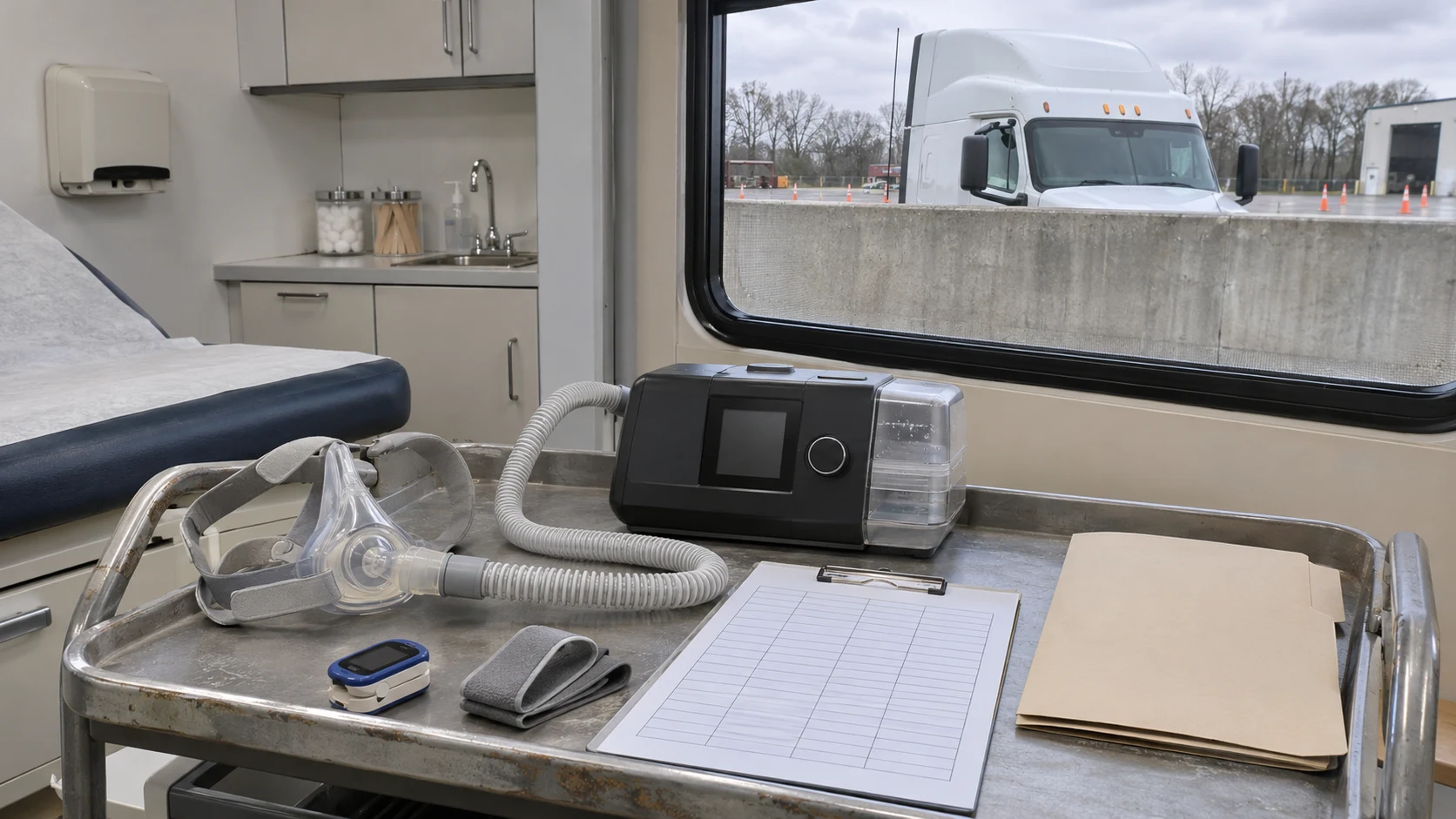
The binding interstate medical standard is 49 CFR 391.41(b)(5). It requires a driver to have no established medical history or clinical diagnosis of a respiratory dysfunction likely to interfere with controlling and driving a commercial motor vehicle safely. The regulation does not name an apnea-hypopnea index, body-mass index, neck measurement, CPAP-use percentage or automatic certification period.
FMCSA's Medical Examiner's Handbook 2024 Edition supplies the current agency guidance. Its OSA section replaced the January 2015 bulletin. The handbook is guidance, not a binding rule, and it directs certified medical examiners to make an individualized safety decision.
What the federal rule says—and what it does not say
| Federal position | Practical meaning |
|---|---|
| A respiratory dysfunction cannot be likely to interfere with safe CMV control | The examiner focuses on functional safety, symptoms, severity and treatment—not the diagnosis label alone |
| Treated moderate-to-severe OSA does not preclude certification | Effective and stable treatment can support a qualified decision |
| No required federal OSA screening procedure | FMCSA does not mandate one questionnaire, score or body measurement for every driver |
| No required federal testing or treatment method | The FMCSRs do not prescribe an in-lab test, home test, CPAP, oral appliance or another single method |
| No federal treatment-compliance formula for OSA | The regulations do not establish a universal percentage or nightly-use threshold |
| No OSA-specific waiting period or maximum certificate length | The examiner uses medical judgment and may shorten certification when follow-up is appropriate |
This distinction prevents two common errors: treating every clinical recommendation as federal law, or assuming that the lack of an OSA-specific formula means the condition is irrelevant. The binding safety standard still applies, and the examiner must decide whether the driver's condition and treatment support safe operation.
Why untreated OSA matters in a commercial vehicle
OSA involves repeated reductions or pauses in breathing during sleep. FMCSA explains that untreated moderate-to-severe OSA may contribute to fatigue and unintended sleep episodes, along with reduced attention, concentration, situational awareness and memory. Those effects can matter before a driver visibly falls asleep: missed hazards, delayed braking and poor lane control can begin with reduced alertness.
The operational rule is separate from the medical-certificate decision. Under 49 CFR 392.3, a driver must not begin or continue operating when fatigue, illness or another cause impairs—or is likely to impair—alertness enough to make driving unsafe. A carrier also may not require or permit that operation. See ProntoCDL's fatigue-management guide for practical stop-driving decisions.
The examiner should look at multiple risk factors
FMCSA's handbook says using multiple risk factors is a reasonable way to identify drivers at risk for moderate-to-severe OSA. It cautions against relying on only one criterion. Factors the examiner may consider include:
- loud snoring or witnessed pauses in breathing;
- sleepiness during normal waking hours;
- a small airway or large neck size;
- obesity or high body-mass index;
- hypertension or cardiovascular disease; and
- a history of stroke, diabetes or other related conditions.
A high BMI by itself is not an automatic federal failure. A driver also should not dismiss serious symptoms because one measurement falls below a clinic's referral threshold. The examiner combines the medical history, MCSA-5875 responses, physical findings, known diagnoses, treatment records and safety impact.
When a sleep-study referral may be appropriate
If an examiner identifies several risk factors or symptoms suggesting moderate-to-severe OSA, FMCSA guidance says the examiner should consider recommending a sleep study when the driver has not already been evaluated. That is not the same as a federal rule ordering a test for every driver who snores or meets a single body measurement.
A prior negative study or a finding of only mild OSA may remain informative. The handbook says another study may not be warranted unless symptoms or risk factors have changed significantly. OSA does not require retesting on a fixed federal schedule. For a driver already treated with continuous or bilevel positive airway pressure, the treating provider decides whether retesting is clinically needed because symptoms returned or risk factors changed.
Prepare a useful treatment record—not just a device screenshot
The FMCSRs do not list an OSA document packet, but a complete and organized record lets the examiner make a better-supported decision. Before the examination, ask the clinic what it wants and assemble:
- Diagnostic report. Bring the final sleep-study interpretation, not only the appointment receipt or raw data.
- Treating-provider summary. A current note can identify the diagnosis, symptoms, treatment plan, response and any safety concerns.
- Therapy settings and usage report. If a PAP device is used, provide a recent report showing the period requested by the examiner or treating provider.
- Effectiveness information. Include residual events, mask leak or other data the clinician uses, plus whether daytime sleepiness has improved.
- Equipment problems. Document mask-fit issues, replacements, travel-device changes or interruptions instead of leaving unexplained gaps.
- Medication list. Report sleep aids and any medicine that may cause drowsiness. The examiner evaluates both the underlying condition and treatment effects.
Do not edit, crop or selectively hide therapy data. If a download shows a problem, discuss it with the treating provider and correct the underlying issue. An accurate record of improved treatment is more useful than an incomplete printout.
The “70 percent rule” is not a universal FMCSA regulation
Drivers often hear that federal law requires PAP use for at least four hours on 70 percent of nights. FMCSA's current handbook expressly says the FMCSRs do not establish requirements for assessing OSA treatment compliance. A sleep clinic, examiner, employer, insurer or equipment program may use a benchmark in its own clinical or administrative process, but that does not transform the benchmark into a universal federal regulation.
The examiner's federal question is broader: has treatment been shown to be adequate, effective, safe and stable, and are any symptoms likely to interfere with safe CMV operation? A usage number cannot by itself answer whether the driver remains sleepy, whether the mask leaks heavily, whether therapy is effective or whether another condition is contributing to fatigue.
A shorter medical certificate can be a monitoring tool
The federal rules do not impose an OSA-specific maximum certification period. A certified examiner may nevertheless issue a certificate shorter than the ordinary maximum when follow-up is needed to confirm treatment effectiveness, stability or symptom control. That is an individualized medical judgment, not proof that every driver with OSA must receive the same card length.
Plan renewal around the date actually printed on the Medical Examiner's Certificate. Keep treatment appointments and device reports current, address equipment problems early and allow time for the examiner to request clarification. ProntoCDL's medical-card reporting guide explains how certification information reaches the State driver record.
Do not confuse medical certification with dispatch readiness
A valid medical certificate is not permission to drive while dangerously sleepy. If alertness is impaired or likely to become impaired, stop at the nearest safe place, notify the carrier through its safety procedure and obtain medical help when appropriate. Coffee, an open window or a short burst of activity does not treat OSA and should not be used to push through unsafe symptoms.
Also review other causes of fatigue. Insufficient sleep opportunity, irregular schedules, sedating medicine, alcohol, acute illness and unrelated sleep disorders can still affect safe operation. The prescription-medication guide explains how medication effects are evaluated, while the blood-pressure guide covers a common OSA risk factor that has its own certification considerations.
Practical takeaways
- A sleep-apnea diagnosis does not automatically disqualify a commercial driver.
- The binding rule is the respiratory safety standard in 49 CFR 391.41(b)(5).
- FMCSA does not mandate one screening score, BMI cutoff, sleep-test method, treatment method or compliance percentage.
- Examiners should use symptoms and multiple risk factors rather than one measurement alone.
- Treated moderate-to-severe OSA can be compatible with certification when treatment is adequate, effective, safe and stable.
- Bring the diagnostic report, treating-provider note, therapy settings, recent usage/effectiveness data and medication list.
- OSA is not subject to automatic retesting on a fixed federal schedule; clinical changes may justify another study.
- A shorter certificate may be used for monitoring even though no OSA-specific federal maximum exists.
- Do not drive when fatigue or illness makes safe operation doubtful, regardless of certificate status.
- Intrastate medical requirements may differ; confirm the rules that apply to the operation.
CDL sleep-apnea FAQ
Does FMCSA require every CDL driver with a high BMI to take a sleep-apnea test?
No. The Federal Motor Carrier Safety Regulations do not create a universal OSA screening rule or a single-factor referral trigger. FMCSA guidance says an examiner may consider multiple risk factors—including symptoms, BMI, neck size, hypertension and other conditions—and may recommend a sleep study when several factors suggest risk for moderate-to-severe OSA.
Does a sleep-apnea diagnosis automatically disqualify a CDL driver?
No. FMCSA’s current handbook states that treated moderate-to-severe OSA does not preclude medical certification. The examiner evaluates whether symptoms could interfere with safe CMV operation and whether treatment is adequate, effective, safe and stable.
Is the 70-percent CPAP compliance rule an FMCSA regulation?
No. The FMCSRs do not specify a treatment-compliance percentage, minimum nightly usage formula or preferred treatment method for OSA. A treating provider, examiner, employer or insurer may use clinical or administrative benchmarks, but those should not be presented as a universal federal regulation.
What sleep-apnea records should a CDL driver bring to the DOT physical?
Useful records include the diagnostic sleep-study report, treating-provider summary, current treatment settings, recent device-usage or therapy report, information about mask or equipment problems, and a current medication list. These records help the examiner assess symptoms, treatment effectiveness, stability and side effects.
How often does FMCSA require a driver with OSA to repeat a sleep study?
FMCSA’s handbook says OSA is not a condition that requires testing on a regular schedule. For drivers treated with positive airway pressure, retesting is determined by the treating provider based on returning symptoms or a significant change in risk factors.
Is there a mandatory one-year DOT card limit for every driver with sleep apnea?
No OSA-specific maximum certification period appears in the FMCSRs. The examiner applies the respiratory standard case by case and may issue a shorter certificate when monitoring is appropriate. The ordinary maximum medical-certificate period is not a promise that every qualified driver will receive that full period.
Continue with ProntoCDL's fatigue guide, medical-card guide and blood-pressure guide.