
CDL Adverse Driving Conditions Exception: The 2-Hour Rule
The federal adverse-driving-conditions exception is a narrow tool for an unforeseen delay—not a way to rescue an impossible dispatch. A qualifying driver may use only the time actually needed, up to two additional hours, while every safety rule and the 60/70-hour limit still applies.
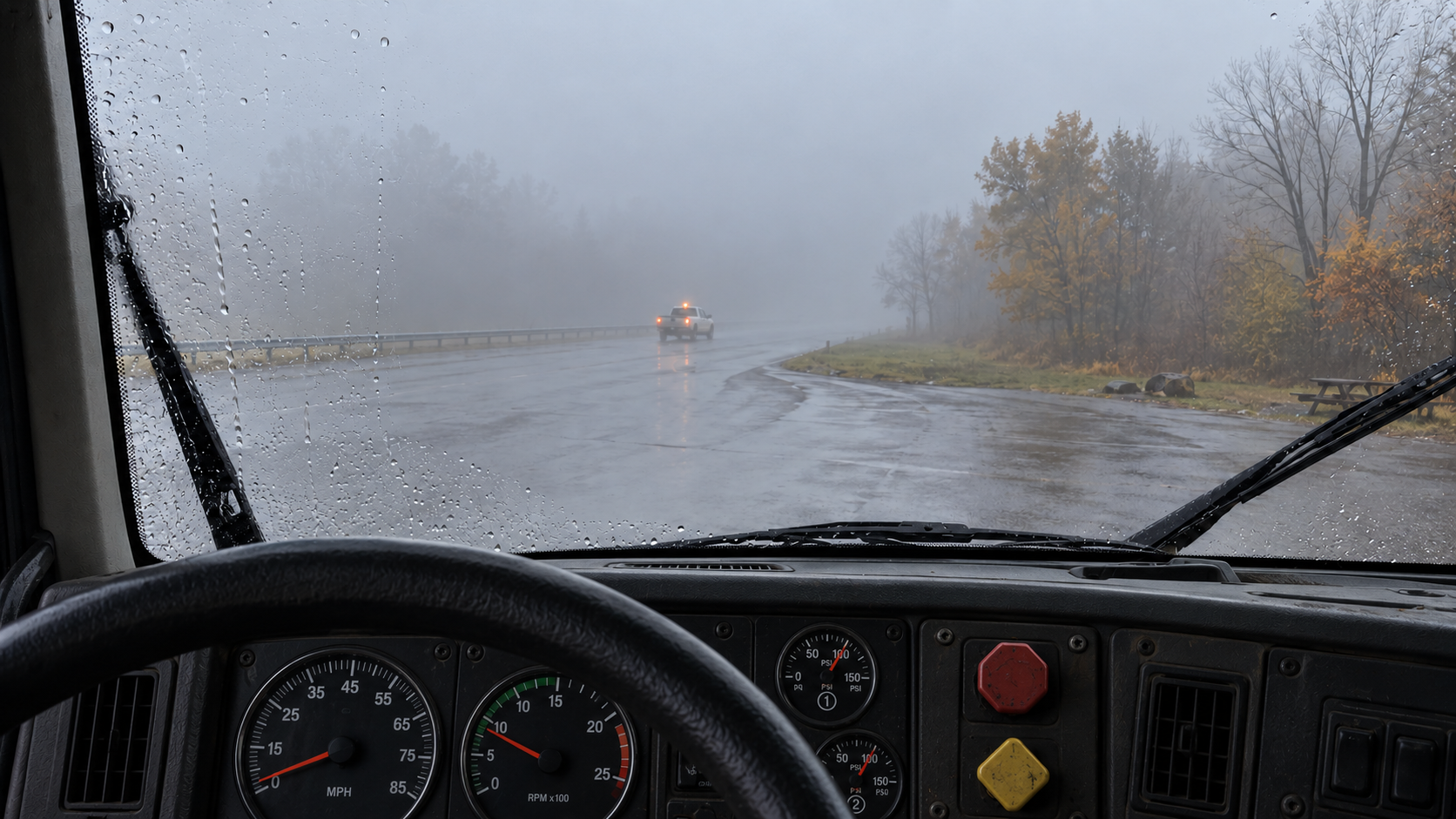
Snow begins earlier than forecast. A rock slide closes the only practical route after dispatch. A crash creates a backup that no reasonable pre-trip check could have predicted. These events can consume the legal margin in an otherwise realistic trip plan. Under specific conditions, 49 CFR 395.1(b)(1) allows a driver to finish the run or reach a place offering safety for the occupants and security for the vehicle and cargo.
The key word is unforeseen. A driver and carrier should be able to explain what changed after the relevant planning point, how the event inhibited progress, why the original run could normally have been completed legally and how much extra time was actually necessary.
What the two-hour exception changes
The rule reaches the daily limits in 49 CFR 395.3(a) for property-carrying drivers and 395.5(a) for passenger-carrying drivers. It does not erase the clocks or create a fresh duty day.
| Driver type | Normal federal limit | Maximum with qualifying conditions |
|---|---|---|
| Property-carrying | 11 hours driving after 10 consecutive hours off; no driving beyond the 14th consecutive hour after coming on duty. | Up to 13 hours driving and up to a 16-consecutive-hour driving window. |
| Passenger-carrying | 10 hours driving after 8 consecutive hours off; no driving after 15 hours on duty. | Up to 12 hours driving and up to 17 hours on duty. |
These are ceilings, not automatic entitlements. FMCSA’s current FAQ says that if the adverse condition adds one hour, the driver gets one additional hour—not the unused second hour. The separate 60/70-hour multi-day limit is outside the daily limits extended by § 395.1(b)(1), so a driver may not drive after reaching that cycle limit.
Keep the clocks separate with the ProntoCDL hours-of-service guide. The exception extends only the applicable daily limit by the qualifying delay; it does not convert on-duty time to off-duty time, remove the 30-minute driving-break requirement or reset accumulated hours.
What counts as an adverse driving condition
49 CFR 395.2 lists snow, ice, sleet, fog, other adverse weather and unusual road or traffic conditions. A listed hazard is not enough by itself. It also must have been unknown—and not reasonably knowable—to:
- the driver immediately before beginning the duty day;
- the driver immediately before driving after a qualifying rest break or sleeper-berth period; or
- the motor carrier immediately before dispatching the driver.
That definition creates a planning test. Check forecasts, official road information, dispatch notes and realistic route times before leaving. A poor plan does not become an adverse condition merely because the legal clock runs short.
The qualifying-rest checkpoint matters
FMCSA explains that a qualifying checkpoint includes a sleeper-berth period of at least seven hours, a qualifying split-sleeper rest period of at least two hours off duty or in the sleeper berth, or a break of at least 10 consecutive hours. A routine 30-minute break is not such a checkpoint.
This matters because the “could reasonably have been known” test can be refreshed immediately before driving after qualifying rest. If a driver completes a valid split-sleeper segment, checks conditions and then encounters a genuinely unforeseen closure, the analysis starts from that new checkpoint. Review the clock mechanics in the split-sleeper guide.
What does not qualify
The exception is not a general late-load allowance. FMCSA guidance says the trip must normally and reasonably have been capable of legal completion and the unforeseen event must arise after the trip begins. A driver dispatched after the carrier knew or should have known about the condition is not eligible on that basis.
| Situation | Likely analysis | Better response |
|---|---|---|
| Recurring weekday congestion on a familiar route | Predictable traffic is not an unusual, unknowable condition. | Plan the dispatch and legal stopping point around normal traffic. |
| Storm and closure warnings posted before dispatch | The carrier and driver could reasonably know about the condition. | Delay, reroute or redesign the trip before departure. |
| Long loading delay at the shipper | Detention is not weather or an unusual road/traffic condition. | Update the appointment, relay the load or stop inside the ordinary limits. |
| Mechanical failure | FMCSA guidance does not treat a mechanical failure as the adverse-driving exception. | Secure the vehicle, report the defect and follow repair/tow procedures. |
| Sudden crash closes the route after departure | May qualify if it was not reasonably knowable and it actually inhibits progress. | Document the event, recalculate every clock and use only necessary time. |
| Driver wants to reach home or the terminal | Personal convenience does not create an adverse condition. | Use a lawful stopping location and resume after required rest. |
A shipper’s deadline, a shortage of drivers or pressure from dispatch does not change the rule. If an assignment cannot be completed legally even in ordinary conditions, the remedy is a new plan—not an exception. Use the trip-planning guide to build fuel, traffic, parking and weather margin before the clock becomes critical.
A five-question eligibility check
- Was the original run legal? Confirm it could normally and reasonably have been completed within every applicable limit.
- Was the event unforeseeable? Record what the driver and carrier knew at dispatch or at the latest qualifying-rest checkpoint.
- Does the event fit the definition? Identify the adverse weather or unusual road/traffic condition—not merely the resulting lateness.
- Did it actually inhibit progress? Estimate the time the condition added and preserve available supporting facts.
- Is driving still safe and otherwise legal? Check the 60/70-hour total, break requirement, fatigue, vehicle condition and a safe destination before moving.
If any answer is no, do not rely on the exception. Update dispatch and use the next lawful, safe option.
Worked clock examples
Example 1: unexpected crash closure—qualifying use
A property-carrying driver starts with a legal plan requiring 10 hours 30 minutes of driving inside a 13-hour duty schedule. Three hours into the trip, an unexpected major crash closes the only practical route. The resulting backup adds 75 minutes. The driver checked official conditions before departure, and the carrier had no notice at dispatch.
If the facts satisfy the definition, the driver may use the 75 minutes actually needed—up to the two-hour cap. The exception can extend both the driving limit and the 14-hour window, but the driver must still remain under the 60/70-hour limit, satisfy the break rule and stop if the conditions or fatigue make continued operation unsafe.
Example 2: known winter storm—no exception
A severe winter warning and chain restrictions were published before dispatch. The planned run already requires nearly all 11 driving hours in good conditions. The truck is delayed by the forecast storm. Because the condition was known or reasonably knowable to the driver and carrier before departure, the adverse-driving exception is not the proper basis for extra time. The trip should have been delayed, shortened, relayed or rerouted.
Example 3: condition clears, backup remains
A rock slide occurs after departure and is removed before the truck reaches the area, but the resulting traffic backup still delays the driver. FMCSA says the exception may still apply because the condition continues to inhibit progress even though the obstruction itself is gone. The driver should document the remaining delay and use only the necessary additional time.
Annotate the ELD with useful facts
FMCSA states that a driver using the exception must annotate the ELD under 49 CFR 395.28(c). An annotation does not change automatically recorded driving time and does not prove that the condition qualified; it explains why the driver relied on the exception.
A useful annotation should be concise and factual:
- the condition encountered, such as an unexpected crash closure or sudden dense fog;
- the date, approximate time and location;
- how the event inhibited the run;
- the approximate additional time used; and
- the safe destination reached or the time the exception ended.
Notify the carrier according to policy and retain supporting dispatch or road-condition information when available. If the device itself fails, use the separate procedures in the ELD malfunction and paper-log guide.
The exception never overrides a safe-stop decision
49 CFR 392.14 requires extreme caution when snow, ice, sleet, fog, mist, rain, dust or smoke affects visibility or traction. Speed must be reduced, and operation must stop when conditions become sufficiently dangerous until the CMV can be safely operated.
Extra legal time is not extra traction, visibility or alertness. A driver may qualify for the HOS exception and still have to stop. Use the high-wind guide and fatigue guide to separate a schedule decision from the independent safety decision.
Common mistakes
- Treating the exception as an automatic two-hour credit.
- Using predictable traffic, known weather or an unrealistic dispatch plan as the qualifying event.
- Forgetting that the carrier’s knowledge before dispatch is part of the definition.
- Assuming the exception extends the 60/70-hour limit or resets other accumulated time.
- Failing to annotate the ELD or writing only “bad weather” without useful facts.
- Continuing after the condition ends and the necessary additional time has been used.
- Driving into unsafe visibility or traction because the clock technically permits it.
- Confusing the adverse-driving exception with a declared emergency exemption.
Practical takeaways
- Start with a trip that could normally and reasonably be completed legally.
- Check forecasts, route conditions and realistic traffic before dispatch and after qualifying rest.
- Identify the unforeseen weather or unusual road/traffic condition and how it delayed the run.
- Use only the additional time actually necessary, never more than two hours.
- Track the driving limit, duty window or on-duty limit, break and 60/70-hour total separately.
- Annotate the ELD with specific facts and preserve available supporting information.
- Stop whenever visibility, traction, fatigue or another hazard makes continued operation unsafe.
Adverse-driving-conditions FAQ
What does the adverse-driving-conditions exception add for a property-carrying driver?
When the conditions qualify, the driver may use only the additional time reasonably needed, up to two hours. That can extend the normal 11-hour driving limit to as much as 13 hours and the 14-consecutive-hour driving window to as much as 16 consecutive hours. The exception does not add hours to the separate 60/70-hour limit.
Does ordinary rush-hour traffic qualify as an adverse driving condition?
Normally, no. The definition covers unusual road or traffic conditions that were not known and could not reasonably have been known at the relevant pre-trip or post-rest decision point. Routine congestion, a published closure or a delay the carrier knew about before dispatch does not become qualifying merely because it makes the schedule difficult.
Can a driver automatically use the full two extra hours?
No. FMCSA says the exception provides up to two hours. If the qualifying condition causes one hour of delay, only one additional hour is available. The driver must still stop when the run is complete, a safe and secure place is reached or another applicable limit prevents driving.
Must a driver annotate the ELD when using the exception?
Yes. FMCSA states that a driver using the adverse-driving-conditions exception must annotate the ELD. A useful annotation identifies the unexpected condition, where and when it was encountered, how it delayed the run and when the exception began and ended. The underlying driving time remains driving time.
Can the exception be used after a crash or rock slide has been cleared?
Yes, if the unforeseen event still inhibits the driver’s progress. FMCSA gives the example of a cleared rock slide that leaves a traffic backup. The event must still meet the definition and actually delay the driver; a historical event with no remaining effect does not create extra time.
How often may the adverse-driving-conditions exception be used?
FMCSA places no numerical frequency limit, but every use must independently satisfy the definition in 49 CFR 395.2. Repeated reliance on predictable congestion, known weather or unrealistic dispatch plans is not made valid by the absence of a frequency cap.
Plan first. Document the unexpected. Stop safely.
Practice the clocks as separate limits so an unforeseen delay never turns into an improvised legal theory.
Start free CDL practice